


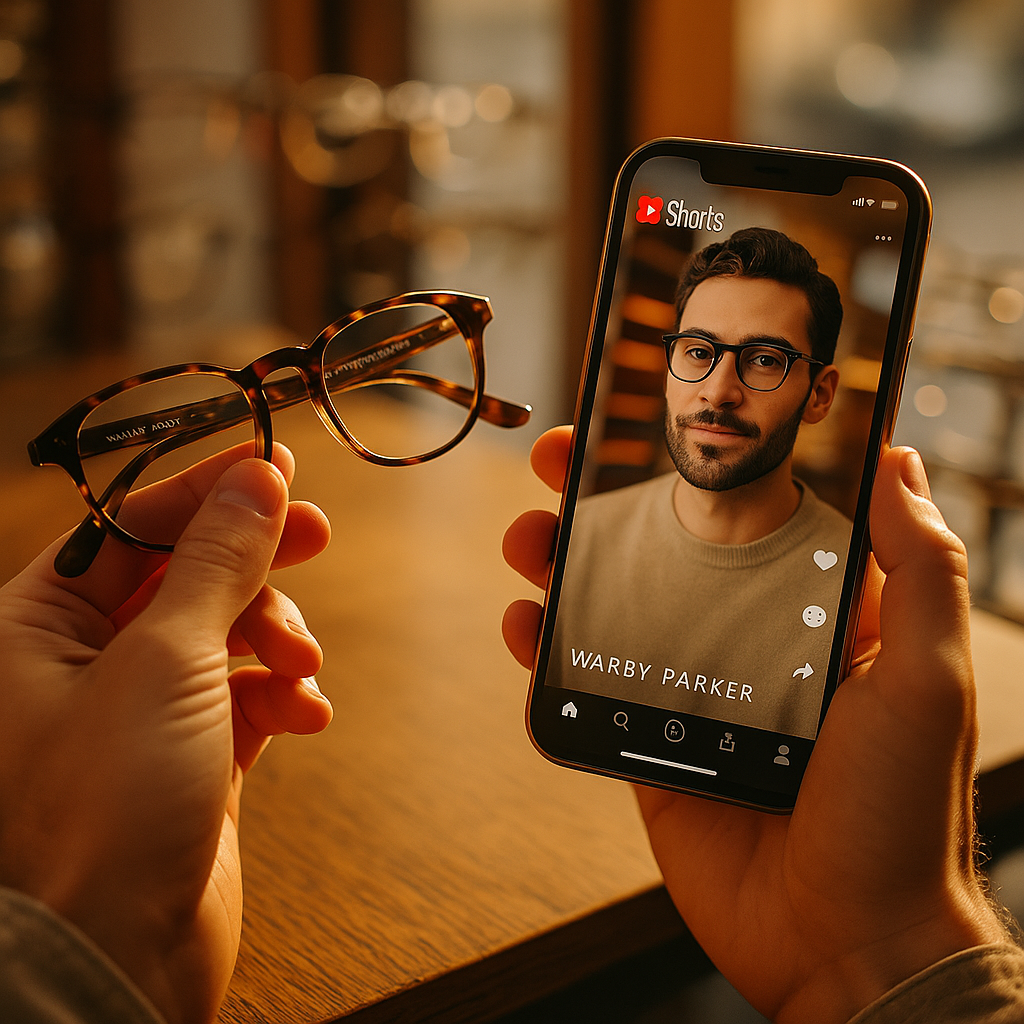
Zero discount codes. Zero promo bundles. Just a 12-second Short and a 40% jump in Home Try-On bookings. While most DTC brands were burning margin on YouTube Shorts promos, Warby Parker ran the opposite playbook — and it worked because the product, not the price, did the convincing.
That’s the headline. But the mechanics behind it matter more for anyone running a brand or media budget in 2026, when every platform rep is pushing “just add a discount” as the default fix for soft conversion. Warby Parker’s Home Try-On Kit campaign is a useful counter-example, and it’s worth dissecting line by line.
The Setup: A 20-Year-Old Product Idea Meets a New Format
The Home Try-On Kit isn’t new. Warby Parker built its entire early brand on the idea: pick five frames online, get them shipped free, try them at home, send back what you don’t want. It removed the single biggest friction point in eyewear shopping — you can’t try glasses on through a screen — and turned that removal into the product pitch itself.
What’s new is where the pitch is landing. Warby Parker’s growth team shifted a meaningful chunk of its performance budget into YouTube Shorts in the back half of the year, running short, almost documentary-style clips: a customer opening the box, trying frames in their bathroom mirror, deciding on camera. No actor script. No “swipe up for 20% off.” Just the mechanic of the offer, shown plainly.
The campaign’s core insight: when the offer itself removes risk (free shipping, free returns, no purchase required to try), a discount is redundant — and can even cheapen the perceived value of the product.
Why Skip the Discount at All?
This is the part that makes marketing directors nervous. Discounting is the default lever because it’s fast, measurable, and rarely fails to move short-term volume. So why would a brand with Warby Parker’s scale leave that lever untouched on a new ad surface?
A few reasons, based on how the campaign was structured and what the brand has said publicly about its performance marketing approach:
- The Home Try-On Kit is already the “discount.” Free shipping both ways and zero financial commitment functions as the risk-reversal mechanism. Stacking a percentage-off code on top doesn’t add urgency, it just trains customers to wait for the next one.
- Margin protection at scale. Eyewear has healthy unit economics, but Warby Parker’s optical lab, retail footprint, and try-on logistics all carry real cost. A blanket discount code running across a high-volume format like Shorts would compound fast.
- Brand equity signaling. Constant discounting on paid social quietly tells consumers the “real” price is always lower than sticker. Warby Parker has spent two decades positioning itself as accessible but not cheap — a discount-heavy Shorts push risks undoing that.
- Shorts users are browsing, not buying yet. Try-on kit requests are a lower-commitment action than a direct purchase. The ad doesn’t need a coupon to get someone to request five free frames; it needs to make the process look effortless.
That last point is the one performance marketers underrate. A discount is a purchase-stage lever. Home Try-On is a consideration-stage action. Applying a bottom-funnel tactic to a mid-funnel ask is a mismatch, and Warby Parker’s team seems to have recognized that early.
What the Creative Actually Did Differently
Most eyewear ads on Shorts still lean on before/after try-on transitions set to trending audio — effective, but formulaic, and increasingly ignored as viewers pattern-match the format. Warby Parker’s Home Try-On spots broke the mold in three specific ways.
They showed the mail, not just the mirror. Several of the top-performing Shorts opened on the actual kit arriving at someone’s door. That single beat did a lot of work: it made the offer feel tangible and logistically real, not like a vague “try before you buy” tagline.
They kept the CTA procedural, not promotional. Instead of “Shop Now — 20% Off,” the on-screen text read something closer to “Order 5 frames. Try at home. Free returns.” It reads like an instruction manual, not an ad. That plainness builds trust in a format where viewers are primed to skip anything that smells like a sales pitch.
They let real customers narrate the decision. Rather than a single polished testimonial, the campaign used quick clips of different people — different face shapes, different styles — going through the same five-second decision moment: “this one” or “not this one.” It’s a format that scales well because it doesn’t require a single hero customer to carry the whole campaign.
This mirrors a pattern seen across other DTC categories lately. Brands like Vessi turned a single product demo into a referral engine by keeping the format unpolished and procedural rather than promotional. The lesson generalizes: on short-form video, showing the mechanism of the offer often outperforms selling the discount attached to it.
The Numbers That Matter (and the Ones That Don’t)
Warby Parker doesn’t publish granular channel-level ROAS, but the directional signals from the campaign period are informative. Home Try-On Kit requests, the brand’s own tracked mid-funnel KPI, rose sharply during the flighting window when Shorts inventory carried the bulk of the media spend. Cost per try-on request came in meaningfully below the brand’s paid social benchmark from the prior comparable period, according to details shared in trade coverage of the campaign.
More telling: the brand didn’t need to lower average order value to get there. Requests converted to purchase at a rate consistent with (in some reporting, slightly above) historical baseline, meaning the funnel wasn’t just filling with lower-intent traffic lured by a coupon. Quality held.
Compare that to what typically happens when brands run heavy discount codes on new ad inventory: volume spikes, AOV drops, and post-campaign retention often takes a hit because the customer relationship was priced on the discount, not the product. Warby Parker avoided that trade entirely.
For context on category norms, eMarketer’s retail media and DTC benchmarks consistently show that discount-driven acquisition tends to correlate with weaker 90-day retention across apparel and accessories verticals. Skipping the discount wasn’t just a brand play here, it was a retention hedge.
Where YouTube Shorts Fits in the Funnel
It’s tempting to read this case study as “YouTube Shorts is undervalued, allocate more budget.” That’s true in a narrow sense, but the more useful takeaway is about format-to-funnel-stage fit.
Shorts inventory sits in an odd spot: intent signals are weaker than search, but attention is higher than static feed placements, and the audience skews slightly older and more habitual-viewing than TikTok’s. That combination makes it a strong fit for offers that are low-commitment but require a beat of explanation — exactly what “order five frames for free” needs. A pure discount CTA doesn’t need explanation; a logistics-based offer does.
Google’s own guidance on Shorts ad formats and placements emphasizes vertical-native creative and fast hooks, which lines up with what Warby Parker ran: no slow brand-building open, straight into the mechanic.
This is a similar principle to what’s worked for subscription and trial-based products elsewhere. Whoop’s ambassador-driven content succeeds for related reasons: the offer (a wearable you test against your own body data) needs demonstration, not discounting, to convert skeptics.
The Compliance Angle Brands Often Miss
Home Try-On campaigns sit close to a regulatory gray zone that’s worth flagging for any brand copying this model. “Free” trial offers, even genuinely free ones with no hidden charges, attract more scrutiny from the FTC than standard product ads, particularly around clarity of terms (how many days to return, whether a card is required, what happens if items aren’t sent back).
Warby Parker’s Shorts creative handled this cleanly by stating terms in plain on-screen text rather than burying them in a description box. That’s a low-cost, high-value compliance habit other brands running trial-based or sample-based offers should copy directly. It’s the same instinct behind how Chubbies built compliance into its nano-creator drops — treating disclosure as part of the creative, not an afterthought bolted on for legal sign-off.
Brands running influencer or creator-fronted versions of a try-before-you-buy offer should be even more careful. If a creator is paid to promote a free trial kit, that’s a material connection requiring disclosure under FTC guidelines, regardless of whether money changes hands with the end customer. Get this wrong and the platform risk (ad rejection) becomes the smaller problem compared to regulatory risk.
What Other Brands Can Actually Steal From This
Not every category has a “try five things for free” mechanic sitting around unused. But the underlying strategy generalizes further than eyewear:
- Audit your existing risk-reversal offers before reaching for a discount. Free returns, extended trial windows, sample kits — these are often already built into policy but never dramatized in ad creative.
- Match the CTA to the funnel stage, not the platform default. Shorts and TikTok both push toward “shop now” CTAs by default. Overriding that with a lower-commitment ask can lift volume without lifting cost.
- Use plain, procedural on-screen text over promotional copy. “Here’s how it works” consistently outperforms “here’s why you should buy” in early-stage short-form ad testing across multiple verticals.
- Protect AOV and retention as seriously as you track CPA. A cheaper acquisition cost that erodes downstream value isn’t a win. Warby Parker’s team clearly weighted both sides of that ledger.
Brands in adjacent trial-heavy categories — mattresses, contact lenses, subscription meal kits — have room to run a near-identical playbook. HelloFresh’s dual-strategy approach of blending broad campaigns with lower-funnel affiliate content shows a version of the same discipline: not every offer needs a price cut to convert, it needs the right proof at the right moment.
Next step: before your team’s next Shorts flight, pull your existing return policy, trial terms, or sample program and ask whether it’s ever been dramatized as the hero of a short-form ad. If the answer is no, that’s a cheaper test to run than another discount code — and it protects margin while you’re at it.
FAQs
Did Warby Parker use any influencers or creators in this campaign?
The core Shorts creative leaned on real-customer style footage rather than paid creator partnerships, though the brand has used creator seeding for other product lines. The Home Try-On Kit campaign specifically prioritized an unscripted, documentary feel over creator-fronted content.
Why didn’t Warby Parker just run a discount to boost conversions further?
Because the Home Try-On Kit itself already functions as risk reversal — free shipping and free returns remove the financial barrier to trying the product. Adding a discount on top would have diluted margin without meaningfully increasing conversion, since the friction being solved wasn’t price.
Is YouTube Shorts a good fit for other trial-based or sample offers?
Generally yes, particularly for offers that need a beat of explanation before the ask makes sense. Shorts inventory tends to reward procedural, fast-hook creative over polished brand storytelling, which suits low-commitment trial mechanics well.
What compliance risks apply to “free trial” style ads like this?
The FTC scrutinizes free trial and sample offers for clarity around terms, return windows, and any hidden costs. Brands should state terms plainly in the ad itself, not just in a linked landing page, and disclose any paid creator involvement per standard material connection rules.
How can a brand tell if their offer can support a no-discount ad strategy?
Check whether your existing policies already reduce purchase risk — free returns, extended trials, or sample programs. If so, test dramatizing that mechanic directly in short-form creative before defaulting to a discount code.
FAQs
Did Warby Parker use any influencers or creators in this campaign?
The core Shorts creative leaned on real-customer style footage rather than paid creator partnerships, though the brand has used creator seeding for other product lines. The Home Try-On Kit campaign specifically prioritized an unscripted, documentary feel over creator-fronted content.
Why didn’t Warby Parker just run a discount to boost conversions further?
Because the Home Try-On Kit itself already functions as risk reversal — free shipping and free returns remove the financial barrier to trying the product. Adding a discount on top would have diluted margin without meaningfully increasing conversion, since the friction being solved wasn’t price.
Is YouTube Shorts a good fit for other trial-based or sample offers?
Generally yes, particularly for offers that need a beat of explanation before the ask makes sense. Shorts inventory tends to reward procedural, fast-hook creative over polished brand storytelling, which suits low-commitment trial mechanics well.
What compliance risks apply to “free trial” style ads like this?
The FTC scrutinizes free trial and sample offers for clarity around terms, return windows, and any hidden costs. Brands should state terms plainly in the ad itself, not just in a linked landing page, and disclose any paid creator involvement per standard material connection rules.
How can a brand tell if their offer can support a no-discount ad strategy?
Check whether your existing policies already reduce purchase risk — free returns, extended trials, or sample programs. If so, test dramatizing that mechanic directly in short-form creative before defaulting to a discount code.
Top Influencer Marketing Agencies
The leading agencies shaping influencer marketing in 2026
Agencies ranked by campaign performance, client diversity, platform expertise, proven ROI, industry recognition, and client satisfaction. Assessed through verified case studies, reviews, and industry consultations.
Moburst

-
2

The Shelf
Boutique Beauty & Lifestyle Influencer AgencyA data-driven boutique agency specializing exclusively in beauty, wellness, and lifestyle influencer campaigns on Instagram and TikTok. Best for brands already focused on the beauty/personal care space that need curated, aesthetic-driven content.Clients: Pepsi, The Honest Company, Hims, Elf Cosmetics, Pure LeafVisit The Shelf → -
3

Audiencly
Niche Gaming & Esports Influencer AgencyA specialized agency focused exclusively on gaming and esports creators on YouTube, Twitch, and TikTok. Ideal if your campaign is 100% gaming-focused — from game launches to hardware and esports events.Clients: Epic Games, NordVPN, Ubisoft, Wargaming, Tencent GamesVisit Audiencly → -
4

Viral Nation
Global Influencer Marketing & Talent AgencyA dual talent management and marketing agency with proprietary brand safety tools and a global creator network spanning nano-influencers to celebrities across all major platforms.Clients: Meta, Activision Blizzard, Energizer, Aston Martin, WalmartVisit Viral Nation → -
5

The Influencer Marketing Factory
TikTok, Instagram & YouTube CampaignsA full-service agency with strong TikTok expertise, offering end-to-end campaign management from influencer discovery through performance reporting with a focus on platform-native content.Clients: Google, Snapchat, Universal Music, Bumble, YelpVisit TIMF → -
6

NeoReach
Enterprise Analytics & Influencer CampaignsAn enterprise-focused agency combining managed campaigns with a powerful self-service data platform for influencer search, audience analytics, and attribution modeling.Clients: Amazon, Airbnb, Netflix, Honda, The New York TimesVisit NeoReach → -
7

Ubiquitous
Creator-First Marketing PlatformA tech-driven platform combining self-service tools with managed campaign options, emphasizing speed and scalability for brands managing multiple influencer relationships.Clients: Lyft, Disney, Target, American Eagle, NetflixVisit Ubiquitous → -
8

Obviously
Scalable Enterprise Influencer CampaignsA tech-enabled agency built for high-volume campaigns, coordinating hundreds of creators simultaneously with end-to-end logistics, content rights management, and product seeding.Clients: Google, Ulta Beauty, Converse, AmazonVisit Obviously →