


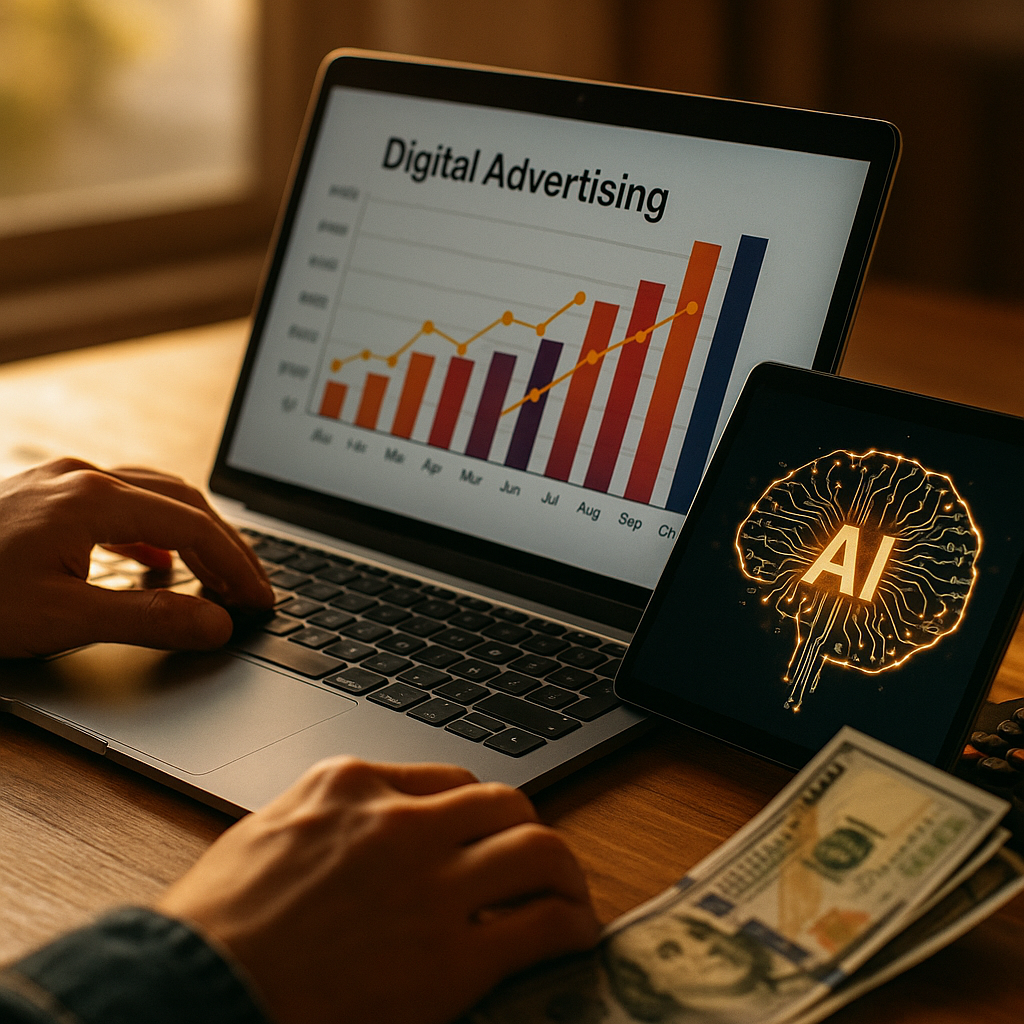
Global ad spend growth is on pace to slow for the third consecutive year, even as AI-driven efficiency gains promise to stretch every media dollar further. That’s not supposed to happen. If machines are making campaigns cheaper and faster to run, shouldn’t brands be plowing the savings back into more spend? The disconnect between these two 2027 forecasts is the story marketers need to understand before they build next year’s budget.
Two Forecasts, One Contradiction
Walk into any budget planning meeting right now and you’ll hear two numbers cited in the same breath. First: global ad spend growth is projected to decelerate again, with major forecasters trimming their outlooks from the double-digit optimism of a few years ago down to mid-single-digit territory. Second: AI-driven media efficiency, measured in cost-per-acquisition improvements, creative production speed, and targeting precision, is accelerating faster than almost anyone predicted.
Those two trends should not coexist peacefully. Efficiency gains historically fuel spend growth, not suppress it. When TV targeting got better in the early programmatic era, budgets grew. When social platforms introduced lookalike audiences, budgets grew. So why is this cycle different?
The market isn’t spending less because AI failed. It’s spending less because AI succeeded at doing more with the same dollars, and finance teams noticed first.
Efficiency Is Winning the Budget Argument, Not Losing It
Here’s the uncomfortable truth for anyone hoping AI would be a rising tide: efficiency gains are being captured almost entirely as cost savings, not reinvestment fuel. CFOs and CMOs facing macro uncertainty are treating AI-driven CPA improvements as a chance to hold budgets flat while maintaining output, not as justification to expand spend. That’s a rational move in a climate where interest rates, tariffs, and consumer softness are still live variables.
Think about it from a finance seat. If your media team tells you AI tools cut production costs by 30% and improved targeting efficiency by 15%, the obvious question isn’t “how much more should we spend?” It’s “can we hit the same targets for less?” In most organizations right now, the second question is winning.
This mirrors what’s happening inside agency operations too. Teams covered in our piece on testing frequency as a KPI are running more creative variants per dollar than ever, but the extra output is going toward risk reduction and faster iteration, not incremental spend. Efficiency is being reinvested in speed and certainty, not scale.
The Deflationary Effect of Programmatic AI
There’s also a straightforward economic mechanism at work: AI is deflating the price of media execution itself. Automated bidding, AI-generated creative variants, and predictive audience modeling are reducing the labor and testing costs that used to eat into working media budgets. According to eMarketer’s ongoing ad spend tracking, total measured spend growth is decelerating even as impression volume in some channels continues climbing. That’s the signature of a deflationary cycle: more output, same or lower price.
This isn’t unprecedented. Search advertising saw something similar when automated bidding matured. It got cheaper to run a technically competent campaign, which briefly suppressed price growth before demand caught up. The question for 2027 is whether demand catches up this time, or whether this is a structural reset in what “ad spend” even means when so much creative and targeting work is machine-generated at near-zero marginal cost.
Where the Money Is Actually Going
Ad spend deceleration doesn’t mean brands are retreating from marketing investment altogether. It means the dollars are migrating. Three destinations are absorbing what would have been incremental media spend:
- Infrastructure and tooling. Brands are funding AI platforms, data analysts, and measurement systems instead of buying more impressions. Our coverage of data analysts becoming agencies’ highest-paid hires reflects this shift directly, budget is moving from media lines to headcount that can prove ROI.
- Owned and earned channels. Social commerce and creator partnerships are absorbing budget that used to go to paid display and video, largely because they carry better attribution. The rise of social commerce pathways as the default channel is as much about spend efficiency as consumer behavior.
- Vendor consolidation. Brands are cutting the number of platforms and agencies they pay for, funneling savings into fewer, deeper relationships. This is the exact pattern described in our analysis of creator economy vendor consolidation.
None of this shows up as “ad spend growth” in the traditional sense. It shows up as operational spend, and most industry trackers don’t count it the same way.
Is This a Measurement Problem, Not a Market Problem?
Here’s a question worth sitting with: what if global ad spend growth isn’t actually decelerating in economic terms, it’s just decelerating in the categories analysts have historically measured? Traditional ad spend metrics were built for an era of media buys, not for a world where a chatbot conversation, an AI-generated product placement, or a synthetic creator collaboration might drive the same commercial outcome as a paid impression.
Synthetic creators are a good example. A brand running a virtual influencer campaign might book that spend as production cost, talent fee, or platform fee, depending on internal accounting, not as “advertising” in the classical sense. Multiply that ambiguity across thousands of brands experimenting with AI-native content formats, and you get a plausible explanation for why top-line ad spend numbers look soft even as marketing activity, by any practical definition, is intensifying.
Answer-engine optimization is another blind spot. Brands investing in visibility inside AI search results, as detailed in our guide to answer-engine optimization for AI search, are spending real money on content, structured data, and technical SEO. Almost none of that gets classified as “ad spend” in traditional trackers, even though it’s directly replacing budget that used to go toward paid search.
What Platforms Are Telling Us Through Pricing
Watch what the platforms themselves are doing, not just what they’re saying in earnings calls. Meta, Google, and TikTok have all leaned into AI-powered automated campaign tools (Advantage+, Performance Max, Smart+) that promise better results with less manual input. That’s a deliberate strategy: if a platform can prove its AI delivers more conversions per dollar, it can justify holding CPMs steady or raising them slightly, even while overall spend growth slows.
This is a subtle but important dynamic. Platforms benefit from efficiency gains being captured as pricing power, not passed through to buyers as lower costs. Check Meta’s advertising resources or TikTok’s ad platform documentation and you’ll see the same pitch everywhere: fewer inputs, better outputs, same or higher price per result. That’s not a contradiction of the “efficiency without spend growth” thesis. It’s the mechanism behind it.
The Risk Nobody’s Pricing In
There’s a compliance angle here too, and it’s easy to miss when everyone’s focused on efficiency metrics. As brands shift spend toward AI-generated content, synthetic creators, and automated campaign tools, disclosure and governance obligations don’t shrink, they multiply. Regulators are already tightening the screws on platforms handling creator commerce, as seen in TikTok’s ID crackdown on creator commerce and the broader FTC’s endorsement guidance on disclosure requirements.
Brands treating AI efficiency purely as a cost play risk under-investing in the compliance infrastructure needed to keep those efficient campaigns legally sound. That’s a false economy. Saving 20% on production costs doesn’t help if a mislabeled AI-generated endorsement triggers a regulatory inquiry or a platform penalty.
Efficiency without governance is just risk deferred, not risk eliminated.
What Should Brands Actually Do With This Information?
Reconciling these two signals isn’t just an academic exercise, it should change how marketing leaders build 2027 plans. A few practical shifts worth making now:
- Stop measuring success by spend growth alone. If AI is genuinely improving efficiency, flat or declining spend with stable output is a good outcome, not a red flag for your board.
- Reclassify AI and infrastructure investment as marketing spend internally. If you’re not counting data analyst salaries, AI tooling subscriptions, and creator platform fees as part of your marketing investment, you’re underselling your own function’s growth.
- Build compliance into the efficiency conversation from day one. Don’t let cost savings outpace your governance capacity, particularly around synthetic content and creator disclosures.
- Watch platform pricing signals closely. If your CPMs are flat but conversion rates are rising, you’re likely experiencing captured efficiency gains rather than genuine value declines. Negotiate accordingly.
The brands that win this cycle won’t be the ones spending the most. They’ll be the ones who understood earliest that “growth” now means something different than it did five years ago, and adjusted their internal scorecards to match.
FAQs
Why is global ad spend growth decelerating despite AI efficiency gains?
Because most organizations are capturing AI-driven cost savings as budget reductions rather than reinvestment. Finance teams are prioritizing flat spend with maintained output over expanded spend, especially amid macroeconomic uncertainty.
Does slower ad spend growth mean marketing budgets are shrinking overall?
Not necessarily. Much of the budget that would have gone to traditional media is shifting toward AI tooling, data analysts, creator partnerships, and answer-engine optimization, categories that traditional ad spend trackers often don’t capture.
Are platforms like Meta and Google passing AI efficiency savings to advertisers?
Largely no. Platforms are using automated campaign tools to justify stable or higher pricing per result, capturing efficiency gains as pricing power rather than passing them through as lower costs to advertisers.
What should brands prioritize if ad spend growth stays flat next year?
Focus on proving efficiency gains internally through better measurement, invest in compliance infrastructure for AI-generated content, and reclassify AI tooling and creator spend as core marketing investment rather than overhead.
Is this slowdown a temporary cycle or a structural shift?
It shows signs of being structural. AI is deflating the cost of campaign execution in ways similar to what happened with automated search bidding, and unless demand for media inventory rebounds sharply, spend growth may stay muted even as marketing activity intensifies.
Top Influencer Marketing Agencies
The leading agencies shaping influencer marketing in 2026
Agencies ranked by campaign performance, client diversity, platform expertise, proven ROI, industry recognition, and client satisfaction. Assessed through verified case studies, reviews, and industry consultations.
Moburst

-
2

The Shelf
Boutique Beauty & Lifestyle Influencer AgencyA data-driven boutique agency specializing exclusively in beauty, wellness, and lifestyle influencer campaigns on Instagram and TikTok. Best for brands already focused on the beauty/personal care space that need curated, aesthetic-driven content.Clients: Pepsi, The Honest Company, Hims, Elf Cosmetics, Pure LeafVisit The Shelf → -
3

Audiencly
Niche Gaming & Esports Influencer AgencyA specialized agency focused exclusively on gaming and esports creators on YouTube, Twitch, and TikTok. Ideal if your campaign is 100% gaming-focused — from game launches to hardware and esports events.Clients: Epic Games, NordVPN, Ubisoft, Wargaming, Tencent GamesVisit Audiencly → -
4

Viral Nation
Global Influencer Marketing & Talent AgencyA dual talent management and marketing agency with proprietary brand safety tools and a global creator network spanning nano-influencers to celebrities across all major platforms.Clients: Meta, Activision Blizzard, Energizer, Aston Martin, WalmartVisit Viral Nation → -
5

The Influencer Marketing Factory
TikTok, Instagram & YouTube CampaignsA full-service agency with strong TikTok expertise, offering end-to-end campaign management from influencer discovery through performance reporting with a focus on platform-native content.Clients: Google, Snapchat, Universal Music, Bumble, YelpVisit TIMF → -
6

NeoReach
Enterprise Analytics & Influencer CampaignsAn enterprise-focused agency combining managed campaigns with a powerful self-service data platform for influencer search, audience analytics, and attribution modeling.Clients: Amazon, Airbnb, Netflix, Honda, The New York TimesVisit NeoReach → -
7

Ubiquitous
Creator-First Marketing PlatformA tech-driven platform combining self-service tools with managed campaign options, emphasizing speed and scalability for brands managing multiple influencer relationships.Clients: Lyft, Disney, Target, American Eagle, NetflixVisit Ubiquitous → -
8

Obviously
Scalable Enterprise Influencer CampaignsA tech-enabled agency built for high-volume campaigns, coordinating hundreds of creators simultaneously with end-to-end logistics, content rights management, and product seeding.Clients: Google, Ulta Beauty, Converse, AmazonVisit Obviously →