


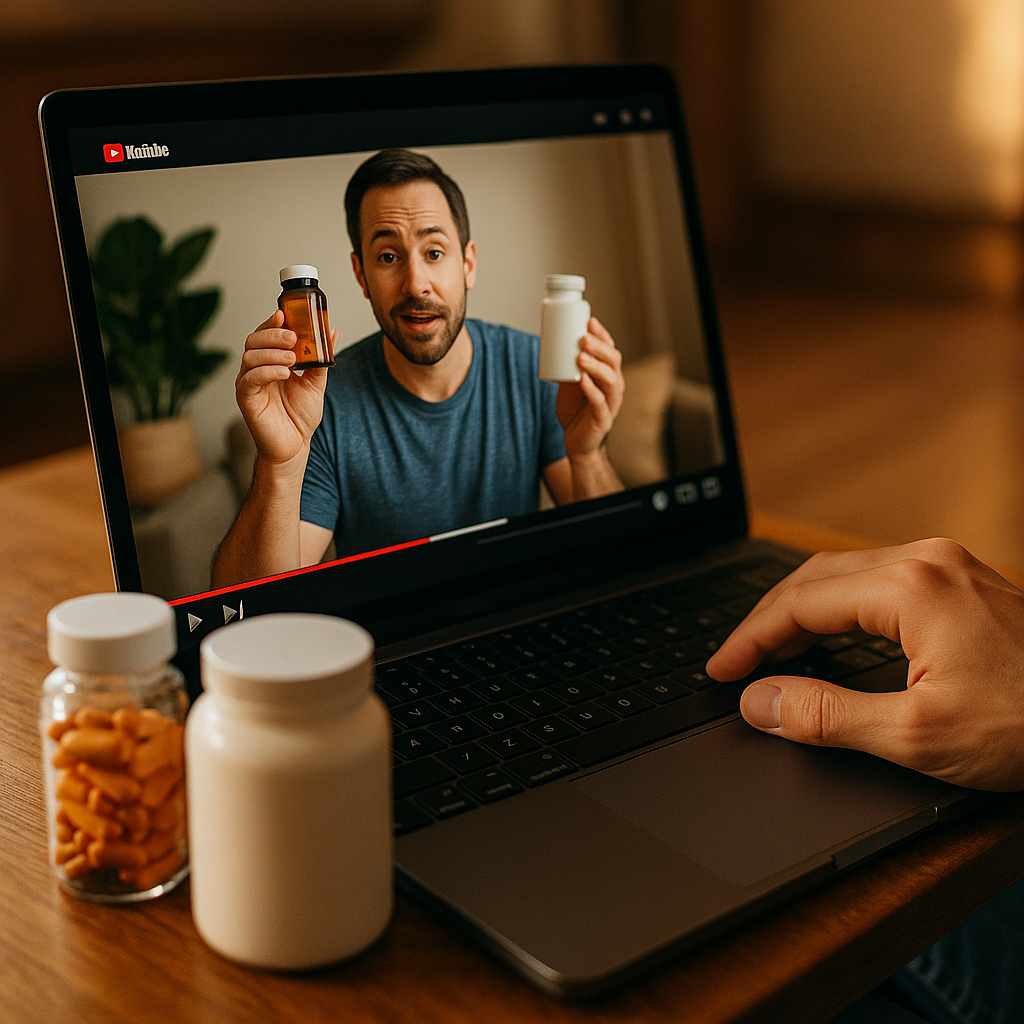
Seventy-two percent of consumers say they trust health information more when it’s explained in depth rather than summarized in a 15-second clip. That single stat should reframe how supplement brands allocate creator budgets. While everyone chases short-form velocity, YouTube’s trust advantage for long-form health and supplement content keeps quietly outperforming on the metrics that actually matter: consideration, retention, and repeat purchase.
This isn’t a nostalgia play for old-school video marketing. It’s a structural advantage baked into how YouTube’s algorithm, ad policies, and viewer behavior all intersect around health content specifically. Brands that understand why — and build briefs around it — get a compounding edge competitors on TikTok and Instagram simply can’t replicate.
Why Depth Beats Speed in Health Content
Short-form video rewards hooks. Long-form video rewards proof. And health decisions, unlike a $12 impulse buy, require proof.
Think about the last time you researched a supplement — magnesium glycinate, creatine, a new adaptogen blend. Did you make a decision off a six-second TikTok? Probably not. You searched YouTube for “does X actually work,” watched a 14-minute breakdown with citations, maybe checked a second video for a dissenting opinion, then bought. That’s not a hypothetical funnel. It’s the documented pattern behind YouTube’s dominance in supplement research behavior, and it’s why brands increasingly treat the platform as a consideration-stage engine rather than a top-of-funnel awareness play.
Health and wellness purchases involve more research steps than almost any other consumer category — and YouTube is where most of that research happens, because it’s the only major platform built for sustained explanation rather than quick impressions.
Compare this to Instagram or TikTok, where the format itself works against nuance. You can’t cite a study in a 30-second Reel. You can’t walk through mechanism-of-action science in a caption. YouTube’s runtime tolerance is the whole point — it’s the one platform where a creator can actually explain why something works, not just assert that it does.
The Algorithm Rewards What Health Content Needs
YouTube’s recommendation system optimizes heavily for watch time and session duration, not just click-through rate. For supplement and health explainer content, this creates a rare alignment: the platform’s ranking incentives and the audience’s actual need (thorough, trustworthy information) point in the same direction.
This matters more since search-intent tools rebuilt long-form video strategy across the platform. Creators and brands can now map explainer content directly to what people are actually typing into search bars — “best magnesium for sleep,” “does collagen powder work,” “ashwagandha side effects” — and build videos engineered to answer that query completely. That’s a fundamentally different content strategy than chasing trending sounds.
It also changes how you should brief creators. Instead of asking for “engaging content,” ask for content structured around a specific search query, with a clear thesis stated early and evidence-backed sections that keep viewers watching past the ten-minute mark. That structure is exactly what’s covered in our breakdown of why YouTube long-form wins trust for supplement brands — it’s less about production polish and more about information architecture.
What This Means for Compliance and Risk
Here’s where the brand perspective gets interesting. Health and supplement marketing sits under heavier regulatory scrutiny than almost any other vertical — the FTC has been explicit about disclosure requirements and unsubstantiated health claims, and platforms increasingly enforce their own layer of restrictions on top of that.
Long-form video actually reduces risk here, counterintuitively. A rushed 15-second claim (“this cured my brain fog”) is far more likely to trigger a compliance flag than a 12-minute video that walks through mechanism, cites research, includes appropriate hedging language (“may support,” “some studies suggest”), and discloses the partnership clearly on screen and in the description. You have room to be accurate. Short-form format basically forces overstatement because there’s no time for nuance.
That said, don’t assume length equals safety. Reviewers still need to fact-check every claim in the script, verify citations are current, and make sure FTC disclosure language appears both verbally and in text overlay — not buried in a description box nobody reads. Build a compliance checklist into your creator brief template, not just your legal team’s post-production review.
Building the Brief: What Actually Works
A generic “make a video about our product” brief wastes YouTube’s structural advantages. Here’s what separates high-performing supplement explainer content from filler:
- Lead with the question, not the product. “Does creatine cause bloating?” outperforms “Why our creatine is different” almost every time, because it matches actual search intent.
- Cite sources on screen. Text overlays showing study names or journal references build credibility fast and signal editorial rigor, not just sponsorship.
- Address the skeptical counterargument. Letting a creator say “here’s what critics say, and here’s my honest take” builds more trust than a purely promotional angle.
- Structure for retention, not just information. Chapter markers, a clear intro promise, and a payoff at the end keep watch time high, which feeds the algorithm.
- Plan for repurposing. A strong 15-minute explainer can be cut into three or four short-form clips, but the reverse rarely works — you can’t stretch a 30-second hook into deep-dive trust.
That last point connects to a bigger budget question a lot of brand teams are still getting wrong. Long-form and short-form aren’t competing line items — they’re sequential. Our brand budget framework for Shorts vs long-form breaks down how to split spend so Shorts drive discovery while long-form closes the trust gap.
Measuring What Actually Matters
If you’re still reporting views and likes on health explainer content to leadership, you’re measuring the wrong layer. Watch-time percentage, average view duration, and audience retention graphs tell you whether the content actually delivered proof — or whether people bailed at minute two once the sponsorship disclosure hit.
Retention drop-off at specific timestamps is diagnostic gold. If viewers consistently leave right after a claim is made, that’s a script problem — the evidence probably wasn’t convincing or came too late. If they leave right after the sponsor mention, that’s a trust problem, and no amount of production value fixes it. Fix the integration, not the edit.
Also worth tracking: branded search lift following a video’s publish date. Tools like Statista and eMarketer regularly publish category benchmarks for wellness content engagement, useful for setting realistic internal targets rather than guessing. If you’re not seeing a bump in direct or branded search within a week of a strong explainer video going live, something in the content-to-conversion bridge is broken — usually a weak or absent call-to-action, or a mismatch between the video’s promise and the landing experience.
Where This Fits in a Broader Creator Strategy
None of this means abandon TikTok or Instagram for supplement marketing — it means sequencing them correctly. Use short-form for top-of-funnel reach and cultural relevance, and reserve YouTube long-form for the consideration and conversion layer where trust actually gets built. Brands running TikTok Shop supplement livestreams without FTC risk already understand this dual-format logic on the compliance side; the same discipline should extend to how you structure the explainer layer on YouTube.
It’s also worth remembering that watch-time equivalence is reshaping how brands brief and pay creators across formats. If your contracts still measure success purely by view count, you’re likely undervaluing the long-form work that’s doing the heaviest lifting. Our piece on watch-time equivalence and creator briefs is a useful companion read if you’re renegotiating creator contracts this quarter.
Tools like HubSpot and Sprout Social can help tie this video performance data back to broader funnel reporting, so long-form YouTube work doesn’t sit in a silo separate from your paid and CRM data.
FAQs
Why does YouTube perform better than TikTok for supplement and health content specifically?
Health purchase decisions require more evidence and research than most consumer categories. YouTube’s long-form format allows creators to cite studies, explain mechanisms, and address skepticism — none of which fits into a 15 to 30 second TikTok clip. The format itself matches the depth of research consumers actually want before buying.
How long should a supplement explainer video be to perform well?
Most high-performing health explainer videos run between eight and 18 minutes, long enough to build a case with evidence but structured tightly enough to hold retention. Chapter markers and a clear intro promise matter more than hitting an exact runtime.
Does long-form video reduce FTC compliance risk?
It can, because there’s room for accurate, hedged language and clear on-screen disclosure rather than rushed claims. But length alone doesn’t guarantee compliance — every claim still needs fact-checking, and disclosures must appear both verbally and as text overlay, not just in the description.
What metrics should brands track instead of views?
Average view duration, audience retention graphs, and branded search lift after publish are far more predictive of trust-building and conversion than raw view counts or likes.
Should brands drop short-form entirely in favor of YouTube long-form?
No. Short-form still drives discovery and reach efficiently. The strongest strategy sequences both: Shorts and TikTok for awareness, YouTube long-form for the consideration and trust-building stage before purchase.
Next step: Audit your last five supplement or health creator briefs. If none of them asked for a cited, question-led, 10-plus-minute explainer, you’re leaving YouTube’s trust advantage on the table — fix the brief template before your next production cycle.
FAQs
Why does YouTube perform better than TikTok for supplement and health content specifically?
Health purchase decisions require more evidence and research than most consumer categories. YouTube’s long-form format allows creators to cite studies, explain mechanisms, and address skepticism — none of which fits into a 15 to 30 second TikTok clip. The format itself matches the depth of research consumers actually want before buying.
How long should a supplement explainer video be to perform well?
Most high-performing health explainer videos run between eight and 18 minutes, long enough to build a case with evidence but structured tightly enough to hold retention. Chapter markers and a clear intro promise matter more than hitting an exact runtime.
Does long-form video reduce FTC compliance risk?
It can, because there’s room for accurate, hedged language and clear on-screen disclosure rather than rushed claims. But length alone doesn’t guarantee compliance — every claim still needs fact-checking, and disclosures must appear both verbally and as text overlay, not just in the description.
What metrics should brands track instead of views?
Average view duration, audience retention graphs, and branded search lift after publish are far more predictive of trust-building and conversion than raw view counts or likes.
Should brands drop short-form entirely in favor of YouTube long-form?
No. Short-form still drives discovery and reach efficiently. The strongest strategy sequences both: Shorts and TikTok for awareness, YouTube long-form for the consideration and trust-building stage before purchase.
Top Influencer Marketing Agencies
The leading agencies shaping influencer marketing in 2026
Agencies ranked by campaign performance, client diversity, platform expertise, proven ROI, industry recognition, and client satisfaction. Assessed through verified case studies, reviews, and industry consultations.
Moburst

-
2

The Shelf
Boutique Beauty & Lifestyle Influencer AgencyA data-driven boutique agency specializing exclusively in beauty, wellness, and lifestyle influencer campaigns on Instagram and TikTok. Best for brands already focused on the beauty/personal care space that need curated, aesthetic-driven content.Clients: Pepsi, The Honest Company, Hims, Elf Cosmetics, Pure LeafVisit The Shelf → -
3

Audiencly
Niche Gaming & Esports Influencer AgencyA specialized agency focused exclusively on gaming and esports creators on YouTube, Twitch, and TikTok. Ideal if your campaign is 100% gaming-focused — from game launches to hardware and esports events.Clients: Epic Games, NordVPN, Ubisoft, Wargaming, Tencent GamesVisit Audiencly → -
4

Viral Nation
Global Influencer Marketing & Talent AgencyA dual talent management and marketing agency with proprietary brand safety tools and a global creator network spanning nano-influencers to celebrities across all major platforms.Clients: Meta, Activision Blizzard, Energizer, Aston Martin, WalmartVisit Viral Nation → -
5

The Influencer Marketing Factory
TikTok, Instagram & YouTube CampaignsA full-service agency with strong TikTok expertise, offering end-to-end campaign management from influencer discovery through performance reporting with a focus on platform-native content.Clients: Google, Snapchat, Universal Music, Bumble, YelpVisit TIMF → -
6

NeoReach
Enterprise Analytics & Influencer CampaignsAn enterprise-focused agency combining managed campaigns with a powerful self-service data platform for influencer search, audience analytics, and attribution modeling.Clients: Amazon, Airbnb, Netflix, Honda, The New York TimesVisit NeoReach → -
7

Ubiquitous
Creator-First Marketing PlatformA tech-driven platform combining self-service tools with managed campaign options, emphasizing speed and scalability for brands managing multiple influencer relationships.Clients: Lyft, Disney, Target, American Eagle, NetflixVisit Ubiquitous → -
8

Obviously
Scalable Enterprise Influencer CampaignsA tech-enabled agency built for high-volume campaigns, coordinating hundreds of creators simultaneously with end-to-end logistics, content rights management, and product seeding.Clients: Google, Ulta Beauty, Converse, AmazonVisit Obviously →