


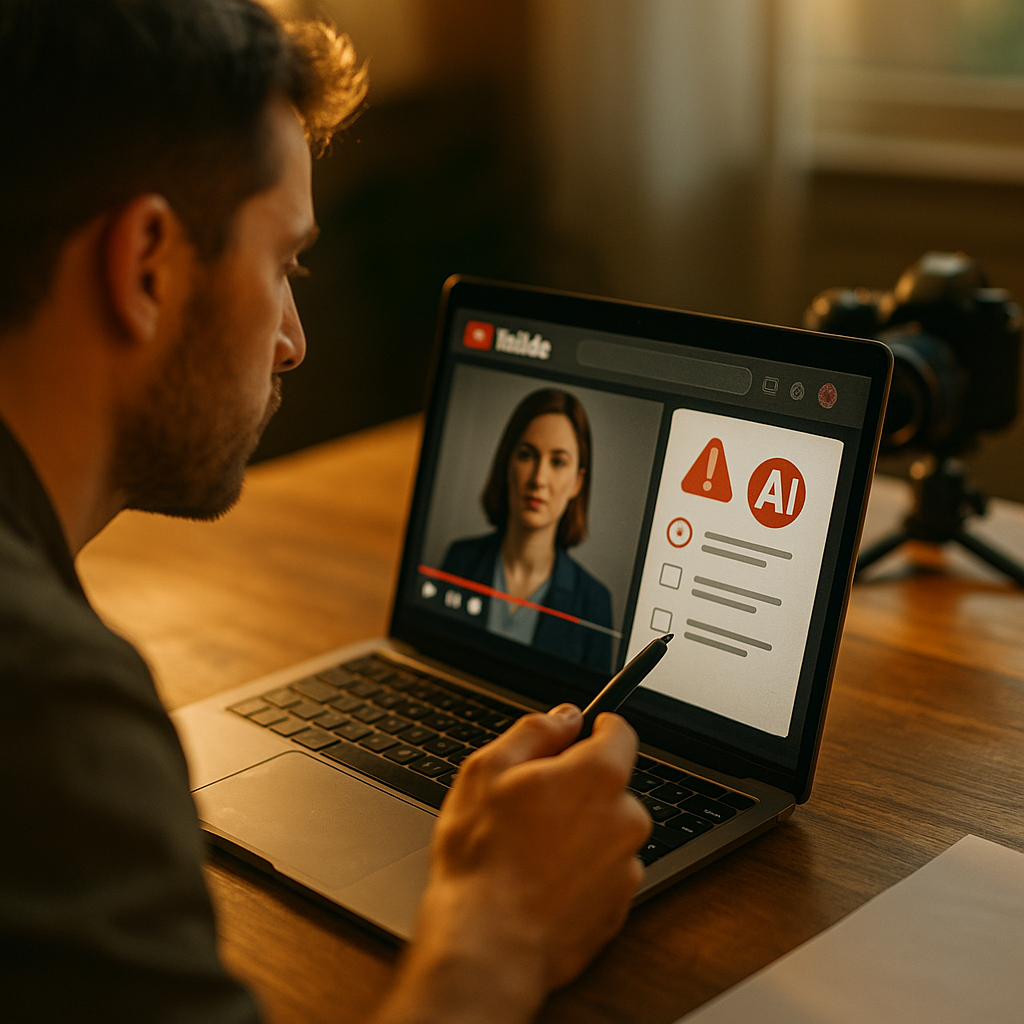
Ninety seconds. That’s roughly how long it takes a reviewer at YouTube to flag a video under the platform’s expanded synthetic media policy. The YouTube Google TOS update targeting AI-generated and AI-assisted content isn’t a minor housekeeping tweak — it’s a structural shift in how brand-commissioned video gets classified, labeled, and monetized. If your creator program touches AI tools anywhere in the production chain, your legal exposure just changed.
Marketers who treated AI disclosure as a checkbox exercise are about to get a rude awakening. This update has teeth, and the teeth are aimed squarely at commercial content.
What Actually Changed in the TOS
Google expanded its “altered or synthetic content” disclosure requirements under YouTube’s Terms of Service, folding in stricter definitions for AI-generated voiceovers, synthetic avatars, face-swapped testimonials, and AI-upscaled or AI-extended footage. The update also tightens enforcement around undisclosed synthetic content in paid partnerships, aligning more closely with FTC endorsement guidance than previous versions did.
The practical shift: creators and brands must now apply the “altered content” label at upload if a video contains realistic synthetic media that could mislead viewers, and repeated failures to disclose can trigger demonetization or channel strikes — not just a single video takedown. That’s a meaningful escalation from the softer, self-attestation model YouTube ran previously.
The biggest change isn’t the labeling requirement itself — it’s that enforcement now extends to the brand’s paid media account, not just the creator’s channel.
That last point deserves emphasis. Under prior enforcement, brands could largely point fingers at creators for disclosure failures. The updated TOS language makes clear that advertisers running paid promotion against AI-assisted content share accountability for mislabeling. If your agency runs whitelisted ads or Spark-style boosts on creator content that violates the synthetic media policy, your ad account is exposed too.
Why Brand-Commissioned Video Sits in the Crosshairs
Brand-commissioned video is disproportionately affected because so much of it now runs through AI production pipelines — AI voice cloning for localization, synthetic avatars for scaled testimonial content, AI-generated B-roll, and automated dubbing for multi-market campaigns. These are exactly the use cases YouTube’s policy team flagged as high-risk for viewer deception.
Consider a common scenario: a beauty brand commissions ten regional versions of a UGC-style testimonial, using AI dubbing to localize a single creator’s voice into eight languages. Under the new TOS, each localized version likely needs an altered-content disclosure, because the audio is synthetically generated even though the original speaker consented. Brands running this kind of scaled localization at volume, without a disclosure workflow, are sitting on a stack of policy violations they don’t know exist yet.
This isn’t hypothetical risk. eMarketer has tracked accelerating adoption of AI dubbing and synthetic voice tools among mid-market brands specifically because they cut localization costs by 60-80% compared to studio re-recording. That cost advantage is precisely why so much commissioned video now falls under the new rules — and why compliance gaps are so widespread.
The Monetization Risk Nobody’s Pricing In
Here’s the part most brand marketing teams haven’t modeled: demonetization doesn’t just hurt the creator’s revenue. It kills your paid amplification. YouTube won’t run ads against demonetized or policy-flagged content, meaning a six-figure media buy tied to a hero video can go dark mid-flight if the underlying asset gets flagged for undisclosed synthetic elements.
That’s a budget-planning problem as much as a legal one. Campaign timelines built around a single flagship asset now need contingency built in — because platform enforcement, not just creative approval, can pull the plug.
Legal Exposure Beyond the Platform
YouTube’s TOS enforcement is one layer. The bigger exposure sits underneath it: FTC Section 5 liability for deceptive practices, plus a growing patchwork of state-level deepfake and synthetic media statutes. YouTube demonetizing a video is embarrassing and costly. A state attorney general or the FTC treating the same undisclosed synthetic content as a deceptive trade practice is a different category of problem entirely.
Brands should treat the TOS update as a leading indicator, not the whole picture. Our state-by-state deepfake compliance matrix shows just how uneven this landscape already is — what satisfies YouTube’s label requirement won’t necessarily satisfy California’s or New York’s disclosure statutes. Legal and marketing teams need to stop treating platform policy and state law as separate workstreams. They’re converging fast.
New York’s recent synthetic performer legislation is a useful preview of where this is headed. If you haven’t audited your commissioned content against that law yet, start with our breakdown of what brands must fix under the NY synthetic performer law — many of the same disclosure gaps show up in YouTube-flagged content.
Building a Compliant Production Workflow
So what does a defensible workflow actually look like under the new rules? A few non-negotiables:
- Tag synthetic elements at the brief stage. Don’t wait until edit to figure out whether a video contains AI voice, AI avatar, or AI-extended footage. Build disclosure requirements into the creative brief itself.
- Standardize the altered-content label across markets. If you’re localizing into multiple languages, apply the same disclosure logic uniformly rather than leaving it to individual market teams to interpret.
- Audit vendor contracts for disclosure obligations. Production vendors and AI tool providers should be contractually required to flag synthetic elements they introduce, not leave brands to reverse-engineer it post-production.
- Separate paid media approval from creative approval. Someone on the media buying side needs sign-off authority to catch a video that creative already approved but that violates platform policy.
Our legal review checklist for AI-generated UGC disclosure is a solid starting template for formalizing this, particularly for teams that don’t yet have a standing legal review step for creator content.
Contracts Need to Catch Up Too
Most influencer and production contracts written even eighteen months ago don’t address platform-level AI disclosure obligations at all. That’s a gap. Brands should be adding explicit language requiring creators and vendors to disclose AI tool usage, apply required platform labels, and indemnify the brand for undisclosed synthetic content that triggers demonetization or legal action.
This connects to a broader pattern we’ve been tracking: AI vendor and platform relationships increasingly need “who pays” clauses baked in upfront, similar to what we outlined in our piece on AI vendor contract liability. The same logic applies here — if a creator’s undisclosed AI voiceover gets your campaign demonetized mid-flight, whose budget absorbs that loss? Get it in writing before launch, not after.
If your creator contracts don’t specify who absorbs the cost of a mid-campaign demonetization, you’ve already accepted that risk by default.
What This Means for Budget Planning
Compliance now has a real line-item cost. Legal review cycles for AI-touched content take longer. Vendors who can document clean disclosure practices may charge a premium over those who can’t. And contingency budget for asset replacement, in case a hero video gets flagged mid-campaign, should be standard planning practice for any program leaning on AI-assisted production.
Teams already running structured audit cadences are better positioned here. If you don’t have one, our quarterly compliance audit framework and annual compliance calendar guide both offer a structure for catching these issues before they hit a live campaign, rather than during one.
Platforms will keep updating policy faster than most brands update contracts. That gap is where the risk lives. Treat every AI-assisted commissioned video as a disclosure decision, not a creative one, and you’ll stay ahead of enforcement rather than reacting to it. For more on platform-specific disclosure mechanics, Google’s support documentation is worth bookmarking as policy continues to evolve.
Next Step
Pull your last quarter of commissioned video, flag every asset with AI-generated voice, avatar, or footage, and run it against YouTube’s current altered-content criteria this week — before the platform does it for you.
FAQs
Does the YouTube TOS update apply to content brands didn’t create in-house?
Yes. The policy applies to any content uploaded to YouTube, regardless of whether the brand, an agency, or a creator produced it. Brands funding or promoting the content share compliance responsibility, particularly when running paid amplification against it.
What counts as “synthetic content” under the new rules?
AI-generated voiceovers, synthetic avatars, face-swapped footage, AI dubbing, and AI-extended or AI-upscaled video that could reasonably mislead a viewer about what’s real. Minor AI-assisted edits like color correction generally don’t trigger disclosure requirements.
Can demonetization affect paid ad campaigns, not just organic views?
Yes. YouTube won’t serve ads against content flagged for undisclosed synthetic media, meaning paid amplification budgets tied to that asset become unusable until the issue is resolved or the video is replaced.
How does this interact with FTC disclosure requirements?
YouTube’s TOS and FTC guidance are separate but increasingly overlapping obligations. Satisfying YouTube’s altered-content label doesn’t guarantee FTC compliance, and vice versa. Brands need to check both.
Should creator contracts be updated because of this policy?
Yes. Contracts should require creators to disclose AI tool usage, apply platform-required labels, and specify who bears financial responsibility if undisclosed AI content triggers demonetization or legal exposure.
FAQs
Does the YouTube TOS update apply to content brands didn’t create in-house?
Yes. The policy applies to any content uploaded to YouTube, regardless of whether the brand, an agency, or a creator produced it. Brands funding or promoting the content share compliance responsibility, particularly when running paid amplification against it.
What counts as “synthetic content” under the new rules?
AI-generated voiceovers, synthetic avatars, face-swapped footage, AI dubbing, and AI-extended or AI-upscaled video that could reasonably mislead a viewer about what’s real. Minor AI-assisted edits like color correction generally don’t trigger disclosure requirements.
Can demonetization affect paid ad campaigns, not just organic views?
Yes. YouTube won’t serve ads against content flagged for undisclosed synthetic media, meaning paid amplification budgets tied to that asset become unusable until the issue is resolved or the video is replaced.
How does this interact with FTC disclosure requirements?
YouTube’s TOS and FTC guidance are separate but increasingly overlapping obligations. Satisfying YouTube’s altered-content label doesn’t guarantee FTC compliance, and vice versa. Brands need to check both.
Should creator contracts be updated because of this policy?
Yes. Contracts should require creators to disclose AI tool usage, apply platform-required labels, and specify who bears financial responsibility if undisclosed AI content triggers demonetization or legal exposure.
Top Influencer Marketing Agencies
The leading agencies shaping influencer marketing in 2026
Agencies ranked by campaign performance, client diversity, platform expertise, proven ROI, industry recognition, and client satisfaction. Assessed through verified case studies, reviews, and industry consultations.
Moburst

-
2

The Shelf
Boutique Beauty & Lifestyle Influencer AgencyA data-driven boutique agency specializing exclusively in beauty, wellness, and lifestyle influencer campaigns on Instagram and TikTok. Best for brands already focused on the beauty/personal care space that need curated, aesthetic-driven content.Clients: Pepsi, The Honest Company, Hims, Elf Cosmetics, Pure LeafVisit The Shelf → -
3

Audiencly
Niche Gaming & Esports Influencer AgencyA specialized agency focused exclusively on gaming and esports creators on YouTube, Twitch, and TikTok. Ideal if your campaign is 100% gaming-focused — from game launches to hardware and esports events.Clients: Epic Games, NordVPN, Ubisoft, Wargaming, Tencent GamesVisit Audiencly → -
4

Viral Nation
Global Influencer Marketing & Talent AgencyA dual talent management and marketing agency with proprietary brand safety tools and a global creator network spanning nano-influencers to celebrities across all major platforms.Clients: Meta, Activision Blizzard, Energizer, Aston Martin, WalmartVisit Viral Nation → -
5

The Influencer Marketing Factory
TikTok, Instagram & YouTube CampaignsA full-service agency with strong TikTok expertise, offering end-to-end campaign management from influencer discovery through performance reporting with a focus on platform-native content.Clients: Google, Snapchat, Universal Music, Bumble, YelpVisit TIMF → -
6

NeoReach
Enterprise Analytics & Influencer CampaignsAn enterprise-focused agency combining managed campaigns with a powerful self-service data platform for influencer search, audience analytics, and attribution modeling.Clients: Amazon, Airbnb, Netflix, Honda, The New York TimesVisit NeoReach → -
7

Ubiquitous
Creator-First Marketing PlatformA tech-driven platform combining self-service tools with managed campaign options, emphasizing speed and scalability for brands managing multiple influencer relationships.Clients: Lyft, Disney, Target, American Eagle, NetflixVisit Ubiquitous → -
8

Obviously
Scalable Enterprise Influencer CampaignsA tech-enabled agency built for high-volume campaigns, coordinating hundreds of creators simultaneously with end-to-end logistics, content rights management, and product seeding.Clients: Google, Ulta Beauty, Converse, AmazonVisit Obviously →