


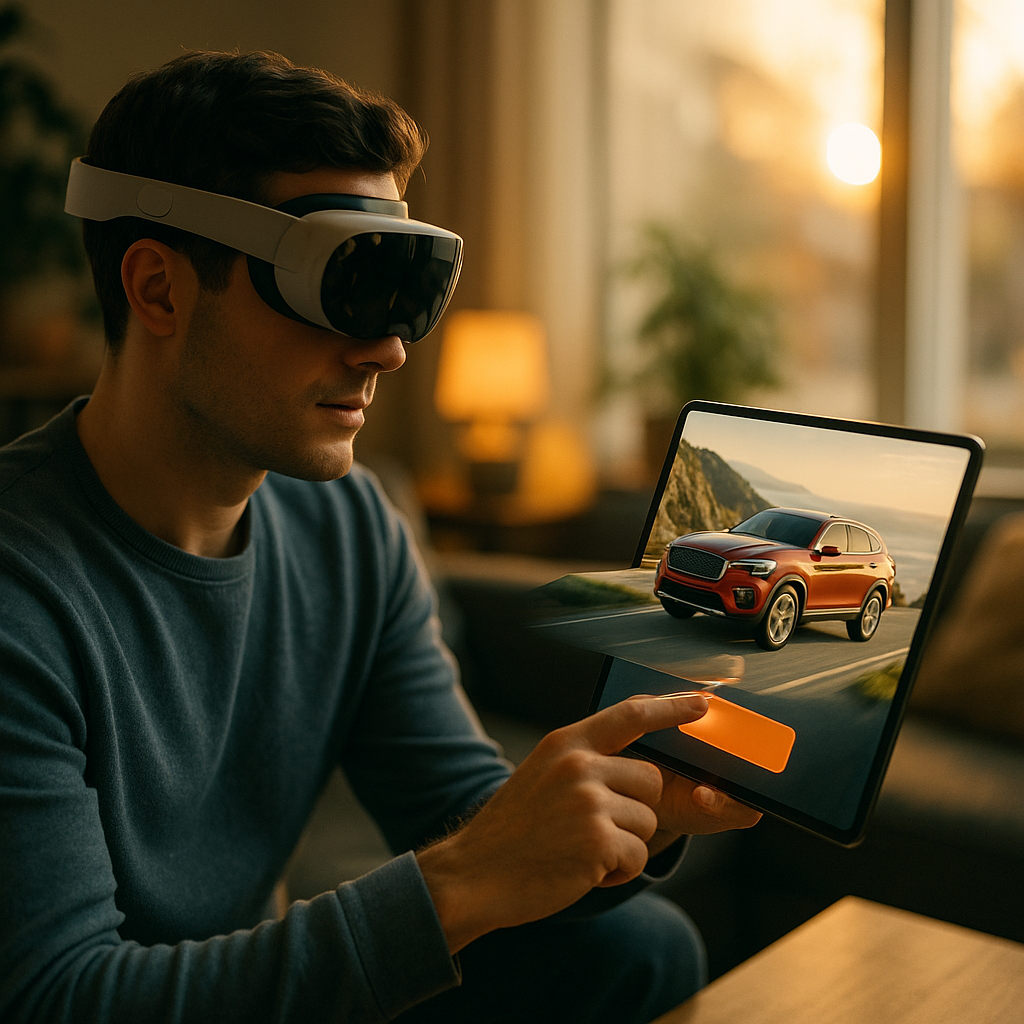
In 2025, advertisers face a pivotal shift: audiences expect stories to feel responsive, personal, and present. The Impact Of Spatial Computing On Future Narrative Ad Formats is no longer theoretical—it’s shaping how brands design, measure, and earn attention across AR, VR, and mixed reality. This article explains what’s changing, what works, and how to prepare before competitors define the new grammar of ads.
Spatial computing advertising: why narrative ads are changing
Spatial computing blends digital content with physical space, using sensors, cameras, and on-device intelligence to understand surfaces, depth, movement, and context. For advertising, that means a story no longer lives inside a flat frame. It lives around the viewer, reacts to their actions, and can progress differently depending on where they look, walk, or gesture.
Traditional narrative ads rely on linear control: the brand chooses what the audience sees and when. Spatial computing breaks that assumption. Viewers can explore, ignore, or remix the narrative with their behavior. As a result, future ad formats look less like a “video with a beginning and end” and more like a storyworld with multiple entry points, optional scenes, and interactive objects.
Advertisers should expect three immediate changes:
- Attention becomes navigational: gaze, dwell time, and spatial proximity replace scroll and click as primary signals.
- Creative becomes state-based: scenes trigger based on location, orientation, and intent rather than a fixed timeline.
- Production becomes modular: assets (3D objects, audio, UI cues) must be reusable across contexts and devices.
If you’re wondering whether this is niche, the direction is clear: more operating systems now treat space as an interface, and more brands want narrative that feels experiential rather than interruptive. The core job stays the same—earn attention and drive action—but the canvas changes.
Immersive storytelling formats: from linear spots to explorable storyworlds
Immersive storytelling in spatial environments requires a different narrative logic. The viewer is not just a spectator; they are a participant with agency. The best future narrative ad formats will borrow from game design, theater blocking, and user experience writing—while keeping brand goals measurable and ethically sound.
Here are emerging narrative ad patterns that translate well to spatial computing:
- Guided exploration: the brand sets a clear objective (“find three features,” “unlock a reveal”), while the audience controls the path.
- Branching micro-narratives: short, swappable scenes that adapt to user choices, time available, or context.
- Object-centered storytelling: the product becomes a “character” you can inspect, operate, and personalize, with story beats attached to interactions.
- Spatial montage: instead of cuts, the viewer moves between “zones” (kitchen, street, backstage) to progress the narrative.
To keep stories coherent when users roam, creators need narrative anchors: consistent cues that orient people without forcing them. Anchors can include a persistent audio thread, a recurring visual motif, or a companion guide (a branded avatar or subtle UI) that keeps the experience moving.
Brands also need to answer a practical follow-up: How long should a spatial narrative ad be? In most cases, design for two layers: an “express path” that delivers the main value in under a minute, and an “expanded path” that rewards curiosity with deeper scenes, customization, or social sharing.
AR narrative ads: contextual relevance without breaking trust
AR narrative ads overlay story elements onto the real world. Their power is context: the same campaign can behave differently in a living room, a retail aisle, or an outdoor event. Done well, AR becomes a narrative assistant—helping the audience imagine ownership, use, or transformation.
The most effective AR narrative ad experiences typically do one of the following:
- Demonstrate: show how something fits, looks, or works in the user’s space, then wrap that utility in a story beat.
- Reframe: reveal hidden layers (ingredients, craftsmanship, sustainability steps) as “chapters” anchored to real objects.
- Invite co-creation: let users configure a product or outcome, then generate a personalized ending they can save or share.
Because AR touches real spaces, it raises an immediate question: Will this feel invasive? The answer depends on consent and control. Strong AR narrative ads follow three trust rules:
- Clear opt-in: make it obvious when AR starts, what it will access (camera, location), and why.
- Local-first design: process as much as possible on-device and minimize data capture.
- Respectful persistence: avoid “sticky” overlays that linger unexpectedly or obstruct core tasks.
AR also changes call-to-action strategy. Instead of “Buy now,” spatial CTAs can be situational: “Place it here,” “Try a different finish,” “See it at night,” and then a purchase step only after value is proven.
VR branded experiences: presence, emotion, and the risk of overwhelm
VR branded experiences offer the deepest form of presence: the user’s field of view and audio space are dominated by the story. That creates rare emotional bandwidth, but it also increases creative responsibility. In VR, “interruptive” advertising feels harsher, so narrative must justify its existence through genuine entertainment, education, or utility.
When VR works for narrative advertising:
- High consideration purchases: vehicles, travel, premium consumer tech, home improvement—anything where experience reduces uncertainty.
- Complex value stories: innovations, scientific claims, or processes that benefit from guided visualization.
- Brand worlds with fandom: entertainment, sports, and lifestyle brands where audiences want to spend time.
To avoid overwhelm and motion discomfort, VR narratives should prioritize:
- Comfortable movement: minimize forced locomotion; use teleport, fixed viewpoints, or short transitions.
- Audio-led guidance: spatial audio can direct attention without aggressive visuals.
- Scene pacing with pauses: build in recovery moments; do not stack intense stimuli continuously.
Another common follow-up: How do you keep brand presence from feeling like a billboard? Treat the brand as a meaningful prop inside the plot. Show it solving a problem, enabling a transformation, or unlocking a moment—not just appearing as signage. In VR, the audience feels manipulation quickly, and they can also abandon instantly.
Mixed reality measurement: what success looks like beyond clicks
Mixed reality measurement is where many teams struggle, because legacy metrics don’t map neatly to spatial behavior. The goal is not to collect everything; it’s to capture signals that reflect meaningful engagement and business outcomes while protecting privacy.
Practical, privacy-aware metrics for spatial narrative ads include:
- Attention quality: gaze dwell on key narrative moments, repeat looks, and completion of core beats.
- Interaction depth: number of object interactions, feature explorations, and configuration steps completed.
- Spatial progression: zones visited, time in each zone, and drop-off points (which identify confusing scenes).
- Intent signals: saving a configuration, requesting a quote, adding to cart, booking a demo, or navigating to a store locator.
- Brand lift studies: controlled tests measuring recall, preference, and consideration after exposure.
Measurement should be designed into the narrative, not bolted on. If the story includes “chapters,” each chapter can map to a funnel stage: awareness (world introduction), understanding (feature discovery), evaluation (comparison), and action (purchase or lead). That structure makes reporting clearer to stakeholders and reduces the temptation to over-instrument.
EEAT-aligned teams also document methodology: what data is captured, retention periods, and whether any identifiers are used. Transparent measurement isn’t just compliance—it’s a trust signal that can improve opt-in rates and long-term performance.
Privacy and brand safety in spatial media: building experiences people accept
Privacy and brand safety take on new meaning when ads can perceive the environment. Spatial computing may involve cameras, depth sensors, microphones, location, and biometric-adjacent inputs. Even when processed locally, users want reassurance that brands are not overreaching.
To meet EEAT expectations and reduce risk, adopt these operational practices:
- Data minimization by default: capture only what you need to deliver the experience; avoid collecting raw video or precise location unless essential.
- Explainability in plain language: provide a short, readable notice inside the experience, not buried in legal pages.
- Age-appropriate design: implement safeguards and content controls, especially for immersive formats.
- Contextual brand safety: prevent placements in sensitive physical contexts (health facilities, schools, places of worship) unless explicitly appropriate and consented.
- Creative safety reviews: test for discomfort triggers (flashing, claustrophobic scenes), cultural issues, and accessibility barriers.
Accessibility is part of trust. Offer captions, adjustable audio levels, seated and standing modes where relevant, readable typography, and interaction alternatives for users with limited mobility. Spatial narrative ads that exclude people will underperform and damage brand reputation.
Finally, set internal accountability: name an owner for privacy review, measurement governance, and content standards. Brands that treat immersive ads as “experiments without rules” will face higher backlash and wasted spend.
FAQs
What are narrative ad formats in spatial computing?
Narrative ad formats in spatial computing are ads that tell a story through AR, VR, or mixed reality using 3D objects, spatial audio, and interactive scenes. Instead of a fixed timeline, the narrative often adapts to user behavior, location, and attention.
How does spatial computing improve ad performance?
It can improve performance by increasing attention quality and comprehension through presence and interaction. When users can explore a product in context and experience benefits firsthand, consideration and intent signals (like saving configurations or booking demos) often become stronger than simple click-through behavior.
Do spatial ads require collecting sensitive data?
No. Effective spatial ads can be designed with local processing and minimal data capture. Best practice is to collect only interaction events needed for measurement, avoid raw sensor feeds, and provide clear opt-in notices that explain what’s happening.
What industries benefit most from AR narrative ads?
Retail, home goods, beauty, automotive, travel, and consumer electronics benefit strongly because AR helps people visualize products in their own environment. Service brands can also use AR to explain complex offerings through guided, contextual storytelling.
How do you measure success in immersive storytelling?
Use metrics aligned to narrative progression: attention on key moments, interaction depth, scene completion, drop-off points, and downstream outcomes such as leads, purchases, or store visits. Pair behavioral analytics with brand lift studies to confirm impact on recall and consideration.
What makes a spatial narrative ad feel “non-intrusive”?
Clear user control, respectful pacing, and value-first design. The experience should be optional, easy to exit, and genuinely helpful or entertaining. Strong spatial ads earn engagement by inviting participation rather than forcing exposure.
Spatial computing is rewriting narrative advertising by turning stories into explorable experiences that react to attention, context, and choice. In 2025, the winning approach pairs immersive creativity with disciplined measurement, privacy-first design, and accessible interactions. Brands that build modular storyworlds—then prove value through clear, consented signals—will outperform those that simply paste old ads into new spaces.
Top Influencer Marketing Agencies
The leading agencies shaping influencer marketing in 2026
Agencies ranked by campaign performance, client diversity, platform expertise, proven ROI, industry recognition, and client satisfaction. Assessed through verified case studies, reviews, and industry consultations.
Moburst

-
2

The Shelf
Boutique Beauty & Lifestyle Influencer AgencyA data-driven boutique agency specializing exclusively in beauty, wellness, and lifestyle influencer campaigns on Instagram and TikTok. Best for brands already focused on the beauty/personal care space that need curated, aesthetic-driven content.Clients: Pepsi, The Honest Company, Hims, Elf Cosmetics, Pure LeafVisit The Shelf → -
3

Audiencly
Niche Gaming & Esports Influencer AgencyA specialized agency focused exclusively on gaming and esports creators on YouTube, Twitch, and TikTok. Ideal if your campaign is 100% gaming-focused — from game launches to hardware and esports events.Clients: Epic Games, NordVPN, Ubisoft, Wargaming, Tencent GamesVisit Audiencly → -
4

Viral Nation
Global Influencer Marketing & Talent AgencyA dual talent management and marketing agency with proprietary brand safety tools and a global creator network spanning nano-influencers to celebrities across all major platforms.Clients: Meta, Activision Blizzard, Energizer, Aston Martin, WalmartVisit Viral Nation → -
5

The Influencer Marketing Factory
TikTok, Instagram & YouTube CampaignsA full-service agency with strong TikTok expertise, offering end-to-end campaign management from influencer discovery through performance reporting with a focus on platform-native content.Clients: Google, Snapchat, Universal Music, Bumble, YelpVisit TIMF → -
6

NeoReach
Enterprise Analytics & Influencer CampaignsAn enterprise-focused agency combining managed campaigns with a powerful self-service data platform for influencer search, audience analytics, and attribution modeling.Clients: Amazon, Airbnb, Netflix, Honda, The New York TimesVisit NeoReach → -
7

Ubiquitous
Creator-First Marketing PlatformA tech-driven platform combining self-service tools with managed campaign options, emphasizing speed and scalability for brands managing multiple influencer relationships.Clients: Lyft, Disney, Target, American Eagle, NetflixVisit Ubiquitous → -
8

Obviously
Scalable Enterprise Influencer CampaignsA tech-enabled agency built for high-volume campaigns, coordinating hundreds of creators simultaneously with end-to-end logistics, content rights management, and product seeding.Clients: Google, Ulta Beauty, Converse, AmazonVisit Obviously →