


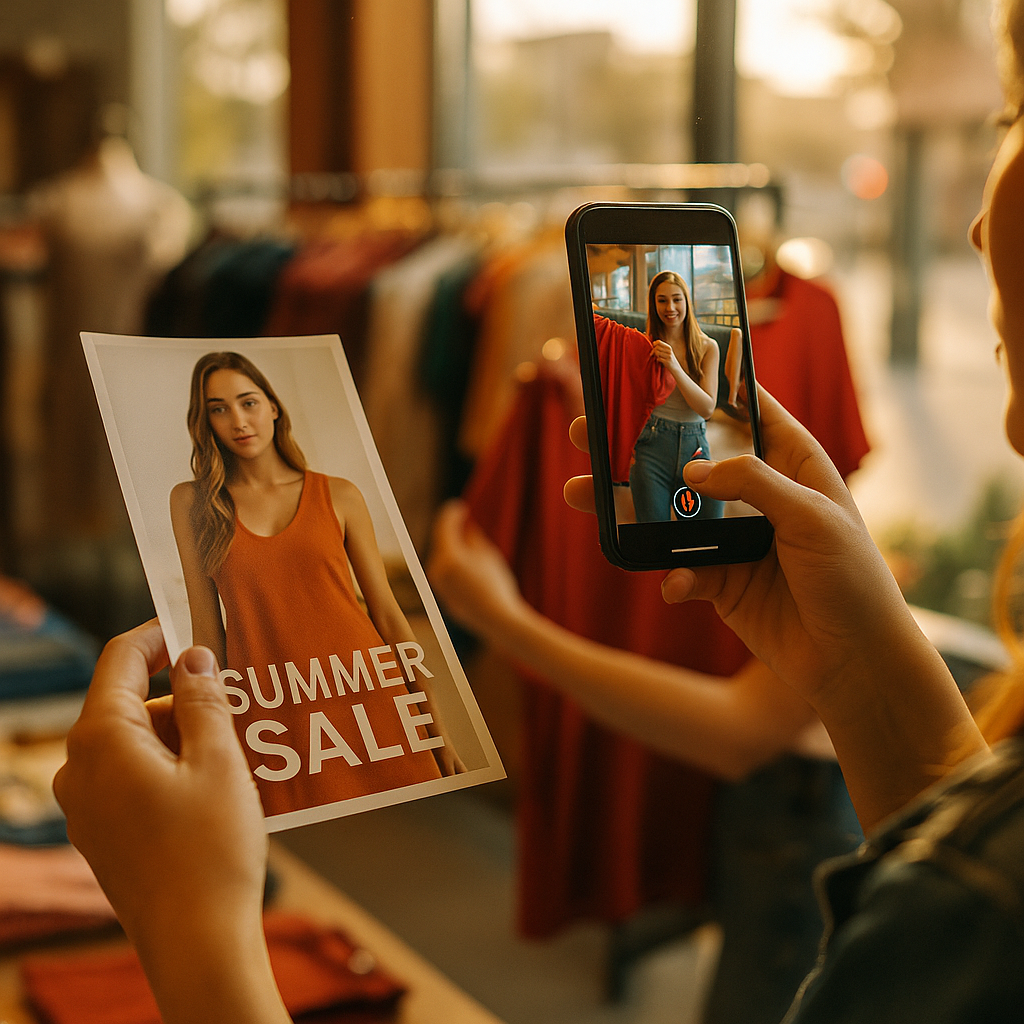
In 2026, print to social video transition is no longer a risky experiment for retailers. It is a practical path to stronger reach, better targeting, and more measurable sales impact. This case study shows how one mid-sized retailer replaced declining print performance with a disciplined social video strategy, what worked, what failed, and the lessons other brands can use today.
Retail marketing strategy: why print stopped delivering efficient growth
The retailer in this case study operated across regional stores and a growing ecommerce channel. For years, its marketing mix depended heavily on local print inserts, direct mail, seasonal catalog drops, and magazine placements. These tactics had once supported store traffic, but by 2026 the business faced a familiar problem: print costs kept rising while attribution remained weak.
The leadership team did not abandon print on a whim. They reviewed three quarters of campaign data and found several issues. First, response windows were too slow to support frequent merchandising changes. Second, creative production cycles left little room for testing. Third, younger audiences were engaging with product discovery on short-form video platforms rather than through circulars or mailers. Finally, the retailer could not confidently connect many print impressions to online purchases.
That gap mattered. The company sold fashion-adjacent seasonal products, and its best-performing inventory changed quickly. If an item started trending, the brand needed to promote it within days, not weeks. Print could not match that pace. Social video could.
The internal goal was clear: shift part of the media budget into channels that offered stronger engagement, faster feedback, and better audience segmentation without damaging brand consistency. Instead of treating social video as a creative side project, the retailer made it a core retail marketing strategy.
The move was not framed as “print is dead.” It was framed as “what channel now fits customer behavior, content consumption, and buying journeys better?” That question led to a measured transition rather than a disruptive overhaul. The company kept a small print allocation for high-performing local events and loyalty mailers, but redirected the majority of awareness and promotional spend into video-first social campaigns.
Social video marketing case study: the transition plan and channel selection
This social video marketing case study stands out because the retailer did not jump straight into production. It began with planning. The team mapped campaign goals to funnel stages and selected platforms based on actual audience behavior, not assumptions.
Its customer data showed three meaningful segments. The first included loyal in-store buyers aged 40 and older, who still responded to promotions but increasingly used social platforms for product research. The second was a younger mobile-first audience that discovered trends through creator-style videos. The third was a practical value-focused segment that responded well to product demos, comparison clips, and limited-time offers.
From that analysis, the retailer chose a mix of short-form video on major social platforms, paid amplification for prospecting, and retargeting video ads for cart abandoners and site visitors. Each channel had a role:
- Short-form awareness videos introduced product categories, seasonal trends, and styling ideas.
- Mid-funnel product videos answered common questions, showed features, and highlighted use cases.
- Retargeting clips reinforced urgency through restocks, social proof, and promotions.
- Store-localized video ads supported foot traffic for key markets.
The retailer also created a clear content operating model. Instead of producing one polished brand film and slicing it into pieces, the marketing team built a repeatable video system. That system included weekly concept planning, a monthly production calendar, rapid editing variations, and a testing framework for hooks, captions, video length, and calls to action.
This approach reduced one of the biggest points of friction in moving away from print: internal approval bottlenecks. Print campaigns had historically involved long sign-off cycles because every asset was costly to produce. Social video required a different mindset. The company established brand guardrails upfront, then gave the digital team more room to test within those rules.
That shift improved speed without sacrificing quality. The retailer moved from campaign thinking to content thinking. Instead of launching one major seasonal promotion and waiting for results, it published and optimized continuously.
Video content strategy for retailers: what the brand actually produced
A strong video content strategy for retailers depends on matching content formats to shopper intent. The retailer identified six video types that could replace the core jobs print had once handled.
- Product spotlight videos showcased one item in the first two seconds, explained benefits quickly, and used overlays for pricing or promotions.
- “How to style” videos helped customers imagine products in real life, increasing confidence and average order value.
- Seasonal trend edits grouped multiple products around a timely theme, replacing the role of traditional catalog spreads.
- Staff-led videos featured store associates sharing quick recommendations, which added credibility and lowered production costs.
- User-generated style clips gave the brand social proof and made ads feel more native to the platform environment.
- Offer and event videos drove urgency around flash sales, local store events, and limited-time bundles.
The company learned early that polished creative did not always outperform practical creative. In many cases, videos filmed with a creator aesthetic and direct voiceover achieved stronger watch-through rates than studio-heavy edits. Why? Because social audiences respond to relevance and clarity first. The most effective videos showed the product immediately, answered one buying objection, and ended with a simple next step.
The retailer also adapted print messaging instead of copy-pasting it. Long promotional headlines that worked in a circular did not work in social feeds. The team rewrote copy for speed and comprehension. For example, “Spring Home Refresh Event” became “3 easy updates under your budget.” That shift improved thumb-stop rates and aligned with mobile viewing behavior.
Importantly, the retailer built content around questions buyers were already asking in search, customer support, and store interactions. That is where EEAT principles became practical. Rather than making broad claims, the brand used staff expertise, product knowledge, and customer pain points to create useful videos. This improved trust. It also increased conversion because content answered real decision-stage questions.
To support consistency, the company documented video best practices:
- Show the product in use within the opening seconds.
- Design for sound-off viewing with clear captions.
- Keep one message per video.
- Use platform-native framing and pacing.
- Refresh hooks often to prevent creative fatigue.
- Feature credible people, including staff and real customers, when possible.
That discipline turned social video from a creative experiment into a dependable retail growth engine.
Retail advertising ROI: results, metrics, and what changed after the shift
The most important question was simple: did the transition improve retail advertising ROI? According to the retailer’s internal reporting, yes. Within six months of reallocating a significant share of its print spend into social video, the business saw measurable gains across both ecommerce and store-support campaigns.
Top-line outcomes included stronger reach among priority audiences, lower cost per qualified site visitor, and more frequent repeat exposure due to retargeting. Video campaigns also produced faster learning cycles. Instead of waiting for a print drop to finish, the team could review performance daily and shift budget to better-performing creative or audience segments.
The retailer tracked several core metrics:
- View-through rate to understand whether hooks and pacing were working.
- Click-through rate to evaluate message relevance.
- Cost per landing page view to compare traffic efficiency.
- Add-to-cart and purchase rate to measure downstream impact.
- Return on ad spend for direct-response campaigns.
- Store traffic lift in targeted regions where location-based video ads ran.
The strongest gains came from mid-funnel and retargeting content, not just awareness videos. This mattered because it proved social video could do more than generate views. It could move shoppers closer to purchase. Product demonstration clips, “back in stock” videos, and short comparison creatives consistently outperformed broad lifestyle content on conversion-oriented campaigns.
Another gain was attribution clarity. Print had often been judged by proxy signals or historical assumptions. Social video gave the retailer much stronger visibility into what creative, audience, and offer combinations were influencing sales. That did not mean every conversion path was perfectly linear, but the business could make smarter decisions with more confidence.
The company also found a less obvious advantage: reduced creative waste. In print, one underperforming concept could consume a large budget before the team learned anything. In social video, underperforming assets were paused quickly, while strong ones were extended or adapted into new variants. This lowered risk and improved media efficiency over time.
For leadership, that was the turning point. The transition was no longer justified by industry trends. It was justified by operational evidence, clearer performance data, and stronger margin protection.
Omnichannel retail transformation: challenges, mistakes, and how the team solved them
No omnichannel retail transformation happens without friction. This retailer faced four common problems during the switch.
Challenge one: internal skepticism. Merchandising and executive stakeholders were used to tangible print assets they could review physically. Social video felt more fluid and less controllable. The marketing team addressed this by setting weekly reporting reviews and sharing side-by-side comparisons of spend, reach, traffic quality, and conversion outcomes.
Challenge two: creative volume. Social platforms reward iteration, and the team initially underestimated how many fresh assets they needed. Their fix was to batch-produce modular footage that editors could turn into multiple versions. One shoot could create product close-ups, model footage, testimonial clips, and promotional edits for different audiences.
Challenge three: balancing brand and platform fit. Early videos looked too much like digital print ads. They felt static and formal. Performance improved only after the retailer embraced native pacing, direct hooks, and more conversational scripting.
Challenge four: connecting online campaigns to store impact. This was important because many purchases still happened in person. The retailer solved this by using geo-targeted campaigns, store-specific landing pages, and promotional codes tied to local creative. While not perfect, the measurement was far stronger than what print had offered.
There were also important strategic lessons:
- Not every print message should become a video. Some offers lacked enough customer relevance to justify paid promotion.
- Speed matters, but process matters too. Without naming conventions, reporting standards, and approval rules, teams lose efficiency fast.
- Short videos still need substance. Fast pacing alone does not convert; useful information does.
- Creative and media teams must work together. Performance improved only when content decisions were informed by audience and conversion data.
These lessons reflect a broader reality in 2026: successful retail marketing is not about choosing one channel over another in isolation. It is about building a connected system where content, targeting, and measurement reinforce each other.
Digital marketing for retailers: practical takeaways for brands planning the same move
For brands evaluating digital marketing for retailers, this case study offers a practical roadmap. The retailer did not win because it posted more videos. It won because it made structured decisions around audience insight, creative relevance, testing, and measurement.
If your organization is considering a similar transition, start with these steps:
- Audit where print still performs. Keep only the placements that deliver clear value.
- Define what social video must do. Awareness, product education, traffic, and retargeting each need different creative.
- Build content around customer questions. Useful content earns attention and trust more reliably than generic promotion.
- Create a repeatable production model. Retailers need content velocity, not one-off campaigns.
- Measure beyond views. Tie performance to site behavior, sales outcomes, and, where possible, regional store impact.
- Plan for iteration. The first version is rarely the best version.
Retailers should also ask a realistic question before making the shift: what internal capabilities are missing? Some brands need stronger editing workflows. Others need better paid media reporting or a more agile approval process. Knowing those gaps early prevents wasted spend later.
EEAT principles matter here as well. Trust grows when the brand demonstrates real product knowledge, uses credible voices, and supports claims with transparent information. In retail, expertise can come from buyers, store staff, stylists, category managers, and customers who use the products in real contexts. That is often more persuasive than high-budget branding alone.
The retailer in this case study succeeded because it aligned content with the way modern shoppers discover and evaluate products. Print had not become useless; it had simply become less effective for the retailer’s most urgent growth goals. Social video met those goals with greater speed, flexibility, and accountability.
FAQs about print to social video transition
Why are retailers moving from print to social video in 2026?
Retailers are shifting because social video offers faster production cycles, stronger targeting, clearer attribution, and more opportunities to test creative. It also aligns better with how many customers now discover products on mobile and social platforms.
Should retailers stop using print completely?
No. Some retailers still see value in local event promotion, loyalty mailers, or specific regional print placements. The smarter approach is to reduce low-efficiency print spend and keep only the formats that prove their value.
What types of social videos work best for retail brands?
Product demos, styling ideas, seasonal collections, staff recommendations, user-generated content, and offer-driven retargeting videos often perform well. The best format depends on whether the goal is awareness, consideration, or conversion.
How can a retailer measure whether social video is outperforming print?
Track traffic quality, click-through rate, add-to-cart rate, purchase rate, return on ad spend, and regional store impact where possible. Compared with print, social video usually provides much more detailed performance data.
Is high-end production necessary for retail social video?
Not always. Many retailers perform better with authentic, platform-native videos that show products clearly and answer real customer questions. Production quality matters, but relevance and clarity usually matter more.
How long does it take to see results after shifting budget from print to social video?
Retailers often start learning within days because social campaigns generate immediate data. Meaningful performance patterns usually become clearer within a few weeks, especially if the brand tests multiple audiences and creative variations.
What is the biggest mistake retailers make during the transition?
One common mistake is treating social video like digital print. Static messaging and overly formal creative rarely perform well. Retailers need platform-native content, strong hooks, and an ongoing testing process.
The clearest lesson from this retailer’s experience is straightforward: social video works when it is treated as a measurable retail system, not a trend. Brands that replace slow, hard-to-attribute print spend with useful, testable video content can improve efficiency, sharpen targeting, and learn faster. The takeaway for 2026 is simple: move deliberately, measure rigorously, and create video that genuinely helps shoppers decide.
Top Influencer Marketing Agencies
The leading agencies shaping influencer marketing in 2026
Agencies ranked by campaign performance, client diversity, platform expertise, proven ROI, industry recognition, and client satisfaction. Assessed through verified case studies, reviews, and industry consultations.
Moburst

-
2

The Shelf
Boutique Beauty & Lifestyle Influencer AgencyA data-driven boutique agency specializing exclusively in beauty, wellness, and lifestyle influencer campaigns on Instagram and TikTok. Best for brands already focused on the beauty/personal care space that need curated, aesthetic-driven content.Clients: Pepsi, The Honest Company, Hims, Elf Cosmetics, Pure LeafVisit The Shelf → -
3

Audiencly
Niche Gaming & Esports Influencer AgencyA specialized agency focused exclusively on gaming and esports creators on YouTube, Twitch, and TikTok. Ideal if your campaign is 100% gaming-focused — from game launches to hardware and esports events.Clients: Epic Games, NordVPN, Ubisoft, Wargaming, Tencent GamesVisit Audiencly → -
4

Viral Nation
Global Influencer Marketing & Talent AgencyA dual talent management and marketing agency with proprietary brand safety tools and a global creator network spanning nano-influencers to celebrities across all major platforms.Clients: Meta, Activision Blizzard, Energizer, Aston Martin, WalmartVisit Viral Nation → -
5

The Influencer Marketing Factory
TikTok, Instagram & YouTube CampaignsA full-service agency with strong TikTok expertise, offering end-to-end campaign management from influencer discovery through performance reporting with a focus on platform-native content.Clients: Google, Snapchat, Universal Music, Bumble, YelpVisit TIMF → -
6

NeoReach
Enterprise Analytics & Influencer CampaignsAn enterprise-focused agency combining managed campaigns with a powerful self-service data platform for influencer search, audience analytics, and attribution modeling.Clients: Amazon, Airbnb, Netflix, Honda, The New York TimesVisit NeoReach → -
7

Ubiquitous
Creator-First Marketing PlatformA tech-driven platform combining self-service tools with managed campaign options, emphasizing speed and scalability for brands managing multiple influencer relationships.Clients: Lyft, Disney, Target, American Eagle, NetflixVisit Ubiquitous → -
8

Obviously
Scalable Enterprise Influencer CampaignsA tech-enabled agency built for high-volume campaigns, coordinating hundreds of creators simultaneously with end-to-end logistics, content rights management, and product seeding.Clients: Google, Ulta Beauty, Converse, AmazonVisit Obviously →