


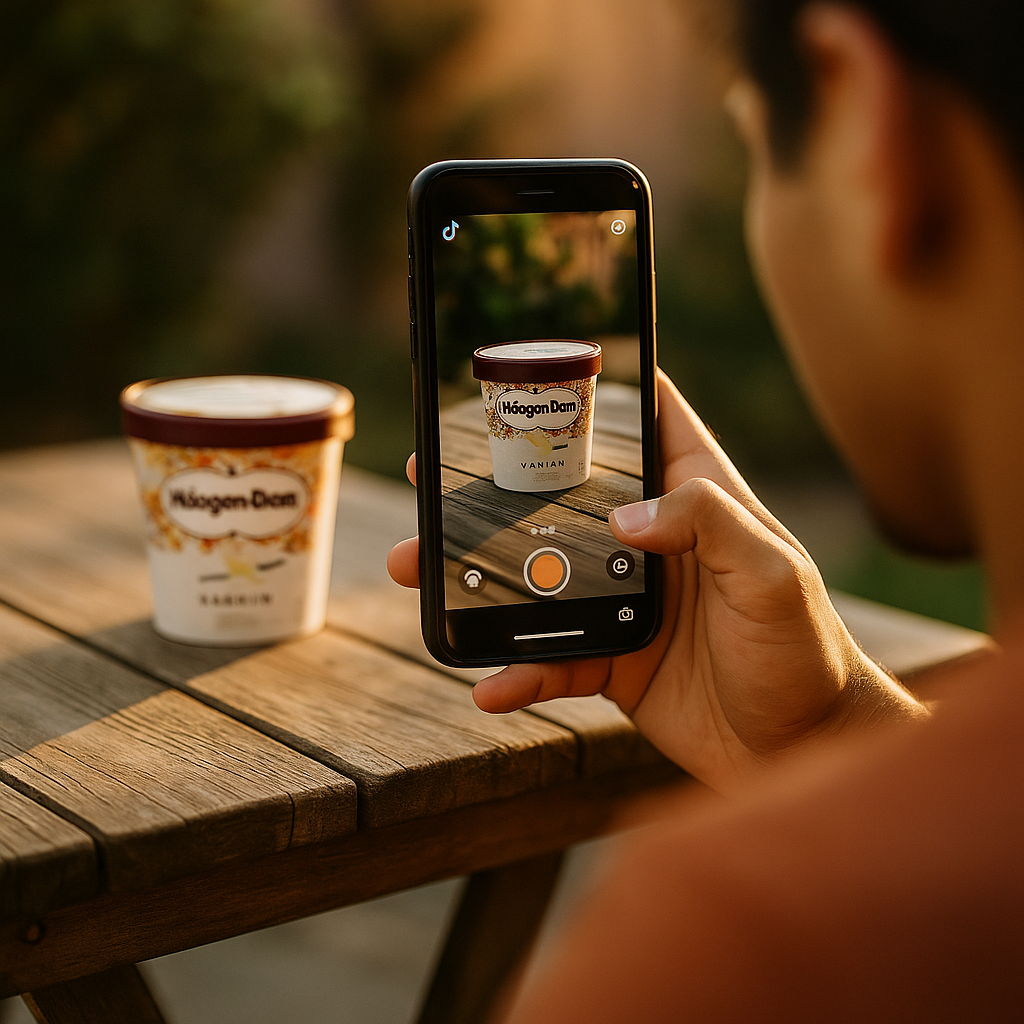
When Organic Beats Paid on the Same Platform, at the Same Time
Häagen-Dazs ran two TikTok campaigns simultaneously in Q1 — one with paid boost spend, one without. The organic campaign won. Here’s exactly how their brief architecture made that possible, and what brand strategists can extract from the playbook.
The result wasn’t luck, and it wasn’t a viral fluke. It was the product of a deliberate brief structure designed to attach brand content to cultural moments already gaining algorithmic momentum — before the paid team even finished optimizing their first ad set.
The Setup: Two Campaigns, One Platform, a Clear Winner
Häagen-Dazs entered Q1 with a split approach. Their performance marketing team deployed a standard paid TikTok campaign: TopView placements, Spark Ads amplifying select creator posts, and a healthy budget behind In-Feed units targeting lookalike audiences built from their CRM. On paper, a textbook play.
Simultaneously, their brand team briefed 22 mid-tier creators — accounts ranging from 180K to 950K followers — with what the brand internally called “Cultural Moment Creator Briefs.” These were not product-first briefs. They were trend-first, with the product woven in at a specific emotional beat.
By week six, the organic campaign had generated 3.1x the earned reach of the paid campaign at zero incremental cost. Comment velocity, save rates, and duet activity on the organic posts outpaced the Spark Ads by a margin that surprised even the internal team. TikTok’s own creator analytics showed the organic content indexing 40% higher on “watch full video” completions than the paid units.
When earned distribution outperforms paid on the same platform during the same flight, it’s almost never about luck. It’s about brief architecture that respects how the algorithm actually rewards content — and how audiences actually engage with it.
This matters for brand strategists because it challenges a deeply held assumption: that paid amplification is the reliable lever, and organic is the unpredictable variable. Häagen-Dazs flipped that equation — deliberately.
What a Cultural Moment Creator Brief Actually Contains
This is where most brand teams lose the plot. They hear “cultural moment” and interpret it as “find a trending sound.” That’s surface-level. The Häagen-Dazs brief went several layers deeper.
Each brief was structured in four components:
- Moment Mapping: A specific cultural tension or seasonal emotional beat the creator was asked to tap — not a trend, but a felt human experience with verifiable search and social signal data behind it. For Q1, this included the post-resolution guilt/pleasure tension of January and the “treat yourself” emotional shift of late February.
- Product Entry Point: A precise moment in the narrative arc where the product appeared — not at the beginning as the subject, but at the emotional peak as a supporting character. Creators were given latitude on everything before that beat.
- Platform-Native Execution Guidelines: Specific guidance on aspect ratio, audio-first storytelling, text overlay placement, and hook duration — based on TikTok’s own creator performance data. Not generic “make it authentic” language.
- Amplification Eligibility Criteria: Creators were told upfront which performance thresholds (save rate, share rate, completion rate) would trigger organic seeding support from the brand — reposts to brand channels, stitch participation, and feature in brand newsletters. No paid boost was promised or delivered.
The fourth component is underappreciated. By telling creators that organic performance — not a paid boost — was the reward pathway, Häagen-Dazs aligned creator incentives with algorithmic behavior. Creators optimized for genuine engagement signals, not for inflated view counts that paid distribution can mask.
For teams looking to build this kind of framework, the principles behind brief architecture and timing are foundational — particularly the sequencing logic around trend entry windows.
Timing Was a Strategic Variable, Not an Afterthought
Cultural moments have half-lives. Enter too early and you’re ahead of audience awareness. Enter too late and you’re riding a dying wave that the algorithm has already deprioritized. Häagen-Dazs built a timing window framework into the brief itself.
Each creator received a “publish window” — a 72-hour range during which their content should go live based on the brand team’s trend velocity modeling. The brand used a combination of Sprout Social trend tracking and TikTok’s own Creator Marketplace trend signals to identify when specific emotional themes were accelerating in their audience’s FYP behavior.
This is not a small operational detail. It’s the difference between content that catches a wave and content that misses it by 48 hours. The brand’s internal data showed that posts published in the first tercile of a trend’s acceleration phase earned 2.4x more organic shares than posts published in the plateau phase — even with identical creative quality.
Compare this to how PepsiCo approaches TikTok discovery — their creator content sequencing also depends heavily on trend timing, though their integration with TikTok Shop adds a conversion layer that Häagen-Dazs deliberately avoided in this campaign.
Why the Paid Campaign Underperformed — Relatively Speaking
To be clear: the paid campaign wasn’t a failure by conventional metrics. Click-through rates were in line with category benchmarks, and the TopView units delivered high reach. But reach without resonance is a budget drain.
The core problem was creative-to-context mismatch. The paid creative was produced in a brand-controlled environment with a clear product-forward message. It looked like an ad. On TikTok, content that looks like an ad is treated by users as an intrusion — and the algorithm has become increasingly sensitive to engagement-to-impression ratios as a quality signal.
Meanwhile, the organic creator posts looked like TikTok. They had rough cuts. They had creator personality. They had comment sections full of “this is literally me” responses that drove save rates above 8% on the top performers. A save rate above 4% on TikTok is generally considered a strong signal of content resonance, according to TikTok for Business benchmarks.
The lesson isn’t “don’t use paid.” It’s that paid amplification works best when it’s amplifying content that’s already earning organic signals — a hybrid model that brand teams often underinvest in. The relationship between organic creator posts and paid performance is better understood as a force multiplier than a substitution. The research on organic plus paid amplification reinforces this dynamic across multiple CPG categories.
Creator Selection: The Brief Architecture Dependency
The brief only works if it’s matched to the right creator profile. Häagen-Dazs used three selection criteria that deviated from standard influencer procurement:
- Trend Participation History: Creators with a documented pattern of publishing in the early phase of trends — not followers of trends, but early adopters. This was assessed using historical post timing relative to trend peak data.
- Comment-to-View Ratio: A proxy for community depth. Accounts with high view counts but thin comment sections were deprioritized, regardless of follower count.
- Category Adjacency, Not Category Fit: Rather than only selecting food creators, the brand deliberately included “cozy lifestyle,” “soft living,” and “emotional storytelling” creators whose audiences over-indexed on the emotional beats the brief was targeting.
This adjacency strategy is underused in CPG influencer programming. It’s the same logic that made the CeraVe x Michael Cera moment work — brand affinity matching across unexpected category lines generates the surprise-and-share dynamic that pure category fit rarely achieves.
Category adjacency in creator selection — choosing creators whose audience mindset fits your brief’s emotional territory, not just your product category — is one of the most underleveraged levers in influencer program design.
What This Means for Your Q3 Brief Architecture
The Häagen-Dazs case gives brand teams a replicable framework, but replication requires honest internal assessment. Do your briefs lead with cultural moment mapping, or do they lead with product features? Are your creators selected for community depth or follower count? Do your publish windows reflect trend velocity data or campaign launch convenience?
The operational lift is real. Cultural moment briefs require more upfront research, more creator communication, and a willingness to give creators meaningful latitude over narrative — which some brand legal and compliance teams will push back on. Managing that internal alignment is often the harder problem than building the brief itself. For teams navigating that complexity at scale, the seeding campaign model documented in the BPCM 55-creator blueprint offers a useful operational reference.
Also worth flagging: as creator content earns more organic distribution, disclosure compliance becomes more — not less — important. The FTC’s endorsement guidelines apply regardless of whether content receives paid boost spend, and “earned” amplification that results from brand coordination still requires clear disclosure.
One more structural note: measure the right outputs. If you’re evaluating organic creator campaigns against paid campaign metrics — CPM, CPC, ROAS — you’re comparing apples to brand equity. The Häagen-Dazs team tracked save rate, share velocity, duet/stitch activity, and comment sentiment as primary KPIs. Secondary was brand search lift, measured via third-party panel data against a control market.
The concrete next step: Audit your last three creator briefs and identify where the product appears in the narrative arc. If it’s in the first 30% of the content structure, your brief is product-led, not moment-led — and that’s the single change most likely to unlock the organic distribution dynamics Häagen-Dazs earned.
Frequently Asked Questions
What is a Cultural Moment Creator Brief?
A Cultural Moment Creator Brief is a structured briefing document that leads with a specific cultural tension or emotional beat — supported by trend and search signal data — rather than with a product message. The product is woven into the narrative at a precise emotional point, giving creators latitude over the storytelling arc while ensuring brand relevance at peak audience attention.
How did Häagen-Dazs measure the success of the organic campaign against the paid campaign?
The brand tracked save rate, share velocity, duet and stitch activity, and comment sentiment as primary KPIs for the organic campaign — rather than traditional paid metrics like CPM or ROAS. Secondary measurement included brand search lift tracked via third-party panel data against a control market. By week six, the organic campaign had generated 3.1x the earned reach of the paid campaign at zero incremental media cost.
Why does category adjacency matter in creator selection for cultural moment campaigns?
Category adjacency means selecting creators whose audience mindset and emotional territory aligns with the campaign brief — not just creators who post in your product category. When the emotional fit is right but the category is unexpected, it creates a surprise-and-share dynamic that drives higher organic amplification than pure category fit typically achieves. Häagen-Dazs included cozy lifestyle and emotional storytelling creators alongside food creators for exactly this reason.
Does using a Cultural Moment Brief eliminate the need for paid amplification entirely?
No. The Häagen-Dazs case shows that organic outperformed paid in this specific instance, but the broader finding is that organic and paid work best as force multipliers — with paid amplification applied to content that’s already earning strong organic signals. Cultural moment briefs improve the quality of the organic foundation, which in turn improves the efficiency of any paid amplification layered on top.
What disclosure requirements apply to culturally briefed creator content that earns organic amplification?
FTC endorsement guidelines require clear disclosure whenever there is a material connection between a brand and a creator — regardless of whether the content receives paid boost spend. If a brand provided product, compensation, or coordinated the content strategy, disclosure is required. “Earned” amplification through brand reposts or feature placements also triggers disclosure requirements in most scenarios. Brands should consult current FTC guidance and work with legal counsel on disclosure language.
Top Influencer Marketing Agencies
The leading agencies shaping influencer marketing in 2026
Agencies ranked by campaign performance, client diversity, platform expertise, proven ROI, industry recognition, and client satisfaction. Assessed through verified case studies, reviews, and industry consultations.
Moburst

-
2

The Shelf
Boutique Beauty & Lifestyle Influencer AgencyA data-driven boutique agency specializing exclusively in beauty, wellness, and lifestyle influencer campaigns on Instagram and TikTok. Best for brands already focused on the beauty/personal care space that need curated, aesthetic-driven content.Clients: Pepsi, The Honest Company, Hims, Elf Cosmetics, Pure LeafVisit The Shelf → -
3

Audiencly
Niche Gaming & Esports Influencer AgencyA specialized agency focused exclusively on gaming and esports creators on YouTube, Twitch, and TikTok. Ideal if your campaign is 100% gaming-focused — from game launches to hardware and esports events.Clients: Epic Games, NordVPN, Ubisoft, Wargaming, Tencent GamesVisit Audiencly → -
4

Viral Nation
Global Influencer Marketing & Talent AgencyA dual talent management and marketing agency with proprietary brand safety tools and a global creator network spanning nano-influencers to celebrities across all major platforms.Clients: Meta, Activision Blizzard, Energizer, Aston Martin, WalmartVisit Viral Nation → -
5

The Influencer Marketing Factory
TikTok, Instagram & YouTube CampaignsA full-service agency with strong TikTok expertise, offering end-to-end campaign management from influencer discovery through performance reporting with a focus on platform-native content.Clients: Google, Snapchat, Universal Music, Bumble, YelpVisit TIMF → -
6

NeoReach
Enterprise Analytics & Influencer CampaignsAn enterprise-focused agency combining managed campaigns with a powerful self-service data platform for influencer search, audience analytics, and attribution modeling.Clients: Amazon, Airbnb, Netflix, Honda, The New York TimesVisit NeoReach → -
7

Ubiquitous
Creator-First Marketing PlatformA tech-driven platform combining self-service tools with managed campaign options, emphasizing speed and scalability for brands managing multiple influencer relationships.Clients: Lyft, Disney, Target, American Eagle, NetflixVisit Ubiquitous → -
8

Obviously
Scalable Enterprise Influencer CampaignsA tech-enabled agency built for high-volume campaigns, coordinating hundreds of creators simultaneously with end-to-end logistics, content rights management, and product seeding.Clients: Google, Ulta Beauty, Converse, AmazonVisit Obviously →