


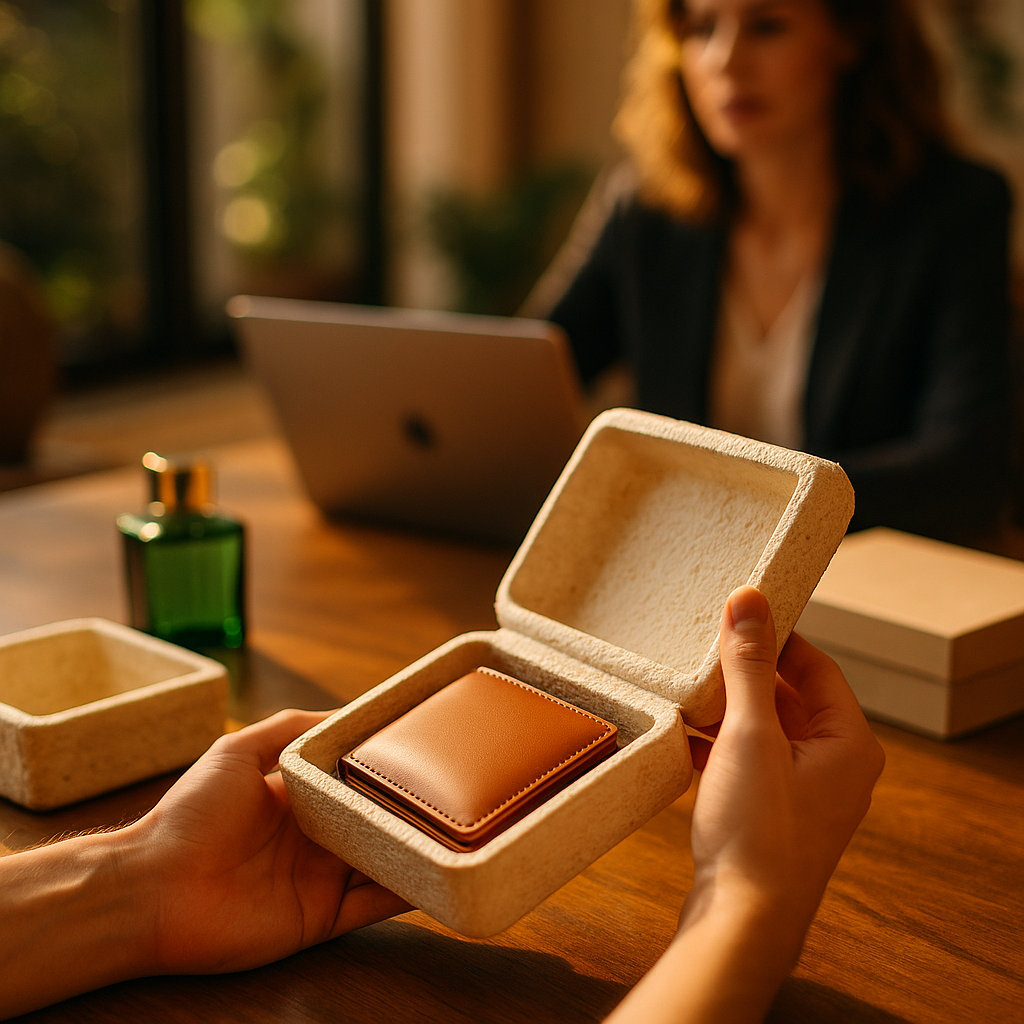
Luxury brands no longer treat packaging as an afterthought. This case study on mycelium packaging shows how Ecovative turned a bio-based material into a premium business advantage, winning high-end clients that demand performance, aesthetics, and sustainability. By pairing material science with sharp market positioning, Ecovative proved that protective packaging can also elevate brand value. So what made luxury buyers say yes?
What Is Mycelium Packaging and Why Luxury Brands Notice Sustainable Packaging
Mycelium packaging is a molded protective material grown from the root-like structure of fungi. Ecovative developed a process that combines agricultural byproducts with mycelium, allowing the material to grow into custom packaging forms. After growth, the product is heat-treated to stop further development, creating a lightweight, compostable structure designed to protect goods during shipping and handling.
For luxury clients, the appeal goes beyond eco-friendly messaging. Premium brands need packaging that communicates quality at first touch. Traditional foam often looks cheap, feels generic, and creates waste that clashes with the values of modern affluent consumers. Ecovative’s mycelium solution offered a different proposition: a tactile, natural material with a distinctive look and a credible environmental story.
That combination matters in 2026 because high-end buyers increasingly expect brands to reduce waste without lowering standards. Sustainability claims now face closer scrutiny from retailers, media, and consumers. A luxury brand cannot afford “green” packaging that underperforms or appears performative. Ecovative positioned mycelium packaging as a material innovation first and a sustainability solution second. That sequence helped attract serious decision-makers.
From an EEAT perspective, this matters because the strongest packaging partnerships are built on demonstrated expertise, not vague promises. Ecovative’s value came from technical know-how, manufacturing capability, and real-world fit for premium applications. Luxury procurement teams want evidence that a new material can survive supply chain pressures, protect fragile products, and reinforce the brand image. Ecovative answered those concerns directly.
How Ecovative Built a Luxury Packaging Case Through Material Innovation
Ecovative did not win luxury clients simply by saying mycelium is compostable. It won them by engineering a packaging experience that solved multiple business problems at once. Luxury companies often need custom protective inserts, premium unboxing, reduced environmental impact, and a credible innovation narrative for stakeholders. Ecovative’s platform aligned with all four.
The company’s core advantage was material control. Instead of adapting a mass-market packaging product to premium use, Ecovative designed growth-based packaging around custom molds. That allowed luxury brands to create inserts and forms tailored to bottles, cosmetics, electronics, home goods, or fragile accessories. Precision matters in luxury because a loose fit signals carelessness, while a snug, purpose-built insert signals craftsmanship.
Equally important, Ecovative offered a sensory difference. Mycelium packaging has an organic texture and matte finish that can feel intentional rather than industrial. For a luxury client, that can support a narrative around natural ingredients, artisanal quality, design-led sustainability, or innovation leadership. The packaging becomes part of the product story instead of an invisible shipping necessity.
Ecovative also benefited from timing. As regulations tightened around plastic and retailers pushed suppliers toward lower-impact packaging, premium brands had stronger incentives to explore alternatives. But many alternatives looked too plain, too flimsy, or too close to commodity paper pulp. Mycelium stood out because it felt new and category-defining.
In practical terms, Ecovative’s luxury case likely rested on these points:
- Performance: cushioning and protection for delicate or high-value products
- Customization: molded forms that match product dimensions and presentation goals
- Brand differentiation: an uncommon material with strong visual and narrative value
- End-of-life advantage: compostability and reduced dependence on petrochemical foams
- Credibility: a science-driven manufacturing process rather than a superficial sustainability claim
This is a useful lesson for any materials startup. Luxury buyers do not purchase novelty. They purchase risk-reduced innovation that makes their brand stronger.
Why Eco-Friendly Packaging Helped Ecovative Win High-End Accounts
Luxury packaging decisions rarely come from one department. Design, procurement, operations, legal, sustainability, and brand leadership often all weigh in. Ecovative’s success came from offering benefits each stakeholder could defend.
For brand teams, eco-friendly packaging helped communicate modern values without sacrificing sophistication. In premium categories, customers notice packaging waste. Oversized boxes, plastic inserts, and foam blocks can undermine a brand’s promise, especially if the product itself is positioned as refined or responsible. Mycelium packaging gave luxury clients a way to reduce that contradiction.
For sustainability teams, Ecovative offered a stronger story than many recycled-content claims. Compostable, bio-based packaging is easier to explain and often easier to celebrate in reports, campaigns, and product pages. That does not remove the need for precise language about disposal conditions, but it gives brands a clearer route to measurable progress.
For operations and procurement, the argument had to be stronger. Sustainable materials do not win if they raise breakage rates, increase complexity, or damage margins. Ecovative’s path into luxury likely depended on proving that mycelium inserts could protect products reliably while fitting into fulfillment workflows. Premium goods often have higher average order value, so avoiding damage is essential. A premium package that fails in transit is expensive twice: first in replacement cost, then in brand damage.
For executives, there was strategic upside. Luxury markets reward distinction. When many competitors still rely on conventional inserts, adopting a visibly different packaging material can position a brand as an innovator. That matters in earned media, social content, retail storytelling, and investor communications. Ecovative’s offer was not just “less bad” packaging. It was packaging that could help premium brands lead.
That is a major reason the company could attract high-end clients. It translated environmental innovation into commercial language each stakeholder understood.
Brand Storytelling and Luxury Packaging Design: The Hidden Sales Driver
One of the most underappreciated reasons Ecovative appealed to luxury clients is storytelling power. Packaging in premium segments is not only functional. It is theatrical. The material, weight, texture, reveal, and disposal experience all shape how customers perceive the product.
Mycelium packaging gave luxury brands a rare storytelling asset: the package itself could embody the brand’s values. A skincare company could tie natural ingredients to a naturally grown insert. A spirits brand could frame the package as a fusion of craft and science. A premium home goods label could show that design excellence extends to every layer of fulfillment, not only the product itself.
This narrative value matters because luxury buyers increasingly discover and evaluate brands across digital channels before they ever touch the product. Packaging appears in unboxing videos, social posts, PR photography, product pages, and review content. Distinctive sustainable packaging can therefore influence demand before the shipment arrives. Ecovative’s material was visually and conceptually different enough to earn attention.
Just as important, the material supported authenticity. Consumers are now better at spotting shallow sustainability marketing. If a luxury brand claims environmental responsibility but ships items in plastic-heavy protective foam, the contradiction is obvious. Mycelium packaging helps close that gap. When the outer message and inner packaging align, trust rises.
Luxury packaging design also benefits from constraints. A brand cannot clutter the experience with excessive text or moralizing. The best premium sustainability signals are subtle and confident. Ecovative’s packaging could work that way. Its appearance already suggested material integrity and innovation, reducing the need for overexplaining. That is especially useful in high-end markets where understatement often performs better than overt persuasion.
In other words, Ecovative sold more than packaging units. It sold a credible, design-compatible story that luxury clients could use across channels.
Lessons From Ecovative for Premium Brands Seeking Circular Packaging
This case study offers practical lessons for brands exploring circular packaging or alternative materials.
- Lead with performance, then sustainability. Procurement teams will not move on values alone. Show drop-test results, fit accuracy, transit reliability, and production consistency first.
- Make the material part of the brand experience. If the new packaging looks generic, it will struggle in luxury. The material should enhance the unboxing moment and reinforce the product’s positioning.
- Answer disposal questions clearly. Compostability claims must be precise. Tell customers what the material is, how to dispose of it, and what conditions matter. That protects trust.
- Build cross-functional support early. Sustainability, design, operations, and finance all need a reason to approve the switch. Tailor the case for each group.
- Use pilots to reduce adoption risk. Start with a limited product line, seasonal release, or flagship SKU. A controlled rollout makes testing easier and gives internal teams proof before scaling.
- Quantify the business value. Track breakage rates, customer feedback, earned media, social mentions, retailer response, and sustainability metrics. Premium innovation needs measurable outcomes.
Ecovative’s path also highlights a broader truth about circular packaging: the best materials win when they solve emotional and operational needs together. Luxury brands need beauty, protection, and credibility. Mycelium packaging addressed all three more effectively than many “green” substitutes.
Brands should also ask a sensible follow-up question: can this approach scale? The answer depends on product type, geography, supply chain demands, and supplier capacity. Not every luxury product is suited to mycelium inserts. But Ecovative showed that alternative materials can move beyond niche pilots when they are engineered for real commercial use.
What This Sustainable Materials Case Study Means for the Future of Packaging
By winning luxury clients, Ecovative helped change how the market evaluates sustainable materials. The old assumption was that eco-friendly packaging belonged to niche, low-budget, or overtly “green” brands. This case suggests the opposite. When done well, sustainable materials can signal innovation, taste, and premium quality.
That shift matters far beyond the luxury segment. High-end adoption often acts as a credibility filter for the broader market. If demanding premium brands trust a new material with expensive products and brand-sensitive customers, mainstream companies pay attention. Luxury can therefore function as a proving ground for packaging innovation.
Ecovative’s example also reflects a larger market direction in 2026: businesses want materials with a stronger end-of-life story, but they do not want to compromise on protection or presentation. Suppliers that can deliver both will capture the strongest opportunities. Those that focus only on environmental claims will struggle.
For decision-makers, the takeaway is practical. Sustainable packaging becomes easier to justify when it improves the brand experience, reduces reputational risk, and creates a point of difference competitors cannot copy overnight. Ecovative did not win by being worthy. It won by being useful, distinctive, and credible.
That is why this case remains relevant. It shows how material science, brand strategy, and sustainability can reinforce each other when execution is strong.
FAQs About Mycelium Packaging, Ecovative, and Luxury Clients
What is mycelium packaging made from?
Mycelium packaging is typically made by growing fungal mycelium through agricultural waste or plant-based fibers inside molds. The growth binds the biomass into a solid form that is later dried or heat-treated for use as protective packaging.
Why would luxury brands choose mycelium packaging over foam?
Luxury brands choose mycelium packaging because it can offer custom protection, a more premium and natural look, and a stronger sustainability story. It also helps align packaging with modern consumer expectations around waste reduction and responsible design.
Is mycelium packaging durable enough for premium products?
It can be, depending on product weight, shape, fragility, and shipping conditions. Brands should validate performance through testing, including transit and drop tests, before full rollout. Ecovative’s success with luxury clients suggests that, for the right applications, performance can meet premium standards.
Is mycelium packaging compostable?
Many mycelium packaging products are designed to be compostable, but brands should confirm disposal guidance for the specific product and region. Clear customer instructions are important to avoid confusion and support credible sustainability claims.
How did Ecovative make mycelium packaging feel premium?
Ecovative helped make it feel premium by combining custom molded protection with a distinctive organic texture and a compelling innovation story. For luxury buyers, the package looked intentional and design-led rather than merely eco-friendly.
What can other brands learn from Ecovative’s approach?
Other brands can learn to sell sustainable packaging through business outcomes, not slogans. Focus on product protection, customization, operational fit, customer experience, and measurable brand value. Sustainability works best when it strengthens the full packaging proposition.
Luxury packaging is now a strategic lever, not a finishing touch. Ecovative showed that mycelium packaging could win premium clients by combining material performance, brand storytelling, and credible sustainability in one solution. The clearest takeaway is simple: alternative packaging succeeds when it protects the product, strengthens the brand, and makes environmental progress feel tangible rather than theoretical.
Top Influencer Marketing Agencies
The leading agencies shaping influencer marketing in 2026
Agencies ranked by campaign performance, client diversity, platform expertise, proven ROI, industry recognition, and client satisfaction. Assessed through verified case studies, reviews, and industry consultations.
Moburst

-
2

The Shelf
Boutique Beauty & Lifestyle Influencer AgencyA data-driven boutique agency specializing exclusively in beauty, wellness, and lifestyle influencer campaigns on Instagram and TikTok. Best for brands already focused on the beauty/personal care space that need curated, aesthetic-driven content.Clients: Pepsi, The Honest Company, Hims, Elf Cosmetics, Pure LeafVisit The Shelf → -
3

Audiencly
Niche Gaming & Esports Influencer AgencyA specialized agency focused exclusively on gaming and esports creators on YouTube, Twitch, and TikTok. Ideal if your campaign is 100% gaming-focused — from game launches to hardware and esports events.Clients: Epic Games, NordVPN, Ubisoft, Wargaming, Tencent GamesVisit Audiencly → -
4

Viral Nation
Global Influencer Marketing & Talent AgencyA dual talent management and marketing agency with proprietary brand safety tools and a global creator network spanning nano-influencers to celebrities across all major platforms.Clients: Meta, Activision Blizzard, Energizer, Aston Martin, WalmartVisit Viral Nation → -
5

The Influencer Marketing Factory
TikTok, Instagram & YouTube CampaignsA full-service agency with strong TikTok expertise, offering end-to-end campaign management from influencer discovery through performance reporting with a focus on platform-native content.Clients: Google, Snapchat, Universal Music, Bumble, YelpVisit TIMF → -
6

NeoReach
Enterprise Analytics & Influencer CampaignsAn enterprise-focused agency combining managed campaigns with a powerful self-service data platform for influencer search, audience analytics, and attribution modeling.Clients: Amazon, Airbnb, Netflix, Honda, The New York TimesVisit NeoReach → -
7

Ubiquitous
Creator-First Marketing PlatformA tech-driven platform combining self-service tools with managed campaign options, emphasizing speed and scalability for brands managing multiple influencer relationships.Clients: Lyft, Disney, Target, American Eagle, NetflixVisit Ubiquitous → -
8

Obviously
Scalable Enterprise Influencer CampaignsA tech-enabled agency built for high-volume campaigns, coordinating hundreds of creators simultaneously with end-to-end logistics, content rights management, and product seeding.Clients: Google, Ulta Beauty, Converse, AmazonVisit Obviously →