


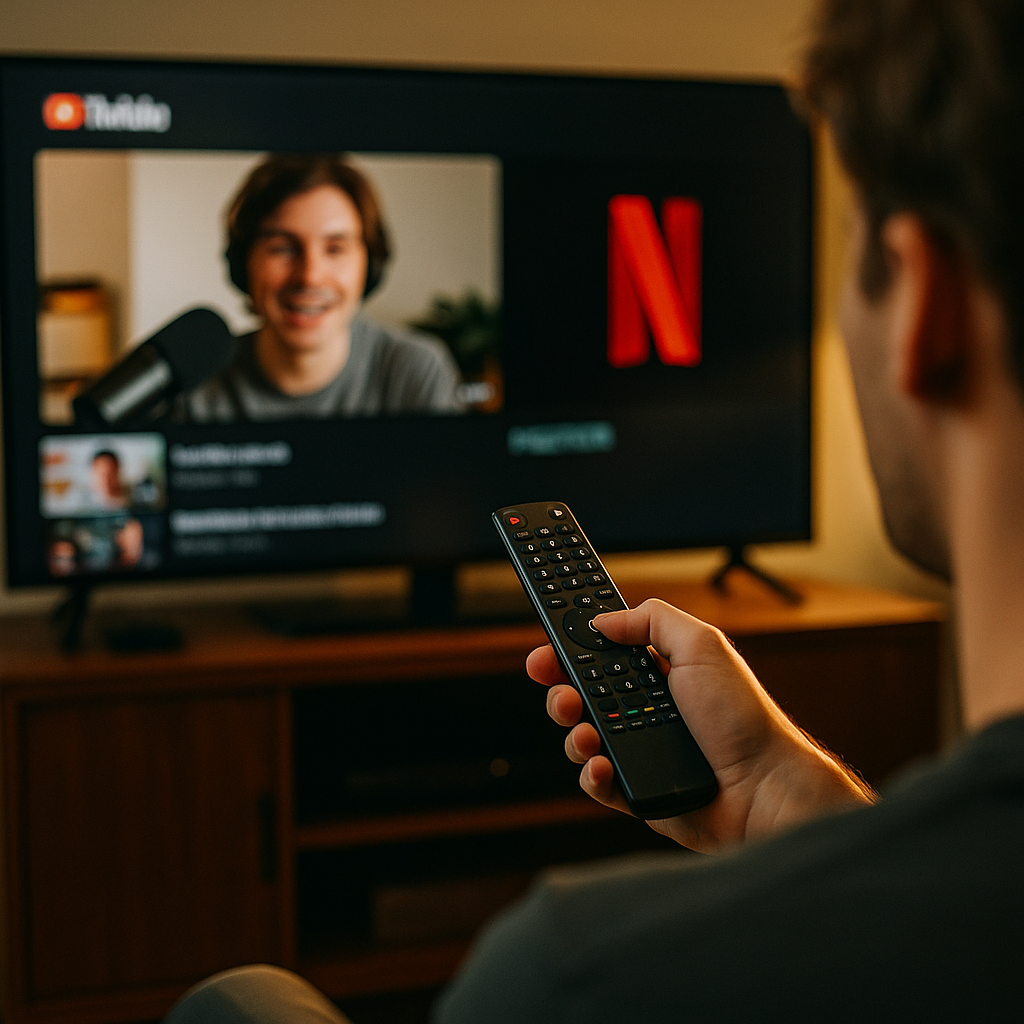
Netflix spends roughly $17 billion annually on content. Your brand’s YouTube creator partner is competing for the same viewer attention — and most brand briefs still treat that creator like a billboard. That’s the core problem with how brands currently approach the YouTube creator economy.
The Real Competition Isn’t Other Brands
When a viewer opens YouTube on their TV at 9 PM, they’re not choosing between your brand’s sponsored video and a competitor’s sponsored video. They’re choosing between your creator partner’s video and a new season of Squid Game. That reframe changes everything about how you should write a creator brief.
Most brand briefs optimize for compliance and message delivery. They specify logo placement, mention windows, CTA timing, and product shot requirements. What they don’t specify is: why would someone choose to watch this instead of something else?
YouTube has crossed 1 billion hours of daily watch time, with over 45% now consumed on TV screens according to Google’s own platform data. The lean-back, appointment-viewing behavior that defined network television has migrated — and it’s landed on YouTube channels with dedicated subscriber bases and serialized content formats. Brands that understand this are extracting disproportionate value from their creator partnerships.
A creator brief that doesn’t answer “why would someone choose to watch this?” is optimizing for compliance, not competition. In a lean-back YouTube environment, compliance doesn’t hold attention — entertainment value does.
What “Competing for Audience Time” Actually Means in a Brief
The shift isn’t about production budget. MrBeast doesn’t outperform Netflix in certain demographics because he spends more — he outperforms because his content structure is engineered around viewer retention loops, not message delivery schedules.
Brands need to brief creators on entertainment architecture, not just brand architecture. That means the brief should address:
- Content premise tension: What is the core conflict, challenge, or question that makes a viewer want to see how it resolves? This is what streaming platforms call a “hook.” Your brief should require one.
- Serial value: Does this video reward returning subscribers, or is it a standalone ad? The most valuable YouTube channels create continuity — briefs should encourage episode structures that build anticipation.
- Pacing benchmarks: Specify expected average view duration targets, not just view count. A 20-minute video with 65% average watch time is vastly more valuable than a 6-minute video with 30% retention.
- Authentic creator voice protection: The single fastest way to tank retention is to force a creator to sound like a brand press release. Briefs should define the brand’s non-negotiables narrowly and leave creative execution wide open.
For teams building out brief frameworks across formats, the principles behind emotional engagement briefs translate directly to long-form YouTube — the emotional hook is just sustained over a longer arc.
Why YouTube’s Algorithm Rewards Entertainment Quality Over Ad Compliance
YouTube’s recommendation engine doesn’t care about your brand’s messaging hierarchy. It cares about click-through rate, watch time, satisfaction surveys, and return visits. Content that feels like an ad — even a well-produced one — consistently underperforms on all four signals.
This creates a structural misalignment. Brands brief for brand safety and message delivery. The algorithm rewards entertainment and engagement. The creator sits in the middle, often forced to produce content that satisfies the brand brief but loses the audience that makes the partnership valuable in the first place.
Sophisticated brand teams are resolving this by inverting the brief structure. Instead of starting with “here are our brand requirements,” they start with “here is the entertainment problem we want to help this creator solve.” That might mean funding a more ambitious production that the creator couldn’t afford independently, or providing access and exclusivity — a behind-the-scenes factory tour, an early product — that creates genuine storytelling value.
The format prioritization framework matters here too: long-form YouTube isn’t interchangeable with Shorts or Reels, and brands that treat them as the same format are wasting creator relationships built on lean-back viewing behavior.
The Brief Structure That Actually Works
Here’s what a streaming-competitive YouTube creator brief looks like in practice. Strip out the boilerplate and build around five components:
- Audience problem statement: What does this creator’s audience care about that your brand has a credible, interesting angle on? Not what does your brand want to say — what does the audience want to understand, experience, or feel?
- Entertainment premise: What is the video’s “show concept”? Challenge format, documentary, experiment, serialized build — pick a structure that creates intrinsic watch motivation.
- Brand integration boundaries (not requirements): Define what the brand cannot do (false claims, off-brand tone, restricted claims) and leave the integration method to the creator. Integration that feels earned by the narrative performs significantly better than scripted reads.
- Success metrics aligned to platform behavior: Watch time percentage, subscriber growth on the video, comment sentiment, and return viewer rate — not just impressions and reach.
- Rights and repurposing scope: If content competes for streaming-level attention, it has streaming-level shelf life. Brief for evergreen reusability, not a 30-day campaign window.
This structure also produces content with better downstream utility. AI-optimized content structure benefits from the same depth and narrative coherence that makes YouTube videos retain viewers — content that holds attention also holds context that AI retrieval systems can surface.
The brands winning on YouTube in a streaming-competitive environment aren’t buying ad inventory inside creator content. They’re co-producing content that audiences would watch even if the brand name were removed — and then integrating naturally because they earned that placement through the storytelling itself.
Measuring Success at the Channel Level, Not the Campaign Level
Campaign-level measurement is the enemy of channel-competitive content. When you measure a YouTube creator partnership by a single video’s campaign lift metrics, you’re treating a TV show like a commercial. The value compounds differently.
Channel-level metrics to track alongside standard campaign KPIs:
- Subscriber velocity during and after the partnership
- Average view duration trend across brand-integrated vs. non-integrated videos
- Comment quality and brand mention sentiment (qualitative but significant)
- Cross-video viewer return rate — are people who watched the brand video coming back for the next one?
Brands that invest in a creator’s channel health — not just their own campaign metrics — get preferential integration treatment, better creative collaboration, and audience associations that compound over time. CPM comparisons across formats consistently show that long-form YouTube’s cost per engaged hour remains undervalued relative to the depth of attention it commands.
One practical move: ask for access to YouTube Studio analytics at the channel level, not just post-campaign reports. YouTube’s creator analytics surface audience retention graphs, re-watch behavior, and traffic source data that tell you whether your content competed — or was skipped.
The Contractual and Compliance Angle Brands Ignore
Longer-form, higher-production-value content creates different compliance exposure than a 60-second Reels integration. FTC disclosure requirements apply consistently, but the execution differs — a 20-minute video needs disclosure at the start, not buried after 15 minutes of entertainment. Brief this explicitly.
Rights clauses also need updating. If you’re briefing for streaming-competitive content, you likely want extended licensing windows, TV rights for connected TV distribution, and potentially the ability to run the content as paid media. Most standard influencer contracts aren’t written for this — and most legal teams haven’t been briefed that the content strategy has changed. Align these before the brief goes out.
Teams managing creator content across multiple channels and formats will find that the quality signal frameworks that convert younger audiences apply directly here — Gen Z in particular expects YouTube content to earn their time, not demand it.
The Operational Shift Required
This approach requires brand teams to operate more like content studios and less like media buyers. That’s uncomfortable for some organizations. It means longer lead times, more creative collaboration, less control over final output, and different success metrics conversations with stakeholders.
But the alternative — continuing to brief YouTube creators like banner ad vendors while Netflix, Prime Video, and Max compete for the same eyeballs — means paying for diminishing attention in a market that is actively rewarding quality. eMarketer’s connected TV data confirms that digital video and streaming are now in direct audience-time competition, and brands sitting on the ad-inventory side of that equation are losing ground fast.
The next brief you send to a YouTube creator partner should answer one question before it addresses anything else: why would a person choose to watch this instead of their next streaming episode? If your brief can’t answer that, revise it before it leaves your desk.
Frequently Asked Questions
How is briefing a YouTube creator for channel content different from a standard influencer brief?
A standard influencer brief typically centers on brand message delivery, compliance requirements, and campaign metrics like reach and impressions. A channel-content brief for YouTube focuses on entertainment architecture — the premise, retention hooks, and serial value that make someone choose to watch and return. It treats the creator as a content studio partner, not a media placement vehicle, and measures success at the channel level over time rather than per-campaign.
What metrics should brands use to evaluate YouTube creator content that competes with streaming?
Beyond standard campaign metrics, brands should track average view duration percentage (aiming for 50%+ on long-form content), subscriber velocity during the partnership, return viewer rate across videos, and comment sentiment quality. These signals indicate whether the content earned audience time rather than simply receiving it through algorithmic delivery.
How should brand integration be handled in entertainment-first YouTube content?
Brand integration should be earned by the narrative, not inserted on a schedule. The brief should define narrow non-negotiables — claims that cannot be made, off-brand tones to avoid, mandatory disclosures — while leaving the integration method to the creator. Integrations that flow from the story (a product genuinely used in a challenge, a service that solves the video’s problem) consistently outperform scripted reads in both retention and brand recall.
Does this approach work for smaller YouTube creators, or only for large channels?
The entertainment-first briefing approach works at any audience size, but the execution scales differently. Smaller creators with highly engaged niche audiences often have stronger lean-back viewing behavior and community loyalty than larger generalist channels. The key is matching the creator’s existing content format and audience expectations — a mid-tier educational creator with 200K subscribers can produce streaming-competitive content that outperforms a 2M-subscriber creator whose content is structured around short viral moments.
What rights and licensing considerations apply when producing streaming-competitive YouTube content?
Standard influencer contracts typically cover 30-90 day usage windows and social media distribution only. Streaming-competitive content requires extended licensing windows (12-24 months minimum), connected TV and paid media distribution rights, and potentially cross-platform syndication clauses. FTC disclosure requirements apply regardless of content length — for videos over 5 minutes, disclosure should appear prominently at the start of the video, not embedded mid-content.
Top Influencer Marketing Agencies
The leading agencies shaping influencer marketing in 2026
Agencies ranked by campaign performance, client diversity, platform expertise, proven ROI, industry recognition, and client satisfaction. Assessed through verified case studies, reviews, and industry consultations.
Moburst

-
2

The Shelf
Boutique Beauty & Lifestyle Influencer AgencyA data-driven boutique agency specializing exclusively in beauty, wellness, and lifestyle influencer campaigns on Instagram and TikTok. Best for brands already focused on the beauty/personal care space that need curated, aesthetic-driven content.Clients: Pepsi, The Honest Company, Hims, Elf Cosmetics, Pure LeafVisit The Shelf → -
3

Audiencly
Niche Gaming & Esports Influencer AgencyA specialized agency focused exclusively on gaming and esports creators on YouTube, Twitch, and TikTok. Ideal if your campaign is 100% gaming-focused — from game launches to hardware and esports events.Clients: Epic Games, NordVPN, Ubisoft, Wargaming, Tencent GamesVisit Audiencly → -
4

Viral Nation
Global Influencer Marketing & Talent AgencyA dual talent management and marketing agency with proprietary brand safety tools and a global creator network spanning nano-influencers to celebrities across all major platforms.Clients: Meta, Activision Blizzard, Energizer, Aston Martin, WalmartVisit Viral Nation → -
5

The Influencer Marketing Factory
TikTok, Instagram & YouTube CampaignsA full-service agency with strong TikTok expertise, offering end-to-end campaign management from influencer discovery through performance reporting with a focus on platform-native content.Clients: Google, Snapchat, Universal Music, Bumble, YelpVisit TIMF → -
6

NeoReach
Enterprise Analytics & Influencer CampaignsAn enterprise-focused agency combining managed campaigns with a powerful self-service data platform for influencer search, audience analytics, and attribution modeling.Clients: Amazon, Airbnb, Netflix, Honda, The New York TimesVisit NeoReach → -
7

Ubiquitous
Creator-First Marketing PlatformA tech-driven platform combining self-service tools with managed campaign options, emphasizing speed and scalability for brands managing multiple influencer relationships.Clients: Lyft, Disney, Target, American Eagle, NetflixVisit Ubiquitous → -
8

Obviously
Scalable Enterprise Influencer CampaignsA tech-enabled agency built for high-volume campaigns, coordinating hundreds of creators simultaneously with end-to-end logistics, content rights management, and product seeding.Clients: Google, Ulta Beauty, Converse, AmazonVisit Obviously →