


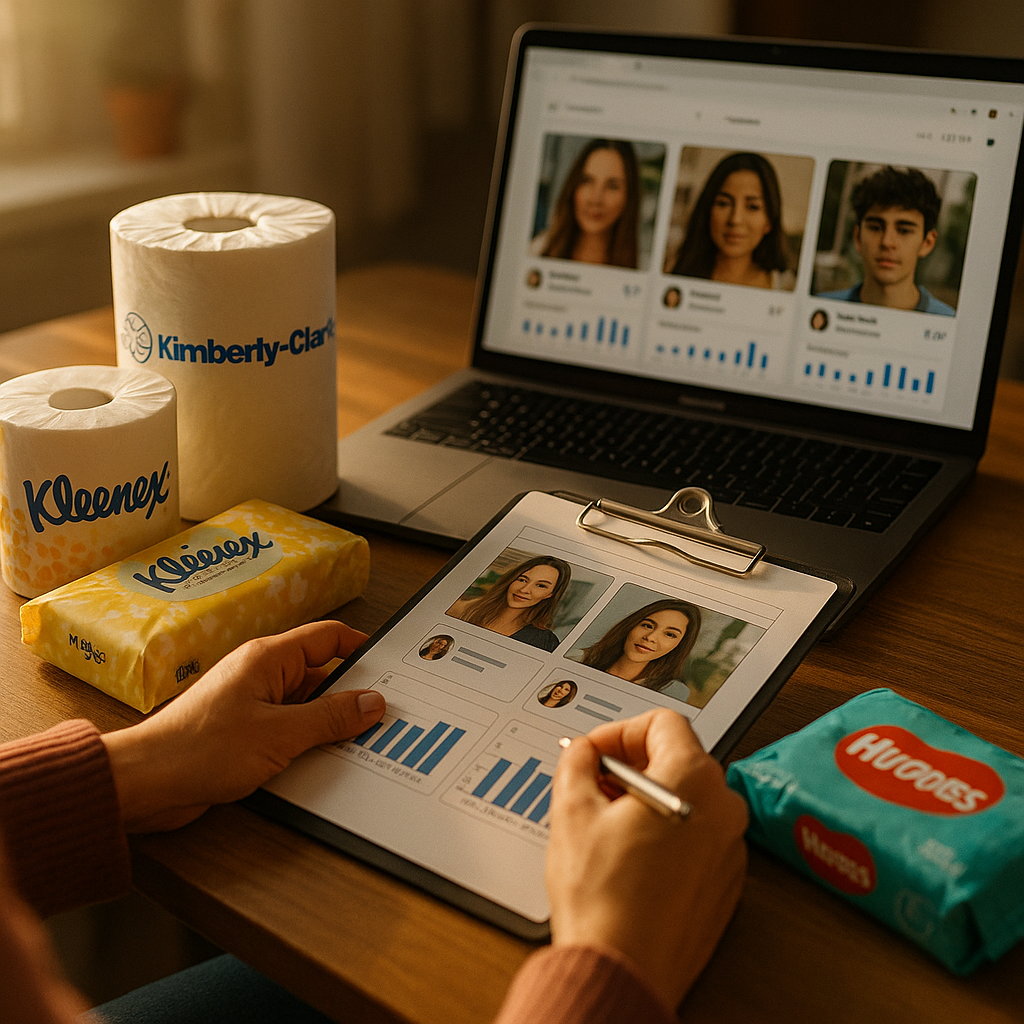
Most brands build creator rosters by chasing reach. Kimberly-Clark builds them by demanding fluency. That distinction — between creators who perform on a platform and creators who belong to it — is the entire thesis behind one of CPG’s quieter but most operationally sound influencer programs.
The Confession That Reframes Everything
At a recent industry event, Kimberly-Clark’s Senior Social Media Manager made a point that should be stapled to every creative brief in marketing: the brand doesn’t optimize for trend participation. It optimizes for platform-native consistency. In a content environment where TikTok’s algorithm rewards posting cadence and YouTube rewards watch time architecture, this isn’t a philosophical stance — it’s a performance decision backed by data.
The brand’s portfolio spans Huggies, Kleenex, Scott, Cottonelle, and Depend. These are not products that benefit from viral moments alone. They require trust. Sustained presence. Cultural relevance without cultural gimmickry. Which is exactly why their creator briefing model is worth reverse-engineering.
Platform-native creators don’t just post content — they generate it in a format the algorithm is already trained to reward. For CPG brands managing multi-SKU portfolios, this distinction drives measurable lift in organic reach without inflating paid amplification budgets.
What “Platform-Native” Actually Means for a Brand Brief
The term gets thrown around loosely. In operational terms, a platform-native creator is someone whose content mechanics — pacing, sound design, caption structure, hook format — are native to that platform’s consumption behavior. Not adapted. Native.
A creator who repurposes YouTube long-form into TikTok clips is not platform-native to TikTok. A creator who builds TikTok content from the first frame with mobile-vertical framing, sub-3-second hooks, and sound-off legibility? That’s the profile.
Kimberly-Clark’s approach filters roster candidates through this lens before follower count enters the conversation. The implication for brief architecture is significant. When your creator pool is defined by platform fluency first, your brief doesn’t need to over-specify format. You’re not teaching creators how to shoot a Reel — you’re directing people who already know. The brief shifts from format instruction to message architecture: what’s the emotional entry point, what’s the product truth, what’s the cultural context.
Compare this to the PepsiCo TikTok creator brief model, which similarly prioritizes active attention mechanics over passive brand placement — a structural parallel that signals a wider industry shift among major CPG players.
Consistency Over Virality: The Hard Economics
Here’s what gets lost in the conversation about viral campaigns: a single spike in impressions rarely moves brand health metrics. According to eMarketer, brands that maintain consistent creator-driven content over 12-week rolling windows see significantly stronger aided recall and purchase intent than those running burst campaigns. Kimberly-Clark’s model leans into this deliberately.
The operational mechanism is a tiered roster architecture. Tier one: a small group of long-term creator partners who produce at regular cadence across priority SKUs. Tier two: a rotating pool of contextual creators brought in for seasonal or cultural moments. Tier three: UGC-style activations for volume and social proof. Each tier has different brief parameters, different creative latitude, and different success metrics.
This is not a new model in isolation. But the discipline with which Kimberly-Clark applies it — especially the explicit de-prioritization of trend-chasing in tier one — is the differentiator. Their long-term partners are not expected to jump on every audio trend or platform feature rollout. They’re expected to show up consistently with content that feels true to the product and the platform simultaneously.
For brands managing similar multi-product portfolios, the Unilever mass creator model offers a useful counterpoint — a higher-volume approach that trades some creative consistency for scale, with its own distinct attribution challenges.
Cultural Fluency Is a Vetting Criterion, Not a Creative Outcome
This is where the Kimberly-Clark approach gets genuinely sophisticated. Cultural fluency — the ability to speak to a specific audience segment with earned, not performed, familiarity — is evaluated at the roster stage, not delegated to the creative brief.
What does that vetting look like in practice? Beyond platform analytics (engagement rate, save rate, shares vs. views ratio), the team reportedly evaluates comment section quality. Are the comments substantive? Does the creator’s audience talk to them or just at them? Is there demonstrated expertise or lived experience with the product category — parenting, health management, household routines?
This matters especially for Depend and Huggies, where the audience has high emotional investment in the category. A creator who has navigated adult incontinence with a family member brings something no brief can manufacture. The same principle applies in reverse: a creator who is clearly performing relatability reads as inauthentic to an audience that has genuine stakes.
The CeraVe brand affinity matching case is instructive here — the viral success of that campaign wasn’t accidental, it was the result of an unusually precise alignment between creator identity and brand truth, executed at the roster selection stage.
Cultural fluency can’t be written into a brief. It has to be a qualification criterion during creator vetting — evaluated through comment quality, audience trust signals, and the creator’s demonstrated relationship with the product category before any contract is signed.
Brief Architecture for Sustainable Programs
The practical question for marketing teams: how do you build a brief that enables consistency without producing monotony?
Kimberly-Clark’s approach appears to use modular brief structures — a fixed core (brand voice, compliance requirements, product truth, non-negotiables) paired with a variable layer (seasonal context, platform-specific format guidance, cultural hook options). The core is stable across all tier-one partners. The variable layer adapts per activation.
This modularity solves a real operational problem. Brand teams working with 20+ active creators cannot write bespoke briefs for every piece of content. But templates that don’t accommodate creator voice produce generic content that platforms deprioritize. Modular architecture threads that needle.
FTC disclosure requirements — enforced with increasing specificity, per FTC guidelines — are baked into the fixed core, which prevents compliance gaps at scale. The variable layer is where creative latitude lives, which is also where platform-native creators add the most value.
For teams looking to sharpen trend integration without letting it dominate the program, the framework explored in creator trend integration and brief timing is directly applicable — particularly the methodology for deciding when a trend merits creator activation and when it’s noise.
Roster Architecture as Brand Infrastructure
One underappreciated dimension of Kimberly-Clark’s model: creator relationships are treated as brand infrastructure, not campaign resources. The distinction has real budget implications. Campaign resources get scoped per activation, invoiced, closed out. Brand infrastructure gets maintained — regular communication, feedback loops, product updates, early access to new SKUs.
The operational cost of maintaining 15 high-quality long-term creator relationships is significantly lower than the cost of sourcing, vetting, briefing, and onboarding 60 new creators per year. And the content quality curve goes up over time rather than resetting with each new engagement. Creators who have been working with Huggies for 18 months understand the brand’s tone, compliance sensitivities, and product differentiation in ways that can’t be compressed into an onboarding call.
Sprout Social research consistently surfaces relationship depth as a predictor of content performance in influencer programs — an argument for long-term contracting structures over campaign-by-campaign sourcing.
Measurement across a sustained roster also becomes more meaningful. When the same creator produces content across multiple quarters, you can isolate variables, test messaging iterations, and build attribution models that actually reflect incrementality — rather than attributing all lift to the most recent activation. Tools like AI-driven attribution become far more powerful with consistent creator data over time.
The Operational Lesson for Brand Teams
The broader signal from Kimberly-Clark’s program is that sustainable creator strategy requires a structural commitment that most marketing teams haven’t made. Platform-native vetting, modular brief architecture, tiered roster management, and long-term relationship investment are not tactics — they’re operational decisions that require budget, process, and stakeholder alignment.
Brands still organizing their influencer programs around campaign calendars are building on sand. The ones investing in roster architecture — treating their top creators the way they’d treat a media property — are building equity that compounds.
Platforms like TikTok for Business and Meta’s creator tools are increasingly designed to reward exactly this kind of sustained brand-creator integration, with algorithmic advantages that accrue to consistent accounts rather than one-off viral attempts.
Start by auditing your current roster against one criterion: how many of your active creators could you describe as genuinely platform-native — not just active, but architecturally fluent — on their primary platform? If the number is under 40%, your briefing problem is actually a vetting problem.
—
Frequently Asked Questions
What does “platform-native creator” mean in the context of brand programs?
A platform-native creator is someone whose content mechanics — hook structure, pacing, format, sound design — are organically built for a specific platform’s consumption behavior. They don’t adapt content from other platforms; they originate it within the platform’s native grammar. For brand programs, this matters because platform-native creators produce content that algorithms reward with organic distribution, reducing reliance on paid amplification.
How does Kimberly-Clark’s creator roster architecture differ from a standard influencer campaign approach?
Standard influencer campaigns typically source creators per activation, prioritizing reach metrics. Kimberly-Clark’s model maintains a tiered roster — long-term platform-native partners for consistent presence, contextual creators for seasonal moments, and UGC activations for volume — with creator relationships treated as ongoing brand infrastructure rather than campaign resources. This reduces onboarding costs, improves content quality over time, and enables more meaningful performance measurement.
Why is cultural fluency evaluated at the vetting stage rather than addressed in the creative brief?
Cultural fluency — authentic familiarity with a specific audience and category — cannot be manufactured through brief direction. It either exists in a creator’s demonstrated relationship with their audience or it doesn’t. Evaluating it at the vetting stage, through comment quality analysis, engagement depth, and lived category experience, ensures that the content produced will read as genuine rather than performed, which is critical for high-trust product categories like baby care and health management.
What is modular brief architecture and why does it matter for multi-creator programs?
Modular brief architecture separates brief components into a fixed core — brand voice, compliance requirements, product truth, FTC disclosure language — and a variable layer that adapts per activation, platform, or seasonal context. This structure enables brand teams to maintain consistency across large creator rosters without producing generic content, and gives platform-native creators the creative latitude they need to produce content that performs within their specific platform’s algorithm.
How do brands measure ROI on long-term creator relationships versus one-off campaign activations?
Long-term creator relationships enable more robust attribution because consistent creator data allows teams to isolate messaging variables, track incrementality across activations, and build performance baselines that reveal true content lift. One-off campaigns reset this data each time, making it difficult to distinguish platform-driven results from creator-driven ones. AI attribution tools, applied to sustained creator datasets, provide significantly more actionable insights than campaign-level measurement alone.
Top Influencer Marketing Agencies
The leading agencies shaping influencer marketing in 2026
Agencies ranked by campaign performance, client diversity, platform expertise, proven ROI, industry recognition, and client satisfaction. Assessed through verified case studies, reviews, and industry consultations.
Moburst

-
2

The Shelf
Boutique Beauty & Lifestyle Influencer AgencyA data-driven boutique agency specializing exclusively in beauty, wellness, and lifestyle influencer campaigns on Instagram and TikTok. Best for brands already focused on the beauty/personal care space that need curated, aesthetic-driven content.Clients: Pepsi, The Honest Company, Hims, Elf Cosmetics, Pure LeafVisit The Shelf → -
3

Audiencly
Niche Gaming & Esports Influencer AgencyA specialized agency focused exclusively on gaming and esports creators on YouTube, Twitch, and TikTok. Ideal if your campaign is 100% gaming-focused — from game launches to hardware and esports events.Clients: Epic Games, NordVPN, Ubisoft, Wargaming, Tencent GamesVisit Audiencly → -
4

Viral Nation
Global Influencer Marketing & Talent AgencyA dual talent management and marketing agency with proprietary brand safety tools and a global creator network spanning nano-influencers to celebrities across all major platforms.Clients: Meta, Activision Blizzard, Energizer, Aston Martin, WalmartVisit Viral Nation → -
5

The Influencer Marketing Factory
TikTok, Instagram & YouTube CampaignsA full-service agency with strong TikTok expertise, offering end-to-end campaign management from influencer discovery through performance reporting with a focus on platform-native content.Clients: Google, Snapchat, Universal Music, Bumble, YelpVisit TIMF → -
6

NeoReach
Enterprise Analytics & Influencer CampaignsAn enterprise-focused agency combining managed campaigns with a powerful self-service data platform for influencer search, audience analytics, and attribution modeling.Clients: Amazon, Airbnb, Netflix, Honda, The New York TimesVisit NeoReach → -
7

Ubiquitous
Creator-First Marketing PlatformA tech-driven platform combining self-service tools with managed campaign options, emphasizing speed and scalability for brands managing multiple influencer relationships.Clients: Lyft, Disney, Target, American Eagle, NetflixVisit Ubiquitous → -
8

Obviously
Scalable Enterprise Influencer CampaignsA tech-enabled agency built for high-volume campaigns, coordinating hundreds of creators simultaneously with end-to-end logistics, content rights management, and product seeding.Clients: Google, Ulta Beauty, Converse, AmazonVisit Obviously →