


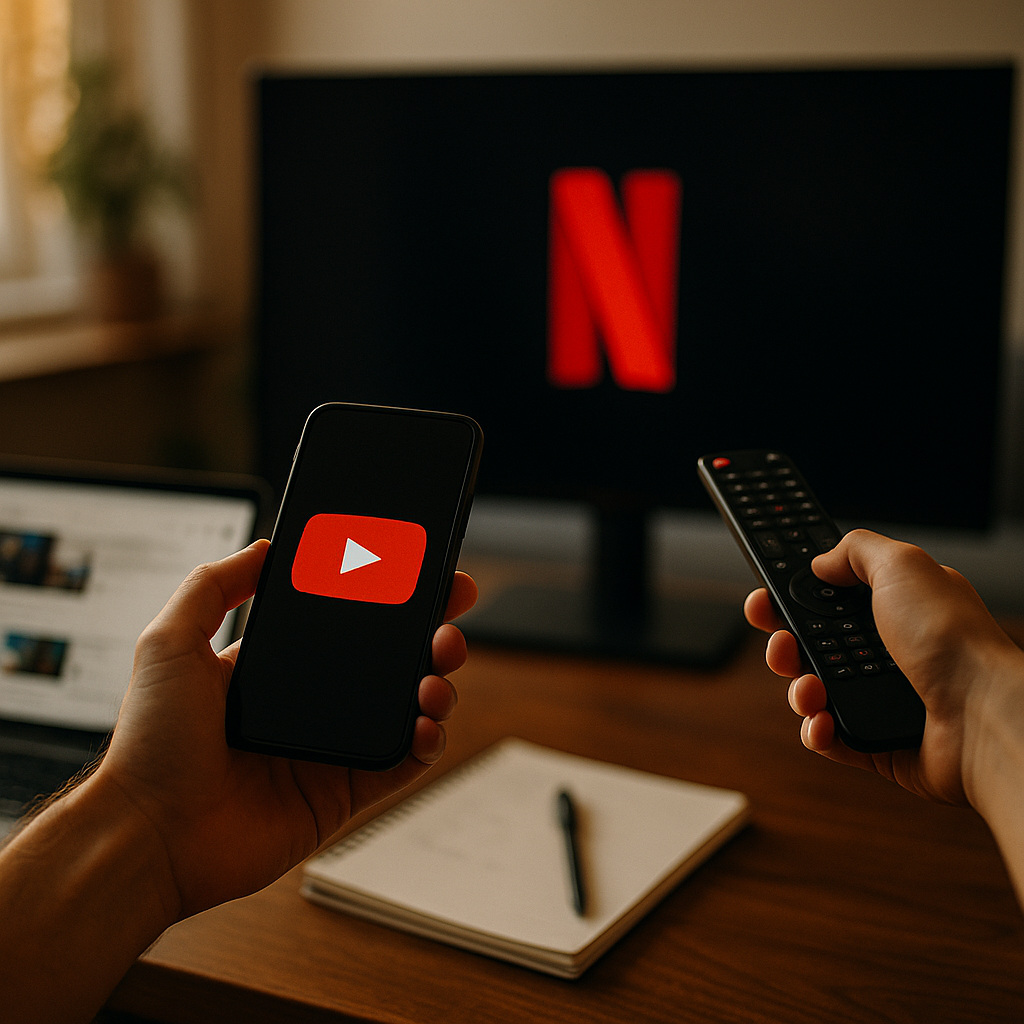
YouTube just beat Netflix at its own game. With 12.7 percent of U.S. streaming watch time against Netflix’s 8.4 percent, creator content has crossed a threshold that should force every brand media team to rethink how they evaluate, structure, and commit to creator channel partnerships — especially when upfront season rolls around.
The Streaming Math Has Changed. Your Budget Allocation Probably Hasn’t.
For years, the standard media planning assumption held that premium streaming — Netflix, Hulu, Max — carried audience quality that justified higher CPMs and longer commitment windows. Creator content on YouTube was treated as a performance tactic: run it, measure it, move on. That logic no longer holds.
Nielsen’s The Gauge report consistently places YouTube at the top of the streaming rankings, above every ad-supported and subscription streaming service combined. The viewer sitting in front of a connected TV watching a MrBeast video, a Marques Brownlee deep-dive, or a finance channel like Graham Stephan is the same demographic that brands once paid premium CPMs to reach via linear TV and SVOD inventory. The audience hasn’t changed. The distribution has.
This matters operationally. If you’re allocating the majority of your video budget to traditional streaming buys and treating creator sponsorships as a line item afterthought, you’re systematically underweighting the channel where your audience actually spends the most time. For a detailed breakdown of how to reframe those numbers, the YouTube vs Netflix budget weighting analysis is required reading before your next planning cycle.
YouTube’s 12.7 percent streaming share isn’t a creator economy story anymore. It’s a media reach story — and brands that keep treating it like the former are leaving measurable audience impressions on the table.
What “Upfront-Style” Actually Means for Creator Channels
The TV upfront model works because it solves a specific problem: securing premium inventory before it’s gone, at negotiated rates, with some guarantee of audience delivery. Networks offer packages. Buyers commit budgets. Everyone aligns on reach projections for the broadcast year ahead.
Creator channels can now offer an analogous structure — but the mechanics are different, and most brand teams aren’t set up to evaluate them correctly.
When a top-tier creator like MKBHD or a finance educator with 4 million engaged subscribers offers a six-video annual commitment, they’re effectively offering upfront inventory. Fixed sponsorship slots across a projected content calendar. Audience delivery based on historical view averages. Category exclusivity within their niche. That’s not a one-off deal — that’s a media partnership. The MrBeast upfront model demonstrates exactly how these commitment structures translate into measurable reach guarantees.
The evaluation framework should mirror how you’d assess a streaming buy:
- Audience composition: What percentage of this creator’s viewers match your target demo? Tools like YouTube’s Brand Lift studies and third-party platforms like Tubular Labs give you demographic breakdowns that rival panel-based TV measurement.
- Inventory consistency: How regular is the creator’s posting cadence? A creator who publishes 40 videos a year offers more predictable inventory than one who posts sporadically.
- Viewership floor: What’s the guaranteed minimum view count per video, and what’s the historical floor? Netflix commits to eyeballs. Creator channels can too, when contracts are written correctly.
- Content adjacency: Does the creator’s subject matter create natural brand fit, or is every integration a stretch? Contextual relevance on YouTube functions like programming context on linear TV.
For brands navigating the structural side of these deals, the guide on creator programs at TV upfronts covers the budget architecture in detail.
Why Creator Audiences Are Now Indistinguishable From Premium Streaming Viewers
This is the claim that still gets pushback in planning meetings. The assumption persists that streaming viewers are somehow more “premium” — higher income, more engaged, more brand-receptive — than YouTube viewers.
The data doesn’t support it.
According to eMarketer, connected TV usage among adults 25-54 — the core brand-spend demographic — is dominated by YouTube, not Netflix. YouTube’s CTV penetration has grown faster than any other streaming platform over the past three years. And critically, the content formats that drive the most watch time on YouTube — long-form educational content, serialized entertainment, documentary-style storytelling — are functionally identical to what premium streamers produce.
The production quality gap has also collapsed. A top creator investing in a dedicated studio, professional editors, and custom set design is producing content that holds viewer attention as effectively as a Netflix documentary series. Audience retention curves on long-form YouTube content from established creators routinely exceed 50 percent at the 20-minute mark. That’s a number most streaming platforms would celebrate.
For Gen Z specifically, the preference is even more pronounced. Creator trust scores consistently outperform traditional media trust, which has direct implications for brand messaging absorption. The Gen Z brand loyalty data makes the case that for audiences under 30, creator endorsement carries the weight that celebrity placement once did on traditional TV.
Risk Mitigation in Multi-Video Creator Commitments
Here’s where the upfront analogy gets complicated. TV networks carry reputational and legal infrastructure that individual creators don’t. When you commit six figures to a 12-month creator channel partnership, you’re taking on platform risk, creator conduct risk, and content quality risk simultaneously.
Smart contracts hedge all three. Conduct clauses should be standard — not boilerplate, but specifically tailored to the creator’s category and audience. A finance creator carries different compliance exposure than a lifestyle creator, especially with FTC disclosure requirements tightening across the board. Check the FTC endorsement guidelines before any multi-video deal closes.
Platform risk is harder to contract around, but it can be partially mitigated. Building cross-platform content rights into the deal — so that sponsored content can be repurposed for brand-owned channels, paid social, and CTV placements — creates an asset that survives algorithm shifts. Flat-fee contracts that don’t account for content usage rights are systematically mispriced, and this is where many brand teams leave value unrealized.
Creator conduct risk requires due diligence that goes beyond a content audit. Review the creator’s comment section, their community posts, their response to brand controversies in adjacent categories. You’re not just buying impressions — you’re buying audience trust. That trust is the entire value proposition.
A multi-video creator commitment without content usage rights built in is the equivalent of buying a TV spot without the right to run it in secondary markets. You’re leaving distribution value on the table from day one.
Structuring the Buy: What Upfront-Style Creator Deals Should Include
The operational structure of an upfront-style creator commitment needs five non-negotiable components.
1. Guaranteed delivery thresholds. Minimum view guarantees, with make-good provisions if a video underperforms. This is standard in broadcast — it should be standard in creator deals.
2. Content calendar visibility. Brands should have 30-60 day sight lines into upcoming content topics, not to control creative, but to ensure brand integration makes contextual sense. Poor adjacency kills integration effectiveness.
3. Exclusivity windows. Category exclusivity during the deal term is essential for premium creator partnerships. If a competitor can run a pre-roll on the same video your sponsorship appears in, you’ve undermined your own investment.
4. Audience reporting standards. Agree upfront on what metrics constitute delivery — not just views, but verified audience demographics, watch time, and click-through benchmarks where applicable. Nielsen and Comscore both offer creator content measurement solutions that bring TV-comparable audience verification to YouTube.
5. Usage rights and amplification permissions. Specify exactly what the brand can do with the content post-publication. Paid amplification through YouTube’s own ad products — TrueView, YouTube Select — can dramatically extend a sponsorship’s effective reach. The paid-first distribution playbook outlines how to structure this amplification layer correctly.
The IAB Signal Brands Should Not Ignore
The IAB’s projection of $44 billion in creator ad spend is not a ceiling — it’s a floor. As measurement infrastructure matures and creator content becomes more consistently plannable, brand investment will accelerate. The brands that develop internal competency in creator channel evaluation now — before the market fully institutionalizes these buys — will command better rates, better creative, and better audience relationships than those who wait for the upfront market to force the conversation. The IAB creator ad spend breakdown provides the budget framework for building that internal case.
The window to establish preferred creator relationships at reasonable rates is narrowing. Premium creator inventory — serialized channels with large, loyal, demographically attractive audiences — is already being treated as scarce. Act accordingly.
Your next step: Pull your current video budget allocation and map actual audience reach against platform share data. If YouTube’s 12.7 percent streaming share isn’t reflected proportionally in your commitments, you have a structural misallocation to correct before the next planning cycle closes.
FAQs
What does “upfront-style creator commitment” mean for brands?
An upfront-style creator commitment means securing a multi-video sponsorship agreement with a specific creator channel over a defined period — typically six to twelve months — in exchange for negotiated rates, audience delivery guarantees, and category exclusivity. It mirrors the TV upfront model where brands commit budget early to secure premium inventory before it’s sold to competitors.
How do brands measure ROI on long-term YouTube creator partnerships?
ROI measurement should combine view-based delivery metrics (verified views, watch time, audience demographics) with downstream performance signals (site traffic, branded search lift, conversion attribution). YouTube’s Brand Lift studies provide incrementality data, while third-party tools like Tubular Labs or Comscore can validate audience composition against the brand’s target demo. Multi-video deals allow for optimization across the commitment window, which improves ROI over time compared to one-off sponsorships.
Why does YouTube’s streaming share matter more than its social media metrics?
YouTube’s 12.7 percent streaming share — measured against total TV and streaming time, not just digital — signals that creator content is being consumed in the same lean-back viewing environment as premium streaming and traditional TV. This means brands reaching YouTube audiences are accessing viewers in a high-attention, brand-receptive context, not a quick-scroll social feed. That changes the effective CPM calculation significantly.
What contract protections should brands require in creator upfront deals?
Essential contract protections include: minimum view guarantees with make-good provisions, category exclusivity for the deal term, FTC-compliant disclosure requirements explicitly stated, creator conduct clauses, content calendar visibility rights, and full usage rights for paid amplification and brand-owned channel repurposing. Deals without usage rights are structurally undervalued from the start.
How do creator audiences compare to Netflix or Hulu audiences for brand targeting?
Recent eMarketer data shows that YouTube’s connected TV audience among adults 25-54 is larger than any individual streaming platform, including Netflix. Creator channels in specific verticals — finance, tech, health, parenting — often deliver more precise audience targeting than broad streaming platform buys, because the content context self-selects a highly relevant audience. The assumed “premium” quality of traditional streaming audiences relative to YouTube viewers is not supported by current demographic data.
Top Influencer Marketing Agencies
The leading agencies shaping influencer marketing in 2026
Agencies ranked by campaign performance, client diversity, platform expertise, proven ROI, industry recognition, and client satisfaction. Assessed through verified case studies, reviews, and industry consultations.
Moburst

-
2

The Shelf
Boutique Beauty & Lifestyle Influencer AgencyA data-driven boutique agency specializing exclusively in beauty, wellness, and lifestyle influencer campaigns on Instagram and TikTok. Best for brands already focused on the beauty/personal care space that need curated, aesthetic-driven content.Clients: Pepsi, The Honest Company, Hims, Elf Cosmetics, Pure LeafVisit The Shelf → -
3

Audiencly
Niche Gaming & Esports Influencer AgencyA specialized agency focused exclusively on gaming and esports creators on YouTube, Twitch, and TikTok. Ideal if your campaign is 100% gaming-focused — from game launches to hardware and esports events.Clients: Epic Games, NordVPN, Ubisoft, Wargaming, Tencent GamesVisit Audiencly → -
4

Viral Nation
Global Influencer Marketing & Talent AgencyA dual talent management and marketing agency with proprietary brand safety tools and a global creator network spanning nano-influencers to celebrities across all major platforms.Clients: Meta, Activision Blizzard, Energizer, Aston Martin, WalmartVisit Viral Nation → -
5

The Influencer Marketing Factory
TikTok, Instagram & YouTube CampaignsA full-service agency with strong TikTok expertise, offering end-to-end campaign management from influencer discovery through performance reporting with a focus on platform-native content.Clients: Google, Snapchat, Universal Music, Bumble, YelpVisit TIMF → -
6

NeoReach
Enterprise Analytics & Influencer CampaignsAn enterprise-focused agency combining managed campaigns with a powerful self-service data platform for influencer search, audience analytics, and attribution modeling.Clients: Amazon, Airbnb, Netflix, Honda, The New York TimesVisit NeoReach → -
7

Ubiquitous
Creator-First Marketing PlatformA tech-driven platform combining self-service tools with managed campaign options, emphasizing speed and scalability for brands managing multiple influencer relationships.Clients: Lyft, Disney, Target, American Eagle, NetflixVisit Ubiquitous → -
8

Obviously
Scalable Enterprise Influencer CampaignsA tech-enabled agency built for high-volume campaigns, coordinating hundreds of creators simultaneously with end-to-end logistics, content rights management, and product seeding.Clients: Google, Ulta Beauty, Converse, AmazonVisit Obviously →