


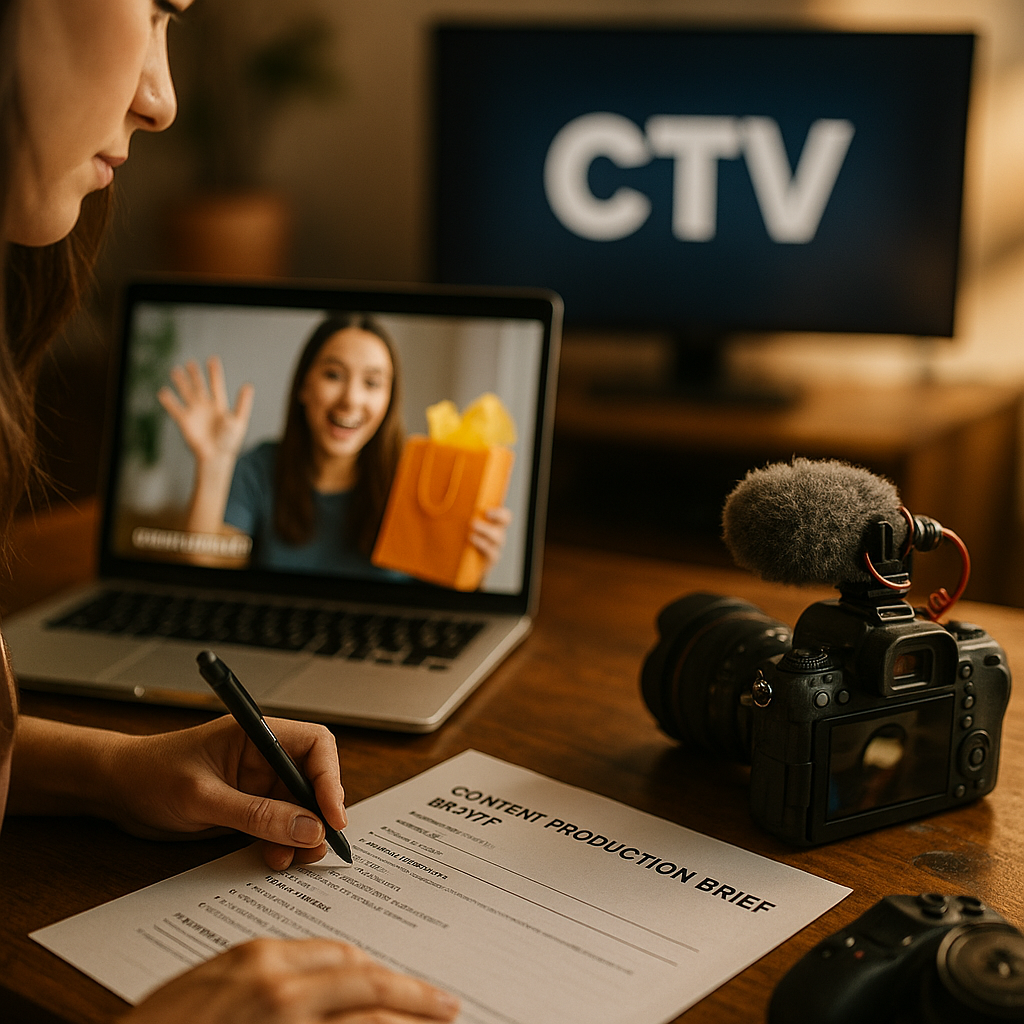
CTV ad spend is projected to surpass $42 billion in the US alone, yet most brands are still shipping vertical, lo-fi creator clips into a premium lean-back environment and wondering why completion rates tank. Designing creator content for connected-TV distribution requires a fundamentally different production brief — one that bridges creator authenticity with broadcast-grade technical requirements.
Why CTV Is Not Just Another Ad Placement
Let’s be direct: a 9:16 TikTok repurposed into a 16:9 pre-roll on Amazon Fire TV is not a CTV strategy. It’s a placeholder. The viewing context is radically different. Audiences are sitting 8–10 feet from a 55-inch screen, audio is on, and they cannot scroll past your ad. That’s an enormous opportunity — and an enormous creative liability if your brief wasn’t built for it.
CTV platforms like Amazon Ads, Netflix’s ad tier, and Google’s DV360 inventory have strict technical specs and editorial quality expectations that most creator briefs simply don’t address. Resolution minimums, loudness normalization (LKFS standards), safe zone requirements for overscan, and brand safety signals embedded in metadata — none of this is covered in a standard social brief.
The CTV opportunity isn’t about repurposing creator content. It’s about redesigning the brief upstream so creators produce assets that work across both social and the living room screen simultaneously.
The Five-Layer CTV Production Brief Framework
A CTV-ready creator brief operates on five distinct layers. Most brands only brief the first two. Here’s what the full stack looks like.
1. Platform Context Layer
Specify which CTV inventory the content is being produced for. Amazon DSP, Netflix’s Microsoft-powered ad network, and Google DV360 each have different ad format requirements. Amazon allows interactive overlays and pause ads. Netflix currently limits to non-skippable 15- and 30-second pre-roll/mid-roll. Google’s YouTube CTV environment supports skippable TrueView but with different engagement mechanics than mobile. Your brief must name the platform and the specific unit type, not just “CTV.”
2. Technical Specifications Layer
This is where most creator briefs break down. At minimum, a CTV production brief should specify: 1920×1080 minimum resolution (3840×2160 preferred for premium inventory), 23.976 or 29.97fps, stereo audio mastered to -24 LKFS with a -2 dBTP true peak ceiling, and a safe area that keeps all critical visual elements within the inner 80% of the frame to account for overscan on older TVs. If you’re working with creators who shoot on iPhone 15 Pro or Sony ZV-E1 rigs, these specs are achievable — but they must be explicit.
3. Narrative Structure Layer
CTV viewers are captive but not passive. They notice production quality, pacing, and audio polish in ways that mobile viewers don’t. The brief should specify that the hook happens in the first 3 seconds (same as social), but that the mid-section can breathe — 10 to 20 seconds of substantive demonstration or storytelling works well in a 30-second CTV unit where it would lose a mobile audience entirely. Think of it like a compressed TV commercial, not a scaled-up Reel.
4. Compliance and Clearance Layer
CTV distribution introduces licensing complexity that social posting does not. Background music must be cleared for broadcast, not just digital. On-screen talent (including the creator themselves) may need a separate broadcast usage agreement if your talent contract only covers social platforms. Brand logos of third parties visible in frame — competitor products, venue signage, apparel logos — require review. This layer should explicitly reference your FTC-compliant creator brief protocols and expand them for broadcast contexts.
5. Versioning and Repurposing Layer
A smart CTV brief plans for multiple outputs from a single shoot. The creator captures the hero content in 16:9 at broadcast quality, but the brief should simultaneously specify a 9:16 reframe, a square 1:1 cutdown, and a 6-second bumper. This is the production efficiency play that justifies the higher per-asset cost of a broadcast-spec shoot. For operational guidance on this, the single-session creator shoot model applies directly here — you’re just adding CTV as the anchor deliverable rather than social.
Casting and Creative Direction for the Living Room
Not every creator is right for CTV. This isn’t a judgment on talent quality — it’s a pragmatic observation about production style. Creators who shoot handheld, walk-and-talk content in natural light may produce phenomenal TikTok content that becomes visually chaotic on a large screen. For CTV, you want creators who either already produce elevated content or who are willing to adapt to a more structured shoot format.
Casting criteria for a CTV brief should include: the creator’s existing video production quality (check their YouTube channel, not just their TikTok), their comfort with scripted or semi-scripted delivery (ad-lib works on social; CTV requires tighter message control), and their licensing flexibility for broadcast usage rights. The brief should make broadcast usage rights a negotiated line item, not a surprise clause sent post-production.
Creative direction should explicitly address camera distance and framing. Close-up talking-head content that reads as intimate on a 6-inch phone screen can feel claustrophobic on a 65-inch TV. Brief your creators to use a mid-shot or medium-wide as the primary frame, with close-ups reserved for product detail moments.
Platform-Specific Brief Addenda
Once the core five-layer brief is built, each platform destination requires a one-page addendum. Here’s the shorthand:
- Amazon DSP / Prime Video: Lean into product integration and demo sequences. Amazon’s audience data makes contextual relevance exceptionally precise — brief creators to treat the content as a short product story, not a brand awareness piece. Interactive overlay specs (if using) require separate asset delivery.
- Netflix Ad Tier: Non-skippable inventory means completion is guaranteed but goodwill is finite. The brief must prioritize entertainment value over conversion messaging. A hard sell in a non-skippable unit is a brand safety risk, not just a creative misfire.
- Google DV360 / YouTube CTV: Skippable formats mean the first 5 seconds are existential. Brief your creators to treat the skip button as the enemy and structure the hook accordingly. For non-skippable 15-second bumpers on YouTube CTV, the brief should specify a single message, a single visual focus, and a single audio cue — no more.
For brands already running CTV creator distribution programs, these addenda can be templated and integrated into your standard brief workflow within a single creative ops cycle.
Netflix’s non-skippable CTV inventory demands entertainment-first creative. If your brief leads with a discount code, you’re paying premium CPMs to annoy a captive audience.
Measurement and Attribution in the Brief
This gets overlooked constantly. A CTV production brief should include a measurement mandate — not just campaign KPIs, but specific creative-level signals you want to track. Amazon’s brand lift studies, Netflix’s third-party measurement partnerships (Kantar, Nielsen ONE), and Google’s CTV reach reporting in DV360 each surface different data. The brief should specify which signals constitute creative success so the creator understands what “working” looks like beyond views.
For direct-response brands, QR code overlays in CTV ads are now standard on most platforms. Brief creators to frame a natural pause moment at the 20-25 second mark of a 30-second unit where a QR overlay can be served without obscuring the creative. This is a production decision, not a post-production patch.
If you’re building a broader UGC repurposing pipeline that includes CTV as a paid distribution channel, measurement architecture should be consistent across the full funnel — social, owned, and now the living room screen.
The Brief Is the Product
Brands that win on CTV creator inventory won’t be the ones with the biggest production budgets. They’ll be the ones who built a brief framework disciplined enough to extract broadcast-quality outputs from creator workflows. The production brief for CTV isn’t a creative constraint — it’s the operational infrastructure that makes creator content scalable across the most premium video inventory available today.
For teams also thinking about how creator aesthetics are influencing premium video production more broadly, the analysis of how TV brands borrow creator aesthetics is directly relevant context for CTV brief development. And if you’re planning episodic formats rather than one-off spots, the episodic brand series framework provides a complementary structural model.
Start with one CTV platform, build the five-layer brief for it, run one creator through the full spec, and QA the output against broadcast technical requirements before you scale. That single test flight will surface every gap in your current briefing process — and close it faster than any strategy document will.
Frequently Asked Questions
What technical specs do creator assets need to meet for CTV ad inventory?
At minimum, CTV creator assets should be delivered at 1920×1080 resolution (preferably 3840×2160 for premium inventory), at 23.976 or 29.97fps, with stereo audio mastered to -24 LKFS and a -2 dBTP true peak ceiling. All critical visual elements should stay within the inner 80% of the frame to account for overscan. Platform-specific requirements from Amazon, Netflix, and Google DV360 may add additional constraints, which is why a platform context layer is essential in every CTV production brief.
Can brands simply repurpose existing short-form creator content for CTV ads?
Technically possible, but strategically inadvisable. Vertical 9:16 social content repurposed into a horizontal CTV environment typically suffers from framing issues, audio quality problems, and narrative structures that don’t match lean-back viewing behavior. CTV audiences are captive and viewing on large screens where production quality is immediately apparent. The better approach is to brief creators for simultaneous CTV and social outputs from a single shoot, using the CTV 16:9 format as the anchor deliverable.
What licensing rights do brands need to secure for CTV distribution?
CTV distribution requires broadcast usage rights, which are distinct from the digital or social usage rights in most standard creator contracts. Background music must be cleared for broadcast. Talent agreements need to explicitly cover broadcast platforms. Any third-party brand logos or identifiable products visible in frame require legal review. Brands should audit existing creator contracts before running any social asset in CTV inventory — the licensing exposure can be significant.
How does CTV creative strategy differ across Amazon, Netflix, and Google?
Each platform has materially different ad formats and audience contexts. Amazon Prime Video inventory supports interactive overlays and benefits from purchase-intent targeting, making it well-suited for product-forward creator content. Netflix’s ad tier currently offers non-skippable pre-roll and mid-roll units, which demand entertainment-first creative to avoid audience backlash. Google’s YouTube CTV environment includes skippable TrueView formats where the first 5 seconds determine whether the audience stays or skips. Each platform should receive a tailored brief addendum on top of the core CTV production framework.
How should brands measure the effectiveness of creator content in CTV ad inventory?
Measurement should be specified in the production brief itself, not added as an afterthought. Amazon offers brand lift studies and purchase attribution. Netflix partners with third-party measurement vendors including Kantar and Nielsen ONE. Google DV360 provides CTV-specific reach and frequency reporting. For direct-response objectives, QR code overlays are now supported across most CTV platforms and should be built into the creative at the production stage. Brands should align on a consistent measurement framework across all CTV platforms before deploying creator content at scale.
Top Influencer Marketing Agencies
The leading agencies shaping influencer marketing in 2026
Agencies ranked by campaign performance, client diversity, platform expertise, proven ROI, industry recognition, and client satisfaction. Assessed through verified case studies, reviews, and industry consultations.
Moburst

-
2

The Shelf
Boutique Beauty & Lifestyle Influencer AgencyA data-driven boutique agency specializing exclusively in beauty, wellness, and lifestyle influencer campaigns on Instagram and TikTok. Best for brands already focused on the beauty/personal care space that need curated, aesthetic-driven content.Clients: Pepsi, The Honest Company, Hims, Elf Cosmetics, Pure LeafVisit The Shelf → -
3

Audiencly
Niche Gaming & Esports Influencer AgencyA specialized agency focused exclusively on gaming and esports creators on YouTube, Twitch, and TikTok. Ideal if your campaign is 100% gaming-focused — from game launches to hardware and esports events.Clients: Epic Games, NordVPN, Ubisoft, Wargaming, Tencent GamesVisit Audiencly → -
4

Viral Nation
Global Influencer Marketing & Talent AgencyA dual talent management and marketing agency with proprietary brand safety tools and a global creator network spanning nano-influencers to celebrities across all major platforms.Clients: Meta, Activision Blizzard, Energizer, Aston Martin, WalmartVisit Viral Nation → -
5

The Influencer Marketing Factory
TikTok, Instagram & YouTube CampaignsA full-service agency with strong TikTok expertise, offering end-to-end campaign management from influencer discovery through performance reporting with a focus on platform-native content.Clients: Google, Snapchat, Universal Music, Bumble, YelpVisit TIMF → -
6

NeoReach
Enterprise Analytics & Influencer CampaignsAn enterprise-focused agency combining managed campaigns with a powerful self-service data platform for influencer search, audience analytics, and attribution modeling.Clients: Amazon, Airbnb, Netflix, Honda, The New York TimesVisit NeoReach → -
7

Ubiquitous
Creator-First Marketing PlatformA tech-driven platform combining self-service tools with managed campaign options, emphasizing speed and scalability for brands managing multiple influencer relationships.Clients: Lyft, Disney, Target, American Eagle, NetflixVisit Ubiquitous → -
8

Obviously
Scalable Enterprise Influencer CampaignsA tech-enabled agency built for high-volume campaigns, coordinating hundreds of creators simultaneously with end-to-end logistics, content rights management, and product seeding.Clients: Google, Ulta Beauty, Converse, AmazonVisit Obviously →