


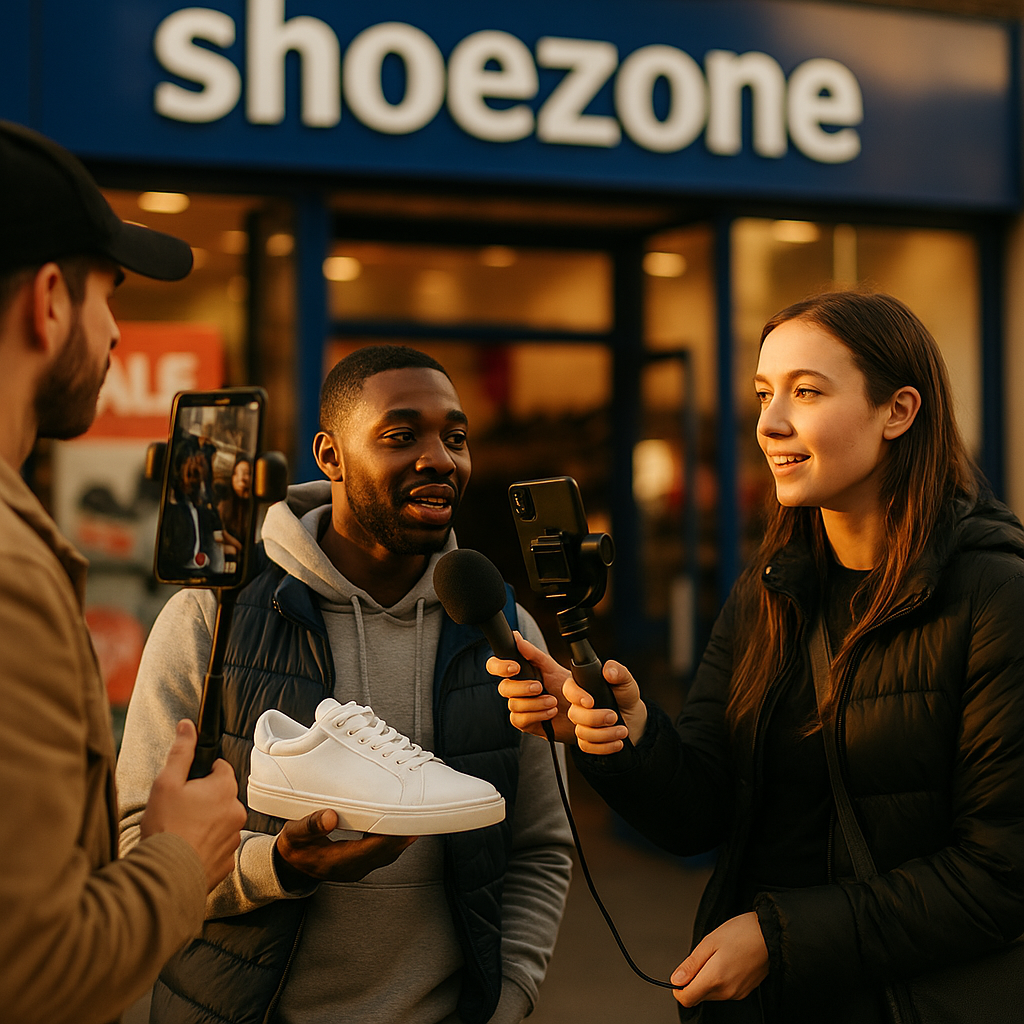
Street Interviews Are Closing Sales. Here’s How Shoezone Built the Playbook
TikTok Shop now drives more impulse footwear purchases per session than any other social commerce platform, and Shoezone figured out why street-interview content converts at rates traditional unboxing formats can’t match. This is a tactical breakdown of how they built it, and what footwear retail brands can steal from the model.
Why Street Interviews Work for Low-to-Mid Price Footwear
Street interviews operate on a simple psychology: real people, real opinions, no script. For a value footwear brand like Shoezone, which competes on price and accessibility rather than hype, that authenticity closes a credibility gap that polished studio content never can. When a creator stops someone on a high street, asks what they paid for their trainers, and then reveals the Shoezone equivalent at half the price, the viewer’s immediate reaction is the conversion mechanism.
The format also sidesteps a core problem in footwear marketing: aspiration mismatch. Premium brands sell aspiration. Shoezone sells value. Over-produced content signals the wrong message. Street interviews, by contrast, frame the product inside everyday life, which is exactly where Shoezone’s customer already lives.
The conversion trigger in street-interview content isn’t the product itself. It’s the visible surprise from a third party, a person the viewer has no reason to disbelieve, validating the price-to-quality equation in real time.
For other footwear retail brands operating in the sub-£60 segment, this is the critical lesson: your creative format needs to match your brand’s value proposition. Price-positive surprises need witnesses, not spokespersons.
Creator Selection: The Profile That Actually Converts
Shoezone’s approach to creator selection is worth examining closely, because it deviates from the instinct most retail brands have when they first enter TikTok Shop. The temptation is to find creators with large followings in fashion or lifestyle. That’s the wrong move for this format.
The creators driving measurable sales through Shoezone’s street-interview model share a specific profile: mid-tier accounts (typically 50,000 to 500,000 followers) with audiences skewing toward budget-conscious consumers in UK regional markets, strong on-camera rapport with strangers, and a posting cadence that signals consistent production rather than one-off viral chasing. Engagement rate matters more than reach here. A creator with 80,000 followers and a 7% engagement rate on shopping content outperforms a 400,000-follower account with 1.2% engagement every time.
The street-interview format also requires a specific skill set that follower count doesn’t measure: the ability to hold a natural, unscripted conversation in public. Brands should ask for examples of previous street or vox-pop style content before signing any agreement. Creators who’ve done man-on-the-street formats for other categories, comedy, opinion polls, social experiments, tend to translate well to commerce-led versions.
For reference, e.l.f. Beauty’s mid-tier creator results demonstrated the same pattern in beauty: smaller, more engaged audiences consistently beat celebrity reach for direct conversion campaigns. Footwear retail is no different.
Embedded Link Placement: The Mechanic That Turns Views Into Revenue
This is where most brands lose the sale they’ve already earned creatively.
TikTok Shop’s native product link feature allows creators to pin a product card directly into the video. The placement timing is everything. In Shoezone’s highest-converting videos, the product link appears at the moment of price reveal, not at the end of the video as a generic call to action. That’s a deliberate structural choice. The viewer’s purchase intent peaks at the moment of the price surprise. A product card sitting passively in the caption or appearing 45 seconds in misses that window entirely.
The operational implication for brands: creator briefs must specify link placement timing, not just link inclusion. If the brief says “include a product link,” you will get links placed at random. If the brief says “the product card should appear on-screen at the moment you reveal the price comparison,” you get a conversion-optimised video.
Secondary link strategy also matters. Shoezone supplements the in-video product card with a pinned comment containing the direct product URL, and the creator’s bio link points to a curated TikTok Shop collection rather than a generic homepage. Each layer catches a different viewer behaviour: the impulse buyer taps the in-video card; the considered buyer revisits via the comment link or bio. See how Target’s shoppable link approach applies a similar layered conversion architecture across a dual-creator model.
Attribution: What the Dashboard Won’t Tell You
TikTok Shop’s native analytics show last-click attribution. That’s useful, but incomplete. A viewer who watches a street-interview video, doesn’t tap the product card immediately, then searches Shoezone directly two days later will never appear in TikTok Shop’s conversion data, even though the creator drove the sale.
Shoezone’s attribution approach addresses this with a parallel tracking layer. Each creator in the programme uses a unique UTM parameter tied to their content, and Shoezone’s web analytics capture traffic from creator-specific short links even when the purchase path moves off TikTok. Creator-specific discount codes provide a third data point: not all buyers use them, but those who do confirm creator influence with zero ambiguity.
The combination of TikTok Shop native data, UTM-tagged off-platform traffic, and promo code redemption gives a more honest view of creator-attributed revenue than any single source alone. Brands serious about this model should integrate all three into a unified dashboard, either through a tool like Sprout Social or a dedicated creator commerce platform.
There’s a deeper attribution challenge worth flagging: halo effects on in-store traffic. For Shoezone, which operates physical retail locations, TikTok content demonstrably drives footfall that never touches digital attribution. Regional creators covering specific cities correlate with store visit uplift in those markets. This requires a separate measurement methodology, typically matched-market testing or store-level sales comparison against a control period. It’s imperfect, but ignoring it understates creator ROI significantly. The Lowe’s micro-creator strategy for in-store traffic offers a comparable framework for measuring footfall attribution from social content.
Last-click TikTok Shop attribution undercounts creator-driven revenue by a meaningful margin. Brands that only measure what the platform dashboard shows are optimising against an incomplete signal.
Brief Architecture for Street-Interview Commerce Content
The brief is the production infrastructure. Get it wrong, and no amount of creator talent recovers the campaign. For street-interview TikTok Shop content specifically, the brief needs to specify five things that most standard creator briefs omit:
- Price comparison framing: Define the competitive price point the creator should use in the comparison. Vague briefs produce vague price reveals.
- Product card timing: Specify the exact narrative moment the in-video product link should appear, tied to a content beat, not a time code.
- Location context: Street interviews shot in recognisable regional locations perform better for local audiences. Brief creators on preferred settings.
- Reaction capture: Instruct creators to hold camera on the interviewee’s face at the moment of price reveal. The reaction is the creative. Don’t let creators cut away.
- Compliance requirements: Paid partnerships must be disclosed in line with FTC guidelines and, for UK creators, the ASA’s CAP Code. Build disclosure language into the brief, not as an afterthought.
For a broader look at how brief structure affects creator output and platform performance, the analysis of creator format partnerships is worth reviewing before drafting your next brief cycle.
Scaling the Model Without Diluting Conversion
The scalability question for this format is real. Street-interview content is labour-intensive compared to product-placement or haul formats. Creators need to film in public, recruit willing participants, and edit for a specific narrative arc. Brands that try to scale by simply briefing more creators without quality controls get diluted content and diluted results.
Shoezone’s approach to scale focuses on creator depth rather than creator breadth. A smaller roster of creators producing multiple street-interview videos per month outperforms a large roster each producing one. The creators who do this format regularly develop a production rhythm, better instincts for which price comparisons land, and improved interviewing technique. There’s a compounding quality effect that gets lost when brands rotate through too many creators.
The full Shoezone TikTok Shop strategy explores how this roster discipline connects to their broader commerce architecture. For brands building from scratch, that context is essential before committing to scale decisions.
One scaling mechanism that does work: organic-to-paid amplification. A street-interview video that performs organically above a set engagement threshold gets amplified with TikTok Spark Ads. The brand doesn’t change the creative. The existing social proof embedded in the video carries into the paid distribution. Organic-plus-paid amplification as a systematic approach can double or triple the revenue output of your best-performing creator videos without producing a single additional asset.
According to TikTok for Business data, Spark Ads built from creator-authorised organic posts consistently outperform standard in-feed ads on cost-per-acquisition metrics, particularly in retail categories. That’s not a coincidence. The social proof signals that make street-interview content convert organically don’t disappear when the post is boosted.
The eMarketer social commerce data for retail similarly shows that video-led discovery formats now account for a growing majority of first-touch product exposure in the footwear category, reinforcing the strategic rationale for investing in this content type rather than treating it as an experimental add-on.
The immediate next step for any footwear retail brand reading this: audit your current creator brief for the five street-interview-specific elements listed above. If fewer than three are present, your brief is the bottleneck, not your creators or your product.
FAQs
What makes street-interview content more effective than standard unboxing or haul videos for footwear retail brands?
Street interviews introduce an unscripted third party whose visible reaction to a price or quality reveal functions as real-time social proof. For value footwear brands, this validates the price-to-quality equation in a way that polished or scripted content cannot. The viewer trusts the stranger’s surprise more than they trust the creator’s enthusiasm, which is precisely the credibility gap that affordable footwear brands need to close.
How should footwear brands select creators for TikTok Shop street-interview campaigns?
Prioritise mid-tier creators (50,000 to 500,000 followers) with high engagement rates on shopping or discovery content, particularly those with prior experience in unscripted street or vox-pop formats. Follower count is a secondary metric. Ask for examples of previous street-style content before signing any agreement, and weight your selection toward creators whose audiences align demographically with your core customer, not just their total reach.
Where should the TikTok Shop product link appear within a street-interview video to maximise conversions?
The product card should appear at the moment of the price or value reveal, not at the end of the video. Purchase intent peaks at the surprise moment. A product link that appears 45 seconds in or only in the caption misses the conversion window. Creator briefs must specify this placement timing as a content beat, tied to the narrative structure rather than a generic “include a link” instruction.
How do you accurately attribute revenue from TikTok Shop street-interview creator content?
Use three parallel tracking layers: TikTok Shop’s native last-click data, UTM-tagged short links that capture off-platform purchase journeys, and creator-specific promo codes that confirm influence when used. For brands with physical retail, matched-market testing against control-period store sales can help quantify in-store traffic uplift driven by regional creator content, which native platform data will never capture.
What compliance requirements apply to TikTok Shop creator partnerships in street-interview formats?
In the US, paid creator partnerships must be disclosed per FTC endorsement guidelines. In the UK, the ASA’s CAP Code requires clear disclosure of commercial relationships. Both apply regardless of content format, including street-interview style videos. Disclosure language should be embedded in the creator brief itself, not left to the creator’s discretion, and should be visible in the video caption or as an on-screen label where required by the relevant regulatory body.
Top Influencer Marketing Agencies
The leading agencies shaping influencer marketing in 2026
Agencies ranked by campaign performance, client diversity, platform expertise, proven ROI, industry recognition, and client satisfaction. Assessed through verified case studies, reviews, and industry consultations.
Moburst

-
2

The Shelf
Boutique Beauty & Lifestyle Influencer AgencyA data-driven boutique agency specializing exclusively in beauty, wellness, and lifestyle influencer campaigns on Instagram and TikTok. Best for brands already focused on the beauty/personal care space that need curated, aesthetic-driven content.Clients: Pepsi, The Honest Company, Hims, Elf Cosmetics, Pure LeafVisit The Shelf → -
3

Audiencly
Niche Gaming & Esports Influencer AgencyA specialized agency focused exclusively on gaming and esports creators on YouTube, Twitch, and TikTok. Ideal if your campaign is 100% gaming-focused — from game launches to hardware and esports events.Clients: Epic Games, NordVPN, Ubisoft, Wargaming, Tencent GamesVisit Audiencly → -
4

Viral Nation
Global Influencer Marketing & Talent AgencyA dual talent management and marketing agency with proprietary brand safety tools and a global creator network spanning nano-influencers to celebrities across all major platforms.Clients: Meta, Activision Blizzard, Energizer, Aston Martin, WalmartVisit Viral Nation → -
5

The Influencer Marketing Factory
TikTok, Instagram & YouTube CampaignsA full-service agency with strong TikTok expertise, offering end-to-end campaign management from influencer discovery through performance reporting with a focus on platform-native content.Clients: Google, Snapchat, Universal Music, Bumble, YelpVisit TIMF → -
6

NeoReach
Enterprise Analytics & Influencer CampaignsAn enterprise-focused agency combining managed campaigns with a powerful self-service data platform for influencer search, audience analytics, and attribution modeling.Clients: Amazon, Airbnb, Netflix, Honda, The New York TimesVisit NeoReach → -
7

Ubiquitous
Creator-First Marketing PlatformA tech-driven platform combining self-service tools with managed campaign options, emphasizing speed and scalability for brands managing multiple influencer relationships.Clients: Lyft, Disney, Target, American Eagle, NetflixVisit Ubiquitous → -
8

Obviously
Scalable Enterprise Influencer CampaignsA tech-enabled agency built for high-volume campaigns, coordinating hundreds of creators simultaneously with end-to-end logistics, content rights management, and product seeding.Clients: Google, Ulta Beauty, Converse, AmazonVisit Obviously →