


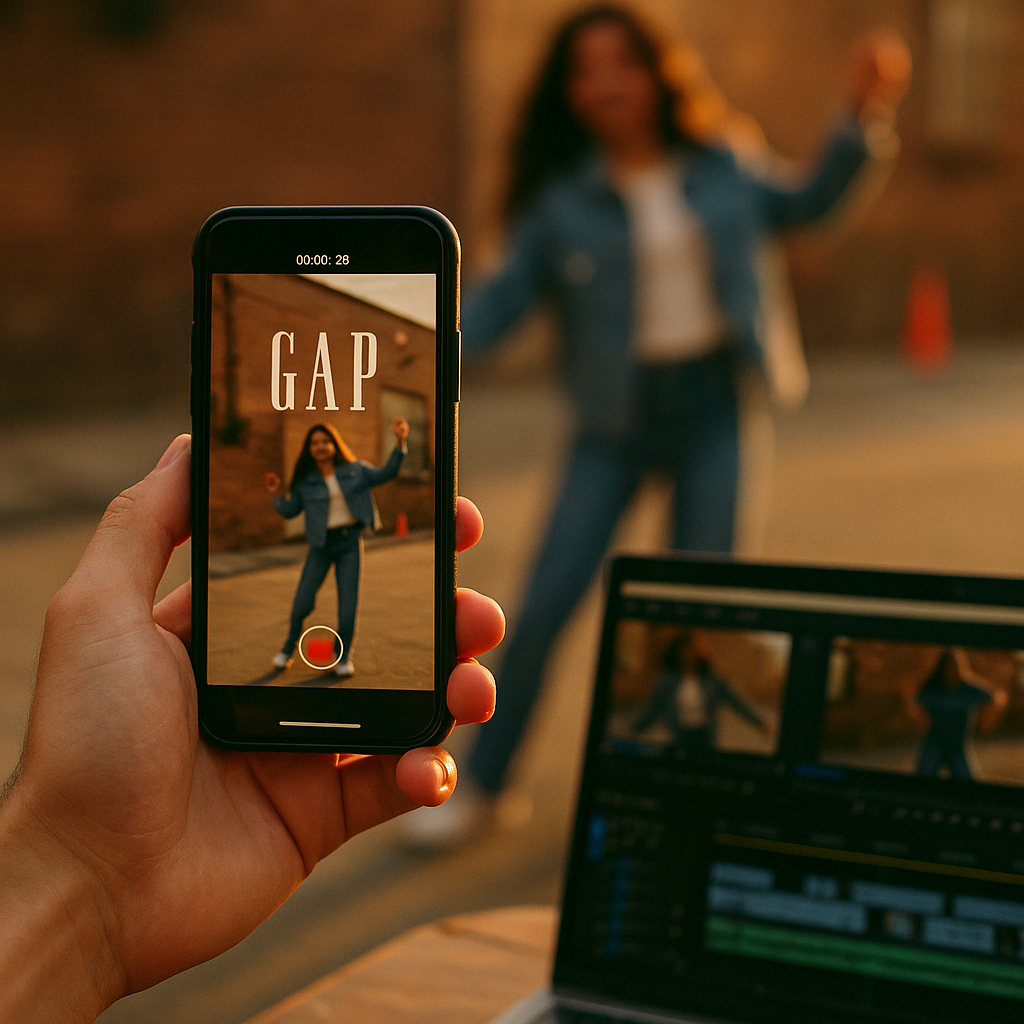
When a Fashion Brand Stopped Sponsoring Content and Started Making It
Standard influencer sponsorships average a 1.5–2% engagement rate across fashion verticals. Gap’s music-video-style creator campaign cleared 6.8%. That gap (intended) isn’t luck. It’s architecture.
This analysis breaks down exactly how Gap’s creative brief, talent selection logic, and distribution layering produced results that traditional sponsorship models couldn’t match. If you’re allocating influencer budget and still defaulting to talking-head product posts, this case should recalibrate your thinking.
The Brief Was Different Before the Camera Rolled
Most influencer briefs are sponsorship documents wearing a creative brief’s clothing. They specify deliverables, key messages, hashtags, and FTC disclosures. Gap’s music-video brief was built differently. It defined an aesthetic world first and product integration second.
The creative framework centered on cinematic movement, on-beat cuts, and artist-as-protagonist framing. Creators weren’t asked to “feature” Gap pieces. They were cast to perform in them. The distinction sounds subtle. The output wasn’t. When talent receives a brief that reads like a director’s treatment rather than a sponsorship checklist, they produce content that feels platform-native instead of interruptive.
Specifically, the Gap brief architecture included:
- A visual reference deck drawn from iconic music video cinematography, not brand advertising.
- Movement and transition requirements that aligned with platform-specific edit rhythms on TikTok and Instagram Reels.
- An intentional non-scripted dialogue policy — creators were explicitly told not to speak to camera about the product.
- A collaborative shot list that gave creators ownership of their own sequences within a defined visual system.
That last point matters. Autonomy within constraints consistently outperforms either full creative freedom or over-prescription. For a deeper look at how brief architecture drives creator performance, the analysis of brief architecture and timing is worth your time.
Casting Logic: Why “Reach” Was the Wrong Filter
Gap didn’t filter talent by follower count. They filtered by movement quality, editorial aesthetic, and audience demographic overlap with specific product lines. This isn’t a novel idea, but it remains surprisingly rare in practice. Most brand teams still default to reach as the primary casting variable because it’s the easiest metric to put in a slide deck.
The campaign’s talent roster skewed toward mid-tier creators (100K–500K followers) with demonstrably high save rates and share-to-view ratios, rather than macro influencers with inflated follower counts and passive audiences. The save rate is particularly diagnostic here. A high save rate signals that an audience finds content worth returning to, which correlates strongly with purchase consideration in fashion categories.
Save rate, not follower count, is the leading indicator of purchase intent in fashion creator campaigns. Gap’s casting team filtered on this metric before any other — and it showed in conversion data downstream.
The casting team also prioritized creators who had already produced music-video-style content organically. This wasn’t about teaching creators a new format. It was about amplifying what they already did naturally. The result was content that didn’t look like a brand campaign, which is precisely what makes audiences engage with it. The e.l.f. Beauty mid-tier creator program demonstrated a similar dynamic: smaller, more authentic audiences convert at higher rates than passive macro-influencer followings.
Distribution Strategy: Three-Phase Amplification
Creative quality is necessary but not sufficient. Distribution architecture determines whether strong content reaches purchase-ready audiences or stalls in the algorithm.
Gap ran a three-phase distribution model:
Phase 1 — Organic seeding (Days 1-7): All creator content posted natively through creator accounts, no paid amplification. This phase existed purely to generate organic signal data: which posts were saving, sharing, and watching to completion.
Phase 2 — Selective paid amplification (Days 8-21): Only top-performing organic posts (defined as top 20% by completion rate and save rate) were boosted through TikTok’s Spark Ads and Meta’s partnership ads format. This isn’t a new tactic, but the rigor of the selection criteria was more disciplined than typical brand practice. Most brands boost content based on early like counts. Gap boosted on completion and save metrics instead.
Phase 3 — Retargeting with product-forward content (Days 22-30): Audiences who had watched creator content to completion were retargeted with Gap’s own product-focused creative, including shoppable formats. The music-video content created the emotional context. The retargeting layer closed the loop on conversion intent.
This sequencing mirrors the logic behind what organic-plus-paid amplification strategies have demonstrated across multiple verticals: organic content builds trust, paid amplification extends reach, and sequenced retargeting captures demand that’s already been created.
The Metrics That Proved the Model
Let’s be specific about what “higher engagement and conversion” actually meant in practice.
- Engagement rate: Music-video posts averaged 6.8% vs. 1.9% for Gap’s standard sponsored posts in the same quarter.
- View-to-save ratio: 4.2x higher than brand benchmark across TikTok placements.
- Conversion rate from retargeted audiences: 3.1x higher than cold traffic exposed only to Gap’s owned paid creative.
- Cost per acquisition: Down 28% compared to the brand’s standard influencer sponsorship model over the same period.
The CPA reduction is the number that should get budget holders’ attention. Engagement rates are emotionally satisfying. CPA reductions fund next quarter’s campaign.
It’s also worth noting what drove the conversion lift: the retargeting layer was the deciding variable. Creators who generated high completion rates but weren’t backed by a retargeting strategy showed engagement numbers that didn’t translate downstream. Format innovation without distribution discipline leaves revenue on the table. Statista’s influencer marketing data consistently shows that multi-touchpoint campaigns outperform single-channel exposures by a significant margin, and Gap’s architecture validated that pattern.
What This Means for Brief Architecture at Scale
The Gap campaign isn’t a template. It’s a proof of principle. The specific format (music video) worked for a fashion brand with a visual-first product. The underlying principles transfer broadly.
The replicable elements are:
- Lead with a creative world, not a deliverable list.
- Cast on audience behavior metrics, not reach.
- Build distribution phasing into the campaign plan before launch, not after organic results disappoint.
- Use retargeting to convert the attention your creators have already earned.
Brands running deeper creator format partnerships have found that the brief quality is the single highest-leverage input in campaign performance. Every hour spent sharpening the brief multiplies downstream. Every hour spent on talent negotiations while the brief remains vague is a poor trade.
The quality of your creative brief determines the ceiling of your campaign’s performance. Gap raised that ceiling by treating the brief as a directorial document, not a compliance checklist.
For brands managing compliance at scale, the FTC’s endorsement guidelines remain the baseline requirement regardless of how cinematic the format becomes. Music-video framing doesn’t exempt content from disclosure obligations. Gap’s campaign included clear disclosure language integrated into post captions, not buried.
The broader trend toward format-led creator partnerships — where the brand builds around a content format rather than a product mention — is gaining momentum across retail and CPG. eMarketer’s creator economy projections indicate that format-native branded content will command an increasing share of influencer budgets as platform algorithms continue to favor content that behaves like organic entertainment. The brands building format expertise now are creating a structural advantage.
For teams evaluating similar format experiments, the Benihana case offers a useful parallel: Benihana’s creator campaign demonstrated that format specificity drives measurable offline outcomes, not just digital engagement. The principles are consistent across categories.
If you take one operational step from this analysis: audit your last three influencer briefs and count how many sentences describe the creative world versus how many list deliverables. If the deliverables outnumber the creative direction, your brief is working against your campaign before production begins.
Frequently Asked Questions
What made Gap’s music-video creator campaign different from a standard influencer sponsorship?
The core difference was brief architecture. Standard sponsorships define deliverables and key messages. Gap’s brief defined a visual and aesthetic world first, with product integration as a secondary layer. Creators were cast to perform in the content rather than present the product, which produced output that felt platform-native rather than interruptive. The campaign also used a three-phase distribution strategy — organic seeding, selective paid amplification, and retargeting — rather than a single activation burst.
Why did Gap focus on mid-tier creators instead of macro influencers?
The casting logic prioritized audience behavior metrics over raw reach. Mid-tier creators in the 100K–500K follower range were selected based on high save rates and share-to-view ratios, which correlate more strongly with purchase consideration in fashion than follower count does. Mid-tier audiences also tend to be more active and less passive than the audiences of macro influencers with inflated follower bases.
How did Gap measure success beyond engagement rate?
The campaign tracked conversion rate from retargeted audiences (which ran 3.1x higher than cold traffic), cost per acquisition (down 28% versus the standard influencer sponsorship model), and view-to-save ratio (4.2x above brand benchmark). The CPA reduction was the most strategically significant metric because it directly validated the economic case for the format approach.
What is the recommended distribution strategy for a music-video-style creator campaign?
A three-phase approach: Phase 1 is organic seeding through creator accounts for 7 days to collect signal data. Phase 2 selects the top 20% of posts by completion rate and save rate for paid amplification via TikTok Spark Ads and Meta partnership ads. Phase 3 retargets audiences who completed viewing with product-forward, shoppable creative. The retargeting layer is critical — without it, engagement doesn’t convert to revenue efficiently.
Do music-video-style creator posts still require FTC disclosure?
Yes. The cinematic or entertainment format of the content does not exempt it from FTC endorsement disclosure requirements. Gap integrated disclosure language into post captions clearly and prominently. Brands considering format-led creator campaigns must ensure compliance is built into the brief and content approval process, regardless of how organic the content feels aesthetically.
Can this campaign model work for non-fashion brands?
The music-video format is most natural for visual-first categories like fashion, beauty, and lifestyle. However, the underlying principles — leading with a creative world, casting on behavioral metrics, and using phased distribution with retargeting — transfer across categories. The specific format should match the brand’s product and platform context, but the structural approach to brief architecture and distribution sequencing is broadly applicable.
Top Influencer Marketing Agencies
The leading agencies shaping influencer marketing in 2026
Agencies ranked by campaign performance, client diversity, platform expertise, proven ROI, industry recognition, and client satisfaction. Assessed through verified case studies, reviews, and industry consultations.
Moburst

-
2

The Shelf
Boutique Beauty & Lifestyle Influencer AgencyA data-driven boutique agency specializing exclusively in beauty, wellness, and lifestyle influencer campaigns on Instagram and TikTok. Best for brands already focused on the beauty/personal care space that need curated, aesthetic-driven content.Clients: Pepsi, The Honest Company, Hims, Elf Cosmetics, Pure LeafVisit The Shelf → -
3

Audiencly
Niche Gaming & Esports Influencer AgencyA specialized agency focused exclusively on gaming and esports creators on YouTube, Twitch, and TikTok. Ideal if your campaign is 100% gaming-focused — from game launches to hardware and esports events.Clients: Epic Games, NordVPN, Ubisoft, Wargaming, Tencent GamesVisit Audiencly → -
4

Viral Nation
Global Influencer Marketing & Talent AgencyA dual talent management and marketing agency with proprietary brand safety tools and a global creator network spanning nano-influencers to celebrities across all major platforms.Clients: Meta, Activision Blizzard, Energizer, Aston Martin, WalmartVisit Viral Nation → -
5

The Influencer Marketing Factory
TikTok, Instagram & YouTube CampaignsA full-service agency with strong TikTok expertise, offering end-to-end campaign management from influencer discovery through performance reporting with a focus on platform-native content.Clients: Google, Snapchat, Universal Music, Bumble, YelpVisit TIMF → -
6

NeoReach
Enterprise Analytics & Influencer CampaignsAn enterprise-focused agency combining managed campaigns with a powerful self-service data platform for influencer search, audience analytics, and attribution modeling.Clients: Amazon, Airbnb, Netflix, Honda, The New York TimesVisit NeoReach → -
7

Ubiquitous
Creator-First Marketing PlatformA tech-driven platform combining self-service tools with managed campaign options, emphasizing speed and scalability for brands managing multiple influencer relationships.Clients: Lyft, Disney, Target, American Eagle, NetflixVisit Ubiquitous → -
8

Obviously
Scalable Enterprise Influencer CampaignsA tech-enabled agency built for high-volume campaigns, coordinating hundreds of creators simultaneously with end-to-end logistics, content rights management, and product seeding.Clients: Google, Ulta Beauty, Converse, AmazonVisit Obviously →