


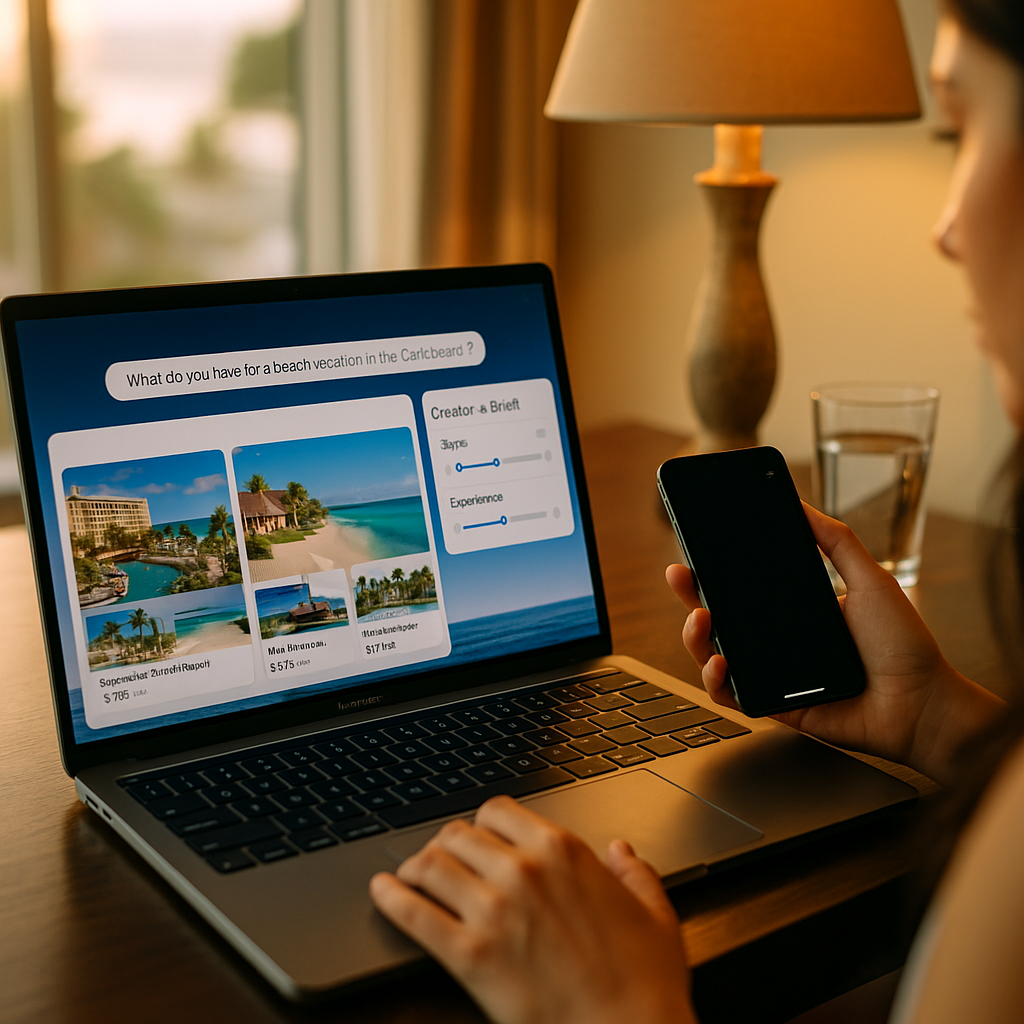
If Your Creator Content Isn’t Answering Questions, It’s Invisible
Generative AI search now influences over 40% of travel-related queries processed through Google, according to data cited by Statista. Marriott’s deployment of a conversational AI search platform, built with Google’s generative infrastructure, isn’t a hotel tech story. It’s a signal flare for every hospitality brand marketer running creator programs today.
What Marriott Actually Built
Marriott’s conversational search experience pulls intent signals from natural language queries and surfaces property recommendations through a layered AI interface. The platform interprets prompts like “best hotel for a quiet work trip near downtown Nashville” and synthesizes structured and unstructured content to produce tailored responses. That unstructured content includes reviews, editorial features, and yes, creator-generated posts indexed across the open web.
The Google partnership matters because it means the underlying retrieval architecture mirrors how Google’s Search Generative Experience (SGE) and AI Overviews work. Content that performs in one environment tends to perform in the other. For brand marketers, this is the key operational implication: creator content optimized for Marriott’s AI discovery layer is, by extension, optimized for broader generative search behavior across Google’s ecosystem.
Creator content that doesn’t contain specific, answerable claims — location context, amenity language, use-case framing — will be deprioritized by generative AI retrieval systems in favor of content that directly responds to traveler intent queries.
Why Intent-Driven Discovery Breaks Traditional Creator Briefs
Most hospitality creator briefs are built around aesthetics. Beautiful pool shot. Ambient lobby footage. A time-lapse of room service arriving at golden hour. These perform on Instagram because they match a discovery model driven by visual appeal and follower affinity. Generative AI search retrieval doesn’t work that way.
AI retrieval systems parse content for semantic relevance to a query. A creator post that says “stayed at the Marriott Bonvoy property in Austin, great for solo business travelers, fast WiFi, quiet rooms on upper floors, walking distance to the convention center” is retrievable by a generative engine answering “best Austin hotel for solo work trips.” A post that says “obsessed with this view” is not. The language gap between those two content types is a direct gap in your program’s discoverability.
This isn’t just theory. Airbnb’s creator strategy for local influencer content demonstrated that specificity of place and use case directly correlated with booking attribution. The mechanism was different, but the underlying principle is identical: descriptive, contextual creator content converts better than aspirational visual content across both algorithmic and AI-driven discovery environments.
The Three Layers of Creator Content Generative AI Systems Can Index
Understanding what gets surfaced requires understanding the retrieval stack. For hospitality brands operating within or alongside Marriott’s ecosystem (think co-branded credit card partners, SPG affiliate properties, or competing hotel groups building similar infrastructure), creator content feeds into three distinct layers:
- Long-form editorial and blog content: Creator posts published on personal websites, Substack newsletters, or travel blogs carry the highest semantic weight for generative retrieval. Google’s crawlers have indexed this content for years, and AI systems draw heavily from it when composing search responses.
- Structured social captions and video descriptions: YouTube video descriptions and TikTok captions with keyword-rich, specific language are increasingly indexed by generative systems. A 200-word TikTok description covering location, amenities, traveler type, and trip context is a legitimate retrieval asset.
- Review and UGC platforms: TripAdvisor, Google Reviews, and even Reddit threads remain high-authority sources for generative AI answers. Brands that build creator advocacy programs encouraging detailed review publishing are building a retrieval moat.
Most current hospitality creator programs invest heavily in the middle layer and almost nothing in the first and third. That’s where the gap is.
Briefing Creators for Generative Search: What Changes Operationally
This isn’t a call to make creator content sound like SEO copy. It’s a call to add intent-layer requirements to your existing brief architecture without killing the authenticity that makes creator content perform in the first place.
Practically, this means four additions to your creator brief:
- Specify the traveler archetype explicitly. “Business traveler,” “solo female traveler,” “anniversary trip couple,” “family with toddlers” — these phrases should appear in creator content because they map directly to natural language queries. Ask creators to name the archetype they’re speaking to.
- Require location specificity. City plus neighborhood plus proximity landmarks. Not just “Miami” but “South Beach, walking distance to Lincoln Road, five minutes from the Art Deco district.”
- Mandate at least three amenity or use-case claims. Specific, verifiable, and phrased the way a traveler would search for them.
- Encourage long-form companion content. A 60-second TikTok paired with a 600-word blog post indexed on the creator’s own site doubles the retrieval surface area for the same creative investment.
For operational context on how brief architecture affects downstream performance, the brief architecture and timing framework is directly applicable here — the same principles that govern trend responsiveness govern generative search optimization.
The Competitive Risk If You Don’t Adapt
Marriott is running a controlled advantage right now. Their AI search platform is surfacing their own properties in response to queries that might otherwise send travelers to Google Hotels, Expedia, or Booking.com. If Marriott’s creator-generated content pool is richer, more specific, and more semantically aligned with traveler intent queries than competitors’, their AI system will consistently produce better answers, and travelers will stay in the loop longer.
Competing brands — Hilton, Hyatt, IHG — face a choice: build comparable AI search infrastructure (expensive, slow) or out-optimize the content layer that feeds any generative retrieval system (faster, creator-program-level achievable). The content layer is where influencer programs have immediate leverage.
This mirrors what Benihana demonstrated in a different hospitality vertical. Their creator campaign reservation lift was built on specific, action-oriented content that matched how diners actually search. The mechanism scales directly to hotel discovery when the brief is designed for intent alignment rather than pure reach.
The hotel brand that builds the most semantically rich creator content library wins the generative search response. This is now a content operations problem as much as a creative one.
Measurement: What Shifts When AI Search Is in the Conversion Path
Your current attribution model almost certainly doesn’t account for generative AI search as a touchpoint. If a traveler asks Google’s AI Overview “best luxury hotel for a solo work trip in Nashville,” reads a synthesized response that cites a creator’s blog post, and then books directly through Marriott.com, that creator gets zero attribution credit in a standard UTM-based model.
This is an urgent gap. Brands running sophisticated creator programs are already building dark social and assisted-conversion measurement frameworks. AI identity resolution approaches used by Coke, Hershey, and United offer a template: probabilistic attribution that connects content consumption to downstream conversion without requiring a direct click path. Hospitality brands need to apply this logic to generative search pathways specifically.
Concretely, this means running incrementality tests against creator content pools optimized for generative retrieval versus those optimized purely for social engagement. The test design isn’t complicated; the organizational will to run it is the harder challenge. Work with your Google account team to access SGE impression data where available, and layer that against creator content publication timelines.
For brands already using creator content to drive in-store and in-venue conversion, the micro-creator traffic model pioneered by Lowe’s offers useful measurement architecture that translates well to hospitality: correlate creator content volume and specificity with booking window data rather than direct click attribution.
Finally, don’t overlook eMarketer’s travel digital ad benchmarks and TikTok’s hospitality vertical data when building the business case internally. Showing leadership that generative search is already influencing traveler decision journeys — with third-party data behind the claim — is often what unlocks creator brief budget for this kind of optimization work.
Start by auditing your last six months of creator content against the intent-alignment criteria above. Score each asset for traveler archetype specificity, location detail, and amenity claim density. The gap will be obvious, and the brief changes required to close it are tactical, not transformational.
Frequently Asked Questions
What is Marriott’s conversational AI search platform and how does it relate to Google?
Marriott’s conversational AI search platform is a generative AI-powered tool that interprets natural language travel queries and surfaces personalized property recommendations. It is built in partnership with Google, meaning its retrieval architecture closely mirrors Google’s Search Generative Experience and AI Overviews. For brand marketers, this means content optimized for one environment tends to perform in the other.
How should hospitality brand marketers change their creator briefs to optimize for AI search?
Briefs should require creators to name specific traveler archetypes, include precise location details (city, neighborhood, proximity landmarks), make at least three specific amenity or use-case claims, and produce long-form companion content such as blog posts alongside short-form social content. These changes improve semantic relevance for generative AI retrieval without sacrificing authentic voice.
Does creator content on social platforms like TikTok or Instagram get indexed by AI search systems?
Partially. YouTube video descriptions and TikTok captions with specific, keyword-rich language are increasingly indexed by generative systems. However, long-form content on personal websites and blogs carries significantly more semantic weight. Instagram captions are largely not crawlable at scale. Brands should encourage creators to publish companion long-form content to maximize retrieval surface area.
How do you measure creator content performance when AI search is in the conversion path?
Standard UTM-based attribution models miss AI-assisted conversions where a traveler discovers creator content through a generative search response and then books directly. Brands should implement incrementality testing comparing AI-optimized versus standard creator content pools, use probabilistic identity resolution to connect content consumption to downstream bookings, and work with Google account teams to access available SGE impression data.
Which hotel brands are most at risk from Marriott’s AI search advantage?
Directly competing full-service and luxury brands including Hilton, Hyatt, and IHG face the clearest competitive risk. If Marriott’s creator content library is more semantically aligned with traveler intent queries, their AI system will consistently produce more relevant responses, keeping travelers inside the Marriott discovery loop rather than navigating to third-party OTAs or competitor sites.
Top Influencer Marketing Agencies
The leading agencies shaping influencer marketing in 2026
Agencies ranked by campaign performance, client diversity, platform expertise, proven ROI, industry recognition, and client satisfaction. Assessed through verified case studies, reviews, and industry consultations.
Moburst

-
2

The Shelf
Boutique Beauty & Lifestyle Influencer AgencyA data-driven boutique agency specializing exclusively in beauty, wellness, and lifestyle influencer campaigns on Instagram and TikTok. Best for brands already focused on the beauty/personal care space that need curated, aesthetic-driven content.Clients: Pepsi, The Honest Company, Hims, Elf Cosmetics, Pure LeafVisit The Shelf → -
3

Audiencly
Niche Gaming & Esports Influencer AgencyA specialized agency focused exclusively on gaming and esports creators on YouTube, Twitch, and TikTok. Ideal if your campaign is 100% gaming-focused — from game launches to hardware and esports events.Clients: Epic Games, NordVPN, Ubisoft, Wargaming, Tencent GamesVisit Audiencly → -
4

Viral Nation
Global Influencer Marketing & Talent AgencyA dual talent management and marketing agency with proprietary brand safety tools and a global creator network spanning nano-influencers to celebrities across all major platforms.Clients: Meta, Activision Blizzard, Energizer, Aston Martin, WalmartVisit Viral Nation → -
5

The Influencer Marketing Factory
TikTok, Instagram & YouTube CampaignsA full-service agency with strong TikTok expertise, offering end-to-end campaign management from influencer discovery through performance reporting with a focus on platform-native content.Clients: Google, Snapchat, Universal Music, Bumble, YelpVisit TIMF → -
6

NeoReach
Enterprise Analytics & Influencer CampaignsAn enterprise-focused agency combining managed campaigns with a powerful self-service data platform for influencer search, audience analytics, and attribution modeling.Clients: Amazon, Airbnb, Netflix, Honda, The New York TimesVisit NeoReach → -
7

Ubiquitous
Creator-First Marketing PlatformA tech-driven platform combining self-service tools with managed campaign options, emphasizing speed and scalability for brands managing multiple influencer relationships.Clients: Lyft, Disney, Target, American Eagle, NetflixVisit Ubiquitous → -
8

Obviously
Scalable Enterprise Influencer CampaignsA tech-enabled agency built for high-volume campaigns, coordinating hundreds of creators simultaneously with end-to-end logistics, content rights management, and product seeding.Clients: Google, Ulta Beauty, Converse, AmazonVisit Obviously →