


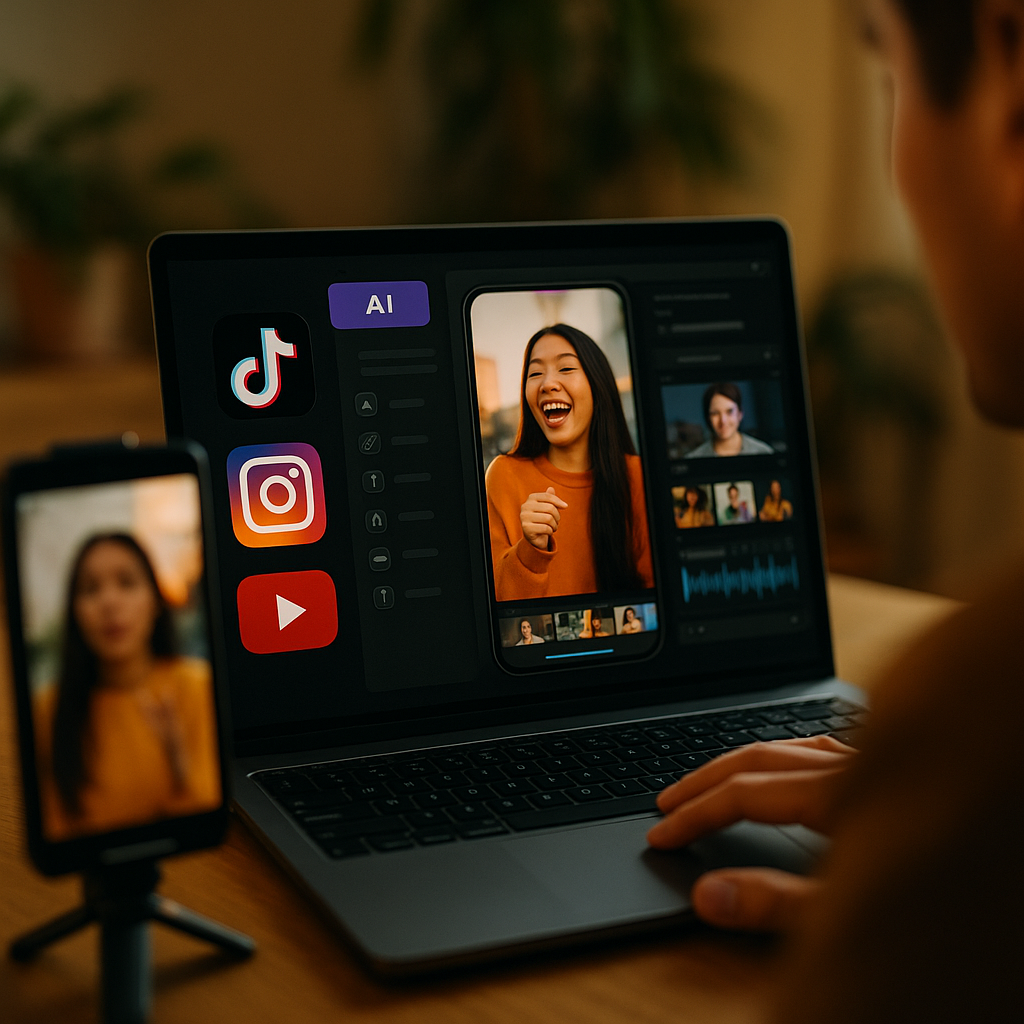
E-commerce brands producing separate video assets for every platform are burning budget. A single AI video editing agent, briefed correctly, can generate compliant, platform-optimized cuts from one product URL in under an hour. Here is how to make that work at scale without sacrificing brand integrity.
Why Multi-Variant Production Is Now a Baseline Expectation
Platform fragmentation is not easing up. TikTok demands 9:16 vertical with a hook inside the first two seconds. Meta’s feed algorithm actively suppresses square videos that stray from its 1:1 format preferences. YouTube Shorts wants native vertical, while standard YouTube pre-roll still performs best in 16:9 widescreen. Running a single hero cut across all three is leaving conversion on the table.
What changed recently is the tooling. AI video editing agents like Runway, Pika, and enterprise platforms like Pencil or Treated can now accept a product URL, scrape product imagery and copy, and generate multiple format-specific variants in a single pipeline pass. The constraint was never the technology. It was the brief.
Brands that invest in structured AI briefs before touching any tool reduce revision cycles by an estimated 40 percent and cut time-to-publish from days to hours, according to early adopter case studies in the DTC sector.
Building the Master Brief: What an AI Agent Actually Needs
Think of your AI video editing agent less like a tool and more like a junior editor who has never seen your brand before. Every assumption you hold about tone, color, pacing, and legal compliance needs to be explicit.
Start with the product anchor. Feed the agent the canonical product URL, not a redirect or a campaign landing page. The agent needs clean structured data: product name, price, key feature claims, imagery assets, and any restricted language your legal team has flagged. If your product listing contains unverified health claims, that is the point where a human gate should exist before AI output goes anywhere near paid media.
Your master brief should define five core variables:
- Brand voice parameters: Tone adjectives (energetic, clinical, dry humor), prohibited words, and required brand handles or hashtags
- Visual identity constraints: Hex codes, approved font stacks, logo placement safe zones, and watermark rules
- Disclosure requirements: Where sponsored labels, affiliate disclosures, or #ad tags must appear and in what format per platform
- Platform-specific output specs: Aspect ratios, maximum duration, safe zones for UI overlays, and caption burn-in preferences
- Hook library: Three to five pre-approved opening lines the agent can select from based on audience persona signals
For teams already running multi-format creator briefs, the transition to AI-agent briefing is less steep than you might think. The structure is largely the same; the difference is that precision errors that a human creator might intuit around get surfaced immediately as malformed output.
Platform-Specific Output Logic: Where Most Brands Get It Wrong
The biggest mistake is treating this as a crop-and-resize exercise. It is not. Each platform variant needs its own pacing logic, not just its own dimensions.
TikTok cuts should front-load the conflict or curiosity gap. The first 1.5 seconds must earn the scroll-stop. Brief your agent to place the primary product benefit claim within the first 3 seconds, keep total duration between 21 and 34 seconds for most product categories, and ensure any on-screen text avoids the bottom 20 percent of the frame where TikTok’s native UI overlays sit. For hook structures specific to TikTok FYP, the pattern matters as much as the words.
Meta placements require a different brief layer. Instagram Reels rewards slightly slower pacing than TikTok. Feed placements, particularly the 1:1 format, need product visibility in the first frame because users often experience these without sound. Brief the agent to generate a silent-watchable version for Meta feed alongside the audio-led Reels cut. See also the operational guidance on how to brief for Meta’s 1:1 format to avoid algorithmic suppression.
YouTube’s dual-format reality (Shorts versus pre-roll) means your agent should produce two distinct YouTube outputs. Shorts follow the same 9:16 logic as TikTok with slightly longer tolerance for setup. Pre-roll needs the brand mark and product CTA visible within the first 5 seconds before the skip button appears at second six.
Disclosure Compliance Is Not Optional, and AI Agents Cannot Own It
This is the area where brand teams most often underestimate their liability. FTC guidelines require clear and conspicuous disclosure for any material connection between a brand and content promoting its products, regardless of whether the content was produced by a human creator or an AI system. The origin of the content does not change the disclosure obligation.
When briefing AI agents, disclosure instructions must be explicit and non-negotiable in the prompt architecture. Do not leave this to post-production review. Instruct the agent to:
- Burn in a “Paid partnership” or “#ad” label as a persistent on-screen overlay for the full duration of any paid placement
- Place disclosure text above the fold on any platform where native disclosure tools exist (Meta’s paid partnership tag, TikTok’s branded content toggle)
- Flag any generated script language that makes comparative claims against named competitors for human legal review before export
- Output a compliance metadata file alongside each video, documenting which disclosure elements were applied and where
For teams managing affiliate-driven content at scale, the same logic applies to affiliate link disclosure. FTC enforcement has increasingly focused on inadequate disclosure in short-form video, and AI-generated volume makes the audit trail more important, not less.
Creative Quality Gates: Keeping Human Judgment in the Loop
Automated production scales output. It does not guarantee quality. The brands running this well are not removing humans from the process. They are repositioning humans earlier in the workflow, at the brief stage, and at the final quality gate before any asset goes live.
Build a three-point quality gate into your pipeline. First, a brand safety check: does the output contain any visual or audio element that contradicts your brand guidelines or creates reputational risk? Tools like Moderation API and Clarifai can automate much of this, but a human creative director should spot-check at least 20 percent of output, especially for new product launches.
Second, a compliance audit: are disclosure labels present, correctly sized, and visible against the background? This is a manual check until automated disclosure verification tools mature further.
Third, a platform-fit review: does the cut feel native to the platform, or does it feel like a repurposed asset? This is the hardest thing to systematize and the most valuable thing a human reviewer can catch. A modular UGC pipeline approach can help standardize what “native” looks like for each platform before agents are briefed, giving reviewers a clearer rubric.
Scaling the System: From One Product Link to a Full Catalog
Once your brief architecture works for one product, catalog scaling becomes a templating exercise. The master brand brief stays constant. The product-specific layer, built from the scraped product URL, swaps in per SKU. Most enterprise AI video platforms support batch processing with variable injection, meaning your agent can process 50 product URLs overnight and return platform-ready cuts for each by morning.
The operational unlock here is separating the creative strategy work (which humans should do once, well) from the production execution work (which agents can do at volume). For teams building out AI video ad pipelines for DTC, this separation is the difference between a tool that saves a few hours and a system that restructures your production economics entirely.
According to eMarketer projections, AI-assisted video ad creation will account for over 60 percent of performance video production for mid-market e-commerce brands by the end of this decade. The brands building structured brief systems now are building compounding operational advantages.
Integrate your agent outputs directly into your creative testing infrastructure. Platforms like Motion or Triple Whale can ingest variant performance data and feed signal back into your next brief cycle, creating a closed-loop system where the brief gets smarter with every campaign.
For teams also managing AI UGC variant testing at scale, connecting hook performance data to your brief templates is where the real efficiency gains compound. When you know that a question-format hook outperforms a statement hook by 23 percent for your skincare SKUs, that goes into the brief as a weighted instruction, not a suggestion.
Reference TikTok Ads Manager and Meta Business Suite for their latest creative specifications before locking your platform output specs; both update their technical requirements regularly, and an agent briefed on outdated specs will produce technically non-compliant assets at scale.
Start here: audit your current product listing quality before briefing any agent. Clean, structured product data is the foundation. If your product URLs return inconsistent imagery, incomplete descriptions, or unverified claims, fix that first. No AI brief compensates for corrupted source data.
FAQs
What does an AI video editing agent need from a product URL to generate platform-ready cuts?
The agent needs clean, structured data from the product page: product name, pricing, key feature claims, high-resolution imagery, and any brand or legal copy restrictions. Ensure the URL resolves to a canonical product page, not a redirect or campaign landing page, and that the page content is free of unverified claims before the agent scrapes it.
How do disclosure requirements apply to AI-generated branded video content?
FTC guidelines require clear and conspicuous disclosure for any material connection between a brand and promotional content, regardless of whether the content was created by a human or an AI agent. Disclosure instructions must be built into the AI brief itself, not added as a post-production afterthought. Persistent on-screen labels and platform-native disclosure tools must both be activated for paid placements.
How do you maintain creative quality when AI agents are producing at volume?
Build a three-point quality gate: brand safety check (automated plus human spot-check), compliance audit (manual verification of disclosure elements), and platform-fit review (human assessment of whether the cut feels native). Positioning humans at the brief stage and final review gate, rather than in mid-production, preserves quality without negating the speed advantage of automated production.
Can the same AI brief be used for TikTok, Meta, and YouTube outputs simultaneously?
A master brand brief can be shared across all platforms, but each platform requires a dedicated output specification layer covering aspect ratio, duration, pacing logic, safe zones, and hook placement. Treating multi-platform production as a simple crop-and-resize operation is the most common reason AI-generated video underperforms on specific platforms.
How do you scale multi-variant AI video production across a full product catalog?
Once the master brief architecture is validated for one product, catalog scaling becomes a variable injection exercise. Most enterprise AI video platforms support batch processing where the brand brief stays constant and the product-specific data layer swaps in per SKU. Connecting variant performance data from tools like Motion or Triple Whale back into your brief templates creates a closed-loop system that improves output quality over time.
Top Influencer Marketing Agencies
The leading agencies shaping influencer marketing in 2026
Agencies ranked by campaign performance, client diversity, platform expertise, proven ROI, industry recognition, and client satisfaction. Assessed through verified case studies, reviews, and industry consultations.
Moburst

-
2

The Shelf
Boutique Beauty & Lifestyle Influencer AgencyA data-driven boutique agency specializing exclusively in beauty, wellness, and lifestyle influencer campaigns on Instagram and TikTok. Best for brands already focused on the beauty/personal care space that need curated, aesthetic-driven content.Clients: Pepsi, The Honest Company, Hims, Elf Cosmetics, Pure LeafVisit The Shelf → -
3

Audiencly
Niche Gaming & Esports Influencer AgencyA specialized agency focused exclusively on gaming and esports creators on YouTube, Twitch, and TikTok. Ideal if your campaign is 100% gaming-focused — from game launches to hardware and esports events.Clients: Epic Games, NordVPN, Ubisoft, Wargaming, Tencent GamesVisit Audiencly → -
4

Viral Nation
Global Influencer Marketing & Talent AgencyA dual talent management and marketing agency with proprietary brand safety tools and a global creator network spanning nano-influencers to celebrities across all major platforms.Clients: Meta, Activision Blizzard, Energizer, Aston Martin, WalmartVisit Viral Nation → -
5

The Influencer Marketing Factory
TikTok, Instagram & YouTube CampaignsA full-service agency with strong TikTok expertise, offering end-to-end campaign management from influencer discovery through performance reporting with a focus on platform-native content.Clients: Google, Snapchat, Universal Music, Bumble, YelpVisit TIMF → -
6

NeoReach
Enterprise Analytics & Influencer CampaignsAn enterprise-focused agency combining managed campaigns with a powerful self-service data platform for influencer search, audience analytics, and attribution modeling.Clients: Amazon, Airbnb, Netflix, Honda, The New York TimesVisit NeoReach → -
7

Ubiquitous
Creator-First Marketing PlatformA tech-driven platform combining self-service tools with managed campaign options, emphasizing speed and scalability for brands managing multiple influencer relationships.Clients: Lyft, Disney, Target, American Eagle, NetflixVisit Ubiquitous → -
8

Obviously
Scalable Enterprise Influencer CampaignsA tech-enabled agency built for high-volume campaigns, coordinating hundreds of creators simultaneously with end-to-end logistics, content rights management, and product seeding.Clients: Google, Ulta Beauty, Converse, AmazonVisit Obviously →