


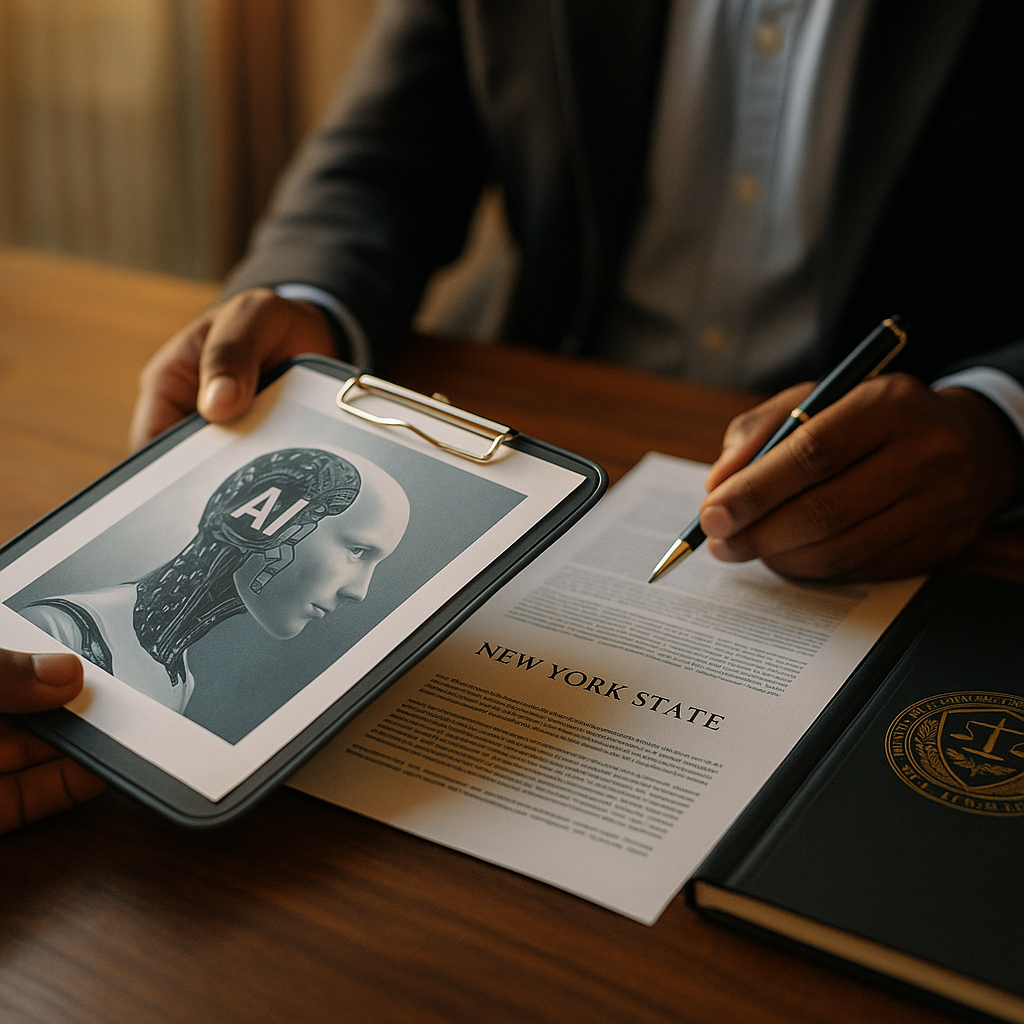
Nearly 60% of brands using AI-generated spokespeople in sponsored content have no documented disclosure protocol. With New York’s synthetic performer law now in effect alongside FTC disclosure standards, that gap is no longer a compliance footnote — it’s a liability.
What New York’s Synthetic Performer Law Actually Requires
New York’s law targets the use of digital replicas and AI-generated performers in commercial content. The statute applies when a brand uses a synthetic version of a real person’s likeness, voice, or performance without consent, or when a fully AI-generated performer is deployed in sponsored content without adequate disclosure to viewers. It covers both situations: replicated real people and wholly synthetic characters.
The consent and disclosure obligations fall on the contracting party, which in most influencer and creator campaigns means the brand or its agency of record. Creators who produce AI-generated content under a paid agreement share liability, but brands cannot contract their way out of primary accountability. If your brief authorized synthetic talent, your legal team needs to know.
Penalties include civil action from the performer whose likeness was used without consent and potential statutory damages. For fully synthetic performers without a real-world counterpart, the disclosure obligation still applies: audiences must be able to identify that they are watching AI-generated content in a sponsored context. The law does not require massive disclaimers, but it does require clear, conspicuous disclosure at the point of engagement.
The New York law applies to the contracting party — which means brands and agencies bear primary disclosure liability, not just the creators they hire.
For a deeper breakdown of exactly what the statute covers, the NY synthetic performer compliance guide maps the key definitions and thresholds that matter for campaign teams.
Where FTC Standards Overlap — and Where They Diverge
The FTC’s endorsement guidelines already require clear and conspicuous disclosure of material connections in sponsored content. What changed is that the FTC now explicitly addresses AI-generated endorsers. Under current guidance, if a brand uses an AI persona to endorse a product — even a persona with no real human counterpart — that relationship must be disclosed.
So where do the two frameworks converge? Both require disclosure to be viewer-facing, not buried in captions or accessible only via link. Both require it to be in the same content frame as the commercial message. And both place the burden on the brand to ensure compliance, regardless of which party produced the asset.
The divergence is in scope. The FTC framework is federal and applies to all commercial endorsements across all platforms. New York’s law is state-specific but creates additional civil liability pathways. A campaign that satisfies FTC disclosure requirements may still fall short of New York’s synthetic performer consent provisions if a real person’s likeness was digitally replicated without a proper agreement in place.
Brands operating at scale need to audit both simultaneously. The FTC dual disclosure framework for AI and influencer campaigns is a practical starting point for teams that haven’t yet reconciled the two compliance layers.
Platform by Platform: What “Clear and Conspicuous” Looks Like
The phrase “clear and conspicuous” does different work on different platforms. Here’s how compliance teams should think about each major channel.
TikTok: TikTok’s Branded Content Policy requires use of its native disclosure toggle, which generates an automatic “Paid Partnership” label. For AI-generated performers, that toggle is necessary but not sufficient under either the FTC or New York standards. The synthetic nature of the performer must also be disclosed in the video itself — spoken, captioned, or both. Embedding it only in the description or comments does not meet the conspicuousness test. For brands running TikTok Shop integrations with AI talent, review the FTC disclosure rules for TikTok Shop before trafficking any creative.
YouTube: YouTube requires creators to check a “paid promotion” flag in video settings, which generates an on-screen overlay. Again, this handles the paid relationship disclosure but not the AI performer disclosure. For long-form content, the synthetic performer disclosure should appear within the first 30 seconds, not buried after a pre-roll ad or at the end of a six-minute video. For Shorts, it should appear as on-screen text given the no-audio viewing behavior common in that format.
LinkedIn: LinkedIn’s sponsored content labeling handles the paid relationship disclosure automatically for paid distribution. But organic posts featuring AI-generated talent used in a brand context still require manual disclosure. LinkedIn’s professional audience context makes this especially important: undisclosed AI personas in B2B sponsored content carry significant reputational risk beyond the legal exposure.
Instagram: Meta’s Paid Partnership label covers the commercial relationship. The synthetic performer layer requires additional in-feed or in-Story disclosure. For Reels, an on-screen text overlay is the cleanest approach. For static feed posts, the first line of caption (before the “more” truncation) must carry the disclosure. Avoid the common mistake of stacking disclosures at the end of a caption — by the time a viewer reaches it, they’ve already consumed the commercial message.
Consent Agreements: The Contract Layer Brands Are Skipping
Most brand compliance programs focus on disclosure. Fewer focus on consent documentation for the synthetic assets themselves.
If your campaign uses a digital replica of a real person — a voice clone, a deepfake-adjacent likeness, a motion-captured performance modeled on an existing creator — you need a signed consent agreement before production, not after. New York’s law is explicit that consent must precede use. Retroactive consent agreements do not cure a violation that occurred at publication.
For brands working with creator networks that produce AI-enhanced content, the contract must specify what synthetic modifications are permitted, who owns the resulting asset, and what disclosure language the creator is obligated to include. The partnership agreement clauses covering AI content rights are often absent from standard influencer agreements and need to be added explicitly.
Equally important: if you’re running campaigns across jurisdictions, your consent and disclosure stack must account for state-level variation. The Virginia geolocation compliance work covered in the Virginia geolocation audit guide illustrates how quickly state-level rules create cross-state complexity for national campaigns.
Retroactive consent agreements do not cure a New York synthetic performer violation that occurred at the moment of publication. Get signatures before production starts.
Building a Compliant Workflow Across Campaigns
Compliance here isn’t a legal review at the end of a campaign. It needs to be embedded in the briefing, production, and trafficking stages.
At briefing: flag any use of AI-generated talent, digital replicas, or voice synthesis. If the brief doesn’t require explicit flagging, add that field to your template today. At production: require consent documentation before asset creation begins. At trafficking: verify platform-native disclosure toggles are activated and that in-content disclosure language is present in the creative itself. At reporting: include disclosure compliance as a campaign KPI alongside reach and engagement.
For brands managing AI liability across multiple vendors and creators, the broader question of who owns the risk when AI-generated content causes harm is addressed in the AI liability in marketing analysis, which is worth circulating to your legal and procurement teams.
One final operational note: platform policy updates can outpace legal cycles. FTC guidance and New York’s statute both use principles-based language, which gives platforms flexibility but also creates ambiguity. Subscribe to policy update feeds from TikTok for Business, Meta Business, and Google’s ad support so your team is not caught in the lag between a platform policy change and your compliance checklist update.
Start with a disclosure audit of every live campaign using AI-generated talent. If you can’t point to explicit in-content disclosure language and a signed consent agreement for each asset, pause trafficking until those are in place. The enforcement risk is real, and the reputational cost of being the first major brand named in a New York synthetic performer enforcement action is not one any brand team wants to absorb.
FAQs
Does New York’s synthetic performer law apply to brands headquartered outside New York?
Yes. If the content is distributed to New York residents or features a performer whose rights are governed by New York law, the statute applies regardless of where the brand is headquartered. National campaigns should assume New York standards apply by default.
What counts as a “synthetic performer” under the law?
The law covers both digital replicas of real individuals (voice clones, AI likeness recreations, deepfake-style video) and wholly AI-generated performers with no real-world human counterpart, when used in commercial or sponsored content contexts.
Does using a platform’s native paid partnership label satisfy both FTC and New York disclosure requirements?
No. Platform-native labels cover the commercial relationship disclosure but do not satisfy the synthetic performer disclosure requirement. In-content disclosure of the AI-generated nature of the performer is required separately, in the creative asset itself.
Who is liable if a creator produces AI-generated content without proper disclosure?
Both the creator and the brand can face liability, but New York’s law and FTC guidance both treat the contracting party — typically the brand or agency — as bearing primary responsibility. Brands cannot delegate compliance entirely to creators through contract language.
Do these rules apply to AI-generated voiceovers, or only to visible AI performers?
Both. AI-generated voice clones of real individuals require consent under New York’s statute. Fully synthetic AI voices used in sponsored content require disclosure under FTC standards. If a real person’s voice was used to train the model, New York’s consent provisions apply regardless of whether the resulting voice is visually attributed to that person.
Top Influencer Marketing Agencies
The leading agencies shaping influencer marketing in 2026
Agencies ranked by campaign performance, client diversity, platform expertise, proven ROI, industry recognition, and client satisfaction. Assessed through verified case studies, reviews, and industry consultations.
Moburst

-
2

The Shelf
Boutique Beauty & Lifestyle Influencer AgencyA data-driven boutique agency specializing exclusively in beauty, wellness, and lifestyle influencer campaigns on Instagram and TikTok. Best for brands already focused on the beauty/personal care space that need curated, aesthetic-driven content.Clients: Pepsi, The Honest Company, Hims, Elf Cosmetics, Pure LeafVisit The Shelf → -
3

Audiencly
Niche Gaming & Esports Influencer AgencyA specialized agency focused exclusively on gaming and esports creators on YouTube, Twitch, and TikTok. Ideal if your campaign is 100% gaming-focused — from game launches to hardware and esports events.Clients: Epic Games, NordVPN, Ubisoft, Wargaming, Tencent GamesVisit Audiencly → -
4

Viral Nation
Global Influencer Marketing & Talent AgencyA dual talent management and marketing agency with proprietary brand safety tools and a global creator network spanning nano-influencers to celebrities across all major platforms.Clients: Meta, Activision Blizzard, Energizer, Aston Martin, WalmartVisit Viral Nation → -
5

The Influencer Marketing Factory
TikTok, Instagram & YouTube CampaignsA full-service agency with strong TikTok expertise, offering end-to-end campaign management from influencer discovery through performance reporting with a focus on platform-native content.Clients: Google, Snapchat, Universal Music, Bumble, YelpVisit TIMF → -
6

NeoReach
Enterprise Analytics & Influencer CampaignsAn enterprise-focused agency combining managed campaigns with a powerful self-service data platform for influencer search, audience analytics, and attribution modeling.Clients: Amazon, Airbnb, Netflix, Honda, The New York TimesVisit NeoReach → -
7

Ubiquitous
Creator-First Marketing PlatformA tech-driven platform combining self-service tools with managed campaign options, emphasizing speed and scalability for brands managing multiple influencer relationships.Clients: Lyft, Disney, Target, American Eagle, NetflixVisit Ubiquitous → -
8

Obviously
Scalable Enterprise Influencer CampaignsA tech-enabled agency built for high-volume campaigns, coordinating hundreds of creators simultaneously with end-to-end logistics, content rights management, and product seeding.Clients: Google, Ulta Beauty, Converse, AmazonVisit Obviously →