


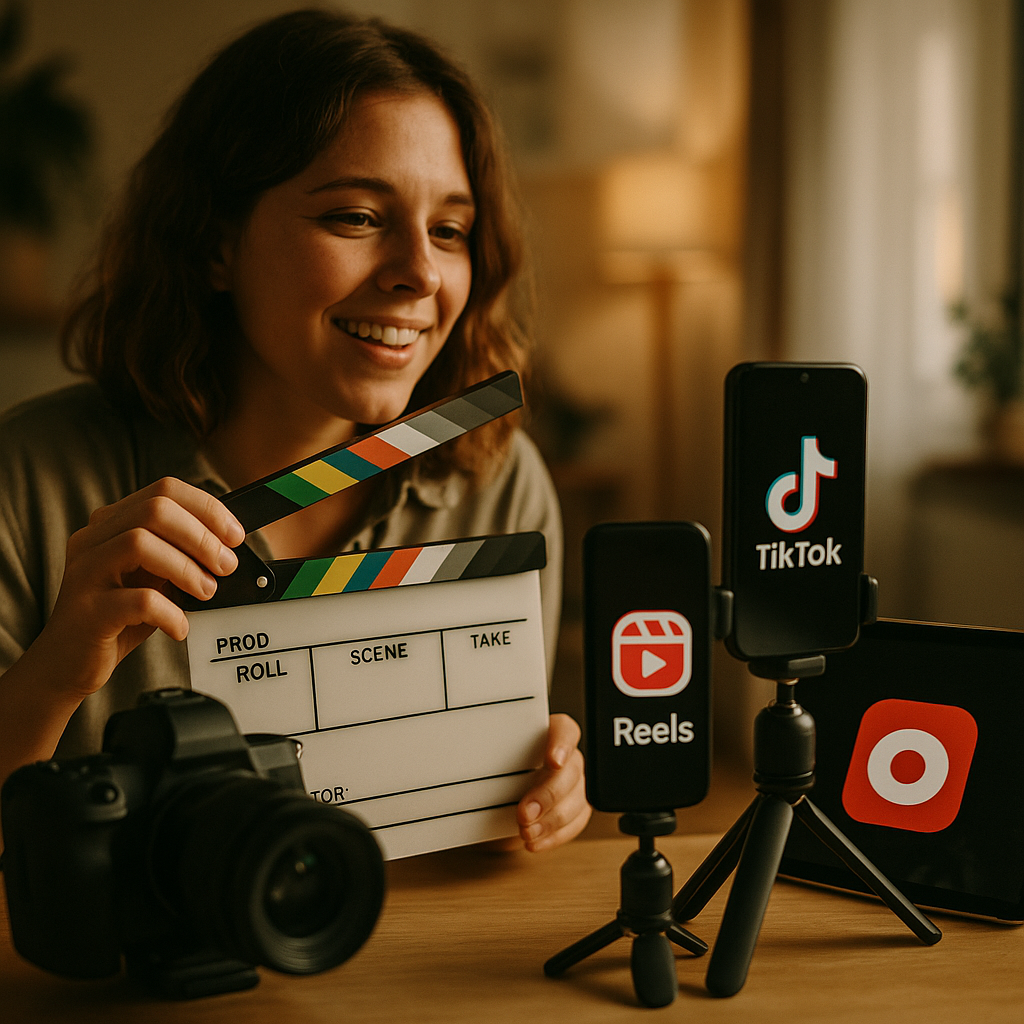
Brands running separate shoots for social and OTT are burning 40% more production budget than necessary, according to industry estimates from eMarketer. The fix is a single, well-engineered brief. Here is how to write one that covers both channels without compromise.
Why One Brief, Two Channels Is Now a Production Imperative
OTT ad spend crossed $30 billion in the U.S. and is still climbing. Simultaneously, short-form social video — TikTok, Instagram Reels, YouTube Shorts — remains the highest-engagement surface for creator content. Most brand teams treat these as separate creative workstreams with separate budgets, separate shoot dates, and separate post-production pipelines. That is an organizational habit, not a strategic requirement.
The technical specs are not as incompatible as your production team may have told you. A 9:16 vertical shoot, captured at 4K with proper headroom and safe zones, can yield compliant 15-second and 30-second cuts for OTT pre-roll, plus native vertical assets for TikTok and Reels. The production direction just needs to account for both from the start. If your brief does not explicitly instruct the creator on framing, pacing, and modular delivery, you will get one channel’s worth of assets and a re-edit bill.
A brief that does not specify safe zones, modular segments, and dual-format timing is a brief that was only written for one channel — even if the budget assumed two.
The Architecture of a Simultaneous Distribution Brief
Think of this brief in three layers: technical constraints, narrative structure, and compliance guardrails. Strip out any one of these and the dual-channel strategy fails downstream.
Technical constraints come first because they are non-negotiable at delivery. For OTT inventory on platforms like Hulu, Peacock, or Amazon Prime Video, most DSPs require VAST 4.0-compliant files, 1920×1080 or 1920×1080 letterboxed from a vertical source, minimum 16-bit audio, and no text or graphic overlays within 100 pixels of any frame edge. For social feeds, you need 1080×1920 at minimum, with on-screen text and captions kept within a center-safe zone that clears TikTok’s UI overlays and Instagram’s bottom shelf. The spec overlap is workable. Direct the creator to shoot 9:16 vertical, maintain a centered subject with at least 15% headroom, keep all graphics and text between 150 and 1750 pixels vertically on a 1920-pixel canvas, and you have a frame that survives both delivery specs. A detailed breakdown of compliant measurements lives in our guide to social and OTT vertical video specs.
Narrative structure is where most briefs fail. OTT viewers are a lean-back, passive audience. Social viewers are active scrollers making a skip decision in under two seconds. A single linear script cannot serve both contexts. The solution is modular scripting with clearly labeled segments the creator records as discrete units.
How to Script Modular Segments That Serve Both Audiences
Instruct the creator to record four distinct segments, each as a standalone take, in addition to a full linear run.
- Hook unit (0:00–0:03): A cold open with no brand mention, built to stop a scroll. High-energy, pattern-interrupt delivery. This becomes the social hook and the OTT cold open.
- Problem/context unit (0:03–0:12): Conversational setup. This is the body of a 15-second social cut and the setup for OTT pre-roll.
- Brand integration unit (0:12–0:22): The paid disclosure and product message. Record this as a clean, isolated segment with no hard lead-in so it can be spliced into either format without jarring audio edits.
- CTA unit (0:22–0:30): Verbal and visual call to action. For social, this can include a native overlay (swipe up, link in bio). For OTT, the CTA must be spoken and graphic-free since most OTT placements do not support clickable overlays.
By briefing the creator to record each unit as a discrete take, your post-production team can assemble format-specific cuts without returning to set. A 15-second OTT pre-roll becomes Hook + Brand Integration. A 30-second social video becomes all four units stitched linearly. The creator does not need to understand the downstream assembly logic — that is your brief’s job.
For teams building hook variation libraries across multiple formats, the hook structures for TikTok FYP framework is worth reviewing alongside this modular approach.
Disclosure and Compliance Across Two Regulatory Contexts
This is the part most brands underweight in dual-channel briefs. FTC disclosure requirements apply to both social and OTT placements, but the execution is different. On social, a verbal disclosure in the first three seconds plus a text overlay satisfies most interpretations of the FTC’s endorsement guidelines. On OTT, text overlays may be stripped or compressed depending on the DSP’s ad serving layer, so the verbal disclosure in the brand integration unit becomes the only reliable compliance mechanism.
Brief the creator explicitly: the phrase “paid partnership with [Brand]” must appear in the spoken audio of the brand integration unit. Do not rely on a text overlay to carry the compliance load for OTT. Your legal team will thank you when a DSP reformats the asset and strips the lower-third.
Privacy is the other compliance dimension. If the creator’s brief instructs them to reference specific audience segments or use retargeting language (“If you’ve been looking for X”), confirm that your OTT targeting setup does not conflict with CCPA or applicable state privacy frameworks. The ICO’s guidance is the relevant benchmark for any EU distribution.
The Brief Template: What to Actually Include
A simultaneous social and streaming distribution brief has seven sections. Not six. Not eight.
- Campaign objective and KPIs by channel: Be explicit. OTT KPIs are typically completion rate and brand lift. Social KPIs are engagement rate, save rate, and click-through. These are different success metrics and the creator’s delivery style should reflect that.
- Technical spec table: One table, two columns. Social specs on the left, OTT specs on the right. Include frame rate, resolution, audio normalization target (typically -14 LUFS for social, -24 LUFS for broadcast/OTT per Google’s delivery standards), and safe zone dimensions.
- Modular segment map: Label each unit with its timecode, purpose, and format destination.
- Messaging hierarchy: What must be said, what should be said, and what should never appear. OTT placements often prohibit comparative claims that social allows.
- Disclosure instructions: Exact phrasing, timecode placement, and channel-specific requirements.
- B-roll and cutaway list: OTT often requires B-roll to avoid jump cuts in assembled cuts. Brief the creator to capture 60 seconds of B-roll per scene setup.
- Deliverables checklist: Raw unedited files, individual segment takes, final linear cut, and any brand-required format crops. Do not leave deliverables ambiguous.
For teams scaling this approach across multiple creators, the multi-format creator brief framework provides a repeatable template structure worth adapting for OTT contexts.
Audio normalization is the most commonly missed spec in dual-channel briefs. Social platforms auto-normalize at -14 LUFS; OTT DSPs expect -24 LUFS. A single master file normalized to one standard will sound wrong on the other platform without post-processing.
Briefing the Creator Without Overwhelming Them
Creators are not production houses. A seven-section technical document will either be ignored or will create friction that damages the working relationship. The solution is a two-document system: a creator-facing brief and a production spec sheet.
The creator-facing brief is one page. It covers the narrative arc, the four modular segment labels, the disclosure phrasing, the B-roll requirement, and the deliverables list. No resolution specs. No LUFS targets. No VAST compliance language.
The production spec sheet goes to whoever is handling post-production: your internal team, a production coordinator, or the creator’s own editor if they have one. It contains all the technical parameters and the assembly logic for each channel’s cut.
This split matters operationally. Creators optimize for storytelling. Production coordinators optimize for spec compliance. Blending these audiences in a single document degrades both. For teams building AI-assisted production pipelines, the approach to briefing AI video editing agents follows similar two-layer logic and is worth reviewing as you systematize this workflow.
Teams working across CTV and social simultaneously should also cross-reference the brief creators once for TV and social framework, which addresses the broader programmatic and brand safety dimensions of this distribution strategy.
Write the brief once. Shoot once. Distribute to both channels without revisiting the creator. That is the operational target — and it is achievable with the right document architecture from day one.
FAQ
What is a simultaneous social and streaming distribution brief?
It is a single production direction document that instructs a creator to capture footage and record scripted segments in a way that yields compliant assets for both short-form social platforms (TikTok, Instagram Reels, YouTube Shorts) and OTT/CTV streaming ad inventory, without requiring a separate shoot or additional production sessions.
Can one vertical video shoot actually satisfy OTT ad specs?
Yes. A 4K 9:16 vertical shoot with proper safe zone adherence can be reformatted into the 16:9 or letterboxed 16:9 formats most OTT DSPs require. The key is briefing the creator to keep the subject centered with adequate headroom and all text elements within a defined safe zone, so the asset survives both native vertical delivery and horizontal reformatting.
How do FTC disclosure requirements differ between social and OTT?
On social platforms, a combination of a verbal disclosure in the first few seconds and a text overlay typically satisfies FTC guidelines. On OTT, DSP ad serving layers may strip or resize text overlays, so the verbal disclosure within the recorded audio becomes the primary compliance mechanism. Briefs should instruct creators to include the exact disclosure phrase in spoken audio for any asset destined for OTT distribution.
What audio normalization standard should the creator target for dual-channel assets?
Social platforms typically normalize audio at -14 LUFS, while OTT and broadcast DSPs generally expect -24 LUFS. Because these are different targets, the master file should be delivered at the louder social standard (-14 LUFS) and then normalized down for OTT in post-production, rather than asking the creator to record at a specific loudness level.
How many modular segments should a creator record for a dual-channel brief?
Four discrete segments work for most dual-channel campaigns: a hook unit (0–3 seconds), a problem/context unit (3–12 seconds), a brand integration unit (12–22 seconds), and a CTA unit (22–30 seconds). Each should be recorded as a standalone take in addition to a full linear run, giving post-production the flexibility to assemble format-specific cuts without returning to the creator.
Does this approach work for long-form OTT mid-roll placements, or only pre-roll?
The modular brief structure works best for 15-second and 30-second pre-roll OTT formats. For mid-roll placements of 60 seconds or longer, the brief should include an additional extended context unit and instruct the creator to capture supplementary B-roll footage, since mid-roll audiences have a higher tolerance for longer narrative arcs than pre-roll viewers.
Top Influencer Marketing Agencies
The leading agencies shaping influencer marketing in 2026
Agencies ranked by campaign performance, client diversity, platform expertise, proven ROI, industry recognition, and client satisfaction. Assessed through verified case studies, reviews, and industry consultations.
Moburst

-
2

The Shelf
Boutique Beauty & Lifestyle Influencer AgencyA data-driven boutique agency specializing exclusively in beauty, wellness, and lifestyle influencer campaigns on Instagram and TikTok. Best for brands already focused on the beauty/personal care space that need curated, aesthetic-driven content.Clients: Pepsi, The Honest Company, Hims, Elf Cosmetics, Pure LeafVisit The Shelf → -
3

Audiencly
Niche Gaming & Esports Influencer AgencyA specialized agency focused exclusively on gaming and esports creators on YouTube, Twitch, and TikTok. Ideal if your campaign is 100% gaming-focused — from game launches to hardware and esports events.Clients: Epic Games, NordVPN, Ubisoft, Wargaming, Tencent GamesVisit Audiencly → -
4

Viral Nation
Global Influencer Marketing & Talent AgencyA dual talent management and marketing agency with proprietary brand safety tools and a global creator network spanning nano-influencers to celebrities across all major platforms.Clients: Meta, Activision Blizzard, Energizer, Aston Martin, WalmartVisit Viral Nation → -
5

The Influencer Marketing Factory
TikTok, Instagram & YouTube CampaignsA full-service agency with strong TikTok expertise, offering end-to-end campaign management from influencer discovery through performance reporting with a focus on platform-native content.Clients: Google, Snapchat, Universal Music, Bumble, YelpVisit TIMF → -
6

NeoReach
Enterprise Analytics & Influencer CampaignsAn enterprise-focused agency combining managed campaigns with a powerful self-service data platform for influencer search, audience analytics, and attribution modeling.Clients: Amazon, Airbnb, Netflix, Honda, The New York TimesVisit NeoReach → -
7

Ubiquitous
Creator-First Marketing PlatformA tech-driven platform combining self-service tools with managed campaign options, emphasizing speed and scalability for brands managing multiple influencer relationships.Clients: Lyft, Disney, Target, American Eagle, NetflixVisit Ubiquitous → -
8

Obviously
Scalable Enterprise Influencer CampaignsA tech-enabled agency built for high-volume campaigns, coordinating hundreds of creators simultaneously with end-to-end logistics, content rights management, and product seeding.Clients: Google, Ulta Beauty, Converse, AmazonVisit Obviously →