


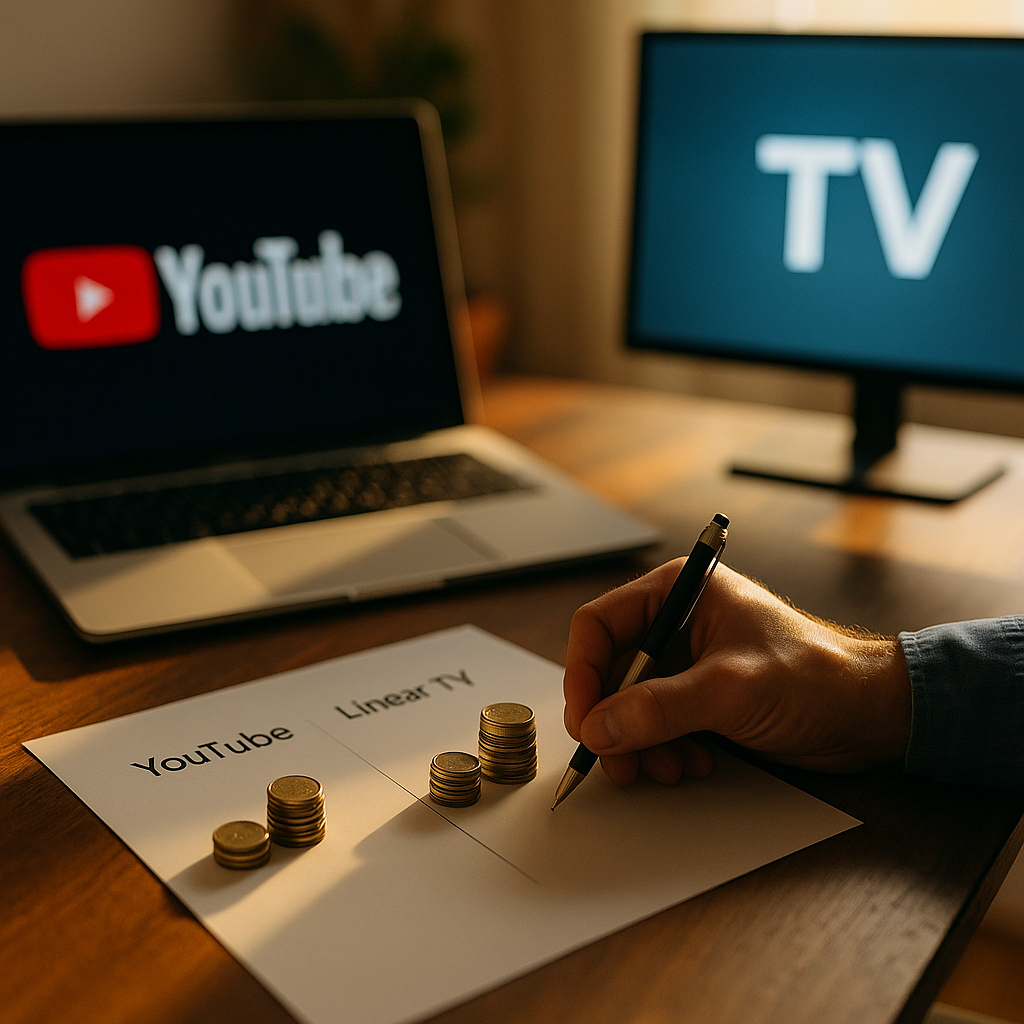
YouTube just crossed $60 billion in annual ad revenue. Nine percent year-over-year ad spend growth. And linear TV’s share of total video ad budgets keeps shrinking. If your upfront commitments still skew toward broadcast and cable, you’re allocating against where attention actually lives.
The Revenue Signal Brands Can’t Ignore
When a platform generates $60 billion annually from advertising, it stops being an “emerging channel” conversation. That number puts YouTube in direct competition with the largest broadcast networks combined, and it reflects where advertiser confidence has durably shifted. The 9 percent ad spend growth figure matters even more than the absolute revenue: it shows acceleration, not plateau.
Compare that with linear TV. Upfront commitments continue to decline in real dollar terms as cord-cutting accelerates among the 18-49 demographic that most brand advertisers covet. The audience isn’t fragmenting. It consolidated. On YouTube.
YouTube now reaches more 18-49 year-olds in the US on connected TVs alone than any single linear cable network. That’s not a trend line — that’s a completed migration.
For media planners still treating YouTube as a digital supplement to a TV-anchored plan, this data reframes the entire budget architecture. The supplement has become the foundation.
Why Episodic Creator Series Deserve a Line Item
The tactical implication most brands miss isn’t about shifting from :30 pre-rolls to skippable ads. It’s about investing in episodic creator series as owned or co-owned programming assets, not just paid placements within someone else’s content.
Brands like Sephora, REI, and MrBeast’s corporate partners have demonstrated what consistent, episodic YouTube presence produces: compounding organic reach, algorithm favorability, and audience loyalty that no single campaign flight can replicate. An episodic series with a creator who has an established subscriber base functions like a cable show with a guaranteed lead-in audience, minus the $500K per-episode production overhead.
The mechanics are different from broadcast sponsorship. You’re not buying adjacency to someone else’s audience. You’re building a recurring touchpoint with viewers who have actively opted in to that creator’s content. Retention rates on episodic YouTube content consistently outperform pre-roll because context and trust transfer from creator to brand. That trust dynamic is something a :15 spot on a streaming service cannot manufacture.
If you want a practical framework for how creator channel inventory fits mainstream media planning, the structural case is already well-established. The gap is execution discipline, not strategic awareness.
Shorts: The Underpriced Inventory Window Is Closing
YouTube Shorts now generates over 70 billion daily views globally. Brands treating Shorts as an afterthought, or worse, repurposing TikTok content with a YouTube watermark, are leaving measurable reach on the table.
Shorts inventory is currently underpriced relative to its attention capture. YouTube’s ad load on Shorts is still maturing, which means CPMs remain competitive compared to TikTok’s in-feed ads or Instagram Reels placements. The window where early movers gain algorithmic advantage before saturation closes is exactly where smart budget allocation happens.
The operational ask is modest: a Shorts-specific content brief developed with creators who understand the format natively, not your brand’s social team reformatting a hero asset. Creators who build on Shorts understand pacing, hook architecture, and audience psychology in ways that translate directly to view-through and click behavior. Scaling creator programs effectively means letting format expertise live with creators, not centralizing it in-house.
The Linear TV Budget Reallocation Math
Let’s be direct about what the reallocation looks like in practice. A brand spending $5 million in linear TV upfronts is typically securing GRP delivery against an audience that over-indexes for ages 55+ and viewing figures that include significant DVR skip rates. The CPM on a verified, completed YouTube view, particularly on connected TV (CTV) where YouTube now commands significant living room screen time, frequently outperforms broadcast on a cost-per-engaged-viewer basis.
Reallocating even 20-30 percent of that linear budget into a combination of episodic creator series, Shorts amplification, and YouTube CTV inventory generates a more attributable, measurable return. Not because YouTube is inherently superior creative real estate, but because the measurement infrastructure is dramatically better. You can connect YouTube ad exposure to search lift, site traffic, and conversion events in ways that broadcast GRP delivery never permitted.
For brands that need to bring CFOs and finance stakeholders along on this reallocation, the case needs to be made in CPA and KPI language, not just reach and frequency. The ROI metrics finance teams approve are entirely compatible with YouTube’s measurement toolkit — the translation work is on the marketing team to make that case internally.
Think with Google publishes ongoing research on YouTube’s reach against linear TV benchmarks that provides the third-party validation most internal budget battles require.
Connected TV Changes the Upfront Calculus Entirely
Here’s the variable that reframes everything: YouTube on connected TV is now the second-most-watched streaming service in the US by time spent, behind only Netflix. That changes the upfront conversation from “digital video” to “premium CTV inventory.”
Brands negotiating TV upfronts with traditional broadcast and cable partners have historically justified the premium on the basis of big-screen, lean-back viewing context. YouTube CTV delivers exactly that context, with better targeting, real-time optimization, and creator-brand alignment that broadcast cannot replicate. The contextual value proposition of linear TV is no longer exclusive to linear TV.
This matters for how you negotiate. If you’re in upfront discussions, pushing for YouTube CTV inventory alongside or instead of traditional scatter market buys is a defensible, data-supported position. eMarketer’s CTV ad spend projections confirm the trajectory: CTV is capturing share from linear at an accelerating rate, and YouTube is the primary beneficiary among ad-supported platforms.
Operational Risks and How to Manage Them
Shifting budget toward YouTube creator programs isn’t without operational complexity. Brand safety, content approval cycles, and creator contract structures require more active management than a traditional media buy. These aren’t reasons to avoid the shift; they’re reasons to build the infrastructure before you scale.
Two areas demand attention. First, creator contract infrastructure needs to explicitly address content rights for episodic series, exclusivity windows, and performance-based renewal triggers. Second, attribution models need to account for YouTube’s halo effects on search and direct traffic, not just last-click conversion. Brands that only measure YouTube on last-touch attribution systematically undervalue it.
YouTube’s own Google Ads support resources provide baseline measurement setup guidance, but brands running material YouTube budgets should be implementing Google Meridian or a third-party MMM solution to capture cross-channel contribution accurately.
Platform concentration risk is real. Diversifying across Shorts, long-form creator series, and YouTube CTV within the platform provides format diversification even within a YouTube-anchored strategy. And integrating creator partnerships with human creator visibility in AI-influenced environments ensures your video investment supports broader discovery across channels.
The brands winning YouTube budgets aren’t the ones spending the most. They’re the ones building creator relationships that compound, not campaigns that expire.
For teams navigating how this fits within a broader evolving media mix, Statista’s advertising market data provides useful benchmarks for tracking platform share trends over reporting cycles. And if your agency structure still separates digital video from influencer, that organizational seam is costing you integrated efficiencies that competitors are already capturing.
The CMO-level upfront budget case for YouTube over linear isn’t a future argument. It’s a current allocation decision. Run the reallocation scenario now, before your next upfront commitment locks you into another year of diminishing broadcast returns.
Frequently Asked Questions
How much of our linear TV budget should shift to YouTube?
There’s no universal figure, but a defensible starting point for most mid-to-large brand advertisers is reallocating 20-30 percent of linear upfront spend toward YouTube, split across CTV inventory, long-form creator sponsorships, and Shorts amplification. Brands in categories with younger-skewing audiences (18-34) should model a more aggressive shift. Run a cross-channel attribution analysis on your current mix before setting a target percentage.
What’s the difference between sponsoring a creator’s existing series versus commissioning an episodic series?
Sponsoring an existing series gives you audience access and creator credibility quickly but limits brand control and content ownership. Commissioning or co-producing an episodic series gives you content rights, deeper integration, and long-term asset value, but requires more upfront investment and a longer timeline to audience development. Most brands benefit from doing both: sponsorships for near-term reach, co-produced series for durable brand equity.
How do we measure YouTube creator campaign ROI in a way that satisfies a CFO?
Map YouTube performance to metrics finance teams already track: cost per acquisition (CPA), search lift (available through Google’s Brand Lift measurement), and incremental revenue contribution modeled through marketing mix modeling (MMM). Avoid presenting YouTube solely on reach and frequency metrics, which carry less weight in budget reviews. Tools like Google Meridian or Analytic Partners’ ROI Genome can quantify YouTube’s contribution to pipeline alongside other channels.
Is YouTube Shorts worth investing in separately from long-form YouTube?
Yes, and the case is strongest right now because Shorts ad inventory is still relatively underpriced compared to TikTok and Reels. Shorts require native content briefs, not repurposed assets, and work best with creators who build primarily in short-form. Budget Shorts as a distinct line item with its own creative approach, not a distribution afterthought for long-form content.
What are the brand safety risks on YouTube and how should we manage them?
Brand safety on YouTube operates at two levels: paid ad placement adjacency (manageable through content exclusion lists, topic targeting, and Google’s brand safety controls) and creator partnership content (managed through contract language, content approval rights, and creator vetting). For episodic series, build a content review step into the production calendar rather than treating approval as a post-production gate. The risk is manageable, but it requires operational process, not just platform settings.
Top Influencer Marketing Agencies
The leading agencies shaping influencer marketing in 2026
Agencies ranked by campaign performance, client diversity, platform expertise, proven ROI, industry recognition, and client satisfaction. Assessed through verified case studies, reviews, and industry consultations.
Moburst

-
2

The Shelf
Boutique Beauty & Lifestyle Influencer AgencyA data-driven boutique agency specializing exclusively in beauty, wellness, and lifestyle influencer campaigns on Instagram and TikTok. Best for brands already focused on the beauty/personal care space that need curated, aesthetic-driven content.Clients: Pepsi, The Honest Company, Hims, Elf Cosmetics, Pure LeafVisit The Shelf → -
3

Audiencly
Niche Gaming & Esports Influencer AgencyA specialized agency focused exclusively on gaming and esports creators on YouTube, Twitch, and TikTok. Ideal if your campaign is 100% gaming-focused — from game launches to hardware and esports events.Clients: Epic Games, NordVPN, Ubisoft, Wargaming, Tencent GamesVisit Audiencly → -
4

Viral Nation
Global Influencer Marketing & Talent AgencyA dual talent management and marketing agency with proprietary brand safety tools and a global creator network spanning nano-influencers to celebrities across all major platforms.Clients: Meta, Activision Blizzard, Energizer, Aston Martin, WalmartVisit Viral Nation → -
5

The Influencer Marketing Factory
TikTok, Instagram & YouTube CampaignsA full-service agency with strong TikTok expertise, offering end-to-end campaign management from influencer discovery through performance reporting with a focus on platform-native content.Clients: Google, Snapchat, Universal Music, Bumble, YelpVisit TIMF → -
6

NeoReach
Enterprise Analytics & Influencer CampaignsAn enterprise-focused agency combining managed campaigns with a powerful self-service data platform for influencer search, audience analytics, and attribution modeling.Clients: Amazon, Airbnb, Netflix, Honda, The New York TimesVisit NeoReach → -
7

Ubiquitous
Creator-First Marketing PlatformA tech-driven platform combining self-service tools with managed campaign options, emphasizing speed and scalability for brands managing multiple influencer relationships.Clients: Lyft, Disney, Target, American Eagle, NetflixVisit Ubiquitous → -
8

Obviously
Scalable Enterprise Influencer CampaignsA tech-enabled agency built for high-volume campaigns, coordinating hundreds of creators simultaneously with end-to-end logistics, content rights management, and product seeding.Clients: Google, Ulta Beauty, Converse, AmazonVisit Obviously →