


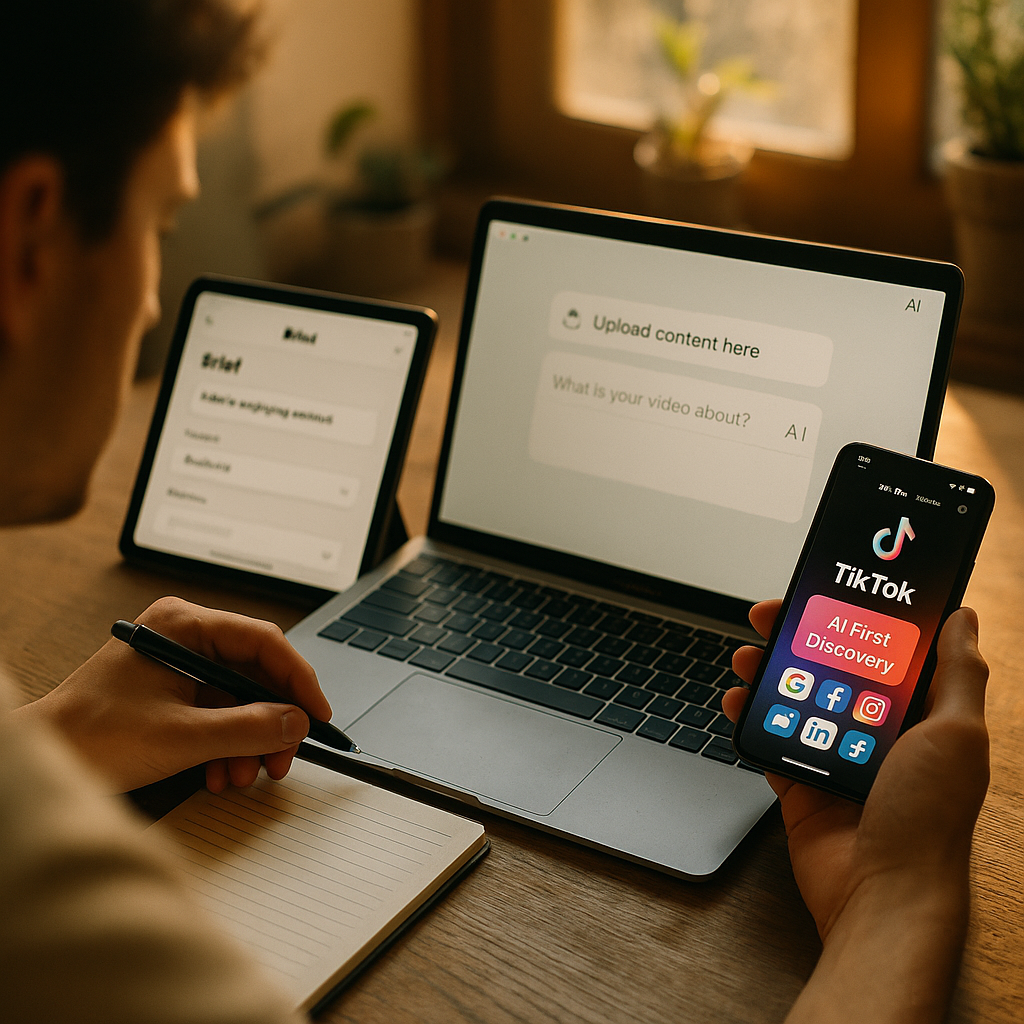
Generative AI now influences over 40% of product discovery journeys, yet most brand briefs still treat creator content as a single-platform deliverable. That gap is costing you reach, relevance, and revenue. Multi-platform creator repurposing for AI-first discovery is no longer a production optimization — it is a core strategic competency.
The Brief Is the Bottleneck
Every inefficiency in your creator program traces back to one document: the brief. If the brief was written to produce one TikTok or one Instagram Reel, that is exactly what you will get. One asset. One platform. One chance at distribution. Meanwhile, generative engines like ChatGPT Shopping, Google’s AI Overviews, and Perplexity are pulling structured, credible, multi-format content into purchase-intent answers — and brands with thin content libraries are invisible in those results.
The fix is not hiring more creators. It is writing smarter briefs that architect a content ecosystem from a single production session.
What “AI-First Discovery” Actually Means for Creator Campaigns
When a consumer asks Perplexity “best SPF moisturizer for oily skin under $40,” the engine does not return a TikTok. It synthesizes credible, structured information from sources it deems authoritative. Creator content earns a seat at that table when it contains specific, quotable, semantically rich language — product names, use-case specifics, ingredient callouts, honest comparisons — wrapped in formats that crawlers and LLM training pipelines can parse.
Short-form video alone does not surface in most generative engine answers. But the transcript of that video, published as a structured blog post or product review, does. A YouTube long-form video with timestamped chapters does. A Reddit-style written testimonial does. Your brief needs to produce all of these from the same creator session.
A creator who shoots one video but delivers a transcript, a structured written review, three platform cuts, and a quote card has just multiplied your distribution surface area by six — with zero additional production cost.
For a deeper look at how brief structure affects LLM citation rates, see our guide on creator briefs cited in ChatGPT and the companion piece on briefing creators for LLM citations.
The Asset Matrix: What a Single Session Should Produce
Think of your brief as a shot list for a film director. Every element serves the final cut, but also stands alone as a clip, a still, a pull quote. Here is the minimum viable asset matrix for a repurposing-first brief:
- Hero short-form video (9:16, 60-90 seconds): Optimized for TikTok and Instagram Reels. Hook in the first two seconds. Product in frame by second five.
- Extended cut (16:9, 3-8 minutes): YouTube and CTV-ready. Includes setup, demonstration, and honest verdict — the structure LLMs favor when synthesizing shopping answers. Our piece on briefing for CTV and mobile from one shoot covers the technical requirements in detail.
- Verbatim transcript with semantic markup: This is the asset most brands forget entirely. The transcript, formatted with H2 headers and bullet points around key product claims, becomes a publishable written asset. It feeds AI training data and gets indexed by search engines.
- Static visuals (3-5 stills): Product in use, creator reaction shot, before/after if applicable. Used for Pinterest, paid social, and email.
- Quote card or text overlay clip: One punchy, specific, ownable claim from the creator. “I’ve used twelve SPF moisturizers this year. This is the only one that doesn’t pill under makeup.” That specificity is citation gold for generative engines.
- Written review (300-500 words): Brief the creator to answer five specific questions in writing after filming. These become a structured product review publishable on your brand site, Amazon, or a creator’s blog.
If this feels like a lot, consider that UGC consistently outperforms brand content on both engagement and conversion metrics. Every additional asset format multiplies the return on the creator fee you have already paid.
How to Write the Brief Section by Section
Objective frame. Open the brief with a distribution objective, not just a creative objective. Example: “This session will produce assets for TikTok organic, YouTube, and structured written content indexed for AI search.” That single line changes what the creator pays attention to on set.
Mandatory spoken elements. List the specific phrases, product names, and use-case language that must appear verbatim in the video. Not as a script — as a word bank. “At some point, say the product name, the key benefit, and the specific use case in the same sentence.” This is the raw material that makes transcripts semantically indexable.
Structural requirements. For the extended cut: brief the creator to include a clear problem statement, a product introduction, a live demonstration, and a verdict. These four beats map to how generative engines structure shopping summaries. They are also the beats that drive YouTube watch time, which affects algorithmic distribution. See our framework on creator briefs for AI and watch time for the specific pacing data.
Written deliverables section. Most creators have never been asked to submit a written review alongside video content. Brief it explicitly. Provide the five questions. Set a word count. Explain where it will be published. Creators with strong personal brands will often write better than you expect — because they know their audience and write in a register that reads as authentic to LLMs and human readers alike.
Rights and usage language. If you plan to publish the transcript on your brand site, run the extended cut as a CTV pre-roll, or submit the written review to retail partners, your usage rights need to cover all of it. Nail this in the contract before the brief goes out. For disclosure requirements across these formats, the FTC guidelines on endorsements apply regardless of where the asset lands.
Platform-Specific Distribution Logic
Once the assets exist, distribution strategy determines how much reach they actually earn. The short-form cut goes native to TikTok and Reels. Do not cross-post the same file — each platform’s algorithm penalizes reposts from competitors. Re-export with platform-native text overlays and audio mixing.
The extended cut lives on YouTube with timestamped chapters. Those chapters are indexed by Google Search and increasingly surfaced in AI Overviews. A chapter titled “Does it actually work for oily skin?” will appear in a generative engine answer before a chapter titled “Part 2” ever will.
The written review and structured transcript go to your brand site (canonical URL), your Amazon storefront’s A+ content section, and optionally to the creator’s own blog with a do-follow link back to the product page. That distributed footprint is what gives generative engines enough signal to treat the product as a credible recommendation.
Pinterest deserves a mention. The platform’s visual search feeds directly into shopping intent queries, and Sprout Social’s research consistently shows Pinterest driving higher average order values than most social channels. Your static stills from the session should be there, with alt text that mirrors the semantic language in your transcript.
The brands winning in generative engine shopping results are not producing more content — they are producing content that exists in more indexable formats from the same creative investment.
Governance, Consistency, and Scale
Running this approach across ten creators simultaneously requires governance infrastructure, not just good briefs. Each creator’s assets need rights tracking, semantic review for brand claim accuracy, and a publication calendar that staggers indexed content to avoid cannibalizing your own search signals.
Tools like Adobe GenStudio are built for exactly this workflow: multi-format asset management, brand compliance review, and channel-specific export at scale. Without a system like this, the operational overhead of managing six asset types per creator across a roster of twenty will bury your team.
For keeping brand voice consistent across multiple creators producing high volumes of varied content, our guide on brand consistency across creators walks through the review frameworks that work without killing authentic voice. That balance matters because LLMs and human audiences both penalize content that sounds like it was written by a brand committee.
Compliance is the last piece most teams address and should be the first. FTC disclosure requirements apply to every format the creator content appears in: the TikTok, the YouTube, the blog post, the Pinterest pin, the CTV cut. One disclosure on the original video is not sufficient coverage for all downstream placements. Brief this explicitly, audit before publication, and consult the FTC’s endorsement guidelines if any ambiguity exists on a specific format.
The Next Step
Audit your last five creator briefs against the asset matrix above. If none of them required a verbatim transcript, a structured written review, or explicit semantic language requirements, your AI discovery coverage is effectively zero. Rewrite one brief this week using the framework here and measure indexed content volume at the 60-day mark.
Frequently Asked Questions
What is multi-platform creator repurposing for AI-first discovery?
It is a briefing and production strategy that directs creators to produce multiple asset formats — short-form video, extended cuts, structured transcripts, written reviews, and statics — from a single session. The goal is to earn organic social distribution across TikTok, Instagram, YouTube, and Pinterest while simultaneously producing indexable content that appears in generative engine shopping answers from platforms like ChatGPT, Perplexity, and Google’s AI Overviews.
Why does a video transcript matter for generative AI discovery?
Generative engines synthesize text-based content when constructing shopping answers. A video on TikTok is not directly indexed by most LLMs, but a formatted transcript published on your brand site or a creator’s blog is. When that transcript contains specific product names, use-case language, and honest comparisons, it becomes citable source material for AI-generated purchase recommendations.
How do you brief a creator for written deliverables alongside video content?
Include a dedicated written deliverables section in the brief. Provide five specific questions — such as “What problem did this product solve for you?” and “Who would you recommend this to and why?” — and require a 300-500 word written response after filming. Specify where the review will be published so the creator can calibrate their tone and audience appropriately.
Does this approach require a bigger production budget?
No. The incremental cost is primarily creator time, not equipment or crew. Most of the additional assets — transcripts, written reviews, static stills from b-roll — are produced from material already captured in the primary video session. The brief structure, not the budget, is what changes. Operator overhead increases if you are managing multiple creators, which is where asset management platforms like Adobe GenStudio add measurable efficiency.
What FTC disclosure requirements apply when creator content is repurposed across formats?
Each individual placement of sponsored creator content requires its own disclosure. A disclosure in the original TikTok video does not automatically carry over to a YouTube cut, a blog post, or a CTV pre-roll. Brands must brief creators to include clear disclosures in every derivative format and should audit all placements before publication. The FTC’s endorsement guidelines are the governing standard for all U.S. placements regardless of format.
How long does it take for repurposed creator content to appear in AI search results?
Indexing timelines vary by platform and generative engine. Written content published on established domains can appear in Google’s AI Overviews within days of indexing. LLM-native platforms like Perplexity and ChatGPT Shopping draw from a broader range of sources and may take weeks to surface new content. Measuring indexed content volume at the 60-day mark after a campaign launch is a practical baseline for evaluating AI discovery impact.
Top Influencer Marketing Agencies
The leading agencies shaping influencer marketing in 2026
Agencies ranked by campaign performance, client diversity, platform expertise, proven ROI, industry recognition, and client satisfaction. Assessed through verified case studies, reviews, and industry consultations.
Moburst

-
2

The Shelf
Boutique Beauty & Lifestyle Influencer AgencyA data-driven boutique agency specializing exclusively in beauty, wellness, and lifestyle influencer campaigns on Instagram and TikTok. Best for brands already focused on the beauty/personal care space that need curated, aesthetic-driven content.Clients: Pepsi, The Honest Company, Hims, Elf Cosmetics, Pure LeafVisit The Shelf → -
3

Audiencly
Niche Gaming & Esports Influencer AgencyA specialized agency focused exclusively on gaming and esports creators on YouTube, Twitch, and TikTok. Ideal if your campaign is 100% gaming-focused — from game launches to hardware and esports events.Clients: Epic Games, NordVPN, Ubisoft, Wargaming, Tencent GamesVisit Audiencly → -
4

Viral Nation
Global Influencer Marketing & Talent AgencyA dual talent management and marketing agency with proprietary brand safety tools and a global creator network spanning nano-influencers to celebrities across all major platforms.Clients: Meta, Activision Blizzard, Energizer, Aston Martin, WalmartVisit Viral Nation → -
5

The Influencer Marketing Factory
TikTok, Instagram & YouTube CampaignsA full-service agency with strong TikTok expertise, offering end-to-end campaign management from influencer discovery through performance reporting with a focus on platform-native content.Clients: Google, Snapchat, Universal Music, Bumble, YelpVisit TIMF → -
6

NeoReach
Enterprise Analytics & Influencer CampaignsAn enterprise-focused agency combining managed campaigns with a powerful self-service data platform for influencer search, audience analytics, and attribution modeling.Clients: Amazon, Airbnb, Netflix, Honda, The New York TimesVisit NeoReach → -
7

Ubiquitous
Creator-First Marketing PlatformA tech-driven platform combining self-service tools with managed campaign options, emphasizing speed and scalability for brands managing multiple influencer relationships.Clients: Lyft, Disney, Target, American Eagle, NetflixVisit Ubiquitous → -
8

Obviously
Scalable Enterprise Influencer CampaignsA tech-enabled agency built for high-volume campaigns, coordinating hundreds of creators simultaneously with end-to-end logistics, content rights management, and product seeding.Clients: Google, Ulta Beauty, Converse, AmazonVisit Obviously →