


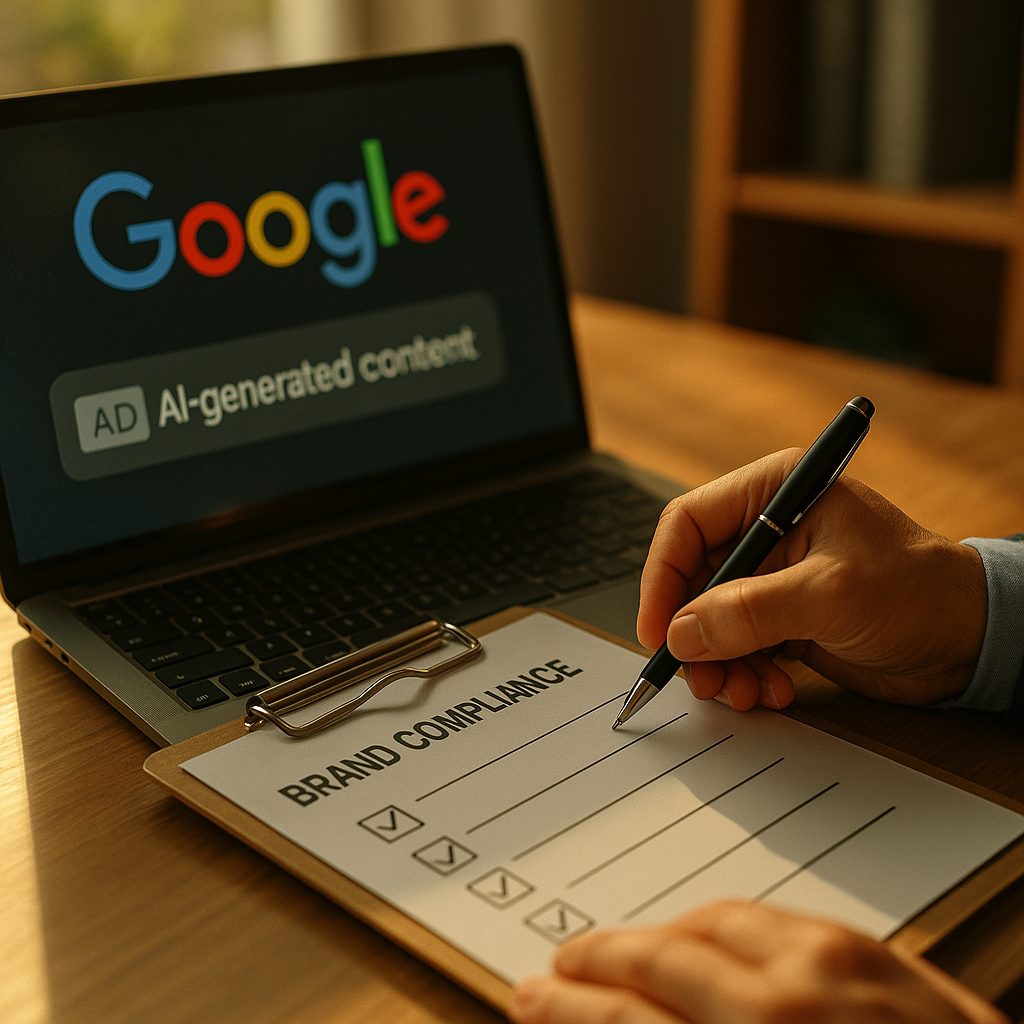
Google quietly split its AI ad disclosure requirements in two: some AI-generated ads get labeled automatically, others require advertisers to self-disclose manually. Miss the distinction and you’re either over-flagging clean creative or under-flagging content that regulators now expect labeled. If your compliance team hasn’t mapped which bucket each campaign falls into, you’re already behind on Google AI ad disclosure requirements.
This isn’t a minor policy footnote. It’s a structural shift in who bears the labeling burden, and it lands right as the FTC, state AGs, and platform trust-and-safety teams are all sharpening scrutiny on synthetic media. Get the workflow wrong and you’re not just risking a policy strike. You’re building a documentation gap that shows up in discovery.
What Actually Changed
Google’s ad platforms have historically leaned on advertiser self-reporting for most policy compliance. Upload the creative, answer a few certification questions, move on. The AI disclosure split changes that model for a subset of ad formats.
Here’s the mechanics: when Google’s systems detect that an ad was generated or substantially modified using its own AI tools (think Product Studio, AI-generated video extensions, or asset generation inside Performance Max), the platform applies an automatic disclosure label. No advertiser action required, no toggle to switch off. It happens at the system level because Google already has the generation metadata.
But when the AI creative originates outside Google’s ecosystem, say a brand ran assets through a third-party generator like Midjourney, Runway, or an in-house model, then uploaded the finished creative, Google has no native signal that AI was involved. In that case, the disclosure burden shifts entirely to the advertiser. You have to manually flag it during upload, or the ad runs without any AI label at all.
That gap is the whole compliance problem in one sentence.
The automatic/manual split means the same underlying question — “was this AI-generated?” — gets answered two completely different ways depending on which tool touched the file last. Compliance teams need a single intake process that catches both.
Why This Creates a Blind Spot for Brands
Most brand compliance workflows were built around a binary: either a platform enforces disclosure automatically, or it doesn’t enforce it at all and you’re on your own. Google’s split creates a third state — partial automatic enforcement — and partial enforcement is where things fall through cracks.
Think about a typical creative pipeline. A creator produces a UGC-style video. An in-house editor runs it through an AI upscaling tool for resolution. A media buyer uploads it to Google Ads. Was that ad “AI-generated” under Google’s policy? Technically, maybe. Google’s system won’t catch it because the generation happened outside its tools. If your team assumes “Google will flag it if it needs flagging,” you’ve just shipped an undisclosed AI ad.
This mirrors a pattern we’ve seen across the industry. Meta’s AI disclosure menu has similar gaps between platform-detected content and advertiser-declared content, and TikTok’s AI labeling rules put even more weight on creator self-reporting. Every major platform is converging on a hybrid model. None of them have made it simple.
Building the Intake Checklist
Compliance teams need a standing process that runs before creative ever reaches the ad platform, not after. Here’s a practical structure:
- Tag the generation source at asset creation. Every creative brief should capture whether AI tools touched the asset, and which ones. Native Google tools, third-party generators, or hybrid workflows (human-shot footage with AI-enhanced elements) all need separate tags.
- Route third-party AI assets through manual disclosure. If the answer is “yes, AI touched this, and it wasn’t Google’s tool,” that asset goes into a manual-flag queue before upload. No exceptions, no “it’s probably fine.”
- Audit auto-labeled ads for accuracy. Don’t assume Google’s automatic detection is flawless. Spot-check a sample of auto-flagged and non-flagged ads monthly to confirm the system is catching what it should.
- Document the decision trail. Every disclosure decision, automatic or manual, needs a timestamped record: what tool was used, who reviewed it, what label was applied. This is your audit defense if a regulator or platform investigation comes knocking.
That last point matters more than most teams realize. Regulatory bodies aren’t just asking “did you disclose.” They’re asking “can you show your process for deciding when to disclose.” A verbal policy isn’t a defense. A logged workflow is.
The Regulatory Backdrop You Can’t Ignore
Google’s disclosure split doesn’t exist in a vacuum. The FTC has made clear through its ongoing enforcement priorities that AI-generated advertising falls under existing Section 5 unfair-and-deceptive-practices authority, no new law required. Guidance from the Federal Trade Commission continues to stress that omitting AI involvement, when it would affect a reasonable consumer’s judgment, is itself a deceptive act.
State attorneys general are moving even faster. Several states now require explicit AI disclosure in advertising regardless of platform-level labeling, which means a Google auto-label doesn’t automatically satisfy state statute. We covered similar overlapping obligations in our breakdown of state AG actions against Meta, and the same logic applies here: platform compliance and legal compliance are not the same checkbox.
Add in the growing body of FTC guidance on liability chains for AI content, and it’s clear that “the platform didn’t flag it” is a weak defense. Regulators are looking at who commissioned the content and who profited from it, not just which button got clicked.
Where Manual Disclosure Gets Genuinely Hard
Here’s the part nobody wants to admit: manual disclosure is easy to describe and hard to execute at scale. A brand running twelve campaigns a month across Performance Max, Demand Gen, and YouTube ads isn’t manually reviewing every asset’s generation history. That’s the honest operational reality.
So what actually works? A few things, based on how leading compliance teams are restructuring their pipelines:
Push the tagging requirement upstream, to the vendor contract. Any agency, creator, or production partner supplying creative should be contractually required to disclose AI tool usage as a deliverable, not an afterthought. This is the same logic we’ve recommended for direct creator partnership contracts — bake disclosure obligations into the paperwork before production starts, not after the ad is live.
Build a lightweight intake form that every creative asset passes through, whether it’s coming from an internal team, agency, or freelancer. One dropdown: “AI tool used?” One follow-up: “Which one?” It takes ten seconds per asset and closes most of the gap.
Assign ownership. Someone specific, not “the marketing team,” needs to sign off on disclosure classification before an ad goes live. Diffuse responsibility is how gaps become patterns.
Teams that treat AI disclosure as a legal afterthought are the ones that end up explaining a compliance gap to a state AG’s office. Teams that build it into creative intake rarely have that conversation.
What This Means for Multi-Platform Programs
Most brands aren’t running Google-only campaigns. They’re stitching together Google Ads, Meta, TikTok, and increasingly agentic AI tools that generate and place creative with minimal human review. That’s the harder problem: agentic AI campaign workflows often skip manual disclosure steps entirely unless they’re explicitly built into the automation logic.
If your intake process only accounts for Google’s split, you’re solving a third of the problem. The same asset might need a different disclosure treatment on TikTok Shop than it does on Google Search ads, per our TikTok Shop compliance guide. Build one master disclosure taxonomy, then map platform-specific rules onto it. Don’t build platform-specific taxonomies from scratch each time; that’s how inconsistencies creep in.
Industry data backs up the urgency here. eMarketer’s research on AI ad adoption shows synthetic and AI-assisted creative now represents a meaningful and growing share of digital ad spend, and platforms are racing to keep labeling infrastructure ahead of adoption. Compliance teams that wait for perfect platform tooling will always be a step behind. Build your own layer now.
The Next Step
Don’t wait for Google to clarify further; audit your current campaigns this week against a simple test: for every AI-touched asset, can you name the tool, the reviewer, and the disclosure decision? If not, that’s your starting punch list, and it’s a smaller lift now than after a platform strike or regulatory inquiry forces the issue.
Frequently Asked Questions
What triggers Google’s automatic AI ad disclosure label?
Google applies automatic labels when its own AI tools, such as Product Studio or native ad-generation features inside Performance Max, are used to create or substantially modify the ad asset. The platform has direct visibility into generation metadata in these cases, so no advertiser action is needed.
When does a brand need to manually disclose AI use in a Google ad?
Manual disclosure is required whenever AI tools outside Google’s ecosystem, like third-party image or video generators, were used to produce the creative before it was uploaded. Google has no native signal for these tools, so the advertiser must flag AI involvement during the upload process.
Does an automatic Google label satisfy state-level AI disclosure laws?
Not necessarily. Several states have their own AI disclosure statutes that apply regardless of platform labeling. A Google auto-label may satisfy platform policy without satisfying a separate state legal requirement, so compliance teams should treat these as two distinct obligations.
What happens if a brand fails to manually disclose third-party AI creative?
Consequences range from platform policy strikes and ad account restrictions to regulatory exposure under FTC Section 5 or state deceptive-advertising statutes. Undisclosed AI use that misleads consumers can also trigger civil liability if a regulator or plaintiff can show it affected purchasing decisions.
How can compliance teams scale manual disclosure across many campaigns?
The most effective approach pushes disclosure tagging upstream into vendor contracts and creative intake forms, rather than relying on manual review at upload. Requiring agencies and creators to declare AI tool usage as a standard deliverable closes most of the gap without adding significant review overhead.
Frequently Asked Questions
Top Influencer Marketing Agencies
The leading agencies shaping influencer marketing in 2026
Agencies ranked by campaign performance, client diversity, platform expertise, proven ROI, industry recognition, and client satisfaction. Assessed through verified case studies, reviews, and industry consultations.
Moburst

-
2

The Shelf
Boutique Beauty & Lifestyle Influencer AgencyA data-driven boutique agency specializing exclusively in beauty, wellness, and lifestyle influencer campaigns on Instagram and TikTok. Best for brands already focused on the beauty/personal care space that need curated, aesthetic-driven content.Clients: Pepsi, The Honest Company, Hims, Elf Cosmetics, Pure LeafVisit The Shelf → -
3

Audiencly
Niche Gaming & Esports Influencer AgencyA specialized agency focused exclusively on gaming and esports creators on YouTube, Twitch, and TikTok. Ideal if your campaign is 100% gaming-focused — from game launches to hardware and esports events.Clients: Epic Games, NordVPN, Ubisoft, Wargaming, Tencent GamesVisit Audiencly → -
4

Viral Nation
Global Influencer Marketing & Talent AgencyA dual talent management and marketing agency with proprietary brand safety tools and a global creator network spanning nano-influencers to celebrities across all major platforms.Clients: Meta, Activision Blizzard, Energizer, Aston Martin, WalmartVisit Viral Nation → -
5

The Influencer Marketing Factory
TikTok, Instagram & YouTube CampaignsA full-service agency with strong TikTok expertise, offering end-to-end campaign management from influencer discovery through performance reporting with a focus on platform-native content.Clients: Google, Snapchat, Universal Music, Bumble, YelpVisit TIMF → -
6

NeoReach
Enterprise Analytics & Influencer CampaignsAn enterprise-focused agency combining managed campaigns with a powerful self-service data platform for influencer search, audience analytics, and attribution modeling.Clients: Amazon, Airbnb, Netflix, Honda, The New York TimesVisit NeoReach → -
7

Ubiquitous
Creator-First Marketing PlatformA tech-driven platform combining self-service tools with managed campaign options, emphasizing speed and scalability for brands managing multiple influencer relationships.Clients: Lyft, Disney, Target, American Eagle, NetflixVisit Ubiquitous → -
8

Obviously
Scalable Enterprise Influencer CampaignsA tech-enabled agency built for high-volume campaigns, coordinating hundreds of creators simultaneously with end-to-end logistics, content rights management, and product seeding.Clients: Google, Ulta Beauty, Converse, AmazonVisit Obviously →