


Most brand AMAs die within the first ten minutes. The host reads a script, the chat goes quiet, and everyone leaves feeling like they sat through a webinar with worse lighting. A Discord Stage Channel AMA doesn’t have to work that way — but only if you structure it like a community event, not a press briefing.
Discord now hosts over 200 million monthly active users, and Stage Channels have quietly become the go-to format for brands running live Q&As without the chaos of unmoderated voice chat. The tool is solid. The problem is almost always the playbook — or the lack of one.
Why Stage Channels Beat Every Other Live Format for AMAs
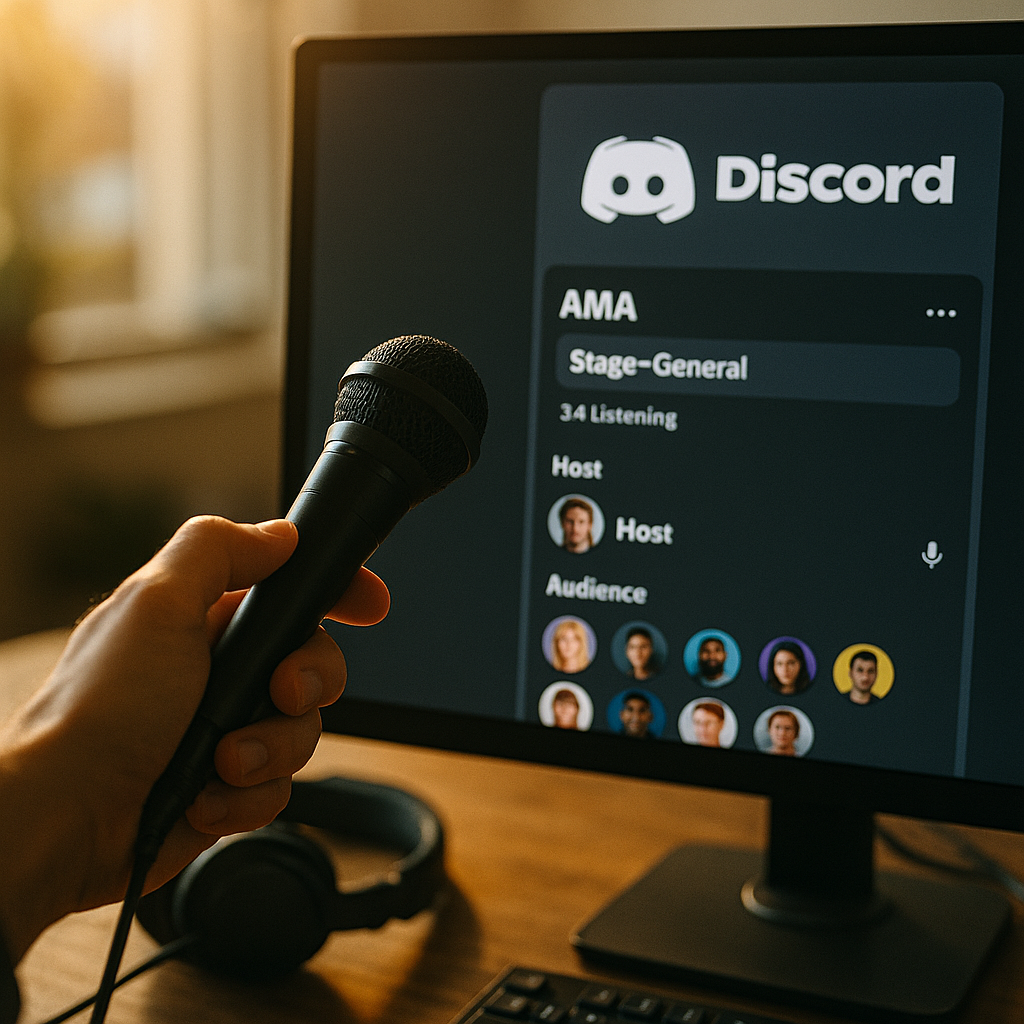
A Stage Channel splits your server into speakers and audience by default. Speakers talk, audience listens, and anyone can raise a hand to join the stage. That structure alone solves 80% of what makes brand AMAs feel messy: no interruptions, no trolls grabbing the mic, no dead air while a moderator scrambles to mute someone.
Compare that to a standard voice channel, where anyone can unmute and start talking whenever they want. Or a livestream on Twitch or YouTube, where chat is one-directional and the host is performing rather than conversing. Stage Channels sit in the middle: structured enough to control, open enough to feel real.
The catch? Structure without intention just becomes a new kind of corporate. A Stage Channel run like a press conference — exec reads talking points, moderator picks three softball questions, everyone logs off — will feel exactly as sterile as a LinkedIn Live. The format isn’t the differentiator. How you run it is.
The single biggest predictor of AMA success isn’t attendance — it’s how many attendees speak, react, or ask a follow-up. Passive audiences don’t become community; they become unsubscribes.
Building the Pre-Event Runway (Most Brands Skip This)
An AMA that starts cold, starts dead. You need momentum before you ever open the Stage.
- Seed questions early. Post a pinned thread in your community text channel a week out, asking members what they want answered. This does two things: it gives your speaker prep material, and it gives lurkers a low-stakes way to participate before the pressure of live voice.
- Recruit a few “planted” questions from real community members. Not fake ones — actual questions from actual people, asked to break the ice in the first five minutes. Cold opens kill momentum; a familiar voice asking the first question doesn’t.
- Announce the speaker’s real personality, not their title. “Our VP of Product will be answering questions about the Q1 roadmap” reads like a memo. “Ask Sarah anything about why we killed the feature everyone hated” reads like an event.
- Cross-post the invite where your community already lives. If you’re also running a WhatsApp channel for superfans, that’s your highest-intent audience for a live event — use it.
Discord’s own event scheduling tool sends automatic reminders to anyone who RSVPs, which meaningfully lifts show-up rate compared to a plain announcement post. Use it every time. Skipping it is leaving free retention on the table.
Casting the Room: Who Should Actually Be On Stage?
This is where most brand AMAs go wrong before a single word is spoken. The instinct is to put your most senior person on stage because it signals importance. Wrong instinct.
Seniority signals authority. It doesn’t signal accessibility, and accessibility is the entire point of an AMA.
The best Stage Channel casts mix three roles:
- The subject expert — someone close enough to the work to answer specifics, not just talking points.
- A community moderator or superfan — someone who already has trust in the server and can translate stiff answers into plain language, or push back when an answer is too vague.
- A rotating community member co-host — invite a different power user each time. This single move does more for perceived authenticity than any script rewrite. It also mirrors what’s working in other creator-led formats, like the power-user dynamics detailed in Reddit’s AMA and power-user trust playbook.
Avoid putting more than two brand-side speakers on stage at once. Beyond that, it starts to feel like a panel defending itself rather than a conversation.
Scripting Less, Structuring More
There’s a real difference between a script and a structure. A script is a document your speaker reads from. A structure is a shape the conversation follows, with room to breathe.
Here’s a structure that consistently outperforms the rigid Q&A format:
- Minute 0-3: Casual opener. No moderator monologue. Speaker greets the room, maybe reacts to something already in chat.
- Minute 3-10: Planted questions from real community members (arranged in advance, but not scripted answers).
- Minute 10-35: Open floor. Raise-hand queue managed by a moderator, capped at 90 seconds per speaker to keep pace.
- Minute 35-45: “Ask us anything we won’t usually answer” segment — a deliberate window for harder, more candid questions. This is the section people screenshot and share.
- Minute 45-50: Close with a concrete next step: a giveaway, an early-access link, a teaser for the next AMA topic.
Notice there’s no dedicated “Q&A slide deck” moment. If your AMA needs slides, it’s not an AMA — it’s a webinar wearing a Discord skin.
The Moderation Layer Nobody Talks About
Stage Channels reduce chaos, but they don’t eliminate the need for active moderation. You still need someone managing three things simultaneously: the speaker queue, the text chat running alongside the stage, and the tone of the room.
Assign a dedicated moderator whose only job is triage — not answering questions, just managing flow. Have them:
- Pre-screen raised hands for relevance before promoting someone to speaker
- Surface the best written-chat questions verbally if the queue runs dry
- Watch for brigading or off-topic pile-ons, especially if the AMA touches a controversial product decision
This matters more than it sounds. A single unmoderated hostile question, left unanswered or fumbled live, will outlive the event in screenshots. The FTC’s endorsement guidance also applies here if your AMA involves paid creators or affiliate speakers — disclosure rules don’t pause just because the format is conversational.
If your Stage Channel is part of a broader partnership arrangement, it’s worth reviewing the disclosure mechanics in Discord’s brand partnership playbook before you go live.
Measuring Success Beyond Attendee Count
Attendee count is a vanity number for a Stage Channel AMA. It tells you reach, not resonance. The metrics that actually matter:
- Speaker-queue participation rate — what percentage of attendees raised a hand or spoke?
- Post-event message volume in the related text channel over the following 48 hours
- Server retention — do AMA attendees stick around in the server 30 days later, compared to non-attendees?
- Recording replay rate if you archive the session (Discord doesn’t natively record Stages, so you’ll need OBS or a similar capture tool)
Community platforms consistently show that engagement quality outperforms raw reach as a predictor of long-term brand community health. Track it that way from the first event, not after the third one flops.
If your AMA recap deck leads with attendee count, you’re measuring the wrong event. Lead with participation rate instead.
Frequency: The Variable Everyone Gets Wrong
Weekly AMAs burn out both your speakers and your community. Monthly feels sustainable for most brand-side teams, but the real answer depends on what you’re protecting: novelty. An AMA that happens too often stops being an event and starts being a recurring meeting nobody wants to attend.
A better cadence: run AMAs around actual news — a launch, a policy change, a controversial decision you need to explain. Tie the event to genuine information asymmetry between your brand and your community. That’s when people show up ready to ask real questions, not filler ones.
If you’re building a broader monetization or membership strategy around your server, the cadence question connects directly to retention economics covered in Discord’s server monetization guide — AMAs work well as a perk tier, not just a general broadcast.
What Happens After the Stage Closes
The AMA isn’t over when the Stage ends. The 48 hours after are where the real community-building compounding happens.
Post a recap thread with the best answers, timestamped if you recorded audio. Tag the community members whose questions got the most reaction. Drop one “we didn’t get to this, so here’s the answer” follow-up for a question that ran out of time — it signals you were actually listening, not just performing availability.
This is also the moment to soft-pitch the next AMA topic, while attention is still warm.
Compare this to how brands are rethinking async engagement in other formats, like the approach detailed in Instagram’s Broadcast Channels playbook — the follow-up window is where retention actually gets built, regardless of platform.
Next step: pick one upcoming announcement, product change, or piece of internal news your community is already speculating about, and build your next AMA around explaining it — not around a generic “ask us anything” theme with no news hook to drive urgency.
FAQs
What is a Discord Stage Channel, and how is it different from a voice channel?
A Stage Channel separates speakers from listeners by default, so only invited or promoted users can talk while everyone else listens and reacts via text or emoji. A standard voice channel lets anyone unmute at will, which makes it harder to moderate for a public brand event.
How long should a brand AMA run on Discord?
Most successful AMAs run 45 to 60 minutes. Shorter events feel rushed and limit real participation; longer ones lose energy and attendance drops off after the first half hour.
Do I need a moderator separate from the speaker?
Yes. The moderator manages the speaker queue, screens raised hands, and monitors chat tone, letting your speaker focus entirely on answering questions well instead of managing logistics.
Can I record a Discord Stage Channel event?
Discord doesn’t offer native recording for Stage Channels, so most brands use screen-capture tools like OBS Studio to archive audio and any shared visuals for later recap posts or replay content.
How often should brands run Stage Channel AMAs?
Tie frequency to real news or product changes rather than a fixed calendar. Monthly is a common sustainable cadence, but an AMA tied to genuine information the community wants will always outperform a routine, calendar-driven one.
Does FTC disclosure guidance apply to Discord AMAs?
Yes, if paid creators, affiliates, or sponsored speakers participate. Disclosure obligations don’t change because the format is conversational rather than a scripted ad, so review current FTC endorsement guidance before involving compensated speakers.
FAQs
What is a Discord Stage Channel, and how is it different from a voice channel?
A Stage Channel separates speakers from listeners by default, so only invited or promoted users can talk while everyone else listens and reacts via text or emoji. A standard voice channel lets anyone unmute at will, which makes it harder to moderate for a public brand event.
How long should a brand AMA run on Discord?
Most successful AMAs run 45 to 60 minutes. Shorter events feel rushed and limit real participation; longer ones lose energy and attendance drops off after the first half hour.
Do I need a moderator separate from the speaker?
Yes. The moderator manages the speaker queue, screens raised hands, and monitors chat tone, letting your speaker focus entirely on answering questions well instead of managing logistics.
Can I record a Discord Stage Channel event?
Discord doesn’t offer native recording for Stage Channels, so most brands use screen-capture tools like OBS Studio to archive audio and any shared visuals for later recap posts or replay content.
How often should brands run Stage Channel AMAs?
Tie frequency to real news or product changes rather than a fixed calendar. Monthly is a common sustainable cadence, but an AMA tied to genuine information the community wants will always outperform a routine, calendar-driven one.
Does FTC disclosure guidance apply to Discord AMAs?
Yes, if paid creators, affiliates, or sponsored speakers participate. Disclosure obligations don’t change because the format is conversational rather than a scripted ad, so review current FTC endorsement guidance before involving compensated speakers.
Top Influencer Marketing Agencies
The leading agencies shaping influencer marketing in 2026
Agencies ranked by campaign performance, client diversity, platform expertise, proven ROI, industry recognition, and client satisfaction. Assessed through verified case studies, reviews, and industry consultations.
Moburst

-
2

The Shelf
Boutique Beauty & Lifestyle Influencer AgencyA data-driven boutique agency specializing exclusively in beauty, wellness, and lifestyle influencer campaigns on Instagram and TikTok. Best for brands already focused on the beauty/personal care space that need curated, aesthetic-driven content.Clients: Pepsi, The Honest Company, Hims, Elf Cosmetics, Pure LeafVisit The Shelf → -
3

Audiencly
Niche Gaming & Esports Influencer AgencyA specialized agency focused exclusively on gaming and esports creators on YouTube, Twitch, and TikTok. Ideal if your campaign is 100% gaming-focused — from game launches to hardware and esports events.Clients: Epic Games, NordVPN, Ubisoft, Wargaming, Tencent GamesVisit Audiencly → -
4

Viral Nation
Global Influencer Marketing & Talent AgencyA dual talent management and marketing agency with proprietary brand safety tools and a global creator network spanning nano-influencers to celebrities across all major platforms.Clients: Meta, Activision Blizzard, Energizer, Aston Martin, WalmartVisit Viral Nation → -
5

The Influencer Marketing Factory
TikTok, Instagram & YouTube CampaignsA full-service agency with strong TikTok expertise, offering end-to-end campaign management from influencer discovery through performance reporting with a focus on platform-native content.Clients: Google, Snapchat, Universal Music, Bumble, YelpVisit TIMF → -
6

NeoReach
Enterprise Analytics & Influencer CampaignsAn enterprise-focused agency combining managed campaigns with a powerful self-service data platform for influencer search, audience analytics, and attribution modeling.Clients: Amazon, Airbnb, Netflix, Honda, The New York TimesVisit NeoReach → -
7

Ubiquitous
Creator-First Marketing PlatformA tech-driven platform combining self-service tools with managed campaign options, emphasizing speed and scalability for brands managing multiple influencer relationships.Clients: Lyft, Disney, Target, American Eagle, NetflixVisit Ubiquitous → -
8

Obviously
Scalable Enterprise Influencer CampaignsA tech-enabled agency built for high-volume campaigns, coordinating hundreds of creators simultaneously with end-to-end logistics, content rights management, and product seeding.Clients: Google, Ulta Beauty, Converse, AmazonVisit Obviously →