


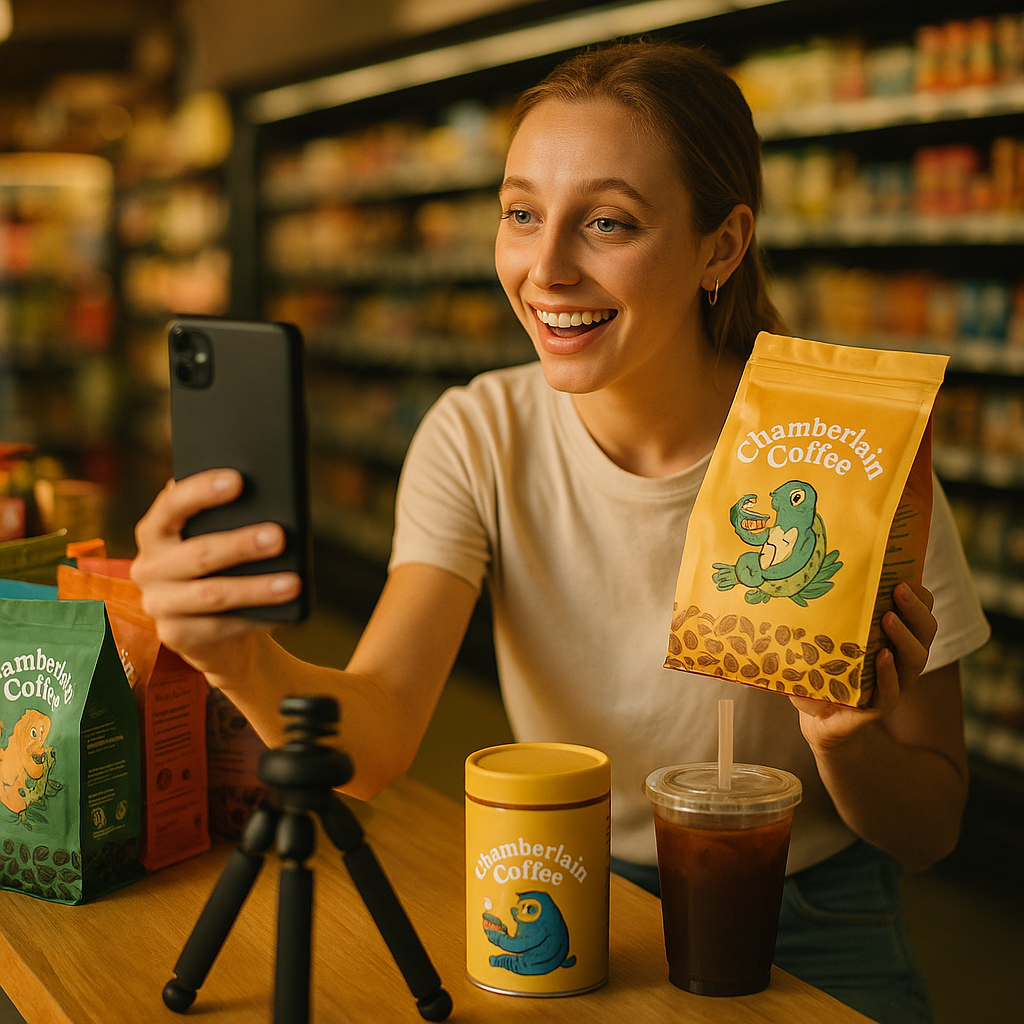
Most founder-led brands lean on the founder. Chamberlain Coffee had one of the most recognizable young creators on the internet as its namesake, and it still chose to build its retail launch around dozens of other creators instead. No halo effect. No shortcut. Just a creator-first retail launch strategy that treated Emma Chamberlain’s fame as a starting point, not a crutch.
That decision is the whole story here. It’s also a masterclass in how brands with a built-in audience can still get creator marketing wrong if they lean too hard on the founder’s name.
The Celebrity-Founder Trap Most Brands Fall Into
Founder-led brands love to coast. Poppi had Rachael Ostovar. Skims had Kim Kardashian. Prime had Logan Paul and KSI. The temptation is obvious: why build a broad creator program when the founder already has 12 million followers?
The problem is durability. Founder-fueled hype spikes hard and fades fast. Retail buyers know this too. A single creator’s face on packaging doesn’t guarantee repeat purchase, and it definitely doesn’t guarantee shelf velocity once the product sits next to twenty other options at Target or Walmart. Retailers want proof of demand that isn’t dependent on one person’s mood, scandal risk, or platform algorithm.
A celebrity founder can open the door to a retail meeting. Only a diversified creator ecosystem can prove the product will actually move off the shelf.
Chamberlain Coffee’s team seemed to understand this early. Rather than centering every retail push on Emma’s own content, they built an ecosystem of micro and mid-tier creators who talked about the coffee the way normal customers do: in their kitchens, in their cars, in their morning routines. It’s the same instinct behind Rare Beauty’s creator cohort strategy, which similarly resisted leaning on a single famous name to carry the brand’s growth.
What “Creator-First” Actually Meant for This Launch
“Creator-first” gets thrown around loosely in this industry. For Chamberlain Coffee, it had a specific operational meaning: creators were briefed and activated before the retail rollout, not after.
Here’s the sequence that made it work:
- Pre-launch seeding to niche coffee and lifestyle creators, months ahead of shelf placement, so organic conversation existed before the SKU hit stores.
- Layered creator tiers, mixing nano-creators (under 10K followers) with mid-tier lifestyle and food creators (50K–500K), rather than betting everything on macro names.
- UGC-style content built for TikTok and Instagram Reels, prioritizing native, low-polish formats over glossy brand ads.
- Retail-specific content requests, asking creators to film “find it at Target” or “found this at Walmart” moments to drive in-store traffic and validate placement decisions to retail buyers.
This mirrors a pattern showing up across CPG launches right now. American Eagle’s TikTok creator strategy used a similar in-store lift mechanic, and Lowe’s creator DIY series proved the same principle in home improvement retail: creator content that references a physical shelf location drives measurable foot traffic in a way that pure awareness content doesn’t.
Why Retail Buyers Care About Creator Diversity, Not Just Reach
Ask any category buyer at a major grocery or mass retailer what worries them about founder-led brands, and you’ll hear some version of the same concern: concentration risk. If 90% of a brand’s social proof comes from one person, that’s a single point of failure. Founders leave companies. They get canceled. They get bored and move to a new venture. Retailers remember what happened to brands that over-indexed on one influential figure and then struggled when that person’s relevance cooled.
Chamberlain Coffee’s spread-out creator roster gave buyers something more durable to evaluate: a distributed base of advocates across different niches (coffee nerds, home baristas, dorm-room students, budget-conscious families) that suggested organic pull independent of Emma Chamberlain’s personal brand. That’s a much stronger data point in a buyer meeting than a single celebrity endorsement.
It also solves a real measurement problem. According to eMarketer research, influencer marketing spend in the US continues to climb even as brands report growing pressure to prove ROI beyond vanity metrics. A concentrated celebrity-founder strategy makes that proof harder, because performance is inseparable from one individual’s popularity curve. A distributed creator base makes attribution and testing much more tractable.
The Content Mix: Coffee-as-Lifestyle, Not Coffee-as-Product
Scroll through Chamberlain Coffee’s creator content and you’ll notice something: very little of it is actually about coffee flavor notes or bean sourcing. Most of it is about routine, aesthetic, and identity. Morning routine videos. “What I eat in a day” content. Dorm setup tours. College budget hacks.
This is deliberate. Gen Z and younger millennial buyers don’t respond to product-spec pitches the way older demographics do. They respond to context. Showing the product inside someone’s actual life does more persuasive work than a close-up of the packaging ever could.
It’s the same insight behind Milani’s approach to Gen Z beauty briefs, detailed in Milani’s TikTok creator brief strategy: give creators a loose creative container, not a rigid script, and let them fold the product into content formats their audience already trusts.
Retail Lift: What the Numbers Suggest
Chamberlain Coffee hasn’t published granular sell-through data publicly, and any brand claiming precise attribution from social content to shelf sales should be treated with some skepticism; the tracking infrastructure for that kind of measurement is still maturing across the industry.
But the directional signals are consistent with what other creator-led CPG and beverage launches have reported. Retail-focused creator campaigns that combine pre-launch seeding with “find it in store” content tend to show measurable upticks in the two to four weeks immediately following retail placement, largely driven by search intent (shoppers looking up “where to buy” before visiting a store). This lines up with what Coors Light’s creator campaign demonstrated around humor-driven content translating into sales attribution, and what Vessi’s single-video shop referral case showed about one well-placed piece of content compounding into a broader retail traffic engine.
The strongest retail lift doesn’t come from the biggest creator. It comes from the highest volume of believable, repeated “I found this” moments across dozens of smaller accounts.
What Brands With a Famous Founder Should Steal From This
If your brand has a celebrity founder, co-founder, or high-profile executive attached, the Chamberlain Coffee approach offers a genuinely useful template. A few operating principles worth borrowing:
- Treat the founder as a top-of-funnel asset, not the whole funnel. Use their reach to generate initial awareness, then hand the mid-funnel and conversion work to a broader creator bench.
- Diversify creator tiers deliberately. A mix of nano, micro, and mid-tier creators reduces both cost and risk compared to concentrating budget on one or two big names.
- Brief for retail-specific moments. Ask creators explicitly to reference where the product can be purchased. This is a small brief change with outsized impact on in-store traffic.
- Seed early, not at launch. Organic conversation needs runway. Waiting until launch day to activate creators wastes the pre-launch window entirely.
- Build measurement into the plan from day one. Track search lift, store locator traffic, and creator-attributed promo codes before the campaign starts, not after.
This same logic shows up in P&G’s modular agency model, which was built specifically to help mid-market brands run creator programs without needing a single celebrity hook to justify the spend. The infrastructure matters more than the famous name.
The Risk Side: Compliance and Brand Safety in a Distributed Model
Spreading a launch across dozens of creators instead of one celebrity founder introduces its own operational headaches. More creators means more contracts, more disclosure checkpoints, and more surface area for something to go off-brief.
The FTC has been increasingly active on influencer disclosure enforcement, and FTC endorsement guidance makes clear that brands share liability when creators fail to disclose paid partnerships properly. A distributed creator program without a compliance workflow is a lawsuit waiting to happen, not a growth hack.
Practical safeguards worth building in:
- Standardized disclosure language baked into every creator contract, not left to individual interpretation.
- A lightweight approval workflow for retail-specific claims (pricing, availability, health claims around caffeine content) before content goes live.
- Regular audits of live content, not just pre-publish review, since platforms and creators edit or repost content long after initial approval.
Brands like Unilever have leaned into interest-based creator discovery over raw follower count precisely because it reduces this kind of operational chaos. The Unilever creator discovery approach is worth studying if you’re scaling past a handful of creator partners and need a repeatable vetting process.
Where This Leaves Founder-Led Brands Heading Into Next Year
The celebrity-founder halo effect isn’t dead. It’s just no longer sufficient on its own. Retail buyers, ad platforms, and consumers have all gotten more sophisticated about spotting manufactured hype versus organic demand. According to Sprout Social’s industry research, audiences increasingly favor creator content that feels unscripted and peer-driven over polished brand or celebrity endorsements, a shift that punishes brands still leaning entirely on founder charisma.
Chamberlain Coffee’s bet, whether fully intentional from day one or refined over time, was to treat Emma Chamberlain’s fame as one input among many rather than the entire strategy. That’s a harder path operationally. It’s also a more resilient one.
The Takeaway
If your brand has a famous founder, don’t build the retail launch around them. Build it around a diversified creator bench, brief for retail-specific moments, and let the founder’s reach do what it does best: get you the meeting, not close the sale.
FAQs
What does “creator-first retail launch” mean in practice?
It means activating a broad roster of creators before and during a retail rollout, rather than relying on paid advertising or a single celebrity endorsement to drive shelf awareness and in-store traffic.
Why didn’t Chamberlain Coffee rely more heavily on Emma Chamberlain’s personal fame?
A concentrated celebrity-led strategy creates risk for retail buyers, who prefer evidence of distributed, organic demand over reliance on one individual’s popularity. Spreading advocacy across many creators also makes performance easier to measure and sustain.
How can brands measure the ROI of a distributed creator strategy?
Track store locator traffic, branded search lift, creator-attributed promo codes, and social listening volume around specific retail placements, ideally starting measurement before the campaign launches rather than after.
What compliance risks come with using many creators instead of one celebrity?
More creators means more disclosure checkpoints and more surface area for FTC violations. Brands need standardized disclosure language, pre-publish approval workflows, and ongoing audits of live content to manage this risk.
Can smaller or mid-market brands replicate this model without a famous founder at all?
Yes. The core mechanics, tiered creator selection, retail-specific briefs, and early seeding, don’t require a celebrity attachment. They rely on process and measurement discipline more than on borrowed fame.
FAQs
What does “creator-first retail launch” mean in practice?
It means activating a broad roster of creators before and during a retail rollout, rather than relying on paid advertising or a single celebrity endorsement to drive shelf awareness and in-store traffic.
Why didn’t Chamberlain Coffee rely more heavily on Emma Chamberlain’s personal fame?
A concentrated celebrity-led strategy creates risk for retail buyers, who prefer evidence of distributed, organic demand over reliance on one individual’s popularity. Spreading advocacy across many creators also makes performance easier to measure and sustain.
How can brands measure the ROI of a distributed creator strategy?
Track store locator traffic, branded search lift, creator-attributed promo codes, and social listening volume around specific retail placements, ideally starting measurement before the campaign launches rather than after.
What compliance risks come with using many creators instead of one celebrity?
More creators means more disclosure checkpoints and more surface area for FTC violations. Brands need standardized disclosure language, pre-publish approval workflows, and ongoing audits of live content to manage this risk.
Can smaller or mid-market brands replicate this model without a famous founder at all?
Yes. The core mechanics, tiered creator selection, retail-specific briefs, and early seeding, don’t require a celebrity attachment. They rely on process and measurement discipline more than on borrowed fame.
Top Influencer Marketing Agencies
The leading agencies shaping influencer marketing in 2026
Agencies ranked by campaign performance, client diversity, platform expertise, proven ROI, industry recognition, and client satisfaction. Assessed through verified case studies, reviews, and industry consultations.
Moburst

-
2

The Shelf
Boutique Beauty & Lifestyle Influencer AgencyA data-driven boutique agency specializing exclusively in beauty, wellness, and lifestyle influencer campaigns on Instagram and TikTok. Best for brands already focused on the beauty/personal care space that need curated, aesthetic-driven content.Clients: Pepsi, The Honest Company, Hims, Elf Cosmetics, Pure LeafVisit The Shelf → -
3

Audiencly
Niche Gaming & Esports Influencer AgencyA specialized agency focused exclusively on gaming and esports creators on YouTube, Twitch, and TikTok. Ideal if your campaign is 100% gaming-focused — from game launches to hardware and esports events.Clients: Epic Games, NordVPN, Ubisoft, Wargaming, Tencent GamesVisit Audiencly → -
4

Viral Nation
Global Influencer Marketing & Talent AgencyA dual talent management and marketing agency with proprietary brand safety tools and a global creator network spanning nano-influencers to celebrities across all major platforms.Clients: Meta, Activision Blizzard, Energizer, Aston Martin, WalmartVisit Viral Nation → -
5

The Influencer Marketing Factory
TikTok, Instagram & YouTube CampaignsA full-service agency with strong TikTok expertise, offering end-to-end campaign management from influencer discovery through performance reporting with a focus on platform-native content.Clients: Google, Snapchat, Universal Music, Bumble, YelpVisit TIMF → -
6

NeoReach
Enterprise Analytics & Influencer CampaignsAn enterprise-focused agency combining managed campaigns with a powerful self-service data platform for influencer search, audience analytics, and attribution modeling.Clients: Amazon, Airbnb, Netflix, Honda, The New York TimesVisit NeoReach → -
7

Ubiquitous
Creator-First Marketing PlatformA tech-driven platform combining self-service tools with managed campaign options, emphasizing speed and scalability for brands managing multiple influencer relationships.Clients: Lyft, Disney, Target, American Eagle, NetflixVisit Ubiquitous → -
8

Obviously
Scalable Enterprise Influencer CampaignsA tech-enabled agency built for high-volume campaigns, coordinating hundreds of creators simultaneously with end-to-end logistics, content rights management, and product seeding.Clients: Google, Ulta Beauty, Converse, AmazonVisit Obviously →