


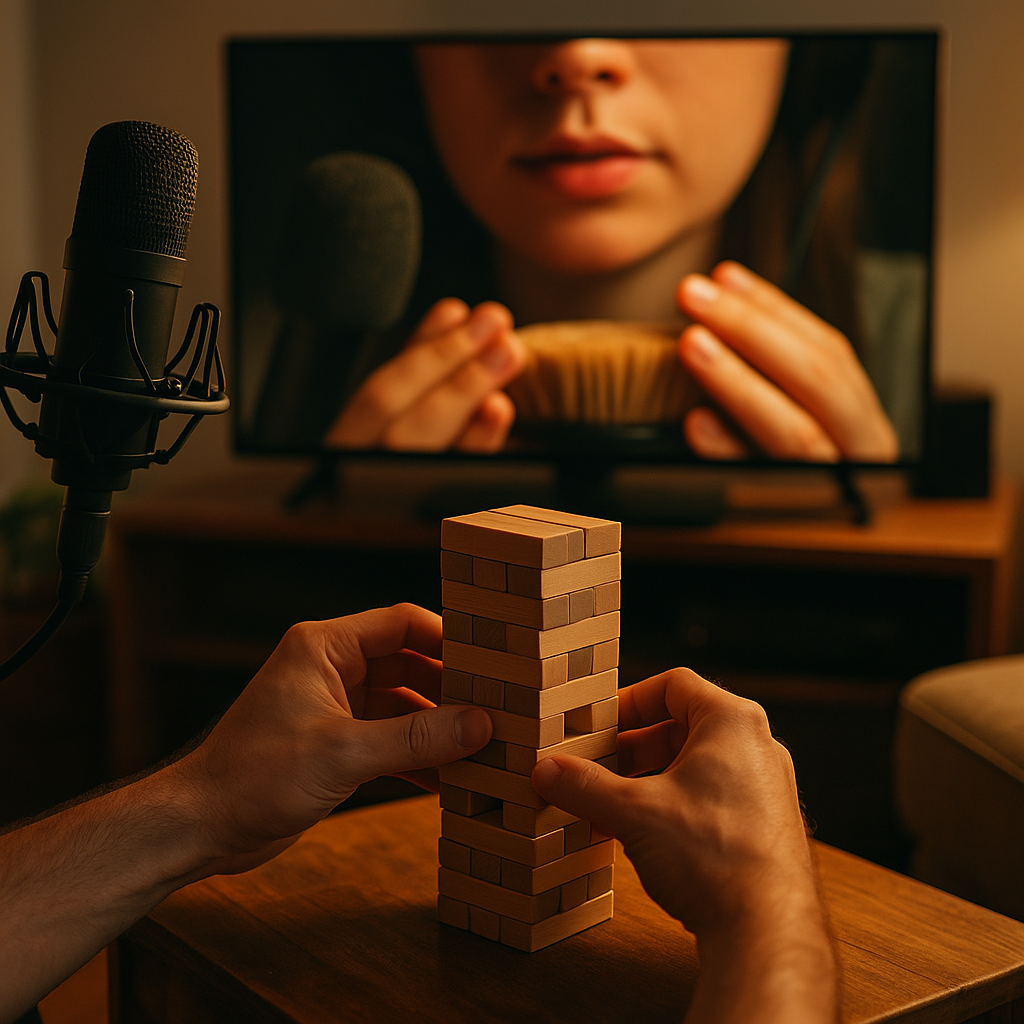
Whispered unboxings and crunchy soap-cutting clips built entire followings on mobile. But drop that same ASMR product demo into a 30-second CTV slot and it can fall flat — living room speakers can’t carry a whisper, and there’s no headphone intimacy to lean on. Adapting ASMR for connected TV isn’t a resize job. It’s a rebuild.
Brands chasing the sensory-content trend on streaming are learning this the hard way. The format works. The delivery mechanism doesn’t translate without real changes to sound design, pacing, and visual framing.
Why ASMR Traveled So Well on Mobile — and Why CTV Breaks the Formula
ASMR content thrives on proximity. A creator taps a lid, crinkles packaging, or drags a spoon through cream, and the mic picks up every micro-texture because the viewer is holding a phone six inches from their face, usually with earbuds in. That intimacy is the entire mechanic. Remove it, and you’re left with someone quietly fondling a product for no clear reason.
Connected TV strips away every one of those conditions. Viewers sit eight to ten feet from the screen. Sound plays through soundbars, built-in TV speakers, or whatever mediocre audio setup came with the smart TV. Most CTV environments are shared spaces — living rooms, not solo scroll sessions — so hyper-quiet, hyper-personal audio design doesn’t just underperform, it can be inaudible.
The core insight: ASMR on CTV isn’t about whispering louder. It’s about redesigning sensory triggers for a communal, low-fidelity, non-skippable environment.
There’s also a structural difference in viewing behavior. On TikTok or Reels, a bad ASMR demo gets scrolled past in under two seconds — the cost of a miss is low. On CTV, ad slots are largely non-skippable and appear in pods alongside other 15- and 30-second spots. A flat, inaudible ASMR ad doesn’t just underperform; it actively bores a captive audience, which is worse for brand recall than no ASMR angle at all.
The Audio Problem Nobody’s Solving Correctly
Most brands trying to force ASMR onto CTV make the same mistake: they take the original mobile audio mix and just upscale volume. That’s not a fix. Whisper-register audio, even amplified, loses its textural detail when played through mid-range TV speakers that can’t reproduce high-frequency crinkle and tap sounds accurately.
The better approach is a dual-layer mix built specifically for large-screen delivery:
- Foreground foley, not whisper narration. Ditch the soft-spoken voiceover almost entirely. Let product sounds — the seal breaking, the pour, the click — carry the sensory weight instead of a person’s voice.
- Mid-frequency emphasis. Work with an audio engineer to boost the 500Hz–2kHz range, where most TV speakers perform best, rather than relying on the crisp high-end detail that headphones capture but soundbars flatten.
- Ambient bed, not silence. Total silence reads as a technical glitch on a shared TV. A subtle ambient tone (room hum, soft music bed) keeps the ad feeling intentional.
This isn’t a hunch — it’s consistent with what audio engineers have long known about home theater mixing, where dialogue and effects are balanced specifically for the frequency response of consumer television speakers rather than studio monitors.
Reframing the Visual: Macro Shots Need a Wide-Screen Translation
Mobile ASMR leans hard on extreme macro — fingertips, texture, close-cropped product detail filling a 9:16 frame. Put that same tight crop on a 16:9 CTV canvas and you get a lot of dead space or an awkward pillarboxed frame that looks like an afterthought.
Reworking for CTV means re-shooting or re-editing with the wider aspect ratio in mind from the start, not center-cropping existing vertical assets.
Practical adjustments that work:
- Widen the frame slightly to include hands, product, and a hint of environment — this fills the 16:9 canvas without losing the macro focal point.
- Use rack focus (shifting focus from background to foreground) to create depth cues that read well on large screens, something flat mobile macro shots rarely need.
- Slow the cut rate. CTV audiences aren’t scrolling; they’re watching passively. A slightly slower edit rhythm (1.5–2 seconds per shot versus the sub-second cuts common in mobile ASMR) reads as premium rather than sluggish on a big screen.
This is the same lesson brands learned adapting slow-motion product reveals for different formats — the emotional payload of a slow, tactile moment depends entirely on matching pacing to screen size and viewing context.
Briefing Creators for a Format They’ve Never Shot This Way
Most ASMR creators have zero experience shooting for 16:9 broadcast-style delivery. Their instinct is to shoot vertical, tight, and quiet. Briefs need to explicitly override those instincts, not assume creators will intuit the shift.
A solid CTV ASMR brief should specify:
- Aspect ratio and framing from the shoot, not just the edit. Shooting natively in 16:9 (or shooting wide enough to reframe) avoids the pillarbox problem entirely.
- Sound priority order. Tell creators which sound is the hero — the pour, the snap, the fizz — so the mix has a clear focal point instead of a wash of competing textures.
- No dead air over three seconds. Living room viewers with the remote nearby will change the channel during silence. Mobile viewers tolerate pauses; CTV viewers don’t.
- A visible brand cue in the first five seconds. Non-skippable doesn’t mean guaranteed attention — plenty of viewers are on their phones during the pod. A quick visual identifier (logo, packaging color, distinct product silhouette) protects brand recall even during partial attention.
This kind of specificity mirrors what worked when brands rebuilt ASMR product demo briefs for feed-based platforms — the format only performs when the brief accounts for the platform’s actual viewing conditions, not a generic template.
Where CTV Ad Slots Actually Fit This Format
Not every CTV inventory slot suits sensory content. Mid-roll pods during premium content (streaming originals, live sports breaks) tend to have higher attention and lower channel-surfing risk than pre-roll on ad-supported tiers like Tubi or Pluto TV, where viewers are more primed to tune out.
Sensory-driven ASMR demos perform best in:
- 15-second slots within shorter pods (less competition for attention span)
- Addressable CTV buys targeting households already showing purchase intent signals (retargeted from site visits or app engagement)
- Contextually adjacent programming — food content for a kitchen gadget ASMR spot, beauty or lifestyle content for skincare
According to eMarketer, CTV ad spend continues to outpace linear TV budget shifts as advertisers chase addressability and better measurement — which means the format competition inside CTV pods is only intensifying. A generic, poorly-mixed ASMR spot won’t just underperform; it’ll get buried next to better-produced sensory and demo content from competitors who did the audio work.
Measurement: What “Working” Actually Looks Like on CTV
Save rates and rewatch metrics — the usual proof points for ASMR content on TikTok or Instagram — don’t exist on CTV. There’s no save button, no loop count. Brands need a different success framework entirely.
Useful proxies include:
- Completion rate segmented by pod position (early vs. late in the ad break)
- Brand lift studies comparing ASMR-style creative against standard demo spots in the same campaign
- Second-screen search lift — did the spot drive an immediate spike in branded search from the same household during or after airtime
- Attention metrics from measurement partners that track co-viewing and device-down attention, increasingly available through CTV DSPs
Statista data on CTV ad engagement consistently shows completion rates as the most reliable early signal, since most platforms don’t yet offer granular attention data at scale. Treat completion rate as your baseline KPI, and layer brand lift on top once budget allows.
Compliance Doesn’t Disappear Just Because It’s Broadcast-Style
ASMR demos sit close to the line on implied claims — a satisfying “snap” or “click” can imply product quality or durability that hasn’t actually been substantiated. That risk doesn’t shrink on CTV; if anything, broadcast-style creative reads as more authoritative to viewers, which raises the bar for accuracy.
The FTC’s endorsement guidance still applies even when there’s no creator talking-head disclosure moment — if a paid creator’s product experience is being dramatized through sound and visual, that relationship needs clear on-screen disclosure, sized and timed to be legible on a TV screen from viewing distance, not a tiny mobile-scale caption.
This is the same discipline covered in before-and-after brief compliance work — the format changes, the disclosure obligation doesn’t.
Quick Reference: Mobile ASMR vs. CTV ASMR
- Aspect ratio: 9:16 vertical → 16:9 native
- Audio focus: Whisper narration → Foreground foley, mid-frequency mix
- Viewing distance: 6-12 inches → 8-10 feet
- Skip risk: High (scroll) → Low (non-skippable) but channel-surf risk instead
- Success metric: Saves, rewatches → Completion rate, brand lift, search lift
None of this means abandoning what made ASMR work in the first place. The sensory hook — that visceral, almost involuntary satisfaction response — still drives attention better than a standard product shot. It just needs a new engineering approach for a screen and speaker setup the format was never built for.
FAQs
Frequently Asked Questions
Can ASMR content actually work on CTV given the audio limitations?
Yes, but only with a remixed audio approach. Foreground foley sounds mixed for mid-range frequencies perform far better on TV speakers than whisper-register narration, which was designed for headphone listening and loses detail on soundbars.
Do I need to reshoot mobile ASMR content for CTV, or can I just resize it?
Reshooting or at least re-editing is strongly recommended. Center-cropping vertical footage into a 16:9 frame leaves dead space or forces an awkward pillarbox look. Native widescreen framing with intentional depth cues performs significantly better.
What’s the biggest mistake brands make adapting ASMR for CTV?
Treating it as a resolution and aspect-ratio conversion instead of a full creative rebuild. The audio mix, pacing, and framing all need platform-specific treatment; simply upscaling mobile assets consistently underperforms.
How should success be measured for CTV ASMR ads?
Completion rate segmented by pod position, brand lift studies, and second-screen search lift are the most reliable proxies. Save rates and loop counts, common on social platforms, don’t exist in CTV environments.
Are there compliance risks specific to ASMR-style CTV ads?
Yes. Sensory cues like a satisfying snap or click can imply unsubstantiated quality claims. FTC endorsement disclosure rules still apply and need to be sized and timed for TV viewing distance, not mobile-scale captions.
Next step: before commissioning a CTV ASMR spot, run a speaker test on an actual mid-range TV soundbar, not studio headphones — if the hero sound isn’t clearly audible at that stage, the creative isn’t ready for a media buy.
Top Influencer Marketing Agencies
The leading agencies shaping influencer marketing in 2026
Agencies ranked by campaign performance, client diversity, platform expertise, proven ROI, industry recognition, and client satisfaction. Assessed through verified case studies, reviews, and industry consultations.
Moburst

-
2

The Shelf
Boutique Beauty & Lifestyle Influencer AgencyA data-driven boutique agency specializing exclusively in beauty, wellness, and lifestyle influencer campaigns on Instagram and TikTok. Best for brands already focused on the beauty/personal care space that need curated, aesthetic-driven content.Clients: Pepsi, The Honest Company, Hims, Elf Cosmetics, Pure LeafVisit The Shelf → -
3

Audiencly
Niche Gaming & Esports Influencer AgencyA specialized agency focused exclusively on gaming and esports creators on YouTube, Twitch, and TikTok. Ideal if your campaign is 100% gaming-focused — from game launches to hardware and esports events.Clients: Epic Games, NordVPN, Ubisoft, Wargaming, Tencent GamesVisit Audiencly → -
4

Viral Nation
Global Influencer Marketing & Talent AgencyA dual talent management and marketing agency with proprietary brand safety tools and a global creator network spanning nano-influencers to celebrities across all major platforms.Clients: Meta, Activision Blizzard, Energizer, Aston Martin, WalmartVisit Viral Nation → -
5

The Influencer Marketing Factory
TikTok, Instagram & YouTube CampaignsA full-service agency with strong TikTok expertise, offering end-to-end campaign management from influencer discovery through performance reporting with a focus on platform-native content.Clients: Google, Snapchat, Universal Music, Bumble, YelpVisit TIMF → -
6

NeoReach
Enterprise Analytics & Influencer CampaignsAn enterprise-focused agency combining managed campaigns with a powerful self-service data platform for influencer search, audience analytics, and attribution modeling.Clients: Amazon, Airbnb, Netflix, Honda, The New York TimesVisit NeoReach → -
7

Ubiquitous
Creator-First Marketing PlatformA tech-driven platform combining self-service tools with managed campaign options, emphasizing speed and scalability for brands managing multiple influencer relationships.Clients: Lyft, Disney, Target, American Eagle, NetflixVisit Ubiquitous → -
8

Obviously
Scalable Enterprise Influencer CampaignsA tech-enabled agency built for high-volume campaigns, coordinating hundreds of creators simultaneously with end-to-end logistics, content rights management, and product seeding.Clients: Google, Ulta Beauty, Converse, AmazonVisit Obviously →