


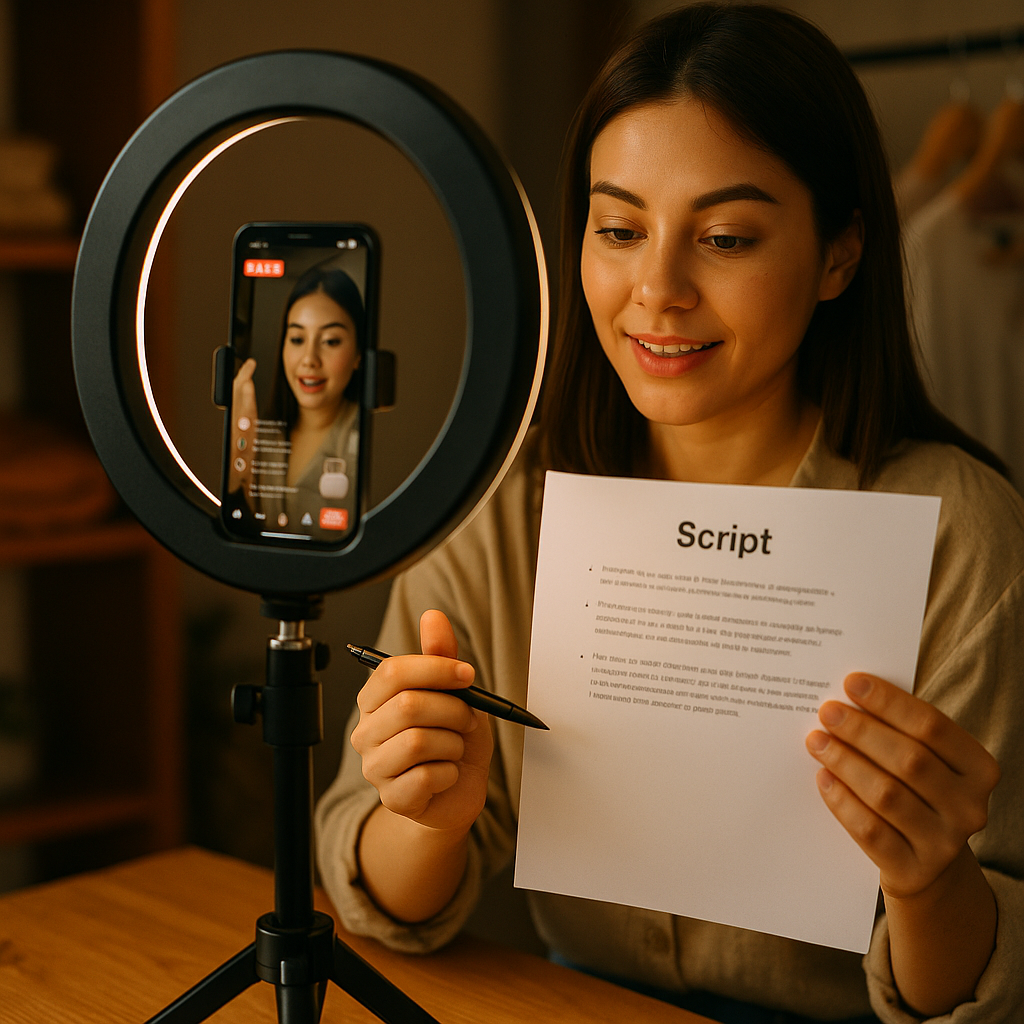
Seventy percent of TikTok Shop livestream viewers decide whether to stay or scroll within the first 90 seconds. Miss that window with a slow intro, a dead-air product setup, or an awkward “hey guys, welcome” and you’ve lost the sale before you’ve even shown the product. The TikTok Shop live commerce game isn’t won on production value. It’s won on the script you run before the viewer’s thumb even twitches.
This playbook breaks down exactly what to say, show, and do in the opening minute and a half of a livestream, minute by minute, so you stop bleeding viewers before the pitch even starts.
Why the First 90 Seconds Decide Everything
TikTok’s live algorithm rewards watch time and retention curves, not just concurrent viewers. A stream that loses half its audience in the first minute gets deprioritized in the For You feed almost immediately, which means fewer new viewers get pushed in to replace the ones who left. It’s a compounding problem. Weak open, shrinking discovery, weaker close.
Brands often obsess over lighting, ring lights, and product staging, and sure, that matters. But the actual drop-off happens for a simpler reason: the host doesn’t give viewers a reason to stay within the first few seconds. TikTok users are scroll-trained. They’ve been conditioned by Shorts and Reels to expect a hook immediately or they swipe. A livestream that opens like a Zoom call (“hi everyone, thanks for joining”) is dead on arrival.
If your livestream’s first line could be copy-pasted onto any other brand’s stream, you’ve already lost the viewer. Specificity is retention.
Second 0 to 15: Skip the Greeting, Lead With Proof
Do not open with “welcome to the live.” Open with the product doing something, or a claim so specific it demands a beat of attention. Think: “This sold out twice last week, I’ve got 40 units restocked right now.” Or show the product mid-action, a texture swatch, a fit-on, a before/after, within the first three seconds of the feed refreshing.
Why this matters: new viewers are landing on your stream at random timestamps throughout the broadcast, not just at the start. That means your “first 15 seconds” script needs to repeat, in some form, every few minutes for the entire stream. But the literal opening of the broadcast is when TikTok’s algorithm is deciding how much initial reach to give you, so it needs to be airtight.
- Lead with a visual hook, not a verbal one. Hold the product up, mid-demo, before you even say a full sentence.
- Name a concrete number: units left, discount percentage, price drop, or time window. Vague enthusiasm doesn’t hook anyone.
- Avoid dead air while you fix your mic or check your phone. Do that off-camera or during a pre-roll countdown graphic.
Compare this to organic content strategy elsewhere on TikTok. Our organic livestream commerce playbook covers the broader cadence, but this piece zooms in specifically on the scripted opening, because that’s where most brands lose the room.
Second 15 to 45: Establish the “Why Now”
Once you’ve hooked attention visually, you have a 30-second window to justify urgency without sounding like a late-night infomercial. This is where most scripts fail, either they oversell (triggering skepticism) or they undersell (triggering boredom).
The move here is specificity plus scarcity plus social proof, delivered fast. Something like: “We restocked this after 3,000 people asked in the comments last stream. I’ve got 200 units, and at this price it usually sells out in under 20 minutes.” That’s one sentence doing three jobs: proof of demand, quantified scarcity, and a time expectation that keeps people watching to see if it actually happens.
Contrast this with a generic script: “This is one of our best sellers, everyone loves it, get yours before it’s gone.” No numbers, no proof, no reason to stay past the first ten seconds. TikTok Shop viewers have seen a thousand of these streams. Generic urgency reads as manufactured urgency, and they’ll scroll straight through it.
Second 45 to 70: Show, Don’t Explain
This is the demo window. Skip the ingredient list, skip the brand history, skip the “we started this company because.” None of that belongs in the first 90 seconds. Viewers who stuck around this far want to see the product do the thing it promises.
If it’s a skincare product, apply it on camera and narrate the texture in real time. If it’s apparel, do a fast on-body fit check with a size callout (“I’m a size 8, wearing a medium here”). If it’s a gadget, trigger the feature that makes it interesting, don’t describe the feature.
This is also the moment to pin the product card and verbally direct people to it: “Tap the yellow basket, it’s pinned at the top.” Repeating this instruction is fine, TikTok Shop hosts often repeat the CTA every 90 seconds throughout the stream, but the first mention needs to land here, not buried under an introduction monologue.
Second 70 to 90: Convert the Lurkers Into Commenters
The final stretch of the opening window should shift from “watch” to “engage.” Ask a direct, low-friction question that’s easy to answer in one word: “Drop your size in the comments if you want a fit check.” Or: “Comment ‘YES’ if you want me to show the second color.” This isn’t filler, it’s a retention mechanic. TikTok’s live algorithm weighs comment velocity heavily when deciding whether to keep boosting a stream to new viewers.
Hosts who skip this step often see a steady bleed of viewers right around the two-minute mark, because nothing has asked them to participate yet. A single low-effort comment prompt in the first 90 seconds meaningfully changes the retention curve for the rest of the hour.
A comment prompt inside the first 90 seconds does more for algorithmic reach than an extra ring light or a better camera ever will.
Building the Script Into a Repeatable Template
None of this works as a one-off. The brands winning on TikTok Shop right now treat the opening 90 seconds as a fixed script, rehearsed and slightly varied stream to stream, not improvised. Here’s a rough structural template worth adapting:
- 0:00–0:15 — Visual hook plus a specific claim (units, price, demand proof).
- 0:15–0:45 — Urgency statement with a number attached, plus a one-line social proof reference.
- 0:45–0:70 — Live product demo with the CTA delivered mid-demo, not before or after.
- 0:70–0:90 — Low-effort comment prompt to spike engagement signals.
Multi-host teams should assign this script to whoever is opening the shift, and rotate it slightly so returning viewers don’t hear an identical loop. Affiliate creators running their own TikTok Shop streams benefit from this structure too, especially newer creators still building an audience, since commission tiers increasingly reward creators who can prove retention, not just views. Our breakdown of affiliate commission tiers and the newer Q4 commission tiers built on match signals both point in the same direction: TikTok is quietly rewarding creators whose streams keep people watching, not just those who drive raw click volume.
What Brands Get Wrong Even With a Good Script
A script only works if the host can deliver it naturally. Reading verbatim off a teleprompter kills the authenticity that makes live commerce convert in the first place. The better approach: memorize the beats, not the words. Know that second 45 needs a demo and a CTA, but let the exact phrasing shift stream to stream.
Second mistake: brands script the opening but ignore re-entry moments. Every few minutes, a fresh wave of viewers lands mid-stream with zero context. If your script only runs once at the true start of the broadcast, you’re only optimizing for a fraction of your total audience. Build a compressed 20-second version of the hook-urgency-demo sequence to loop every five to seven minutes.
Third, and this trips up more brands than it should: compliance. Scarcity claims (“only 40 left”) need to be true, not theatrical. The FTC has been increasingly active on deceptive urgency and endorsement claims in livestream and influencer contexts, and TikTok Shop’s own seller policies require accurate stock representation. A script that manufactures fake urgency isn’t just a brand risk, it’s a regulatory one.
Measuring Whether Your Script Is Actually Working
Don’t just watch concurrent viewer counts. Pull the retention curve from TikTok Shop’s analytics dashboard and look specifically at the drop-off slope between second 0 and second 90. A steep early drop means the hook isn’t landing. A drop concentrated around second 45 to 60 usually means the demo dragged or the CTA got buried.
Benchmark against your own historical streams before comparing to industry averages, since vertical and price point change viewer behavior significantly. A $15 impulse item and a $150 skincare set will have very different natural attention curves. Platforms like Sprout Social and eMarketer publish broader social commerce benchmarks worth checking quarterly, but your own stream-to-stream data will always be the more actionable signal.
Worth comparing notes across platforms, too. Amazon Live hosts are navigating a similar retention challenge post-Rufus AI traffic shifts, and the scripting logic overlaps more than you’d expect. Our pieces on turning Rufus AI traffic into sales and fixing streaming cadence both reinforce the same core principle: the platform’s AI recommendation layer rewards streams that prove early engagement, fast.
Script the first 90 seconds like it’s the only 90 seconds you get, because for a growing share of your audience, it is. Test one variable at a time, hook phrasing, urgency numbers, or CTA timing, and let your own retention data tell you which change actually moved the needle.
FAQs
How long should the opening hook actually be on a TikTok Shop livestream?
Aim for three to five seconds of pure visual hook before you speak a full sentence. The goal is to give scrolling viewers something concrete to look at immediately, not a verbal introduction they have to sit through first.
Should every livestream host use the exact same script?
No. Memorize the structural beats, hook, urgency, demo, comment prompt, but vary the exact phrasing stream to stream. Word-for-word repetition across streams reads as scripted and can hurt authenticity, which viewers pick up on quickly.
How often should the opening sequence repeat during a longer stream?
Run a compressed 15-to-20-second version of the hook-urgency-CTA sequence every five to seven minutes. New viewers land mid-stream constantly, and without a recap they have no context for why they should stay.
What’s the biggest compliance risk in scripting urgency for TikTok Shop?
Overstating scarcity or stock levels. If you script a line like “only 40 left,” that number needs to reflect actual inventory. Regulators including the FTC have scrutinized deceptive urgency claims in livestream and influencer marketing contexts.
Does a strong 90-second open actually affect TikTok’s algorithmic reach?
Yes. TikTok’s live algorithm weighs early retention and comment velocity when deciding how much additional reach to give a stream in the For You feed. A steep early drop-off signals low quality and typically results in reduced distribution for the rest of the broadcast.
Top Influencer Marketing Agencies
The leading agencies shaping influencer marketing in 2026
Agencies ranked by campaign performance, client diversity, platform expertise, proven ROI, industry recognition, and client satisfaction. Assessed through verified case studies, reviews, and industry consultations.
Moburst

-
2

The Shelf
Boutique Beauty & Lifestyle Influencer AgencyA data-driven boutique agency specializing exclusively in beauty, wellness, and lifestyle influencer campaigns on Instagram and TikTok. Best for brands already focused on the beauty/personal care space that need curated, aesthetic-driven content.Clients: Pepsi, The Honest Company, Hims, Elf Cosmetics, Pure LeafVisit The Shelf → -
3

Audiencly
Niche Gaming & Esports Influencer AgencyA specialized agency focused exclusively on gaming and esports creators on YouTube, Twitch, and TikTok. Ideal if your campaign is 100% gaming-focused — from game launches to hardware and esports events.Clients: Epic Games, NordVPN, Ubisoft, Wargaming, Tencent GamesVisit Audiencly → -
4

Viral Nation
Global Influencer Marketing & Talent AgencyA dual talent management and marketing agency with proprietary brand safety tools and a global creator network spanning nano-influencers to celebrities across all major platforms.Clients: Meta, Activision Blizzard, Energizer, Aston Martin, WalmartVisit Viral Nation → -
5

The Influencer Marketing Factory
TikTok, Instagram & YouTube CampaignsA full-service agency with strong TikTok expertise, offering end-to-end campaign management from influencer discovery through performance reporting with a focus on platform-native content.Clients: Google, Snapchat, Universal Music, Bumble, YelpVisit TIMF → -
6

NeoReach
Enterprise Analytics & Influencer CampaignsAn enterprise-focused agency combining managed campaigns with a powerful self-service data platform for influencer search, audience analytics, and attribution modeling.Clients: Amazon, Airbnb, Netflix, Honda, The New York TimesVisit NeoReach → -
7

Ubiquitous
Creator-First Marketing PlatformA tech-driven platform combining self-service tools with managed campaign options, emphasizing speed and scalability for brands managing multiple influencer relationships.Clients: Lyft, Disney, Target, American Eagle, NetflixVisit Ubiquitous → -
8

Obviously
Scalable Enterprise Influencer CampaignsA tech-enabled agency built for high-volume campaigns, coordinating hundreds of creators simultaneously with end-to-end logistics, content rights management, and product seeding.Clients: Google, Ulta Beauty, Converse, AmazonVisit Obviously →