


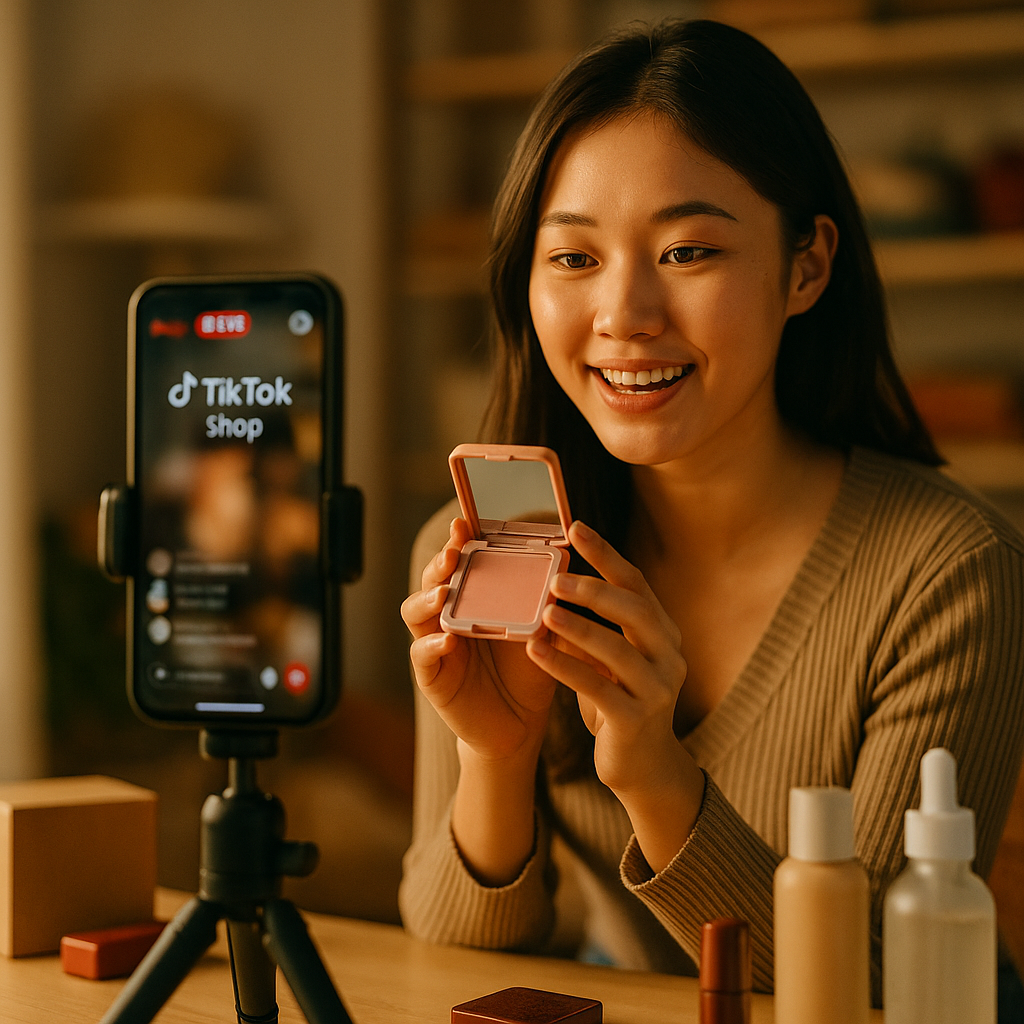
Seventy percent of viewers who leave a TikTok Shop livestream in the first five minutes never come back. That’s not a scare stat — it’s the reality of an algorithm that decides, almost instantly, whether your broadcast deserves distribution. A TikTok Shop livestream lives or dies before most hosts even hit their first product callout.
If you’re still opening with “hey guys, welcome to my live,” you’re leaking viewers by the second. This playbook breaks down exactly what should happen minute by minute, and why the first 300 seconds matter more than the rest of the broadcast combined.
Why the First Five Minutes Carry Disproportionate Weight
TikTok’s livestream algorithm evaluates real-time engagement signals — comments, shares, gift sends, and watch duration — to decide whether to push a broadcast into more For You feeds. It’s a feedback loop that compounds fast. Strong early signals mean broader distribution mid-stream. Weak ones mean your stream gets buried under the next 40 sellers going live in your category.
This isn’t unique to TikTok. YouTube Shorts and Amazon Live run similar logic, rewarding early engagement with amplified reach. Our breakdown of the algorithm and hook mechanics on Shorts covers the same principle applied to short-form video.
A livestream’s first five minutes function like a paid ad’s first three seconds: the algorithm is deciding whether to keep spending impressions on you, and it’s making that call in real time.
Sellers who treat the opening as throat-clearing are essentially paying to lose. Every minute without a hook, a reason to stay, and a low-friction path to purchase is a minute the algorithm quietly downgrades you.
Minute One: The Pattern Interrupt
Scrollers land on your stream mid-swipe. They didn’t search for you. They didn’t plan to watch. You have roughly three seconds to convince them this isn’t another static product-on-a-table stream.
What works: movement, a visible product transformation, a bold claim delivered directly to camera, or an unboxing already in motion when the viewer arrives. What doesn’t: a host staring at their phone waiting for the viewer count to climb.
Some practical openers that consistently outperform generic greetings:
- “I’m not supposed to tell you this, but here’s the actual cost breakdown on this product.”
- Starting mid-demo, as if the viewer just walked into a conversation already underway.
- A visible countdown or ticking discount that creates urgency from second one.
- Addressing the camera with a direct, specific promise: “By the end of this, you’ll know exactly which SPF actually works under makeup.”
This mirrors the logic in our first-90-seconds script framework, which treats the opening as a scripted asset, not improvisation. Livestream hosts who wing the open are gambling with the algorithm’s most sensitive window.
Minute Two: Name the Room, Not Just the Product
Once you’ve stopped the scroll, you need to orient new viewers without boring the ones who’ve been there since minute one. This is the “room-naming” minute: quickly state what’s happening, what’s for sale, and what makes this specific broadcast worth staying for.
Good hosts do this in a single breath: “We’re live testing three skincare dupes against the originals, comments are open, and the first fifty people who comment ‘GLOW’ get an extra 15% off the bundle in the cart below.” That’s orientation, incentive, and a call to action stacked in under ten seconds.
Avoid over-explaining. Nobody wants a five-minute tour of your setup. State the premise, point to the product pinned in the cart, and move.
Minute Three: The First Comment Loop
Comments are the single strongest retention signal TikTok tracks during a livestream. A quiet chat window is a red flag to both the algorithm and to new arrivals scanning for social proof.
Trigger comments early and often in minute three. Ask a binary question (“Team A or Team B, drop it below”), call out specific viewers by username, or run a quick poll using the product itself (“Should I use the red one or the blue one next?”). The goal isn’t information gathering. It’s activity generation.
Hosts running multiple SKUs should treat this minute as a soft funnel: get viewers committing to an opinion about a product before you ever ask them to buy it. Once someone comments “red,” they’ve got a small stake in the outcome. That’s a psychological nudge toward conversion later in the stream.
Minute Four: The First Soft Conversion Ask
This is where most new hosts either rush or freeze. Too early, and you look desperate. Too late, and you’ve wasted the algorithmic momentum you built in minutes one through three.
The soft ask isn’t “buy now.” It’s “tap the yellow basket to see the price” or “the bundle discount is only live for this stream, it’s linked below.” You’re reducing friction, not demanding commitment. Data from TikTok’s own seller resources consistently shows that streams introducing the shopping cart interaction earlier see materially higher click-through rates than streams that delay it past the five-minute mark, according to guidance published on TikTok’s advertiser platform.
Pair the ask with a reason tied to scarcity or exclusivity: limited stock, live-only pricing, or a bundle that disappears when the stream ends. Scarcity mechanics work because they compress the decision window, which matters enormously in a format where viewers can leave with one swipe.
Minute Five: Prove It’s Working
By minute five, you want visible evidence that people are buying. That might mean reading out order numbers, thanking specific usernames for purchases, or showing a running counter of units sold. Social proof compounds. A viewer who sees three purchases confirmed in the last ninety seconds is far more likely to convert than one watching a stream with no visible transaction activity.
If sales haven’t started yet, don’t fake it. Redirect to comment volume or viewer count instead (“we’ve already got 340 people watching this test”) as a proxy signal. Authenticity matters here. Overstating sales numbers is both a trust risk and, depending on the market, a potential compliance issue under advertising standards enforced by bodies like the Federal Trade Commission.
Retention in livestream commerce isn’t about keeping people entertained. It’s about giving the algorithm reasons, every sixty seconds, to keep showing your stream to new people.
What Brands Get Wrong in Practice
Most brand-run livestreams fail not because the host is bad on camera, but because nobody structured the opening as a funnel. Marketing teams often hand a creator a product list and a discount code, then expect retention to happen organically. It doesn’t.
Three recurring mistakes:
- No script for the first two minutes. Hosts default to small talk while the algorithm is actively deciding whether to distribute the stream further.
- Waiting too long to open the cart. Teams worried about looking “salesy” delay the first product tap-through past the five-minute mark, missing peak algorithmic attention.
- Treating comments as a vanity metric instead of a lever. Comment volume directly influences distribution. Ignoring the chat window in early minutes is leaving reach on the table.
For brands scaling this across multiple hosts or SKUs, it’s worth reviewing how commission tiers tied to match signals can incentivize hosts to optimize for these exact retention behaviors, not just gross sales volume. Structuring incentives around early engagement metrics, not just final conversion, tends to produce better opening minutes across the board.
Brands running livestream commerce alongside other creator formats should also look at how Amazon Live is adapting to AI-driven discovery traffic. The retention mechanics are strikingly similar across platforms, even though the audience intent differs.
Building This Into a Repeatable Brief
None of this works as a one-off. The value comes from turning the five-minute structure into a standard brief every host or creator receives before going live. That means specifying the opening hook style, the exact minute for the first cart callout, a comment-trigger script, and a social-proof checkpoint.
Brands that document this once and reuse it across dozens of streams see far more consistent conversion rates than those relying on host instinct. Data from eMarketer on livestream commerce growth suggests the format is scaling fast enough that ad hoc hosting will increasingly lose to teams running structured playbooks.
Treat the first five minutes as a template, not a vibe. Test variations, track where drop-off actually happens using TikTok Shop’s live analytics dashboard, and iterate the script quarterly as platform behavior shifts.
FAQs
Frequently Asked Questions
How long should the opening hook be in a TikTok Shop livestream?
Aim for three to five seconds of pattern-interrupt content before any greeting or explanation. Viewers decide whether to stay almost immediately, so the hook needs to happen before you speak a full sentence of context.
When should I introduce the shopping cart or first discount code?
Introduce the cart or a soft purchase prompt by minute four. Waiting longer sacrifices the algorithmic momentum built during the highest-engagement window of the broadcast.
Does comment volume actually affect how many viewers see my stream?
Yes. TikTok’s livestream distribution logic weighs real-time engagement signals, including comments, shares, and gifts, when deciding whether to push a stream to additional viewers. Low comment activity in the opening minutes typically limits further reach.
What’s the biggest mistake brands make in the first five minutes?
Treating the opening as small talk instead of a scripted funnel. Hosts who don’t plan a hook, an orientation line, a comment trigger, and a soft conversion ask within the first five minutes tend to lose both viewers and algorithmic distribution.
Should every livestream host use the exact same opening script?
Not word for word, but the structure should be consistent: hook, orientation, comment trigger, soft ask, social proof. Brands running multiple hosts should document this structure as a brief so performance stays consistent across creators.
Stop scripting your product pitch and start scripting your first five minutes instead. Build a standard brief around hook, orientation, comment trigger, soft ask, and social proof, then test it against your next three broadcasts before touching anything else in the funnel.
Top Influencer Marketing Agencies
The leading agencies shaping influencer marketing in 2026
Agencies ranked by campaign performance, client diversity, platform expertise, proven ROI, industry recognition, and client satisfaction. Assessed through verified case studies, reviews, and industry consultations.
Moburst

-
2

The Shelf
Boutique Beauty & Lifestyle Influencer AgencyA data-driven boutique agency specializing exclusively in beauty, wellness, and lifestyle influencer campaigns on Instagram and TikTok. Best for brands already focused on the beauty/personal care space that need curated, aesthetic-driven content.Clients: Pepsi, The Honest Company, Hims, Elf Cosmetics, Pure LeafVisit The Shelf → -
3

Audiencly
Niche Gaming & Esports Influencer AgencyA specialized agency focused exclusively on gaming and esports creators on YouTube, Twitch, and TikTok. Ideal if your campaign is 100% gaming-focused — from game launches to hardware and esports events.Clients: Epic Games, NordVPN, Ubisoft, Wargaming, Tencent GamesVisit Audiencly → -
4

Viral Nation
Global Influencer Marketing & Talent AgencyA dual talent management and marketing agency with proprietary brand safety tools and a global creator network spanning nano-influencers to celebrities across all major platforms.Clients: Meta, Activision Blizzard, Energizer, Aston Martin, WalmartVisit Viral Nation → -
5

The Influencer Marketing Factory
TikTok, Instagram & YouTube CampaignsA full-service agency with strong TikTok expertise, offering end-to-end campaign management from influencer discovery through performance reporting with a focus on platform-native content.Clients: Google, Snapchat, Universal Music, Bumble, YelpVisit TIMF → -
6

NeoReach
Enterprise Analytics & Influencer CampaignsAn enterprise-focused agency combining managed campaigns with a powerful self-service data platform for influencer search, audience analytics, and attribution modeling.Clients: Amazon, Airbnb, Netflix, Honda, The New York TimesVisit NeoReach → -
7

Ubiquitous
Creator-First Marketing PlatformA tech-driven platform combining self-service tools with managed campaign options, emphasizing speed and scalability for brands managing multiple influencer relationships.Clients: Lyft, Disney, Target, American Eagle, NetflixVisit Ubiquitous → -
8

Obviously
Scalable Enterprise Influencer CampaignsA tech-enabled agency built for high-volume campaigns, coordinating hundreds of creators simultaneously with end-to-end logistics, content rights management, and product seeding.Clients: Google, Ulta Beauty, Converse, AmazonVisit Obviously →