


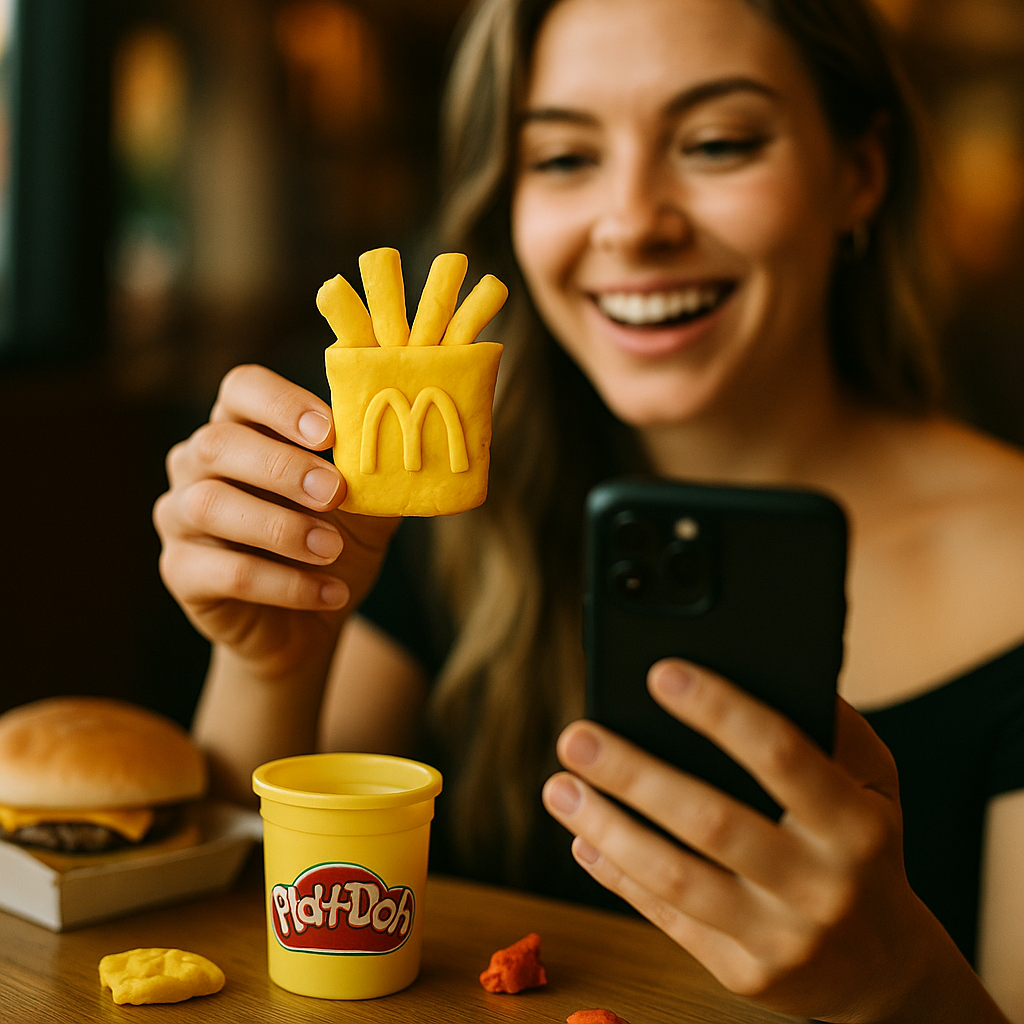
Zero celebrities. Zero seven-figure endorsement checks. Just a plastic toy from 1982 and a legion of creators who couldn’t stop talking about it. When McDonald’s relaunched its Play-Doh Meal tie-in, the campaign generated more organic engagement than several of the chain’s celebrity meal deals combined, and it cost a fraction to execute. That’s the case study every brand strategist should be studying right now.
This is creator-led nostalgia marketing working exactly as intended: no A-list contract, no six-month negotiation cycle, just a well-timed cultural memory handed to the right creators at the right moment.
The Setup: A Toy, Not a Star
McDonald’s has built an entire playbook around celebrity meal tie-ins. Travis Scott. J Balvin. The BTS Meal. Each one worked, but each one also came with the baggage of celebrity marketing: exclusivity clauses, approval chains, PR risk if the star said something controversial mid-campaign. The Play-Doh Meal Toy tie-in flipped that model entirely.
Instead of licensing a person, McDonald’s licensed a memory. Play-Doh as a brand carries decades of built-in nostalgia for millennials and older Gen Z, the exact demographic now raising kids and posting about it constantly on TikTok and Instagram. The toy itself, a simple canister-and-tool set styled after the meal box, didn’t need a celebrity face to generate buzz. It needed the right storytellers.
The core insight: nostalgia is a distribution mechanism. It doesn’t need a famous face to travel, it needs creators who already have an emotional relationship with the source material.
McDonald’s marketing team reportedly seeded the toy to a mix of parenting creators, unboxing accounts, and pop-culture nostalgia pages weeks ahead of the wide launch. No scripted brand deal language, no mandated hashtags beyond basic disclosure. Just product in hand, and a bet that the content would write itself.
Why Nostalgia Marketing Outperforms Celebrity Spend Right Now
Celebrity endorsement has an efficiency problem. According to eMarketer research on influencer spend allocation, brands increasingly report diminishing returns on celebrity-tier partnerships relative to mid-and-micro creator activations, largely because audiences have grown skeptical of paid-to-post celebrity content. A celebrity meal tie-in reads as an ad. A nostalgia-driven creator unboxing a Play-Doh toy with their toddler reads as a moment.
That distinction matters more than most media plans account for.
Consider the mechanics:
- Lower cost per activation. Nano and micro creators command a fraction of celebrity licensing fees, and nostalgia content doesn’t require the same production budget as a splashy celebrity commercial shoot.
- Built-in shareability. Nostalgia content triggers comment-section reminiscing (“I had this exact set!”), which the platform algorithms reward with extended reach.
- Lower reputational risk. A celebrity partner can implode a campaign overnight. A beloved 80s toy brand carries almost none of that volatility.
- Cross-generational pull. Parents post for themselves, kids react on camera, and the content does double duty across demographic segments.
This mirrors a pattern Influencers Time has tracked across multiple categories. Duolingo’s owl strategy proved that a beloved mascot, deployed through creators rather than paid media, can outperform traditional celebrity buys on both cost and cultural relevance. McDonald’s applied the same logic to a licensed toy property instead of an owned character.
The Creator Mix: Who Actually Drove the Numbers
The campaign’s creator roster wasn’t built around follower count. It was built around emotional authority on the topic of nostalgia itself. Three creator categories did the heavy lifting:
- Parenting creators who framed the toy as a generational handoff moment: “showing my kid the toy I had as a kid.”
- 90s/80s nostalgia accounts with no direct food or parenting angle, who covered the toy purely as a pop-culture artifact.
- Unboxing and collector creators, a niche that thrives on Meal Toy history and treated the relaunch as a legitimate collectible event.
None of these creators required celebrity-tier fees. Most fell into the micro-to-mid range, the same tier that Poppi leaned on to rebuild consumer trust after its lawsuit fallout, and that Ryobi used to beat paid social ROAS in a completely different category. The through-line across all three brands: smaller creators with real topical credibility consistently outperform broad-reach celebrity placements when the content itself is inherently shareable.
McDonald’s marketing team also leaned into user-generated content after the initial seeding wave. Once nostalgia creators posted, everyday customers followed with their own Play-Doh Meal unboxings, creating a secondary wave the brand didn’t have to pay for at all. That’s the compounding effect celebrity campaigns rarely produce, because celebrity content tends to feel finished and un-remixable. Nostalgia content invites participation.
What the Data Suggests About ROI
Public reporting on exact campaign metrics from McDonald’s remains limited, which is typical for quick-service marketing pushes that aren’t structured as measurable performance campaigns. But the directional signals are consistent with broader industry data. Statista’s ongoing tracking of influencer marketing spend shows brands shifting budget toward mid-tier and nano creators specifically because engagement rates on that tier consistently beat celebrity-level content, often by a wide margin, even as celebrity posts still win on raw reach.
For a quick-service brand like McDonald’s, reach was never the bottleneck. The Play-Doh Meal already had a built-in audience through existing meal traffic. What the brand needed was earned social proof and shareable content velocity, exactly what nostalgia-driven creator seeding delivers.
Reach isn’t the scarce resource for most major brands anymore. Believable, shareable content is. That’s the entire argument for trading celebrity budget for creator seeding.
Compare this to Ralph Lauren’s Olympics creator strategy, which similarly deprioritized single-celebrity anchoring in favor of distributed creator coverage and still drove 6.5 million new customers. Different category, same operating principle: distributed creator trust beats concentrated celebrity spend when the underlying product story is strong enough to carry itself.
The Risk Side: What Brands Should Watch For
Nostalgia marketing isn’t risk-free, even without a celebrity attached. A few operational realities brand teams need to plan around:
- Disclosure compliance still applies. Seeded product to creators triggers FTC disclosure requirements regardless of whether a celebrity or a nano creator is posting. Brands running nostalgia seeding programs need the same #ad/#gifted governance as any paid partnership.
- Collector market volatility. Toy tie-ins can spike secondary-market reselling, which sometimes generates negative press if scarcity feels engineered rather than organic.
- Nostalgia fatigue. Overusing the same nostalgia lever across every campaign dilutes its emotional impact. This tactic works because it’s not the default McDonald’s play, not because nostalgia is inherently more powerful than other creative strategies.
- Licensing complexity. Play-Doh is a Hasbro property, meaning the tie-in required cross-brand legal coordination that celebrity deals don’t. It’s a different kind of complexity, not necessarily a lighter one.
Brands considering a similar move should also study how Liquid Death built a billion-dollar identity without traditional celebrity spend, since both cases show that a strong creative concept, whether absurdist humor or nostalgic memory, can substitute for star power entirely if the creator activation is executed with discipline.
What This Means for Your Next Campaign Brief
The McDonald’s Play-Doh case isn’t really about toys, or even about McDonald’s. It’s a template for any brand sitting on a dormant piece of cultural equity: an old jingle, a discontinued product, a mascot nobody’s used in a decade. That equity can now be reactivated through creators for far less than a celebrity contract would cost, and often with better engagement outcomes.
The practical brief for marketing teams evaluating this approach:
- Audit your brand archive for nostalgia assets with built-in emotional recognition among a specific age cohort.
- Seed to creators with topical authority, not just reach, and prioritize authenticity over polish.
- Build disclosure compliance into the seeding process from day one, not as an afterthought.
- Measure earned UGC volume as a primary KPI, not just the seeded creator posts themselves.
For teams building out creator briefs around cultural or nostalgic hooks, it’s worth reviewing how Milani structured its creator brief strategy for a younger audience, since brief construction matters just as much as creator selection when the campaign hinges on authentic-feeling content rather than scripted celebrity messaging.
Tools like HubSpot and Sprout Social can help track the secondary UGC wave that nostalgia campaigns tend to generate, giving brand teams the earned-media measurement layer that celebrity campaigns often lack entirely.
FAQs
Frequently Asked Questions
Why did McDonald’s use nostalgia marketing instead of a celebrity partnership for the Play-Doh Meal Toy tie-in?
Nostalgia marketing let McDonald’s tap into decades of emotional brand equity around Play-Doh without the cost, negotiation complexity, or reputational risk that comes with celebrity endorsement deals. It also produced more shareable, participatory content than a typical celebrity meal promotion.
Is creator-led nostalgia marketing cheaper than celebrity endorsement?
Generally yes. Micro and mid-tier creators command significantly lower fees than celebrities, and nostalgia-driven content requires less production investment since authenticity, not polish, drives engagement.
What compliance rules apply to creator seeding campaigns like this?
The same FTC disclosure rules that apply to any influencer partnership apply here. Creators receiving free product or compensation must clearly disclose the relationship, regardless of whether the campaign involves a celebrity or a nano creator.
How do brands measure ROI on nostalgia-driven creator campaigns?
Beyond standard engagement metrics, brands should track secondary user-generated content volume, since nostalgia campaigns often trigger organic customer posts that extend reach well beyond the initial seeded creator wave.
Can this approach work outside the quick-service restaurant category?
Yes. Any brand with a dormant product, mascot, or cultural touchpoint can apply the same framework: identify the nostalgia asset, seed it to creators with genuine topical authority, and prioritize authentic storytelling over scripted brand messaging.
Next step: Audit your brand’s own archive for a dormant product, jingle, or mascot with built-in nostalgia value, then test a small creator seeding wave before committing to a celebrity-tier spend on your next campaign.
Top Influencer Marketing Agencies
The leading agencies shaping influencer marketing in 2026
Agencies ranked by campaign performance, client diversity, platform expertise, proven ROI, industry recognition, and client satisfaction. Assessed through verified case studies, reviews, and industry consultations.
Moburst

-
2

The Shelf
Boutique Beauty & Lifestyle Influencer AgencyA data-driven boutique agency specializing exclusively in beauty, wellness, and lifestyle influencer campaigns on Instagram and TikTok. Best for brands already focused on the beauty/personal care space that need curated, aesthetic-driven content.Clients: Pepsi, The Honest Company, Hims, Elf Cosmetics, Pure LeafVisit The Shelf → -
3

Audiencly
Niche Gaming & Esports Influencer AgencyA specialized agency focused exclusively on gaming and esports creators on YouTube, Twitch, and TikTok. Ideal if your campaign is 100% gaming-focused — from game launches to hardware and esports events.Clients: Epic Games, NordVPN, Ubisoft, Wargaming, Tencent GamesVisit Audiencly → -
4

Viral Nation
Global Influencer Marketing & Talent AgencyA dual talent management and marketing agency with proprietary brand safety tools and a global creator network spanning nano-influencers to celebrities across all major platforms.Clients: Meta, Activision Blizzard, Energizer, Aston Martin, WalmartVisit Viral Nation → -
5

The Influencer Marketing Factory
TikTok, Instagram & YouTube CampaignsA full-service agency with strong TikTok expertise, offering end-to-end campaign management from influencer discovery through performance reporting with a focus on platform-native content.Clients: Google, Snapchat, Universal Music, Bumble, YelpVisit TIMF → -
6

NeoReach
Enterprise Analytics & Influencer CampaignsAn enterprise-focused agency combining managed campaigns with a powerful self-service data platform for influencer search, audience analytics, and attribution modeling.Clients: Amazon, Airbnb, Netflix, Honda, The New York TimesVisit NeoReach → -
7

Ubiquitous
Creator-First Marketing PlatformA tech-driven platform combining self-service tools with managed campaign options, emphasizing speed and scalability for brands managing multiple influencer relationships.Clients: Lyft, Disney, Target, American Eagle, NetflixVisit Ubiquitous → -
8

Obviously
Scalable Enterprise Influencer CampaignsA tech-enabled agency built for high-volume campaigns, coordinating hundreds of creators simultaneously with end-to-end logistics, content rights management, and product seeding.Clients: Google, Ulta Beauty, Converse, AmazonVisit Obviously →