


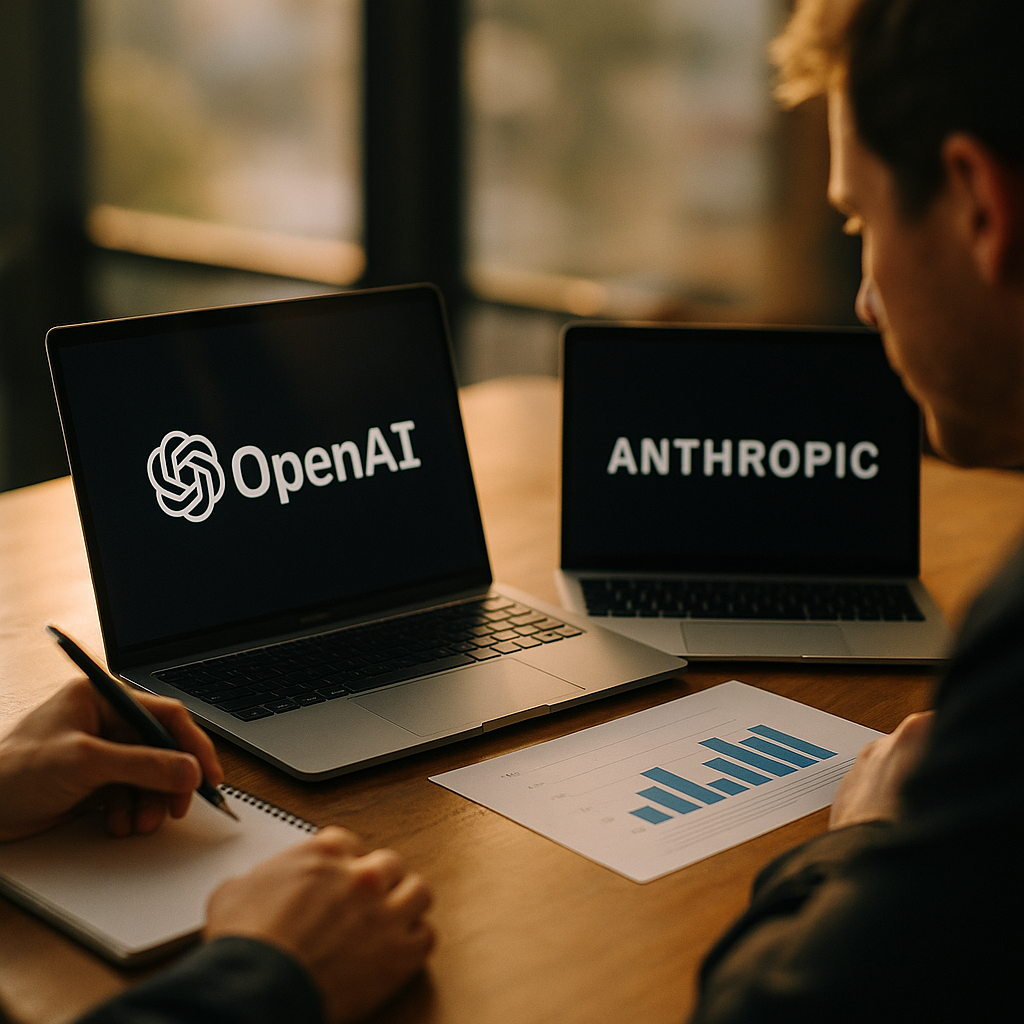
Two AI labs, two opposite bets. OpenAI is reportedly building consumer hardware to make ChatGPT ambient. Anthropic is doubling down on enterprise contracts, compliance tooling, and boring reliability. If you’re the marketer stuck picking a vendor, Ad Age’s emerging tech roundup just handed you a strategic fork in the road, and most brand AI vendor selection frameworks aren’t built to handle it.
This isn’t a debate about which chatbot writes better ad copy. It’s about which company’s roadmap actually matches your org’s risk tolerance, procurement cycle, and data governance requirements. Get the read wrong and you’re either locked into a consumer-first platform that pivots away from your use case, or you’ve overpaid for enterprise armor you didn’t need yet.
What Ad Age’s Roundup Actually Revealed
The details are still fuzzy, as device rumors tend to be. But the signal is clear enough: OpenAI wants to be everywhere, not just inside a browser tab. A hardware push, even a modest one, suggests the company is chasing consumer ubiquity the way Apple chased it with the iPhone. Ambient AI, worn or carried, generating data at the point of daily life.
Anthropic’s moves read almost like a rebuttal. More enterprise sales hires, more compliance certifications, more emphasis on Claude’s use inside regulated industries like finance and healthcare. One company is betting on being in your pocket. The other is betting on being in your procurement stack.
The split isn’t just product strategy — it’s a preview of two different AI markets forming in parallel, one consumer-facing and viral, one enterprise-facing and contractual. Brands need to know which one they’re actually buying into.
For marketing leaders, this matters more than it might first appear. Your martech stack decisions increasingly run through the same handful of foundation model providers. Pick based on hype cycles and you’ll be re-platforming within eighteen months. That churn is expensive, and it’s exactly the kind of budget leakage covered in MarTech’s budget reshuffle analysis — vendor consolidation pressure is already squeezing marketing operations teams without adding a foundation-model gamble on top.
Consumer Hype vs. Enterprise Trust: Why the Distinction Matters for Your Stack
Here’s a blunt question worth asking your team this quarter: does your brand need an AI vendor that scales with consumer attention, or one that scales with data governance?
Most marketing orgs answer “both” reflexively. That’s the wrong answer. You need to rank them.
If your primary use case is content generation, creative ideation, or consumer-facing chat experiences, a vendor chasing ubiquity might actually serve you well. Ubiquity means more training data, faster iteration, and product surfaces you can plug into where your audience already lives. That’s the OpenAI bet, hardware rumors included.
If your primary use case touches customer PII, financial data, regulated claims, or anything that could trigger an FTC inquiry or a GDPR audit, you want the vendor optimizing for trust and auditability. That’s the Anthropic bet. Enterprise clients don’t buy AI models. They buy risk mitigation with a chat interface attached.
- Consumer-facing use cases: content ideation, social listening summarization, creative brainstorming, chatbot experiences for top-of-funnel engagement.
- Enterprise-facing use cases: customer data analysis, compliance documentation, internal knowledge management, anything requiring SOC 2 or HIPAA-adjacent assurances.
Most brands need both categories covered. Few need both from the same vendor. That’s the part procurement teams keep missing when they try to consolidate everything under one AI contract for simplicity’s sake.
Simplicity is nice. It’s also how you end up with a single point of failure.
The Vendor Selection Framework Brands Actually Need
Forget the RFP templates built for traditional SaaS. Foundation model vendors change their terms, their pricing, and sometimes their entire product direction faster than a typical software renewal cycle. A workable framework needs four checkpoints, run quarterly, not annually.
First: data residency and training opt-outs. Does the vendor let you exclude your prompts and outputs from future model training? Anthropic has generally been more explicit here for enterprise tiers, which is table stakes if you’re feeding it customer data.
Second: uptime and reliability commitments. Consumer-first products iterate fast, sometimes at the expense of stability. If your workflow depends on the tool functioning at 9 a.m. on a launch day, read the SLA before you read the marketing deck.
Third: integration debt. How much custom engineering does switching cost you? If the answer is “a full quarter of dev time,” you’re not really choosing a vendor. You’re choosing a dependency.
Fourth: regulatory exposure. This is the one most marketing teams skip, and it’s the one that bites hardest. The FTC’s guidance on AI and consumer protection keeps expanding, and the EU’s approach to algorithmic accountability has already reshaped platform obligations, as seen in the EU DSA ruling on Meta. Any AI vendor touching consumer-facing outputs needs to be evaluated against that regulatory trajectory, not just today’s rules.
Why the Hardware Angle Actually Matters to Brand Marketers
It’s tempting to dismiss device rumors as tech-press noise, irrelevant to a CMO’s Tuesday. That’s a mistake.
If OpenAI ships a consumer device, or even a software layer that behaves like one (always-listening, always-context-aware), it changes where brand impressions happen. Search behavior fragmented once mobile arrived. It fragmented again with social discovery. An ambient AI device would fragment it a third time, pulling attention away from screens entirely and into a conversational, often invisible, interface.
That’s not a hypothetical brands can ignore. It echoes the shift already underway in reach planning amid the attention recession. Every new surface for AI-mediated discovery is another surface where your brand either gets recommended by a model, or doesn’t exist at all.
Consider what that means for SEO and brand visibility. If a device fields a query like “what’s the best running shoe for wide feet,” and answers it directly through a foundation model rather than surfacing ten blue links, your brand’s presence depends entirely on how well-represented you are in that model’s training and retrieval layer. That’s a new kind of media buy, and most brands haven’t budgeted for it yet. It’s closely related to the dynamics already reshaping AI search visibility for independent brands, where ranking in a traditional sense matters less than being cited accurately inside a generative answer.
Anthropic’s Enterprise Push Is a Signal, Not Just a Sales Strategy
Enterprise-first companies don’t chase headlines. They chase renewal rates. Anthropic’s emphasis on compliance-ready deployments, expanded enterprise support, and integrations built for regulated industries tells you where its bets are placed: predictable revenue from risk-averse buyers, not viral consumer growth.
For brand marketers, that’s actually reassuring in certain contexts. A vendor optimizing for enterprise trust is less likely to make a sudden pivot that breaks your integration. It’s also less likely to hand you a PR headache from an ill-considered consumer feature.
But enterprise-first also means slower innovation cycles in consumer-facing capabilities. If your team needs an AI tool for rapid creative testing or trend-responsive content, an enterprise-postured vendor may lag behind a company racing to own consumer mindshare.
Neither posture is “better.” They serve different jobs. Confusing the two is how procurement teams end up locked into 18-month contracts that don’t match their actual use case.
Enterprise-grade AI vendors sell certainty. Consumer-grade AI vendors sell speed. Most brand marketing functions need both, from two different providers, on two different budgets.
Budget Implications: Where the Money Actually Needs to Move
AI spend inside marketing budgets isn’t shrinking. It’s redistributing. Data from eMarketer and Statista has consistently shown AI-related martech investment climbing even as overall digital ad growth slows, a trend covered in depth in digital ad spend growth slowing as AI efficiency eats budgets.
The practical takeaway: don’t treat AI vendor selection as a single line item anymore. Treat it as two separate budget tracks. One for consumer-facing experimentation, where you can afford to move fast and occasionally get burned by a pivot. One for enterprise-grade infrastructure, where stability and compliance justify a premium.
That premium is real, and it’s already showing up in agency billing. The 22% AI-augmented pricing premium agencies are charging isn’t arbitrary. Part of it reflects the operational overhead of managing multiple AI vendors with different compliance postures, security reviews, and integration requirements. If your agency partner is charging that premium, ask them directly which vendor tier they’re building on, and why.
A Quick Gut-Check for Your Next Vendor Review
- Are we buying this AI tool for speed, or for defensibility? Name the primary use case before signing anything.
- Does our legal team understand the training-data opt-out terms, in plain language, not vendor-speak?
- What’s our actual switching cost if this vendor pivots its product roadmap in twelve months?
- Is this spend tracked separately from our core martech budget, so leadership can see the redistribution happening?
Run this gut-check before your next renewal conversation. It takes fifteen minutes and it will save you from a much longer conversation with legal later.
The Real Takeaway for Brand Decision-Makers
Stop trying to pick “the best AI vendor.” That framing assumes a single winner will emerge, and the OpenAI-Anthropic divergence suggests otherwise. Pick the best vendor for each job, track the split explicitly in your budget, and revisit the assignment every quarter, because this market is moving faster than your typical vendor contract cycle was built to handle.
Next step: audit your current AI tool stack this month against the consumer-versus-enterprise framework above, and flag any tool being used outside its intended risk tier before your next contract renewal.
FAQs
Should brands pick one AI vendor or use multiple providers?
Most brands need multiple providers split by use case: one optimized for consumer-facing speed and experimentation, another optimized for enterprise-grade compliance and data governance. Consolidating everything under a single vendor increases risk without proportional cost savings.
How does OpenAI’s device rumor affect brand marketing strategy?
If ambient AI hardware becomes mainstream, it shifts discovery away from search engines and social feeds toward conversational, AI-mediated recommendations. Brands need to start optimizing for visibility inside AI model outputs, not just traditional SEO and social reach.
Why is Anthropic focusing on enterprise clients instead of consumer products?
Enterprise clients offer more predictable, contract-based revenue and reward compliance, reliability, and data governance over rapid consumer feature launches. This positions Anthropic well for regulated industries but may mean slower iteration on consumer-facing tools.
What should marketers check before signing an AI vendor contract?
Review data residency terms, training opt-out options, uptime SLAs, integration switching costs, and regulatory exposure relevant to your industry. Treat foundation model vendors differently from traditional SaaS procurement because their roadmaps shift faster.
Is AI vendor spend part of the broader martech budget or separate?
It should be tracked separately. AI vendor costs are growing even as overall digital ad spend growth slows, and leadership needs visibility into that redistribution to make informed budget decisions.
Top Influencer Marketing Agencies
The leading agencies shaping influencer marketing in 2026
Agencies ranked by campaign performance, client diversity, platform expertise, proven ROI, industry recognition, and client satisfaction. Assessed through verified case studies, reviews, and industry consultations.
Moburst

-
2

The Shelf
Boutique Beauty & Lifestyle Influencer AgencyA data-driven boutique agency specializing exclusively in beauty, wellness, and lifestyle influencer campaigns on Instagram and TikTok. Best for brands already focused on the beauty/personal care space that need curated, aesthetic-driven content.Clients: Pepsi, The Honest Company, Hims, Elf Cosmetics, Pure LeafVisit The Shelf → -
3

Audiencly
Niche Gaming & Esports Influencer AgencyA specialized agency focused exclusively on gaming and esports creators on YouTube, Twitch, and TikTok. Ideal if your campaign is 100% gaming-focused — from game launches to hardware and esports events.Clients: Epic Games, NordVPN, Ubisoft, Wargaming, Tencent GamesVisit Audiencly → -
4

Viral Nation
Global Influencer Marketing & Talent AgencyA dual talent management and marketing agency with proprietary brand safety tools and a global creator network spanning nano-influencers to celebrities across all major platforms.Clients: Meta, Activision Blizzard, Energizer, Aston Martin, WalmartVisit Viral Nation → -
5

The Influencer Marketing Factory
TikTok, Instagram & YouTube CampaignsA full-service agency with strong TikTok expertise, offering end-to-end campaign management from influencer discovery through performance reporting with a focus on platform-native content.Clients: Google, Snapchat, Universal Music, Bumble, YelpVisit TIMF → -
6

NeoReach
Enterprise Analytics & Influencer CampaignsAn enterprise-focused agency combining managed campaigns with a powerful self-service data platform for influencer search, audience analytics, and attribution modeling.Clients: Amazon, Airbnb, Netflix, Honda, The New York TimesVisit NeoReach → -
7

Ubiquitous
Creator-First Marketing PlatformA tech-driven platform combining self-service tools with managed campaign options, emphasizing speed and scalability for brands managing multiple influencer relationships.Clients: Lyft, Disney, Target, American Eagle, NetflixVisit Ubiquitous → -
8

Obviously
Scalable Enterprise Influencer CampaignsA tech-enabled agency built for high-volume campaigns, coordinating hundreds of creators simultaneously with end-to-end logistics, content rights management, and product seeding.Clients: Google, Ulta Beauty, Converse, AmazonVisit Obviously →