


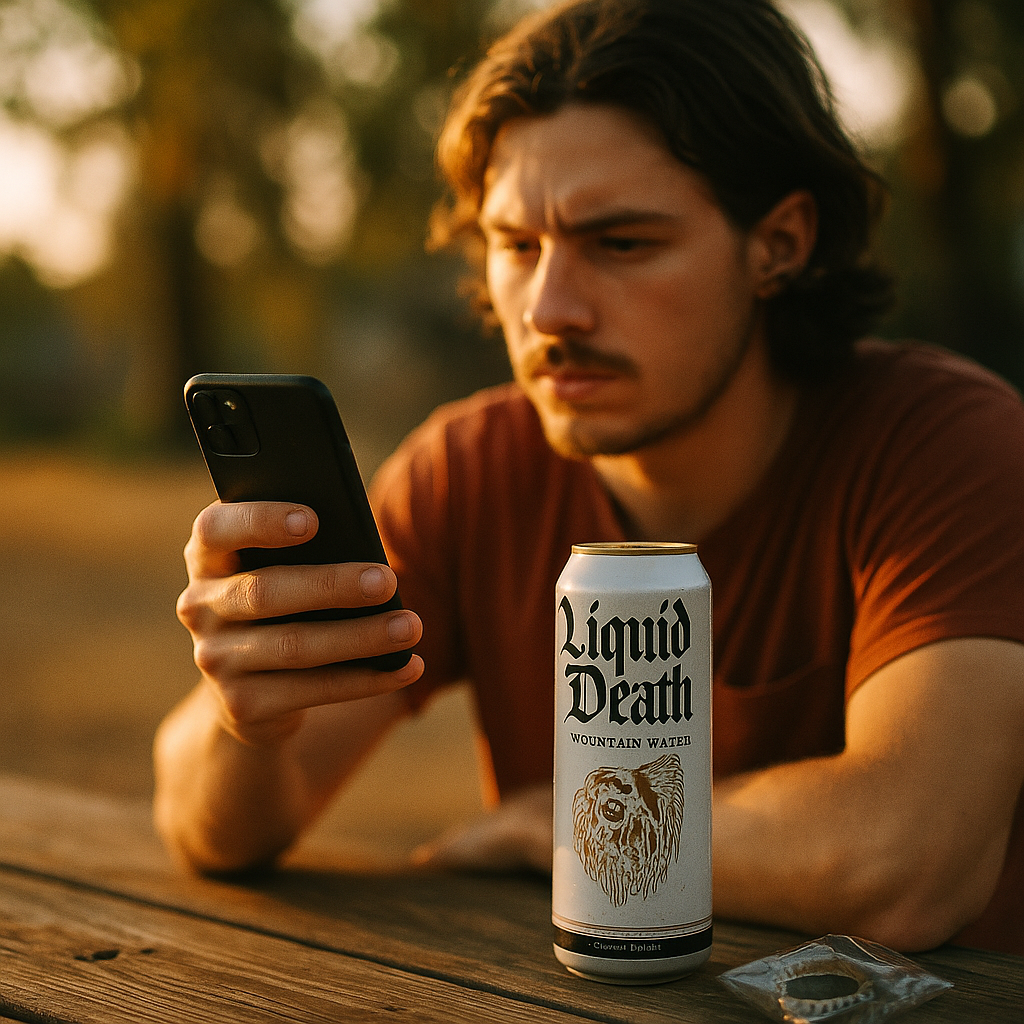
What if a case of sparkling water cost less to acquire a customer than a single Google Ads click? That’s the uncomfortable question Liquid Death’s nano-creator seeding strategy is forcing on the canned water category. While competitors bid up branded and category keywords into the ground, Liquid Death quietly built a cost-per-acquisition advantage by mailing free cans to people with 3,000 followers instead of buying media against people with 3 million.
The Paid Search Trap in Canned Water
Canned water is a brutal category for paid search. Terms like “sparkling water delivery” or “canned water brand” sit in a crowded field with LaCroix, Bubly, Waterloo, and a dozen private-label grocery SKUs all bidding simultaneously. Add in the fact that water is a low-margin, high-repeat-purchase product, and the math gets ugly fast. When your cost-per-click climbs but your average order value stays flat, paid search stops being a growth channel and starts being a tax on visibility.
Liquid Death’s leadership has been vocal about avoiding that trap entirely. The brand has built its identity around not looking, sounding, or marketing like a beverage company. That extends to acquisition strategy. Instead of fighting for scarce, expensive search inventory, the company invested in a distributed network of small-audience creators who could generate organic search demand and shareable content without the CPC arms race.
What Nano-Creator Seeding Actually Looks Like Here
Nano-creator seeding is deceptively simple: send free product to creators with small, engaged followings (typically 1,000 to 20,000) in exchange for no obligation beyond, at most, an honest reaction. No contracts. No usage rights negotiations. No six-figure retainers. Liquid Death has run versions of this at scale, mailing product drops to metal scene micro-influencers, gym creators, skateboarders, and even parents posting about hydration for kids, a deliberate mismatch with the brand’s death-metal aesthetic that generates its own commentary.
The brand’s broader creator playbook has been documented before. Its creator strategy built on absurdism leans into unpredictability rather than polish, and its earlier pivot away from traditional advertising toward YouTube comedy content established the tone nano-creators are now extending at scale.
Nano-creator seeding doesn’t replace paid media, it replaces the *need* for as much of it. Every unboxing video is a search result, a social proof asset, and a low-cost acquisition touchpoint in one.
Why the CAC Math Works in Liquid Death’s Favor
Here’s the operational logic. A single can of Liquid Death costs a fraction of a dollar to produce and ship to a creator. Compare that to a paid search click in the beverage category, where CPCs for competitive terms can run well above a dollar depending on match type and competition, according to industry benchmarks tracked by eMarketer. Even if only a fraction of seeded creators post, and only a fraction of those posts drive a purchase, the acquisition cost per converted customer often lands lower than an equivalent paid search conversion.
The reason isn’t magic. It’s distribution math. One seeded nano-creator with 8,000 followers who posts an authentic reaction can generate more qualified impressions than a search ad shown to the same audience segment, because the content carries social proof a paid placement can’t replicate. Multiply that across hundreds of creators seeded monthly, and you get a compounding organic reach effect that paid search simply cannot buy at the same unit cost.
- Lower unit cost per touchpoint: product cost plus shipping versus CPC bidding.
- Higher trust signal: unpaid, unscripted reactions read as authentic, especially to Gen Z and younger millennial shoppers.
- Compounding search value: creator content ranks in platform search (TikTok, YouTube) and feeds branded search demand on Google, effectively lowering future CPCs.
- No contract overhead: no legal review, no usage rights negotiation, no agency management fee layered on top.
Operational Efficiency: The Part Marketers Underrate
Most conversations about influencer ROI focus on reach and engagement. The more interesting story for brand strategists is operational efficiency. Running a nano-creator seeding program at scale requires almost none of the overhead that traditional influencer marketing or paid search management demands. There’s no bidding console to monitor daily. No negotiation cycle with talent agencies. No creative approval loop involving legal, brand, and a celebrity’s management team.
Instead, the operational lift shifts to logistics: identifying creators, managing shipping, and tracking which seeded product actually converts into content. Brands that treat this like a fulfillment operation rather than a media buy tend to see the best results. That’s a similar lesson to what played out with Liquid I.V.’s nano-creator seeding rebuild, where product-first distribution outperformed paid amplification on trust metrics.
It also mirrors what’s happened in adjacent CPG categories. Aldi’s nano-creator grocery hauls beat traditional CPG ad spend on CPA using a nearly identical mechanism: seed broadly, let organic reactions do the persuasion work, and let the algorithm reward authenticity over production value.
Attribution: The Honest Caveat
None of this is to say nano-creator seeding is easy to measure. Attribution remains the weak link. Unlike paid search, where a UTM-tagged click ties directly to a conversion event, seeded content generates a mix of direct response (someone clicks a bio link or searches the brand after seeing a video) and delayed, indirect influence (someone sees the content, forgets about it, then buys the product weeks later at a retail shelf).
Liquid Death has partially solved this with retail-specific promo codes, trackable link-in-bio tools, and creator-specific landing pages for higher-tier seeded partners. But the brand, like most in this category, ultimately blends CAC modeling with brand lift surveys and incrementality testing rather than relying on last-click attribution alone. Marketers considering a similar model should build measurement expectations around a blended view, not a single dashboard number.
This is consistent with what HubSpot and Sprout Social have both noted about creator marketing measurement trends: brands are increasingly pairing platform-native analytics with post-purchase surveys to triangulate a truer CAC figure. See HubSpot’s marketing research and Sprout Social’s creator economy data for broader context on how brands are adapting measurement frameworks.
What Other Brands Can Actually Take From This
The temptation is to read this case study and think “just send free product to small creators.” That’s necessary but not sufficient. Liquid Death’s advantage comes from three compounding factors most brands skip:
- A brand voice distinct enough to survive unscripted reactions. Nano-creators aren’t reading from brand guidelines. If your brand voice can’t withstand improvisation, seeding gets risky fast.
- Retail availability at the moment content peaks. Seeded content that drives someone to search for a product that isn’t on a nearby shelf wastes the acquisition moment. Liquid Death’s retail expansion has tracked closely with its content velocity.
- A tolerance for chaos. Not every seeded creator will represent the brand the way a PR team would script it. Liquid Death has built its entire identity around embracing that unpredictability rather than fighting it.
Brands outside beverage have applied similar logic with success. Chamberlain Coffee’s nano-creator push into Target and Ryobi’s nano-creator network beating Home Depot media on cost-per-sale both show this isn’t a beverage-only phenomenon. It’s a repeatable model for any CPG or DTC brand willing to trade paid media budget for logistics and brand risk tolerance.
Regulatory and Disclosure Considerations
Seeding free product still counts as a material connection under FTC endorsement guidelines, even when there’s no formal contract or payment involved. Brands running seeding programs at scale need clear disclosure guidance baked into the fulfillment process, not bolted on afterward. This is one area where operational discipline protects the CAC advantage: a compliance misstep that triggers platform removal or regulatory scrutiny erases whatever cost savings the seeding program generated.
Build disclosure reminders into your shipping confirmation emails. Keep a record of what was sent to whom and when. It’s a small process cost that prevents a much larger risk exposure later.
Bottom line: if your paid search CAC is climbing and your category is saturated with bidders, nano-creator seeding isn’t a nice-to-have brand exercise, it’s a legitimate acquisition channel worth budgeting against media spend, not just marketing experimentation.
FAQs
What is nano-creator product seeding?
Nano-creator product seeding is the practice of sending free products to creators with small but engaged followings, typically 1,000 to 20,000 followers, without payment or contractual obligation, in hopes they’ll create organic content about the product.
How does nano-creator seeding compare to paid search on cost-per-acquisition?
In saturated categories like canned water, seeding can produce a lower blended CAC because the unit cost of product plus shipping is often cheaper than rising CPCs, and the resulting content generates both direct conversions and long-term organic search demand.
Is nano-creator seeding measurable the same way paid search is?
Not exactly. Paid search offers direct click-to-conversion attribution, while seeding requires a blended approach combining promo codes, trackable links, and brand lift or incrementality studies to estimate true impact.
Do brands need to disclose relationships with seeded nano-creators?
Yes. Under FTC endorsement guidelines, any product provided for free constitutes a material connection that requires disclosure, regardless of whether a formal contract or payment exists.
Is this strategy only viable for beverage brands?
No. Brands across CPG, retail, and DTC categories, including coffee, home improvement tools, and grocery, have applied similar nano-creator seeding models to reduce acquisition costs relative to paid media.
Top Influencer Marketing Agencies
The leading agencies shaping influencer marketing in 2026
Agencies ranked by campaign performance, client diversity, platform expertise, proven ROI, industry recognition, and client satisfaction. Assessed through verified case studies, reviews, and industry consultations.
Moburst

-
2

The Shelf
Boutique Beauty & Lifestyle Influencer AgencyA data-driven boutique agency specializing exclusively in beauty, wellness, and lifestyle influencer campaigns on Instagram and TikTok. Best for brands already focused on the beauty/personal care space that need curated, aesthetic-driven content.Clients: Pepsi, The Honest Company, Hims, Elf Cosmetics, Pure LeafVisit The Shelf → -
3

Audiencly
Niche Gaming & Esports Influencer AgencyA specialized agency focused exclusively on gaming and esports creators on YouTube, Twitch, and TikTok. Ideal if your campaign is 100% gaming-focused — from game launches to hardware and esports events.Clients: Epic Games, NordVPN, Ubisoft, Wargaming, Tencent GamesVisit Audiencly → -
4

Viral Nation
Global Influencer Marketing & Talent AgencyA dual talent management and marketing agency with proprietary brand safety tools and a global creator network spanning nano-influencers to celebrities across all major platforms.Clients: Meta, Activision Blizzard, Energizer, Aston Martin, WalmartVisit Viral Nation → -
5

The Influencer Marketing Factory
TikTok, Instagram & YouTube CampaignsA full-service agency with strong TikTok expertise, offering end-to-end campaign management from influencer discovery through performance reporting with a focus on platform-native content.Clients: Google, Snapchat, Universal Music, Bumble, YelpVisit TIMF → -
6

NeoReach
Enterprise Analytics & Influencer CampaignsAn enterprise-focused agency combining managed campaigns with a powerful self-service data platform for influencer search, audience analytics, and attribution modeling.Clients: Amazon, Airbnb, Netflix, Honda, The New York TimesVisit NeoReach → -
7

Ubiquitous
Creator-First Marketing PlatformA tech-driven platform combining self-service tools with managed campaign options, emphasizing speed and scalability for brands managing multiple influencer relationships.Clients: Lyft, Disney, Target, American Eagle, NetflixVisit Ubiquitous → -
8

Obviously
Scalable Enterprise Influencer CampaignsA tech-enabled agency built for high-volume campaigns, coordinating hundreds of creators simultaneously with end-to-end logistics, content rights management, and product seeding.Clients: Google, Ulta Beauty, Converse, AmazonVisit Obviously →