


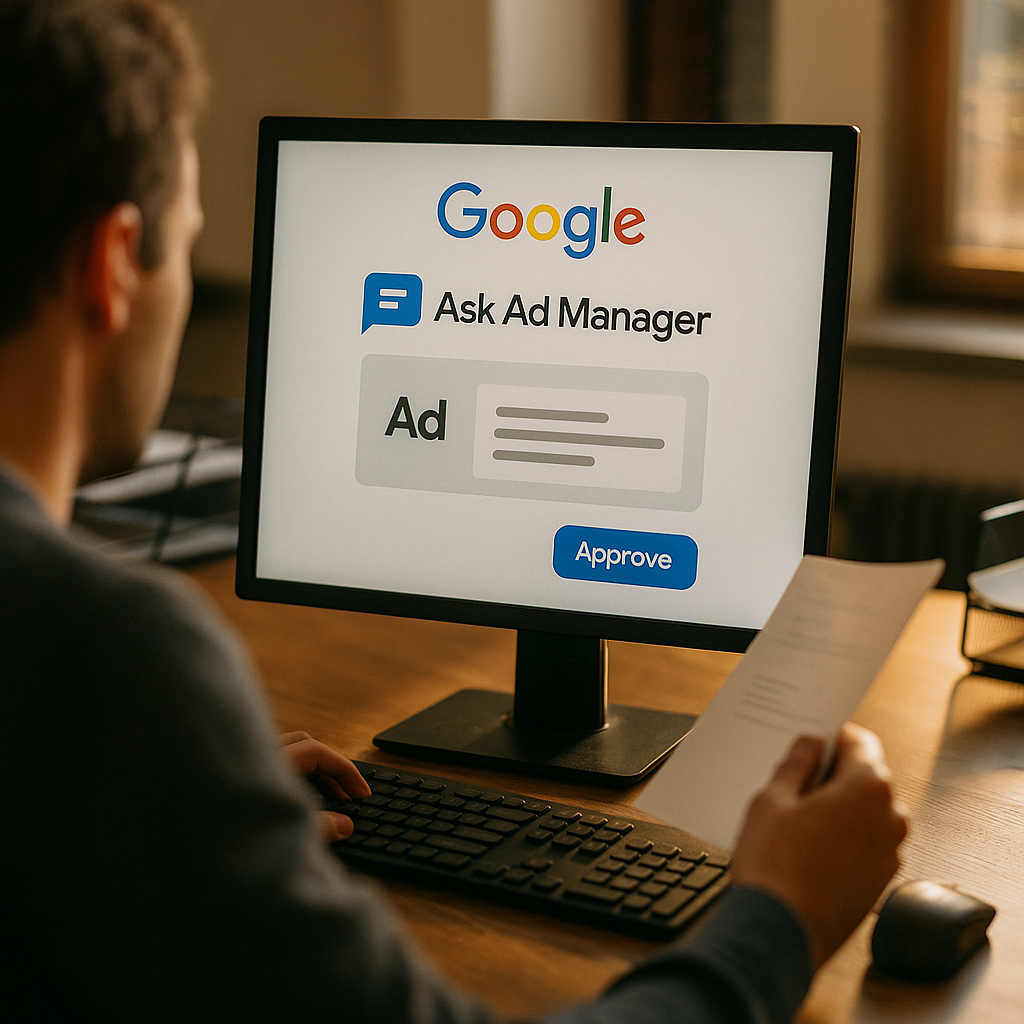
Google quietly told advertisers something important last month: Ask Ad Manager still can’t spend a dollar without a human nodding along first. That’s a strange admission for a product marketed as “autonomous.” One year in, the gap between the pitch and the practice deserves a hard look, especially with Google Ask Ad Manager now embedded in campaign workflows at thousands of agencies.
What Google Actually Shipped
Ask Ad Manager launched as a conversational layer sitting on top of Google Ads and Display & Video 360. Type a request in plain English, and it drafts audience segments, reallocates budget across campaigns, or flags underperforming creative. On paper, it sounded like the beginning of hands-off media buying.
In practice, it’s closer to a very fast analyst than an autonomous agent. It can propose a 15% budget shift from a stagnant Performance Max campaign to a high-CTR Search campaign. It cannot execute that shift without someone clicking approve. That distinction — propose versus execute — is the entire story of this audit.
After twelve months of production use, Ask Ad Manager’s autonomy extends to recommendation and simulation. Execution still requires a human in the loop for any action touching live budget or bidding strategy.
Where the Autonomy Actually Extends
Give the tool credit where it’s earned. Three areas show genuine, unsupervised competence:
- Reporting synthesis. Ask Ad Manager pulls cross-campaign data and generates narrative summaries faster than any analyst on staff. No approval needed because nothing is being spent.
- Anomaly flagging. It catches CPA spikes and conversion-tracking breaks within hours, not days. This is arguably the highest-ROI feature in the product, and it runs continuously without a human gatekeeper.
- Creative variant suggestions. It can propose headline and description combinations pulled from top-performing assets. Suggestion, again, not deployment.
Notice the pattern? Every fully autonomous function is read-only or advisory. The moment money moves, a person has to say yes.
Why Google Built It This Way
This isn’t a technical limitation Google is racing to fix. It’s a deliberate liability wall. Autonomous media buying at scale, without guardrails, is how you get a six-figure overspend in an afternoon. Google has watched competitors stumble here already, and the industry has its own scar tissue: see the account that lost $180K in a personalization outage when an automated system hit an undocumented rate limit and kept firing anyway.
Our sister analysis on this exact product, Google Ask Ad Manager at one year, found the approval requirement isn’t a bug marketers should hope gets patched out. It’s the feature that keeps the tool insurable, auditable, and defensible in a client review.
The Error Rate Nobody Advertises
Here’s the number that should be in every vendor pitch deck and never is. Industry-wide data on AI media-buying agents shows an error rate of roughly 1 in 6 decisions containing a meaningful mistake, whether that’s misreading a seasonality trend, misattributing conversion lift, or recommending budget toward a fatigued audience segment. Ask Ad Manager isn’t immune to this. It’s built on the same foundation of probabilistic inference that trips up every LLM-driven ad tool right now.
That error rate is exactly why the approval gate matters more than the autonomy headline. A 1-in-6 miss rate on suggestions is manageable when a human reviews each one. It’s catastrophic when a system executes unsupervised at scale. Marketers who complain that Ask Ad Manager is “too cautious” are, whether they realize it or not, arguing for a higher error tolerance than the data supports.
Comparing It to the Rest of the Agentic Stack
Google isn’t alone in drawing this line. TikTok’s Symphony Agent, six months into broader adoption, shows a similar pattern: strong at creative assembly and whitelisting suggestions, weak on full autonomy for spend decisions, according to a recent comparison against manual whitelisting. The industry consensus, quietly, is converging: agentic tools handle analysis and drafting well. They handle irreversible financial actions poorly, or at least too unpredictably to trust unsupervised.
Contrast that with generative video tools, where autonomy has advanced further because the downside of a bad output is a wasted render, not a wasted budget. The cost-per-variant comparison across Sora, Veo 3, and Runway Gen-4 shows tools operating with far less human gatekeeping, precisely because the stakes of a bad output are lower and instantly correctable.
What This Means for Budget Owners
If you’re running seven-figure annual spend through Google’s ecosystem, the practical takeaway is straightforward: build your workflow assuming a human approval step exists, because it does and Google shows no sign of removing it soon. Teams that tried to route Ask Ad Manager recommendations straight into execution via API workarounds have, in more than one case we’ve heard about through agency contacts, triggered budget pacing errors that took days to unwind.
Practically, that means:
- Assign a named approver for every campaign type the tool touches — Search, Shopping, PMax, Display.
- Set a review SLA. If recommendations pile up unapproved for 48 hours, they go stale and the underlying data shifts anyway.
- Track override rate. If your team is rejecting more than 20-25% of suggestions, something is wrong with your inputs, not the model.
- Document every approval for compliance. Regulatory scrutiny on algorithmic decision-making is only increasing; the FTC has signaled interest in how automated ad systems make pricing and targeting decisions.
This last point matters more than most marketers give it credit for. Algorithmic systems that touch pricing or targeting increasingly carry disclosure obligations, and the surveillance pricing risk guide is a useful companion read if your Ask Ad Manager usage extends into dynamic pricing tests.
The Kill-Switch Question
One year in, the most useful operational question isn’t “how smart is it,” it’s “how fast can we stop it.” Every agentic ad tool needs a documented, tested kill-switch protocol, not a theoretical one buried in a vendor’s terms of service. The kill-switch protocol for runaway media buys is worth implementing regardless of which platform you’re on, because approval gates reduce risk, they don’t eliminate it. A human clicking “approve” on a bad recommendation is still a bad recommendation, just with a signature attached.
Google’s own support documentation is fairly candid about this scope, if you read past the marketing copy: Ask Ad Manager is positioned as a decision-support tool, not a replacement for a strategist. That framing matches what we’ve seen in the field. Agencies getting the most value treat it like a very well-read junior analyst: fast, tireless, occasionally wrong, always needing a second opinion.
How Agencies Are Restructuring Around This
The smarter shops have stopped asking “when will this be fully autonomous” and started asking “how do we sequence our tool stack around a permanent human checkpoint.” That’s the framing in the CMO sequencing guide for agentic marketing, which treats approval gates as permanent infrastructure rather than a transitional annoyance to engineer around.
Some agencies have built internal multi-agent workflows where Ask Ad Manager’s output feeds into a review layer staffed by a rotating analyst, similar in structure to the setups described in the multi-agent marketing team blueprint. It’s not glamorous, but it’s the difference between a tool that scales safely and one that scales your mistakes.
So Is It Worth Using?
Yes, with realistic expectations. The time savings on reporting and anomaly detection alone justify the license cost for most mid-size accounts, based on eMarketer estimates on time spent by media buyers on manual reporting tasks. The mistake is assuming this frees up headcount for anything other than review work. It doesn’t reduce the human hours needed; it shifts them from execution to oversight. That’s a real efficiency gain, just not the one the marketing copy implies.
Marketers hunting for genuine full-autonomy execution in paid media are going to keep waiting. Google, TikTok, and Meta all have strong commercial and legal reasons to keep a human in the approval seat, and nothing in current product roadmaps suggests that changes soon.
Next Step
Audit your own approval workflow this quarter: if nobody can tell you your Ask Ad Manager override rate or your average approval turnaround time, you’re running the tool blind. Fix that metric gap before you expand its role in your account.
FAQs
Can Google Ask Ad Manager execute budget changes without approval?
No. It can draft and recommend budget reallocations, but execution on live campaigns still requires a human to approve the change before it goes live.
How accurate are its recommendations?
Industry data on similar AI media-buying tools shows roughly a 1-in-6 error rate on decisions, meaning marketers should treat every suggestion as a draft requiring review, not a final call.
What tasks can it handle fully autonomously?
Reporting synthesis, anomaly flagging on metrics like CPA spikes, and generating creative variant suggestions all run without requiring approval, since none of them touch live spend directly.
Does using it reduce the need for media buyer headcount?
It shifts hours rather than eliminating them. Teams spend less time building reports and more time reviewing and approving AI-generated recommendations.
Is there a compliance risk in using it for dynamic pricing?
Yes. Algorithmic pricing decisions increasingly carry disclosure obligations under regulatory scrutiny, so any use extending into pricing tests should be documented and reviewed carefully.
Top Influencer Marketing Agencies
The leading agencies shaping influencer marketing in 2026
Agencies ranked by campaign performance, client diversity, platform expertise, proven ROI, industry recognition, and client satisfaction. Assessed through verified case studies, reviews, and industry consultations.
Moburst

-
2

The Shelf
Boutique Beauty & Lifestyle Influencer AgencyA data-driven boutique agency specializing exclusively in beauty, wellness, and lifestyle influencer campaigns on Instagram and TikTok. Best for brands already focused on the beauty/personal care space that need curated, aesthetic-driven content.Clients: Pepsi, The Honest Company, Hims, Elf Cosmetics, Pure LeafVisit The Shelf → -
3

Audiencly
Niche Gaming & Esports Influencer AgencyA specialized agency focused exclusively on gaming and esports creators on YouTube, Twitch, and TikTok. Ideal if your campaign is 100% gaming-focused — from game launches to hardware and esports events.Clients: Epic Games, NordVPN, Ubisoft, Wargaming, Tencent GamesVisit Audiencly → -
4

Viral Nation
Global Influencer Marketing & Talent AgencyA dual talent management and marketing agency with proprietary brand safety tools and a global creator network spanning nano-influencers to celebrities across all major platforms.Clients: Meta, Activision Blizzard, Energizer, Aston Martin, WalmartVisit Viral Nation → -
5

The Influencer Marketing Factory
TikTok, Instagram & YouTube CampaignsA full-service agency with strong TikTok expertise, offering end-to-end campaign management from influencer discovery through performance reporting with a focus on platform-native content.Clients: Google, Snapchat, Universal Music, Bumble, YelpVisit TIMF → -
6

NeoReach
Enterprise Analytics & Influencer CampaignsAn enterprise-focused agency combining managed campaigns with a powerful self-service data platform for influencer search, audience analytics, and attribution modeling.Clients: Amazon, Airbnb, Netflix, Honda, The New York TimesVisit NeoReach → -
7

Ubiquitous
Creator-First Marketing PlatformA tech-driven platform combining self-service tools with managed campaign options, emphasizing speed and scalability for brands managing multiple influencer relationships.Clients: Lyft, Disney, Target, American Eagle, NetflixVisit Ubiquitous → -
8

Obviously
Scalable Enterprise Influencer CampaignsA tech-enabled agency built for high-volume campaigns, coordinating hundreds of creators simultaneously with end-to-end logistics, content rights management, and product seeding.Clients: Google, Ulta Beauty, Converse, AmazonVisit Obviously →