


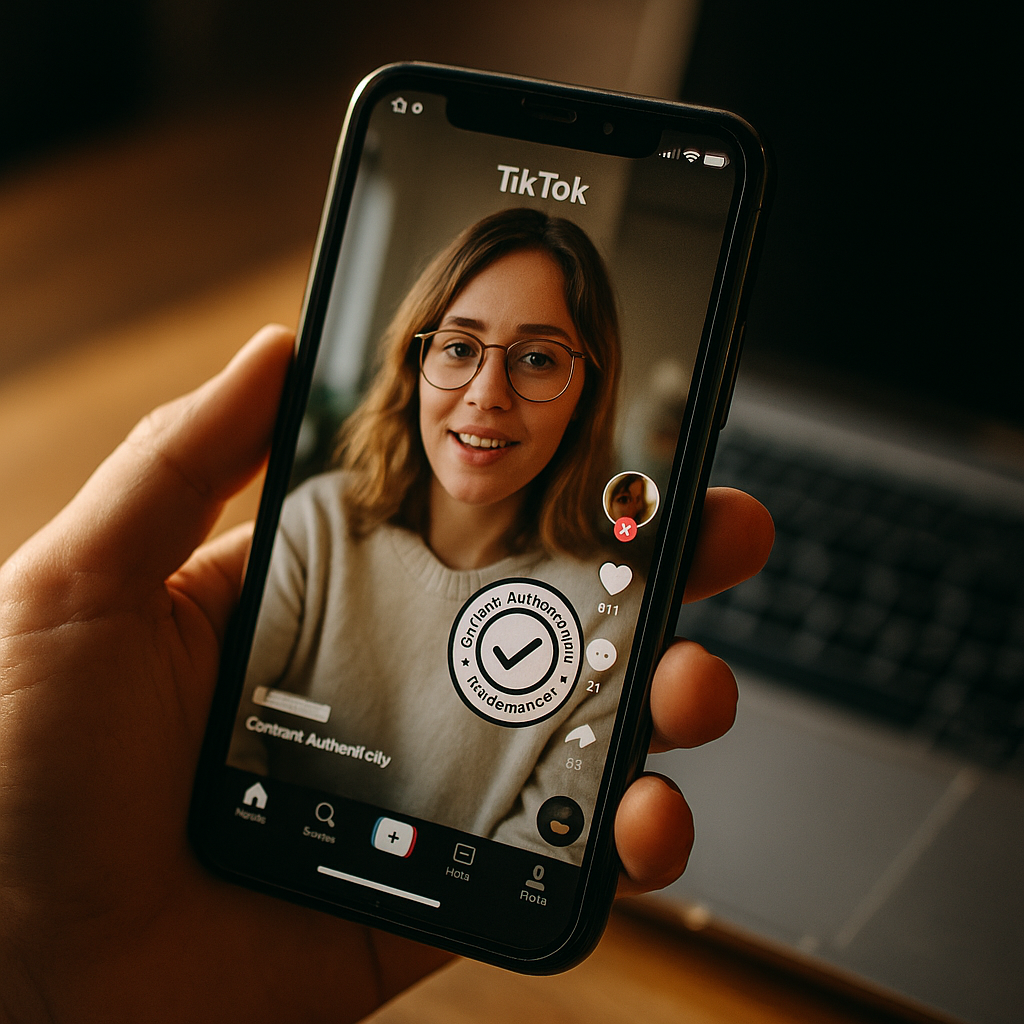
Ninety percent of marketers say they can’t reliably tell AI-generated content from human-made content anymore. TikTok just bet its entire trust layer on fixing that. The platform’s TikTok C2PA content provenance rollout is now live across upload flows, and most brand teams still don’t understand what the watermark actually confirms — or where it quietly stops.
That gap matters. If your legal team is treating a C2PA credential as a stamp of “this is true,” you’re setting up a compliance problem. If your creator ops team ignores it entirely, you’re leaving a free authenticity signal on the table. Let’s get precise about what’s actually happening under the hood.
What C2PA Actually Is
C2PA stands for the Coalition for Content Provenance and Authenticity — a standards body backed by Adobe, Microsoft, Intel, the BBC, and Sony, among others. It’s not a TikTok invention. It’s an open technical specification for attaching cryptographically signed metadata to media files, describing where a piece of content came from and what happened to it along the way.
Think of it less like a watermark in the visual sense and more like a tamper-evident chain of custody. Each edit, export, or AI generation step can append a new “assertion” to the file’s manifest, signed with a certificate tied to the tool or platform that made the change. TikTok reads that manifest on upload and, where available, displays a “Content Credentials” label to viewers.
C2PA doesn’t verify that a video is true, accurate, or safe. It verifies a technical history — what tools touched the file and in what order.
That distinction is the single most misunderstood part of this rollout. A perfectly disclosed, fully C2PA-signed deepfake is still a deepfake. The credential just tells you it was made with, say, OpenAI’s Sora rather than claiming to be unedited camera footage.
What the Watermark Actually Verifies
Strip away the marketing language and TikTok’s implementation verifies four narrow things:
- Origin tool: which app, camera, or AI model generated the base asset (e.g., TikTok’s camera, Adobe Firefly, or a third-party generator that supports C2PA signing).
- Edit history: a sequence of recorded actions — cropped, color-graded, AI-upscaled, captioned — each tied to a timestamp and signing tool.
- Integrity since signing: cryptographic proof the file hasn’t been altered after the last signature was applied, using hash comparisons.
- Issuing certificate authority: confirmation that the signer (TikTok, Adobe, a camera manufacturer) holds a valid, non-revoked C2PA certificate.
That’s it. There’s no fact-check layer. There’s no claim verification against reality. A manifest can honestly disclose “generated with AI video tool” while the video still shows a fabricated event, false product claim, or manipulated statement. The chain of custody is real; the content’s truthfulness is a separate question entirely.
This matters enormously for brand safety teams already running AI hallucination audits on creator briefs. C2PA tells you provenance. It does not replace your claims-review process.
Where the Chain Breaks
Provenance chains are only as strong as their weakest signing link, and there are several ways the chain snaps in practice:
- Screen recording strips metadata. Record a C2PA-signed video off a screen and re-upload it — the credential is gone. This is the single biggest leakage point for repurposed influencer content.
- Non-participating tools break the chain silently. If a creator edits in a tool that doesn’t support C2PA (plenty of free mobile editors still don’t), the manifest either disappears or shows a gap, not a red flag.
- Downloading and re-uploading via third-party apps frequently strips or corrupts metadata during compression, which is common with cross-posting tools brands use to push one asset across channels.
- Malicious stripping is trivial. Removing C2PA metadata is not hard for anyone motivated to fake authenticity or hide AI origin. The standard assumes good-faith participation, not adversarial resistance.
So when a video shows no Content Credentials, that’s not proof it’s untouched, human-made footage. It might just mean it passed through a tool that doesn’t support the standard. Absence of a badge is not absence of manipulation — a nuance that’s going to matter a lot when compliance teams start writing policy around this.
Why TikTok Is Doing This Now
Two forces converged. First, AI video generation quality jumped dramatically with tools compared in our Sora vs Veo 3 vs Runway Gen-4 comparison — synthetic content is now cheap, fast, and often indistinguishable from real footage at native resolution. Second, regulators are circling. The FTC has signaled increasing scrutiny of undisclosed synthetic endorsements, and platforms that don’t self-police risk having disclosure rules imposed on them externally.
The FTC’s endorsement guidance already requires clear disclosure of material connections; AI-generated content adds a new dimension regulators are actively watching.
TikTok adopting C2PA is also a competitive move. Meta, Google, and Adobe are already members of the coalition, and cross-platform interoperability means a properly signed asset can theoretically carry its provenance history from Photoshop to TikTok to a paid social placement without losing the metadata trail — assuming every hop in that chain respects the standard.
What This Means for Brand Programs
For brand and agency teams, this isn’t a checkbox exercise. It changes three operational areas.
Creator briefing. If your influencer program uses AI-assisted editing, dubbing, or voice cloning — increasingly common for scaling one asset across multiple channels — your briefs need explicit language on which tools are C2PA-compliant, and creators need to know their edit tool choice affects the disclosure label their audience sees.
Compliance documentation. Legal and compliance teams evaluating disclosure risk should treat C2PA metadata as supporting evidence, not a substitute for FTC-compliant disclosure language in captions. A Content Credentials badge doesn’t satisfy “clear and conspicuous” disclosure requirements on its own.
Trust signaling in paid media. Brands running AI-assisted ad creative can now use verified provenance as a trust differentiator, similar to how AI and blockchain trust badges are being used to prove review authenticity. Expect provenance badges to become a competitive trust signal in categories like finance, health, and beauty, where synthetic content skepticism runs highest.
Treat C2PA the way you’d treat a shipping manifest: it tells you what happened to the box, not whether what’s inside is what the label says.
The Technical Mechanics, Simplified
For teams that need to explain this to leadership without getting lost in cryptography jargon, here’s the compressed version. Every C2PA-compliant tool generates a “manifest” — a structured data block containing assertions about the asset (creation tool, edits, AI involvement) and a cryptographic hash of the file’s content. That manifest is signed using a certificate issued by a recognized certificate authority, similar in concept to how HTTPS certificates work for websites.
When TikTok ingests a file, it checks: does the manifest’s signature validate against a trusted certificate? Does the file’s current hash match what’s recorded? If both check out, TikTok displays the Content Credentials indicator, and users can tap through to see the tool history. If the file was never signed, or the chain broke somewhere, no badge appears — full stop, no nuance shown to the average viewer.
This is why AI product comparison content and other synthetic commercial media are early test cases — they’re high-volume, high-scrutiny formats where provenance labeling could shift consumer trust metrics measurably. Brands running heavy AI creative pipelines should expect to be early, visible test cases for how these badges land with audiences.
Sprout Social’s platform research and eMarketer’s creator economy data both point to rising consumer skepticism toward unlabeled AI content, which is exactly the trust gap TikTok is trying to close.
What Marketers Should Actually Do
Skip the panic, skip the ignore-it approach, and do three concrete things instead:
- Audit your current creative stack for C2PA compatibility — check whether your AI video tools, editing software, and cross-posting platforms preserve or strip metadata.
- Update creator agreements to require disclosure of AI tool usage independent of whatever badge TikTok shows, since the badge can fail silently.
- Brief compliance and legal teams that C2PA is a provenance layer, not a fact-checking layer, so disclosure policy doesn’t over-rely on it.
None of this replaces human judgment. If anything, it raises the bar for editorial rigor, similar to how agentic ad platforms still require human approval at critical decision points. Provenance metadata is a tool for building trust infrastructure, not a substitute for it.
Next step: pull your last quarter of AI-assisted creator content and check how much of it would actually carry a valid Content Credentials badge today. If the number is lower than you expect, that’s your real starting point for building a provenance-aware creative workflow — not TikTok’s rollout timeline.
FAQs
Does a C2PA badge mean a video is real or unedited?
No. It means the file’s edit history is cryptographically documented and hasn’t been tampered with since the last signature. A fully AI-generated video can carry a valid, honest C2PA credential.
What happens if a creator screen-records a C2PA-signed video?
The metadata is stripped. Screen recording captures pixels, not the underlying file structure, so the provenance chain breaks silently with no error shown to the uploader or viewer.
Is C2PA a TikTok-specific technology?
No. It’s an open standard developed by the Coalition for Content Provenance and Authenticity, backed by Adobe, Microsoft, and others. TikTok is implementing an existing spec, not building proprietary tech.
Does the absence of a Content Credentials badge mean content is fake?
Not necessarily. Many legitimate editing tools still don’t support C2PA signing, so a missing badge often just reflects a gap in tool adoption, not evidence of manipulation.
Do brands still need FTC disclosure language if content carries a C2PA badge?
Yes. C2PA metadata is a technical provenance record, not a substitute for clear and conspicuous FTC-compliant disclosure in captions or on-screen text.
Top Influencer Marketing Agencies
The leading agencies shaping influencer marketing in 2026
Agencies ranked by campaign performance, client diversity, platform expertise, proven ROI, industry recognition, and client satisfaction. Assessed through verified case studies, reviews, and industry consultations.
Moburst

-
2

The Shelf
Boutique Beauty & Lifestyle Influencer AgencyA data-driven boutique agency specializing exclusively in beauty, wellness, and lifestyle influencer campaigns on Instagram and TikTok. Best for brands already focused on the beauty/personal care space that need curated, aesthetic-driven content.Clients: Pepsi, The Honest Company, Hims, Elf Cosmetics, Pure LeafVisit The Shelf → -
3

Audiencly
Niche Gaming & Esports Influencer AgencyA specialized agency focused exclusively on gaming and esports creators on YouTube, Twitch, and TikTok. Ideal if your campaign is 100% gaming-focused — from game launches to hardware and esports events.Clients: Epic Games, NordVPN, Ubisoft, Wargaming, Tencent GamesVisit Audiencly → -
4

Viral Nation
Global Influencer Marketing & Talent AgencyA dual talent management and marketing agency with proprietary brand safety tools and a global creator network spanning nano-influencers to celebrities across all major platforms.Clients: Meta, Activision Blizzard, Energizer, Aston Martin, WalmartVisit Viral Nation → -
5

The Influencer Marketing Factory
TikTok, Instagram & YouTube CampaignsA full-service agency with strong TikTok expertise, offering end-to-end campaign management from influencer discovery through performance reporting with a focus on platform-native content.Clients: Google, Snapchat, Universal Music, Bumble, YelpVisit TIMF → -
6

NeoReach
Enterprise Analytics & Influencer CampaignsAn enterprise-focused agency combining managed campaigns with a powerful self-service data platform for influencer search, audience analytics, and attribution modeling.Clients: Amazon, Airbnb, Netflix, Honda, The New York TimesVisit NeoReach → -
7

Ubiquitous
Creator-First Marketing PlatformA tech-driven platform combining self-service tools with managed campaign options, emphasizing speed and scalability for brands managing multiple influencer relationships.Clients: Lyft, Disney, Target, American Eagle, NetflixVisit Ubiquitous → -
8

Obviously
Scalable Enterprise Influencer CampaignsA tech-enabled agency built for high-volume campaigns, coordinating hundreds of creators simultaneously with end-to-end logistics, content rights management, and product seeding.Clients: Google, Ulta Beauty, Converse, AmazonVisit Obviously →