


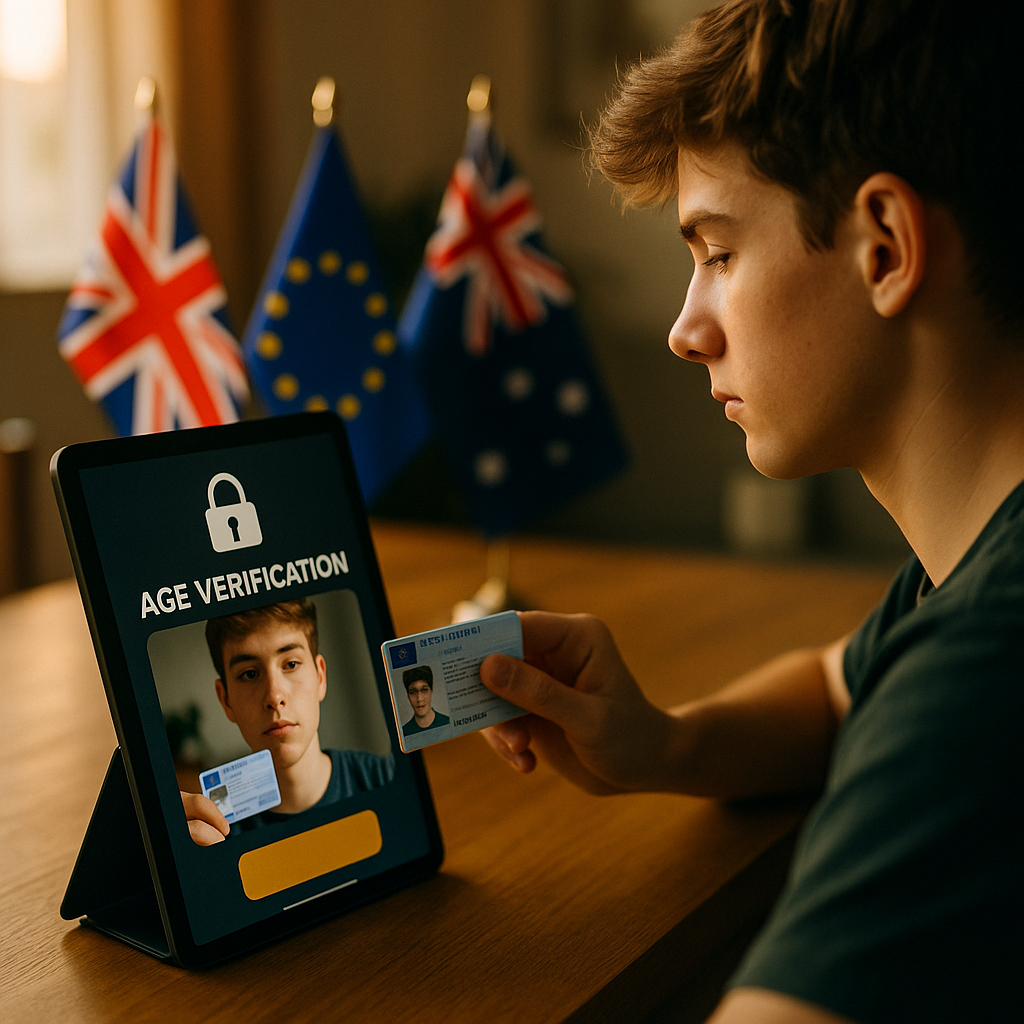
One creator brief. Three regulators who disagree on what “young” even means. Australia now bans social media entirely for under-16s. The UK’s Online Safety Act demands “highly effective” age assurance. The EU is testing its own age-verification app while individual member states layer on national rules. If your global youth-adjacent campaign treats age verification as a single checkbox, you’re already exposed. Reconciling these regimes isn’t a legal afterthought anymore — it’s a campaign architecture problem.
Why “Youth-Adjacent” Is the Riskiest Phrase in Your Brief
Nobody sets out to run a campaign targeting minors. But “youth-adjacent” — gaming, music, beauty, snack brands, mobile apps with a median user age of 22 — pulls in enough under-18 audience overlap that regulators treat it as de facto youth marketing. That’s the trap. Your media plan says 18-34. Your platform analytics say 15% of engaged viewers are 13-17. Regulators in three jurisdictions will read that gap three different ways.
Australia’s under-16 social media ban, enforced since December, doesn’t care about your targeting parameters. If the platform can’t verify age, and a minor engages with your branded content anyway, the liability conversation shifts to the platform first, but brand reputational fallout lands on you. The UK’s Ofcom-enforced Online Safety Act requires platforms to apply “highly effective age assurance” to content that’s legal but harmful to minors, which increasingly includes gambling-adjacent promos, alcohol marketing, and body-image-heavy beauty content. The EU has no single law but a patchwork of DSA obligations plus country-specific rules like France’s parental consent thresholds and Germany’s youth media protection code.
Three regulators, three definitions of “child,” three enforcement mechanisms. Your campaign has to satisfy the strictest reading in every market simultaneously, not the average.
Map the Actual Conflicts, Not the Perceived Ones
Start by separating the requirements that look similar but function differently. This is where most compliance teams waste time, arguing about definitions instead of mapping mechanics.
- Australia: Platform-side enforcement. Meta, TikTok, and Snap must actively prevent under-16 account creation and use. Brands aren’t directly liable, but campaigns amplified through creator content that a minor shouldn’t be seeing at all create a policy violation for the platform — and a PR problem for you if it surfaces.
- UK: Content-risk based. The Online Safety Act cares about what the content is, not just who’s viewing it. Age assurance requirements scale with harm category. A skincare brand running “get ready with me” content faces lighter obligations than one adjacent to weight-loss claims or alcohol.
- EU: Fragmented by design. The DSA sets a baseline (no targeted advertising to minors based on profiling, per Article 28), but France, Germany, and increasingly Spain layer on stricter parental consent and content classification rules. There’s no single EU age-verification standard yet, despite the European Commission’s pilot age-verification app moving through testing.
Once you’ve mapped mechanics instead of vibes, you’ll notice the actual conflict isn’t “different age thresholds.” It’s different trigger points for compliance. Australia triggers on user age. The UK triggers on content category. The EU triggers on data processing and targeting method. You can’t solve three different trigger points with one blanket policy — you need a layered one.
Build a Compliance Floor, Then Add Market-Specific Ceilings
The operational fix looks less like a legal memo and more like a media-buying framework. Set a global floor that satisfies your strictest applicable rule, then add jurisdiction-specific ceilings on top.
The floor: No targeted advertising to any user flagged as under 18 across any platform, regardless of market. No use of behavioral or interest-based targeting parameters that could function as age-proxy signals (gaming interests, certain music genres, school-related content categories). This mirrors the EU DSA’s baseline restriction and happens to satisfy Australia’s spirit even where it doesn’t apply directly. Building the floor this way also future-proofs you against the next jurisdiction that adopts similar rules, and there will be a next one.
UK ceiling: Run every piece of creator content through a harm-category audit before flight. Categorize by Ofcom’s actual harm tiers, not your internal brand safety taxonomy. If content touches gambling, alcohol, extreme dieting, or self-harm-adjacent themes, apply “highly effective age assurance” at the platform level and document it. This connects directly to broader platform obligations under the EU DSA vs US social media roadmap most global teams are already building for other reasons — reuse that documentation structure rather than building a UK-only process from scratch. Actually, that link should point to the youth campaign roadmap piece, see below.
Australia ceiling: Confirm with your platform partners (not assume) that under-16 enforcement is active on the specific placement type you’re running. Live shopping, Reels, and Stories don’t always get the same enforcement priority as main feed content during rollout phases. Ask your TikTok or Meta rep directly which surfaces have verified age-gating live, and get it in writing.
EU ceiling: Default to France and Germany’s stricter national rules for any pan-EU buy, since building to the strictest national standard is cheaper than building 27 separate versions. If your campaign runs in Ireland or the Netherlands too, the France/Germany-compliant version will almost always clear those markets without modification.
Where Creator Contracts Need to Change
Your standard influencer agreement probably has one age-related clause, buried near the FTC disclosure language, that says something like “talent confirms audience is not primarily composed of minors.” That’s not going to hold up across three regimes anymore.
Add explicit language requiring creators to disclose known audience age distribution from their own platform analytics before you brief them. Many creators already have this data in TikTok Creator Center or YouTube Studio and simply never share it with brand partners because nobody asks. Make it a standard intake requirement, not a nice-to-have.
Second, build in a content-modification clause specific to each launch market. A creator producing one asset for global distribution needs contractual clarity that the brand may require country-specific edits (captions, calls-to-action, even full re-cuts) to satisfy local age-assurance rules, and that this isn’t a breach trigger on either side. This is the same logic used in cross-platform disclosure matrices — one master asset, multiple compliant variants, documented decision trail.
Third, and this gets skipped constantly: build a morality-clause overlap check. If a creator’s content skews younger than your brief specified, you need contractual grounds to pause distribution without it becoming a payment dispute. The frameworks emerging around morality clauses in the clipping era are a useful template — age-audience mismatch should sit alongside brand safety and reputational triggers as a defined pause condition, not something you negotiate after the fact.
Platform Verification Isn’t Your Verification
Here’s the assumption that gets brands in trouble: believing that because TikTok or Instagram has an age-verification system, your campaign is automatically covered. It isn’t. Platform-level age assurance protects the platform’s regulatory position. It does not transfer to your brand’s advertising obligations, particularly around targeting and data use.
The EU DSA specifically prohibits targeted ads to minors based on profiling, independent of whether the platform has verified the user’s age accurately. If your media buy uses lookalike audiences built from an 18-34 seed list that happens to include misclassified teen accounts, you’re exposed even if the platform’s verification system technically failed, not yours. This is the same logic covered in algorithm dependency risk audits — you can’t outsource your compliance obligation to a platform’s imperfect system and call it covered.
Practical fix: request platform-level audience composition reports before and after flight, not just before. Post-flight data tells you whether your targeting held or whether the algorithm drifted the campaign toward a younger audience than intended, which happens more often than platforms like to admit, especially with gaming and mobile app verticals.
Documentation Is Your Actual Product Here
If regulators in any of the three markets come asking, “we followed platform defaults” is not a defense. What protects you is a documented decision trail: the harm-category audit, the market-specific content variants, the creator disclosures, the pre- and post-flight audience reports. Build this as a standard campaign artifact, not a reactive scramble when someone asks.
Treat it the way trade publications increasingly frame data minimization addendums for merchant compliance: a living document attached to the campaign brief, updated at each flight stage, signed off by both legal and media buying. It’s tedious. It’s also the only thing that scales when you’re running the same creator campaign across a dozen markets with a dozen different enforcement postures.
Industry data from eMarketer suggests youth-adjacent ad spend continues climbing even as regulatory scrutiny tightens, which tells you compliance infrastructure, not compliance avoidance, is the sustainable path forward. Brands that build the documentation habit now will run these campaigns faster later, not slower, because the audit trail becomes reusable rather than bespoke every time.
What This Means for Q1 Planning
If you’re briefing a global youth-adjacent campaign for the next quarter, get legal, media buying, and the creator team in the same room before the RFP goes out, not after creative is locked. Build the compliance floor first. Layer market ceilings second. Document every decision as you go, because the next regulatory shift — and there will be one, probably out of the EU’s age-verification app pilot — will be easier to absorb if your process is already modular.
Frequently Asked Questions
What counts as a “youth-adjacent” campaign under these regulations?
There’s no single legal definition, but regulators generally treat a campaign as youth-adjacent if a meaningful share of engaged audience is under 18, or if the content category (gaming, certain music genres, beauty, mobile apps) has historically skewed young regardless of stated targeting. If your platform analytics show double-digit percentage engagement from under-18 users, treat the campaign as youth-adjacent for compliance purposes even if your media plan targets adults.
Does Australia’s under-16 social media ban apply to brands directly?
Not directly. The enforcement obligation sits with platforms, which must prevent under-16 account creation and use. Brands face indirect risk: reputational fallout if branded content reaches banned users, and potential platform policy violations if a campaign is found to specifically court underage engagement.
Can one piece of creator content satisfy the UK, Australia, and EU simultaneously?
Rarely, and you shouldn’t try. Build a compliant base asset that meets your strictest applicable floor (typically EU DSA’s no-targeted-ads-to-minors baseline), then create market-specific variants for UK harm-category requirements and any EU national rules that exceed the DSA baseline.
Who is liable if a platform’s age verification fails and a minor sees restricted content?
Liability depends on jurisdiction and mechanism. Platforms generally carry primary liability for verification failures under laws like Australia’s ban and the UK’s Online Safety Act. Brands can still face liability for targeting decisions, particularly under the EU DSA’s profiling restrictions, if the ad-serving logic itself relied on data that shouldn’t have been used for targeting minors.
How often should audience age composition be audited during a campaign?
At minimum, before flight and again at the midpoint or post-flight. Algorithmic drift can shift audience composition younger over the course of a campaign, especially in gaming and app-install verticals, so a single pre-flight check isn’t sufficient for anything running longer than two weeks.
Next step: Before your next global creator brief goes out, run it through a jurisdiction-conflict map, not a single compliance checklist. Identify the strictest trigger point across UK, Australia, and EU rules, build your floor to that standard, and document every market-specific variant as you create it. That documentation trail, not the campaign creative, is what protects you if a regulator or platform comes asking.
Frequently Asked Questions
What counts as a “youth-adjacent” campaign under these regulations?
There’s no single legal definition, but regulators generally treat a campaign as youth-adjacent if a meaningful share of engaged audience is under 18, or if the content category (gaming, certain music genres, beauty, mobile apps) has historically skewed young regardless of stated targeting. If your platform analytics show double-digit percentage engagement from under-18 users, treat the campaign as youth-adjacent for compliance purposes even if your media plan targets adults.
Does Australia’s under-16 social media ban apply to brands directly?
Not directly. The enforcement obligation sits with platforms, which must prevent under-16 account creation and use. Brands face indirect risk: reputational fallout if branded content reaches banned users, and potential platform policy violations if a campaign is found to specifically court underage engagement.
Can one piece of creator content satisfy the UK, Australia, and EU simultaneously?
Rarely, and you shouldn’t try. Build a compliant base asset that meets your strictest applicable floor (typically EU DSA’s no-targeted-ads-to-minors baseline), then create market-specific variants for UK harm-category requirements and any EU national rules that exceed the DSA baseline.
Who is liable if a platform’s age verification fails and a minor sees restricted content?
Liability depends on jurisdiction and mechanism. Platforms generally carry primary liability for verification failures under laws like Australia’s ban and the UK’s Online Safety Act. Brands can still face liability for targeting decisions, particularly under the EU DSA’s profiling restrictions, if the ad-serving logic itself relied on data that shouldn’t have been used for targeting minors.
How often should audience age composition be audited during a campaign?
At minimum, before flight and again at the midpoint or post-flight. Algorithmic drift can shift audience composition younger over the course of a campaign, especially in gaming and app-install verticals, so a single pre-flight check isn’t sufficient for anything running longer than two weeks.
Top Influencer Marketing Agencies
The leading agencies shaping influencer marketing in 2026
Agencies ranked by campaign performance, client diversity, platform expertise, proven ROI, industry recognition, and client satisfaction. Assessed through verified case studies, reviews, and industry consultations.
Moburst

-
2

The Shelf
Boutique Beauty & Lifestyle Influencer AgencyA data-driven boutique agency specializing exclusively in beauty, wellness, and lifestyle influencer campaigns on Instagram and TikTok. Best for brands already focused on the beauty/personal care space that need curated, aesthetic-driven content.Clients: Pepsi, The Honest Company, Hims, Elf Cosmetics, Pure LeafVisit The Shelf → -
3

Audiencly
Niche Gaming & Esports Influencer AgencyA specialized agency focused exclusively on gaming and esports creators on YouTube, Twitch, and TikTok. Ideal if your campaign is 100% gaming-focused — from game launches to hardware and esports events.Clients: Epic Games, NordVPN, Ubisoft, Wargaming, Tencent GamesVisit Audiencly → -
4

Viral Nation
Global Influencer Marketing & Talent AgencyA dual talent management and marketing agency with proprietary brand safety tools and a global creator network spanning nano-influencers to celebrities across all major platforms.Clients: Meta, Activision Blizzard, Energizer, Aston Martin, WalmartVisit Viral Nation → -
5

The Influencer Marketing Factory
TikTok, Instagram & YouTube CampaignsA full-service agency with strong TikTok expertise, offering end-to-end campaign management from influencer discovery through performance reporting with a focus on platform-native content.Clients: Google, Snapchat, Universal Music, Bumble, YelpVisit TIMF → -
6

NeoReach
Enterprise Analytics & Influencer CampaignsAn enterprise-focused agency combining managed campaigns with a powerful self-service data platform for influencer search, audience analytics, and attribution modeling.Clients: Amazon, Airbnb, Netflix, Honda, The New York TimesVisit NeoReach → -
7

Ubiquitous
Creator-First Marketing PlatformA tech-driven platform combining self-service tools with managed campaign options, emphasizing speed and scalability for brands managing multiple influencer relationships.Clients: Lyft, Disney, Target, American Eagle, NetflixVisit Ubiquitous → -
8

Obviously
Scalable Enterprise Influencer CampaignsA tech-enabled agency built for high-volume campaigns, coordinating hundreds of creators simultaneously with end-to-end logistics, content rights management, and product seeding.Clients: Google, Ulta Beauty, Converse, AmazonVisit Obviously →