


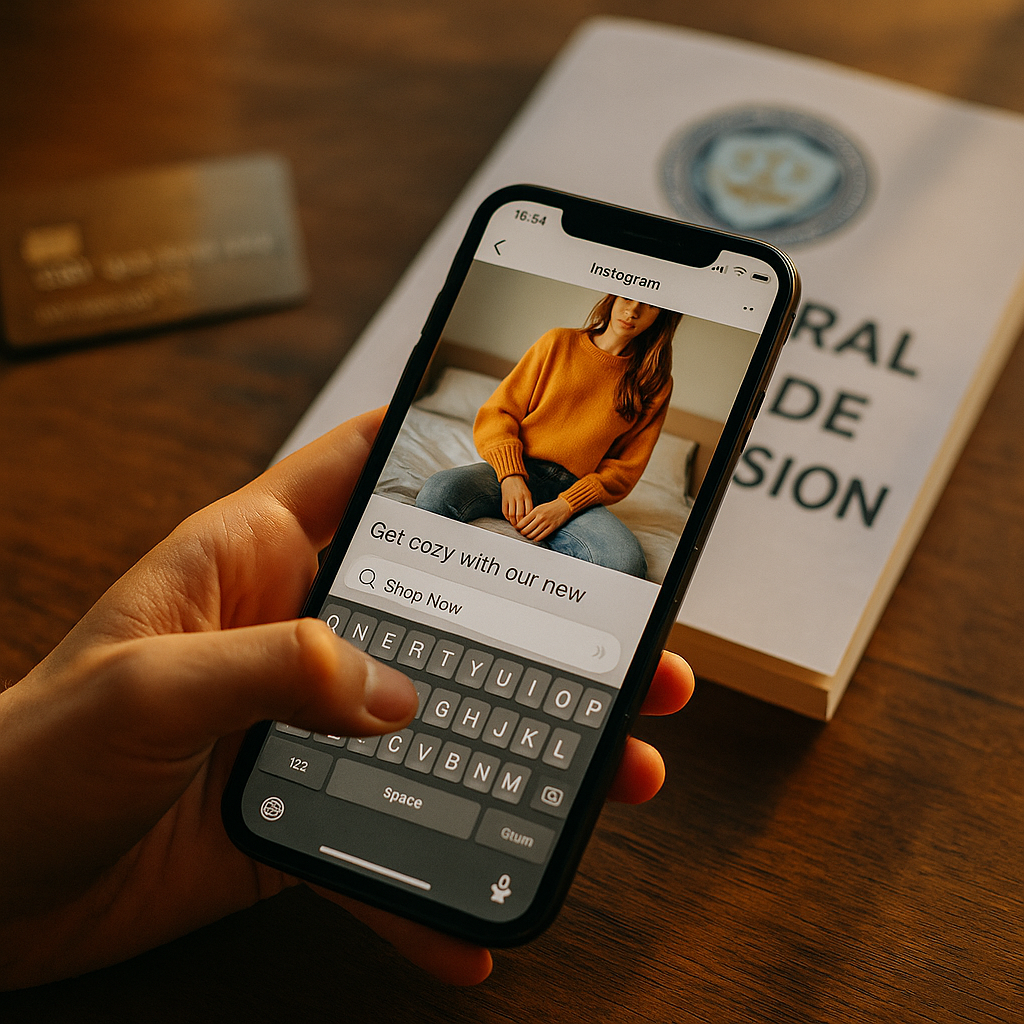
Meta quietly changed how it scores shoppable captions, and most brand teams haven’t noticed. The signal that used to boost reach — a clean, punchy caption — now competes with a new ranking layer built around “buy-moment” language, product tags, and disclosure placement. Get the Instagram buy-moment caption architecture wrong, and you lose feed real estate. Get the FTC disclosure wrong, and you lose a lot more than reach.
This is the tension every social team is quietly wrestling with right now: the caption format that maximizes shoppable placement isn’t automatically the one that satisfies regulators. Here’s how to build one caption architecture that does both.
What Is a Buy-Moment Caption, Exactly?
Meta’s shoppable feed ranking now weighs captions differently depending on where a “buy signal” appears in the text. Think of it as intent scoring applied to language, not just pixels. Captions that front-load purchase intent — price mentions, availability cues, “shop now” phrasing — get prioritized for surfacing in Instagram Shop tabs and shoppable feed carousels. Captions that bury that language three paragraphs deep get deprioritized, even if the product tags are identical.
Meta hasn’t published a full technical spec, but pattern analysis from agency testing (and Meta’s own business platform documentation) suggests the first 125 characters carry outsized weight in shoppable ranking, mirroring how the first line drives organic reach in standard feed posts.
That 125-character window is also, inconveniently, where the FTC wants your disclosure to live.
The FTC doesn’t care where your “shop now” language sits. It cares whether “#ad” is visible without a viewer having to tap “more.” Those two priorities collide in the exact same character count.
The Compliance Trap Hiding in Plain Sight
Here’s the uncomfortable math. Instagram truncates captions after roughly 125 characters before showing “more.” The FTC’s endorsement guidance requires disclosures to be “clear and conspicuous” — meaning a reasonable consumer shouldn’t have to click anything to see that content is sponsored. If your buy-moment keyword strategy pushes “#ad” past character 125 to make room for shoppable trigger phrases, you’ve built a caption that ranks well and violates disclosure guidance simultaneously.
This isn’t hypothetical. Agencies running influencer programs at scale have flagged this exact failure mode over the past two quarters: creators optimizing captions for shoppable reach, unintentionally burying disclosures below the fold.
Brands underestimate how often this happens because nobody’s auditing caption structure at the character level. Legal reviews a caption for the presence of “#ad.” Nobody’s checking whether it’s visible pre-truncation. That’s the gap.
The Architecture That Wins Both
The fix isn’t complicated, but it does require rebuilding your caption template. Here’s the structure that’s testing well across retail and DTC accounts right now:
- Characters 1–15: Disclosure first. “#ad” or “Paid partnership with [Brand]” — non-negotiable, first thing visible.
- Characters 16–90: Buy-moment language. Price point, availability, urgency cue (“back in stock,” “limited restock,” “new colorway”). This is where shoppable ranking signal lives.
- Characters 90–125: Product-specific keyword or category term that reinforces the shoppable tag metadata (helps Meta’s product-matching algorithm confirm caption-to-catalog relevance).
- After the fold: Storytelling, hashtags, secondary CTAs, creator voice.
This sequencing satisfies the FTC’s conspicuousness standard because disclosure appears before truncation, and it satisfies Meta’s shoppable ranking preference because buy-moment language still lands inside the high-weight character window, just shifted 15 characters later.
Fifteen characters sounds trivial. In testing, it’s the difference between a fully compliant caption and one buried in a legal review backlog.
Why Creators Resist This Format (And How to Fix It)
Ask any creator and they’ll tell you: leading with “#ad” feels like burying the lede. It reads clinically, kills the hook, and creators worry it tanks engagement before the audience even gets to the good part. That resistance is real, and it’s the single biggest reason brands fail to enforce this architecture consistently.
The workaround isn’t to fight creators on tone — it’s to make disclosure feel native. “Ad: this restock sold out in 6 hours last time” reads completely differently than a flat “#ad” dropped alone. Same compliance function, different creative execution. Brief creators on the structural requirement (disclosure first, buy-moment second) but give them full latitude on voice within that frame.
Brands running influencer programs through structured briefs — the kind covered in our creator brief playbook — already have the infrastructure to slot this in. It’s a template update, not a new process.
Where This Connects to the Broader Shoppable Feed Shift
This caption architecture doesn’t exist in isolation. It’s part of a larger pattern Meta has been building toward: ranking shoppable content by purchase-intent signals rather than pure engagement metrics. We covered the mechanics of this shift in depth in how the buy-moment algorithm intersects with disclosure rules, and the caption layer is really the tactical execution of that strategic shift.
It also pairs directly with carousel structure. If you’re sequencing shoppable carousels for conversion (see our carousel sequencing framework), the caption sitting above that carousel needs to follow the same disclosure-first logic, or you’ve optimized the visual funnel while leaving the text layer exposed to compliance risk.
Retailers running parallel programs on other platforms should note this isn’t Instagram-specific in principle. TikTok Shop’s algorithm has its own intent-weighting quirks, detailed in our TikTok Shop discovery stack breakdown, and retail media networks are converging on similar shoppable-ranking logic, as we found auditing Amazon and Walmart shoppable video pilots. The caption-compliance collision is becoming a cross-platform problem, not a Meta-only edge case.
Operationalizing It: What Brand Teams Should Actually Do
Three moves, in priority order.
First, audit your last 90 days of shoppable-tagged posts. Pull captions, check character position of disclosure language against the 125-character truncation point. You’ll likely find a meaningful percentage failing conspicuousness even though “#ad” technically appears somewhere in the text. Sprout Social and other social analytics platforms can help pull this data at scale rather than manually.
Second, rebuild your caption template using the four-zone structure above and push it into creator briefs, not just brand-owned posts. Influencer-generated shoppable content carries the same FTC exposure as owned content, and enforcement has increasingly targeted the brand, not just the creator, when disclosure fails.
Third, build a lightweight QA checkpoint before publish — even a simple character-count tool that flags whether disclosure sits before position 125. This is a five-minute check that prevents a compliance headache with real regulatory teeth behind it.
Brands that treat this as a legal-only issue miss half the opportunity. Get the architecture right and you’re not just avoiding risk — you’re actively winning more shoppable feed placement than competitors still front-loading hashtags and hooks.
None of this requires new tooling or budget. It requires updating a template and enforcing it across every creator brief and brand post touching Instagram Shop. That’s it.
FAQs
Does disclosure placement actually affect Instagram’s shoppable feed ranking?
Not directly — the FTC disclosure itself isn’t a ranking signal. But because both disclosure and buy-moment language compete for the same limited pre-truncation character space, poor sequencing can push high-value shoppable keywords out of the algorithm’s highest-weighted zone, indirectly hurting placement.
What counts as “clear and conspicuous” under FTC guidance for Instagram captions?
The disclosure must be visible without requiring the viewer to click “more” or take any additional action. If “#ad” or “paid partnership” only appears after Instagram’s truncation point, it does not meet the FTC’s conspicuousness standard, regardless of whether the words appear later in the full caption.
Should brands still use Instagram’s built-in “Paid Partnership” label, or is a caption disclosure enough?
Use both. The built-in label is a strong baseline, but the FTC has been clear that platform labels alone may not satisfy disclosure requirements in every context, particularly for Stories or Reels where labels can be easy to miss. Caption-based disclosure remains the safer redundant layer.
How many characters does Instagram actually show before truncating a caption?
It varies by device and feed placement, but roughly 125 characters is the commonly cited threshold before “more” appears. Brands should test on both mobile and desktop views since truncation points can differ slightly.
Does this caption architecture apply to Reels and Stories, or just feed posts?
The same disclosure-first, buy-moment-second logic applies across formats, though Reels and Stories have different truncation behavior and additional built-in disclosure tools. The safest approach is to apply the same four-zone caption structure everywhere shoppable tags appear.
Visible FAQ (HTML)
Next step: Pull your last 90 days of shoppable posts this week, check disclosure position against the 125-character mark, and rebuild your caption template around the four-zone structure before your next creator brief goes out.
Top Influencer Marketing Agencies
The leading agencies shaping influencer marketing in 2026
Agencies ranked by campaign performance, client diversity, platform expertise, proven ROI, industry recognition, and client satisfaction. Assessed through verified case studies, reviews, and industry consultations.
Moburst

-
2

The Shelf
Boutique Beauty & Lifestyle Influencer AgencyA data-driven boutique agency specializing exclusively in beauty, wellness, and lifestyle influencer campaigns on Instagram and TikTok. Best for brands already focused on the beauty/personal care space that need curated, aesthetic-driven content.Clients: Pepsi, The Honest Company, Hims, Elf Cosmetics, Pure LeafVisit The Shelf → -
3

Audiencly
Niche Gaming & Esports Influencer AgencyA specialized agency focused exclusively on gaming and esports creators on YouTube, Twitch, and TikTok. Ideal if your campaign is 100% gaming-focused — from game launches to hardware and esports events.Clients: Epic Games, NordVPN, Ubisoft, Wargaming, Tencent GamesVisit Audiencly → -
4

Viral Nation
Global Influencer Marketing & Talent AgencyA dual talent management and marketing agency with proprietary brand safety tools and a global creator network spanning nano-influencers to celebrities across all major platforms.Clients: Meta, Activision Blizzard, Energizer, Aston Martin, WalmartVisit Viral Nation → -
5

The Influencer Marketing Factory
TikTok, Instagram & YouTube CampaignsA full-service agency with strong TikTok expertise, offering end-to-end campaign management from influencer discovery through performance reporting with a focus on platform-native content.Clients: Google, Snapchat, Universal Music, Bumble, YelpVisit TIMF → -
6

NeoReach
Enterprise Analytics & Influencer CampaignsAn enterprise-focused agency combining managed campaigns with a powerful self-service data platform for influencer search, audience analytics, and attribution modeling.Clients: Amazon, Airbnb, Netflix, Honda, The New York TimesVisit NeoReach → -
7

Ubiquitous
Creator-First Marketing PlatformA tech-driven platform combining self-service tools with managed campaign options, emphasizing speed and scalability for brands managing multiple influencer relationships.Clients: Lyft, Disney, Target, American Eagle, NetflixVisit Ubiquitous → -
8

Obviously
Scalable Enterprise Influencer CampaignsA tech-enabled agency built for high-volume campaigns, coordinating hundreds of creators simultaneously with end-to-end logistics, content rights management, and product seeding.Clients: Google, Ulta Beauty, Converse, AmazonVisit Obviously →