


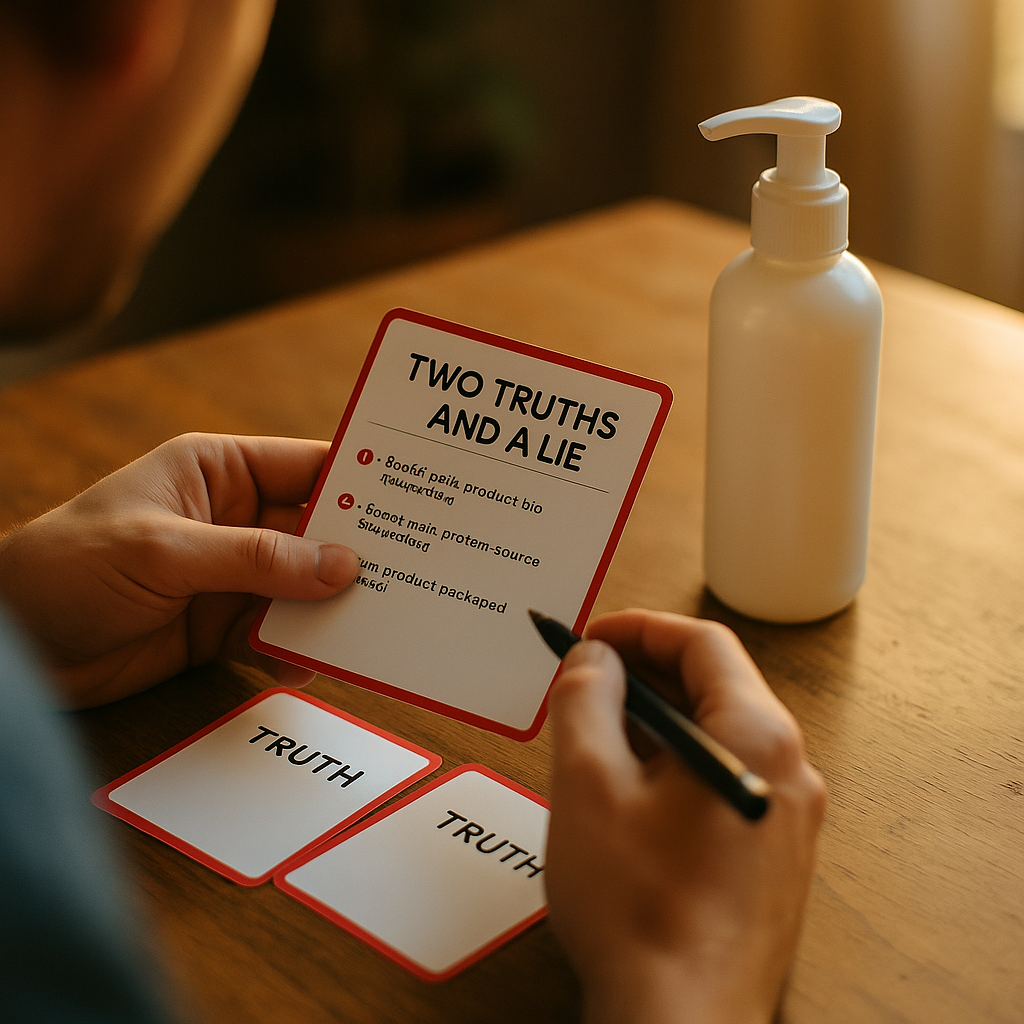
Scroll-stopping content has a 2.3-second window, according to Statista‘s latest attention-span research. So why do most product videos still lead with the pitch? The two-truths-and-a-lie format flips that instinct, forcing viewers to guess before they get sold. It’s one of the sharpest curiosity-gap tools available to brand marketers right now.
The premise is simple. A creator presents three claims about a product. Two are true. One is fabricated, exaggerated, or misleading. Viewers vote, comment, or guess in real time, and the reveal — delivered with proof — becomes the payoff. It’s a game mechanic borrowed from icebreaker culture, repurposed as a conversion engine.
Why This Format Works Better Than a Standard Demo
Traditional product demos tell. This format asks. That distinction matters more than it sounds.
Human brains are wired to close open loops. Psychologists call it the Zeigarnik effect: unfinished tasks stick in memory longer than completed ones. A two-truths-and-a-lie video creates an unresolved question in the first five seconds and holds it until the final beat. That’s why completion rates on this format tend to outperform standard testimonial or unboxing content — viewers stay to find out if they guessed right.
There’s also a trust dividend. When a creator openly admits “one of these is fake,” they’re signaling honesty before the pitch even starts. That’s a sharp contrast to the over-claiming that erodes credibility across creator marketing. Compare it to the psychological groundwork laid in demonstration-first briefs, where skepticism gets addressed head-on rather than glossed over.
A format that admits uncertainty upfront often earns more trust than one that claims total certainty from the first frame.
What Goes Into the Brief
This isn’t a format you hand a creator with a one-line ask. It requires precision, because the stakes are compliance as much as creativity.
- Three claims, vetted by legal/compliance first. Two truths must be independently verifiable — lab results, third-party certifications, sourcing documentation. The “lie” needs to be obviously false once revealed, not a gray-area exaggeration that could itself become a misleading claim.
- A clear reveal mechanism. Specify whether the answer drops via pinned comment, a follow-up video, a link in bio, or an on-screen graphic at the 80% mark. Ambiguity here kills the format’s payoff.
- Disclosure language baked in from frame one. The paid partnership tag isn’t optional flavor text — it’s a FTC requirement, and burying it defeats the format’s trust-building purpose.
- Tone guardrails. Specify whether the creator can improvise the framing of each claim or must read them verbatim. Brand-safe copy for regulated categories (supplements, skincare, financial products) usually needs verbatim language.
- A performance backstop. Require the creator to submit draft claims for approval before filming. Retroactive edits are messy and expensive.
Briefs that skip legal review on the “lie” claim are the single biggest risk factor here. If a viewer screenshots the false claim before the reveal and it circulates without context, you’ve created exactly the kind of misinformation the FTC’s endorsement guidance was built to prevent. Build the takedown-and-correction plan into the brief itself.
Choosing the Right Product Claims to Play With
Not every claim works for this format. The best candidates share three traits: they’re counterintuitive, provable, and low-stakes enough that getting it “wrong” doesn’t damage brand credibility.
A skincare brand might play with “this contains retinol” (true), “this was tested on 200 dermatologists’ own skin” (true, if verifiable), and “this replaces your moisturizer entirely” (false — and clearly flagged as false once revealed, ideally with a dermatologist explaining why). A CPG snack brand might toy with sourcing claims, similar to the transparency work covered in product origin format pieces, where geography and supply chain become the hook.
Avoid claims tied to health outcomes, financial returns, or safety — the categories where a misread “lie” could cause real harm if screenshotted out of context. Save the playful ambiguity for texture, ingredients, price, or manufacturing process. Save the seriousness for anything a regulator would flag.
Platform Mechanics: Where This Format Actually Performs
TikTok and Instagram Reels remain the strongest hosts for this format, largely because their comment sections double as the guessing arena. A pinned comment poll or a Reels “which one is fake?” sticker gives viewers an immediate action, and that action feeds the algorithm’s engagement signals.
YouTube Shorts works too, but the reveal usually needs to happen faster — Shorts audiences have less patience for a slow build than TikTok’s native culture allows. On long-form YouTube, the two-truths format can stretch into a five-to-eight-minute video with B-roll evidence for each claim, which works well for higher-consideration purchases like appliances or supplements where viewers want the receipts.
Livestream shopping formats can absorb this mechanic too. A host can pose the three claims, let live chat vote, then reveal with an on-screen product demo — similar structurally to the interactivity built into shoppable live-commerce briefs. The key difference: the reveal needs a hard cut to proof, not just a verbal confirmation, or you lose the credibility payoff.
Measuring It: What “Working” Actually Looks Like
Vanity metrics won’t tell you if this format is pulling its weight. Track these instead:
- Comment-to-view ratio. Guessing games should spike comments well above your account average — if they don’t, the claims weren’t provocative enough.
- Watch-through to the reveal point. This is the format’s core promise. If viewers are dropping off before the reveal, your setup is too slow or the claims aren’t compelling.
- Save and share rate. Curiosity content tends to get shared as a “guess this” prompt among friends, which is a stronger intent signal than a like.
- Sentiment on the reveal comment thread. Are people saying “I knew it” or “wait, that’s actually wild”? The latter indicates genuine surprise, which correlates with better recall in post-campaign surveys.
According to eMarketer, interactive and gamified content formats are outperforming static posts on engagement rate across most social platforms this year, and the two-truths structure is a direct beneficiary of that shift.
If your comment section isn’t guessing, your claims aren’t tension-worthy enough — go back to the brief before you go back to the creator.
Common Mistakes That Undercut the Format
The most frequent failure is making the lie too obvious. If 95% of viewers guess correctly in the first three seconds, you’ve lost the suspense that makes the format work. The lie needs genuine plausibility — it should sound like something the brand could claim, even if it doesn’t.
The second failure is a weak reveal. Creators sometimes rush the payoff, tacking on “anyway, the fake one was X” without visual proof. That kills the credibility dividend entirely. The reveal deserves as much production care as the setup — treat it the way you’d treat a countdown teaser’s final beat, where anticipation has to land somewhere satisfying.
Third: forgetting to disclose. Some creators treat the guessing-game energy as license to skip the paid partnership tag, assuming the format feels organic enough to bypass FTC requirements. It doesn’t. Every claim-based format involving compensation needs clear, unambiguous disclosure — full stop. For guidance on how other claim-heavy formats handle this, see how split-screen debate briefs manage compliance without sacrificing tension.
A Quick Word on Repeat Use
This format has a shelf life per creator relationship. Run it once and it’s fresh. Run it five times with the same creator and audiences start guessing the pattern — assuming the flashiest claim is always the lie, for instance. Rotate creators, vary the claim order, and occasionally make all three claims true (with a twist reveal explaining why) to keep the format unpredictable. Sprout Social’s engagement benchmarking (sproutsocial.com) suggests novelty fatigue sets in faster on interactive formats than on standard testimonial content, so budget for creative refreshes quarterly rather than annually.
Next step: pull your last quarter’s most-returned or most-questioned product claim, build a three-claim brief around it with legal sign-off, and test the format with one creator before scaling it across your roster.
FAQs
What is the two-truths-and-a-lie content format in influencer marketing?
It’s a creator brief structure where a paid partner presents three claims about a product — two true, one false — and invites the audience to guess before revealing the answer with supporting proof. It’s used to build curiosity and engagement ahead of a product claim reveal.
Is this format compliant with FTC disclosure rules?
Yes, as long as the paid partnership disclosure appears clearly and immediately, not buried after the guessing game. The playful structure doesn’t exempt creators from standard endorsement disclosure requirements under FTC guidance.
What kind of product claims work best for this format?
Counterintuitive, easily provable, low-stakes claims work best — ingredient sourcing, manufacturing quirks, pricing structure, or texture facts. Avoid health, safety, or financial outcome claims where a misread “lie” could cause real confusion if shared out of context.
Which platforms perform best for this format?
TikTok and Instagram Reels tend to perform strongest because their comment sections double as a guessing arena. Long-form YouTube can also work for higher-consideration products that need more evidence per claim.
How do I measure success beyond views?
Track comment-to-view ratio, watch-through rate to the reveal point, save/share rate, and sentiment on the reveal comment thread. These signals indicate genuine curiosity and recall, not just passive viewing.
FAQs
What is the two-truths-and-a-lie content format in influencer marketing?
It’s a creator brief structure where a paid partner presents three claims about a product — two true, one false — and invites the audience to guess before revealing the answer with supporting proof. It’s used to build curiosity and engagement ahead of a product claim reveal.
Is this format compliant with FTC disclosure rules?
Yes, as long as the paid partnership disclosure appears clearly and immediately, not buried after the guessing game. The playful structure doesn’t exempt creators from standard endorsement disclosure requirements under FTC guidance.
What kind of product claims work best for this format?
Counterintuitive, easily provable, low-stakes claims work best — ingredient sourcing, manufacturing quirks, pricing structure, or texture facts. Avoid health, safety, or financial outcome claims where a misread “lie” could cause real confusion if shared out of context.
Which platforms perform best for this format?
TikTok and Instagram Reels tend to perform strongest because their comment sections double as a guessing arena. Long-form YouTube can also work for higher-consideration products that need more evidence per claim.
How do I measure success beyond views?
Track comment-to-view ratio, watch-through rate to the reveal point, save/share rate, and sentiment on the reveal comment thread. These signals indicate genuine curiosity and recall, not just passive viewing.
Top Influencer Marketing Agencies
The leading agencies shaping influencer marketing in 2026
Agencies ranked by campaign performance, client diversity, platform expertise, proven ROI, industry recognition, and client satisfaction. Assessed through verified case studies, reviews, and industry consultations.
Moburst

-
2

The Shelf
Boutique Beauty & Lifestyle Influencer AgencyA data-driven boutique agency specializing exclusively in beauty, wellness, and lifestyle influencer campaigns on Instagram and TikTok. Best for brands already focused on the beauty/personal care space that need curated, aesthetic-driven content.Clients: Pepsi, The Honest Company, Hims, Elf Cosmetics, Pure LeafVisit The Shelf → -
3

Audiencly
Niche Gaming & Esports Influencer AgencyA specialized agency focused exclusively on gaming and esports creators on YouTube, Twitch, and TikTok. Ideal if your campaign is 100% gaming-focused — from game launches to hardware and esports events.Clients: Epic Games, NordVPN, Ubisoft, Wargaming, Tencent GamesVisit Audiencly → -
4

Viral Nation
Global Influencer Marketing & Talent AgencyA dual talent management and marketing agency with proprietary brand safety tools and a global creator network spanning nano-influencers to celebrities across all major platforms.Clients: Meta, Activision Blizzard, Energizer, Aston Martin, WalmartVisit Viral Nation → -
5

The Influencer Marketing Factory
TikTok, Instagram & YouTube CampaignsA full-service agency with strong TikTok expertise, offering end-to-end campaign management from influencer discovery through performance reporting with a focus on platform-native content.Clients: Google, Snapchat, Universal Music, Bumble, YelpVisit TIMF → -
6

NeoReach
Enterprise Analytics & Influencer CampaignsAn enterprise-focused agency combining managed campaigns with a powerful self-service data platform for influencer search, audience analytics, and attribution modeling.Clients: Amazon, Airbnb, Netflix, Honda, The New York TimesVisit NeoReach → -
7

Ubiquitous
Creator-First Marketing PlatformA tech-driven platform combining self-service tools with managed campaign options, emphasizing speed and scalability for brands managing multiple influencer relationships.Clients: Lyft, Disney, Target, American Eagle, NetflixVisit Ubiquitous → -
8

Obviously
Scalable Enterprise Influencer CampaignsA tech-enabled agency built for high-volume campaigns, coordinating hundreds of creators simultaneously with end-to-end logistics, content rights management, and product seeding.Clients: Google, Ulta Beauty, Converse, AmazonVisit Obviously →