


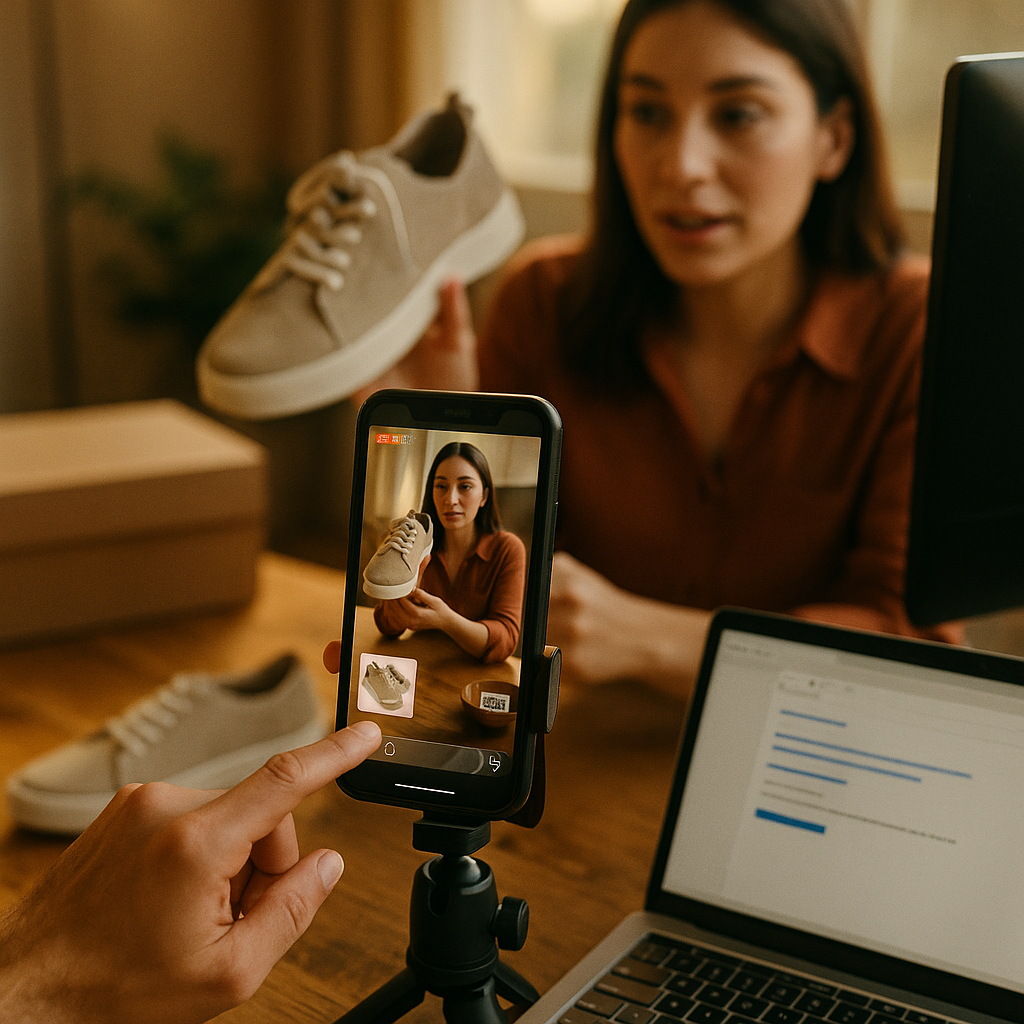
Live shopping generated over $50 billion in China’s market last year, yet most U.S. and European brands still bolt affiliate links onto livestreams as an afterthought. That gap is the opportunity. Shoppable live-commerce only works when the creative brief treats link placement, timing, and disclosure as core production decisions, not post-production patches.
Retail media teams keep asking the same question: why do our livestreams get views but not checkouts? Usually, it’s not the creator. It’s the brief.
Why Most Shoppable Livestreams Underperform
Retail media budgets have shifted hard toward video commerce, but conversion rates lag expectations. The problem is structural. Brands write briefs for content, then ask creators to “add some links” during editing. Links dropped in after the fact rarely align with the emotional peak of a demo, and viewers scroll or tap away before they find the buy button.
Live-commerce demands a different discipline. You’re not briefing a video; you’re briefing a transaction funnel that happens to be entertaining. Every segment needs a purpose: hook, demonstration, objection-handling, and a call-to-action tied to a specific, trackable link. Miss one of those beats and the affiliate link becomes decorative.
A shoppable livestream without a link cadence built into the script is just a video with a shopping cart icon bolted on. The cart icon doesn’t drive sales — timing does.
The Four Elements Every Brief Needs
Whether you’re running on TikTok Shop, Amazon Live, or a retailer’s owned app, the brief should lock down four things before a creator touches a camera:
- Link cadence: exact timestamps or content cues where affiliate links or product tags appear on screen.
- Attribution structure: unique UTM parameters or platform-native tracking IDs per creator, per segment, per SKU.
- Disclosure language: pre-approved phrasing that satisfies FTC endorsement guidelines without sounding like a legal disclaimer read at gunpoint.
- Fallback CTA: what happens when the live link expires or the stream cuts short — a pinned comment, a bio link, a QR code overlay.
Skip any of these and you’re gambling on the creator improvising compliance and commerce simultaneously. That’s a bad bet, especially at scale across dozens of creators.
Link Cadence: The Part Nobody Scripts
Most briefs say “mention the product and link in description.” That’s not a cadence, it’s a hope. A real cadence maps to the stream’s narrative arc: link appears on screen within the first 90 seconds as a soft mention, reappears during the hands-on demo at the emotional high point, then gets a hard CTA repeat in the final two minutes before the stream ends.
Platforms like TikTok Shop and Meta’s shopping tools now support pinned product cards that persist throughout a live session, which removes some of the guesswork. But persistence isn’t the same as prominence. Brief creators to verbally reference the pinned card at specific intervals rather than assuming viewers notice it passively.
Short-Form Isn’t Just a Smaller Livestream
Brands often repurpose livestream clips into short-form without rethinking the link strategy, and it shows. A 45-second Reel or TikTok clip has maybe three seconds to earn attention before the swipe. Affiliate links buried at the 30-second mark are functionally invisible.
For short-form shoppable content, front-load the value proposition. Show the product benefit in the first two seconds, then layer the shopping tag as a persistent on-screen element rather than a mid-roll interruption. This mirrors what worked in our shoppable Reels brief for AR-enabled bookings: attribution has to survive the swipe-away moment, which means tagging needs to happen in the first frame, not the last.
Short-form also compresses your disclosure window. There’s no time for a lengthy spoken disclaimer, so on-screen text disclosure (“#ad” or “Paid partnership” tags) needs to appear immediately and stay visible for the full duration, per FTC guidance on clear and conspicuous disclosure.
Attribution: The Part That Actually Justifies the Budget
Here’s the uncomfortable truth: most retail media teams can’t tell you which creator segment drove which sale in a multi-creator livestream. That’s an attribution failure, not a creative one.
Fix it with segment-level tracking. Assign each creator a unique affiliate code, and if multiple creators appear in a single stream (a format we’ve covered in the two-creator handoff format), assign timestamped sub-codes so you know whether the sale came from the intro host or the guest demo.
Retail media platforms are getting better at this. Amazon Live’s creator dashboard and TikTok Shop’s affiliate center both offer segment-level analytics now, but only if you set up distinct tracking links before the stream, not after. According to eMarketer, live commerce is projected to keep growing as a share of total retail media spend, which makes granular attribution less of a nice-to-have and more of a budget-defense requirement.
If you can’t attribute revenue to a specific creator segment, you can’t justify paying that creator again. Attribution isn’t reporting — it’s the mechanism that keeps your influencer budget alive next quarter.
Building the Brief Template
A workable shoppable live-commerce brief should include:
- Platform-specific technical specs (aspect ratio, max stream length, supported tagging tools)
- A minute-by-minute or beat-by-beat script outline with link cadence marked explicitly
- Unique tracking parameters per creator and per product SKU
- Pre-cleared disclosure copy, positioned and timed
- A contingency plan for stream interruptions, platform glitches, or expired promo codes
- Post-stream clipping guidelines for repurposing into short-form, including where the link/tag moves in the new format
Treat this template the way you’d treat a media plan, not a creative mood board. The creators still bring personality and pacing. But the mechanics of where money changes hands should be non-negotiable, spelled out in writing, and tested before the stream goes live.
Compliance Isn’t Optional, and It’s Not Hard Either
Every affiliate link in a livestream or short-form clip is a paid endorsement, full stop. The FTC has been explicit that live content isn’t exempt from disclosure rules just because it’s ephemeral or “in the moment.” Brands that assume live formats get a compliance pass are setting themselves up for enforcement risk.
Build disclosure into the script itself, not as a caption someone adds later. Our split-screen debate format guide covers how to keep multi-creator content FTC-safe, and the same logic applies here: disclosure language should be baked into the beat sheet, timed to appear alongside every affiliate link mention, not just once at the start.
For UK-facing campaigns, cross-check disclosure requirements against ICO guidance as well, since data handling around affiliate tracking cookies can trigger separate consent obligations.
Production Standards Matter More Than Creative Flair
Shoppable livestreams live or die on technical execution: stream stability, checkout latency, and whether the product tag actually loads before the viewer loses interest. We’ve broken down the baseline requirements in our shoppable livestream production standards piece, and it’s worth reviewing before you greenlight any brief. A gorgeous creative concept means nothing if the buy button takes four seconds to load on mobile data.
Test the full purchase path before the stream airs. Not the demo environment. The actual live link, on the actual platform, on a mid-range Android device with average connectivity. Retail media teams that skip this step are the ones who discover, mid-stream, that the affiliate link redirects to a 404 page.
What Good Looks Like in Practice
Picture a beauty brand running a 30-minute TikTok Shop livestream with two creators. The brief specifies: creator one opens with a hook and soft product mention (link appears on screen at 0:45), creator two joins for a side-by-side demo at the 8-minute mark with a hard CTA repeated every 5 minutes, and the final 3 minutes are dedicated entirely to urgency messaging (“link expires when the stream ends”) with the pinned product card highlighted verbally.
Post-stream, the brand clips the best 45 seconds for TikTok and Instagram, re-tags the link for the front-loaded short-form format, and swaps the disclosure to on-screen text since there’s no time for a spoken version. Every segment has its own tracking code. That’s a brief built for commerce, not just content.
Compare that to a brand that says “go live for 30 minutes, mention the product, drop a link in bio.” One of these gets measurable ROI. The other gets vibes.
Next step: before your next livestream or shoppable short-form drop, rewrite the brief as a beat sheet with link cadence, attribution codes, and disclosure timing built in from the first line, not added in post. That single change will tell you more about what’s actually driving sales than any dashboard will.
FAQs
What makes a livestream “shoppable” versus just a regular live video with a link in the description?
A truly shoppable livestream integrates persistent, on-screen product tags or pinned links that viewers can tap without leaving the stream, paired with a scripted cadence that draws attention to those links at specific moments. A link buried in a description isn’t shoppable in any meaningful sense; it’s just a hidden URL.
How many affiliate links should appear in a single livestream segment?
There’s no universal number, but most effective streams limit active links to one or two featured products per segment. Overloading a stream with simultaneous links dilutes attention and makes attribution messier. Sequence products one at a time, tied to distinct segments of the script.
Do short-form shoppable clips need different disclosure than livestreams?
The underlying FTC requirement is the same: disclosure must be clear and conspicuous. But the execution differs. Livestreams can use spoken disclosure repeated at intervals, while short-form clips typically rely on persistent on-screen text since there’s less time and the format is often watched with sound off.
Which platforms currently support the best native tools for shoppable live-commerce?
TikTok Shop, Amazon Live, and Meta’s shopping tools on Instagram and Facebook currently offer the most mature creator-facing affiliate tracking and pinned product card features. Retailer-owned apps are catching up but often require custom integration work with a retail media platform.
How do we handle attribution when a livestream features multiple creators?
Assign each creator a unique affiliate code, and if possible, layer in timestamped sub-codes tied to specific segments of the stream. This lets you distinguish which creator or moment actually drove the sale, which is essential for renewing or reallocating budget across a creator roster.
FAQs
What makes a livestream “shoppable” versus just a regular live video with a link in the description?
A truly shoppable livestream integrates persistent, on-screen product tags or pinned links that viewers can tap without leaving the stream, paired with a scripted cadence that draws attention to those links at specific moments. A link buried in a description isn’t shoppable in any meaningful sense; it’s just a hidden URL.
How many affiliate links should appear in a single livestream segment?
There’s no universal number, but most effective streams limit active links to one or two featured products per segment. Overloading a stream with simultaneous links dilutes attention and makes attribution messier. Sequence products one at a time, tied to distinct segments of the script.
Do short-form shoppable clips need different disclosure than livestreams?
The underlying FTC requirement is the same: disclosure must be clear and conspicuous. But the execution differs. Livestreams can use spoken disclosure repeated at intervals, while short-form clips typically rely on persistent on-screen text since there’s less time and the format is often watched with sound off.
Which platforms currently support the best native tools for shoppable live-commerce?
TikTok Shop, Amazon Live, and Meta’s shopping tools on Instagram and Facebook currently offer the most mature creator-facing affiliate tracking and pinned product card features. Retailer-owned apps are catching up but often require custom integration work with a retail media platform.
How do we handle attribution when a livestream features multiple creators?
Assign each creator a unique affiliate code, and if possible, layer in timestamped sub-codes tied to specific segments of the stream. This lets you distinguish which creator or moment actually drove the sale, which is essential for renewing or reallocating budget across a creator roster.
Top Influencer Marketing Agencies
The leading agencies shaping influencer marketing in 2026
Agencies ranked by campaign performance, client diversity, platform expertise, proven ROI, industry recognition, and client satisfaction. Assessed through verified case studies, reviews, and industry consultations.
Moburst

-
2

The Shelf
Boutique Beauty & Lifestyle Influencer AgencyA data-driven boutique agency specializing exclusively in beauty, wellness, and lifestyle influencer campaigns on Instagram and TikTok. Best for brands already focused on the beauty/personal care space that need curated, aesthetic-driven content.Clients: Pepsi, The Honest Company, Hims, Elf Cosmetics, Pure LeafVisit The Shelf → -
3

Audiencly
Niche Gaming & Esports Influencer AgencyA specialized agency focused exclusively on gaming and esports creators on YouTube, Twitch, and TikTok. Ideal if your campaign is 100% gaming-focused — from game launches to hardware and esports events.Clients: Epic Games, NordVPN, Ubisoft, Wargaming, Tencent GamesVisit Audiencly → -
4

Viral Nation
Global Influencer Marketing & Talent AgencyA dual talent management and marketing agency with proprietary brand safety tools and a global creator network spanning nano-influencers to celebrities across all major platforms.Clients: Meta, Activision Blizzard, Energizer, Aston Martin, WalmartVisit Viral Nation → -
5

The Influencer Marketing Factory
TikTok, Instagram & YouTube CampaignsA full-service agency with strong TikTok expertise, offering end-to-end campaign management from influencer discovery through performance reporting with a focus on platform-native content.Clients: Google, Snapchat, Universal Music, Bumble, YelpVisit TIMF → -
6

NeoReach
Enterprise Analytics & Influencer CampaignsAn enterprise-focused agency combining managed campaigns with a powerful self-service data platform for influencer search, audience analytics, and attribution modeling.Clients: Amazon, Airbnb, Netflix, Honda, The New York TimesVisit NeoReach → -
7

Ubiquitous
Creator-First Marketing PlatformA tech-driven platform combining self-service tools with managed campaign options, emphasizing speed and scalability for brands managing multiple influencer relationships.Clients: Lyft, Disney, Target, American Eagle, NetflixVisit Ubiquitous → -
8

Obviously
Scalable Enterprise Influencer CampaignsA tech-enabled agency built for high-volume campaigns, coordinating hundreds of creators simultaneously with end-to-end logistics, content rights management, and product seeding.Clients: Google, Ulta Beauty, Converse, AmazonVisit Obviously →