


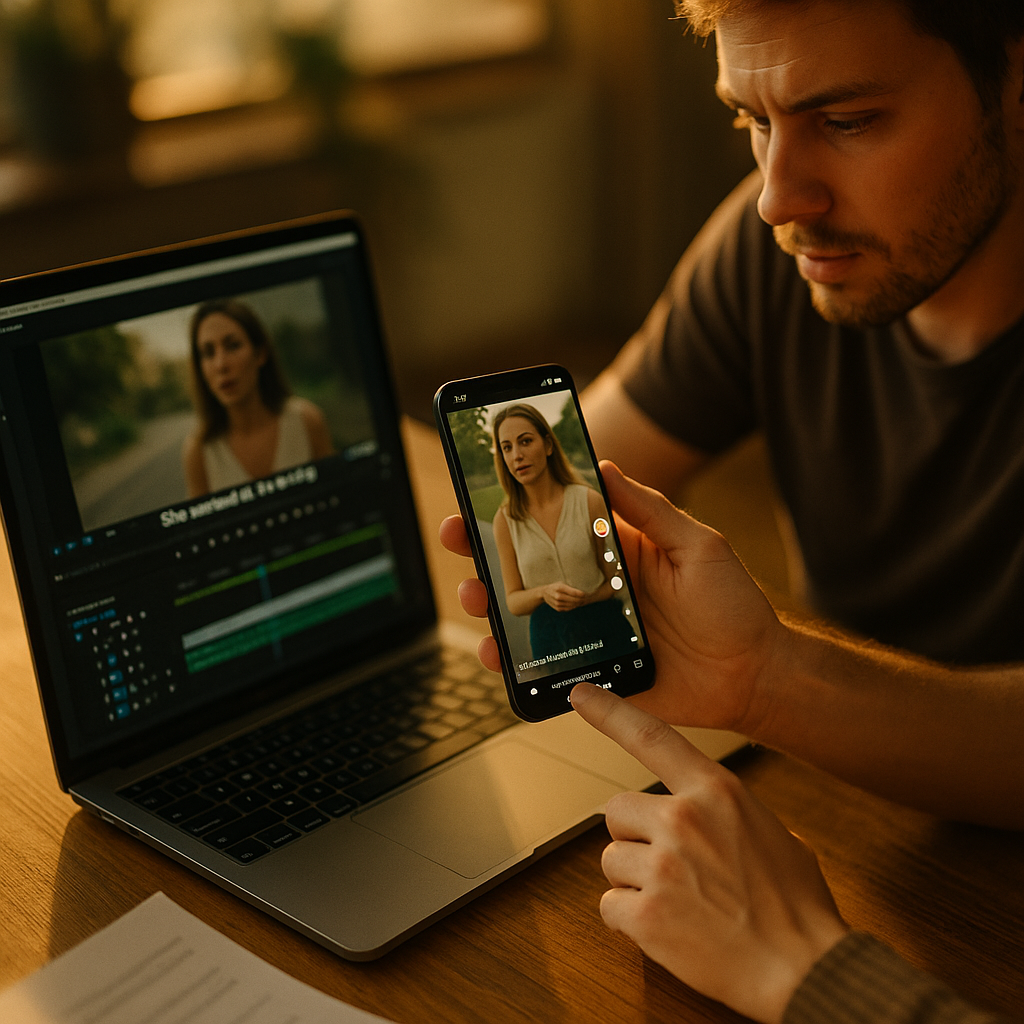
Nearly 85% of Facebook video views happen without sound, and TikTok’s own creator tools now default to auto-captions on almost every upload. So why are most brand briefs still written for voiceover-first storytelling? The silent subtitle story format flips that assumption, using only on-screen text to carry a full narrative arc, no narration, no talking head, just words doing the emotional heavy lifting.
Why Silence Is Becoming a Deliberate Creative Choice
Muted-first viewing isn’t new. What’s new is creators treating silence as a format, not a fallback. The silent subtitle story format asks a creator to build tension, humor, or a plot twist entirely through paced text overlays, sometimes paired with ambient sound or trending audio, but never dependent on a voice explaining the joke.
Think of it as visual storytelling stripped down to captions and cuts. No host walking you through it. The text itself becomes the character.
For brands, this matters because it solves a real distribution problem: sound-off environments (office scrolling, public transit, workplace breaks) still dominate a huge share of mobile video consumption. A format built for silence performs consistently regardless of context. That’s not a nice-to-have, that’s reach you’re currently leaving on the table.
The Format in Practice
A typical silent subtitle arc follows a three or four-beat structure, similar to what we’ve seen work in countdown-to-launch teaser formats, but compressed into text pacing instead of visual reveals:
- Setup text: A short line establishing context or a relatable problem (“POV: you just found out your skincare routine was backwards.”)
- Escalation text: Building tension or stakes, often with comedic timing through delayed captions.
- Turn: The product or brand moment, delivered as a reveal, not a pitch.
- Resolution/CTA: A closing line that’s more punchline than sales copy.
The pacing is everything. Text appearing a half-second too early kills the joke. Too late, and viewers scroll past before the payoff lands. This is choreography, not just captioning.
Silent subtitle storytelling isn’t about removing sound, it’s about removing dependency on sound. The best examples still use music or ambient audio; they just never require a voiceover to make sense.
What Makes This Different From Standard Captioning
Every creator adds captions now. Platforms practically demand it for accessibility and algorithmic favor, and TikTok’s own advertising resources recommend on-screen text for exactly that reason. But standard captioning is transcription. Silent subtitle storytelling is direction.
The difference is intent. A captioned video assumes someone might also be listening. A true silent subtitle piece is built assuming they won’t be, and every creative decision, timing, font size, word choice, flows from that assumption.
This changes what you’re briefing for. You’re not asking a creator to “add captions to their usual video.” You’re asking them to storyboard a narrative where text is the primary performer. It’s closer to directing a silent film than producing a talking-head UGC ad.
Where the Format Wins (and Where It Doesn’t)
Silent subtitle formats perform especially well for:
- Relatable problem/solution narratives (skincare, home organization, personal finance apps)
- Comedic brand moments where timing matters more than explanation
- Product reveals that benefit from suspense, similar to the pacing logic in slow-reveal booking formats used in travel content
- Cross-market content, since text can be swapped for localization without a full reshoot
Where it struggles: highly technical explanations, regulated claims requiring precise spoken disclosure, or anything needing nuance that’s hard to compress into short caption bursts. If your product story needs a demo walkthrough, pair this format with something like demonstration-first briefs instead of forcing silence where clarity should win.
Briefing Creators for Narrative, Not Just Captions
Here’s where most brands get it wrong: they hand creators a script and say “just add text instead of talking.” That produces flat, literal videos. Good silent subtitle content requires a different kind of brief, one built around beats, not bullet points.
Your brief should specify:
- The emotional arc, not just the message. What should the viewer feel at second three versus second twelve?
- Pacing cues, even loosely. “Let the reveal breathe for a beat before the CTA text appears.”
- Tone of the text itself. Dry humor reads differently in caption form than in spoken delivery, and creators need room to write in their own voice.
- What NOT to over-explain. Silent formats rely on implication. Overwritten captions kill the format’s appeal.
Give creators creative latitude on wording. You’re briefing structure, not dialogue. This is similar to how mockumentary-style briefs work, you set the frame, the creator fills it with authentic voice.
Compliance Doesn’t Disappear Just Because There’s No Voice
This is the part brands underestimate. Silence doesn’t remove disclosure obligations. If anything, it makes them easier to miss. The FTC’s endorsement guidance applies regardless of whether disclosure is spoken or written, but on-screen disclosures need to be legible, unambiguous, and not buried in a fast caption sequence.
Practical rules for silent subtitle briefs:
- Disclosure text (“#ad” or “Paid partnership with…”) must appear early, not just in a corner during the final second.
- Font size and contrast need to meet basic legibility, not just look aesthetically minimal.
- If claims are made in text form (efficacy, pricing, comparisons), they carry the same substantiation requirements as spoken claims.
This is the same logic we’ve covered in split-screen debate compliance guidance: creative novelty is never a shield against disclosure rules. Brief it in writing, review drafts before posting, and don’t assume “it’s just text” means it’s lower risk. Legal teams should treat this format with the same scrutiny as spoken-ad content.
Measuring Performance: What Actually Moves
Standard engagement metrics still apply, but silent subtitle content tends to show specific patterns worth tracking:
- Completion rate often outperforms voiceover content because text-paced videos train viewers to keep watching for the next line.
- Rewatch rate can spike when jokes or reveals land on a delay, viewers replay to catch what they missed.
- Sound-on vs. sound-off view splits, available through platform analytics, help confirm whether the format is actually reaching muted audiences at scale.
Platforms like Sprout Social and native analytics dashboards can help isolate these patterns against your voiceover-based content for a fair comparison. Don’t just compare against average benchmarks, compare against your own historical formats to see if silence is genuinely lifting completion and shares.
If your silent subtitle content isn’t outperforming voiceover content on completion rate, the pacing is off, not the concept.
Production Realities Brands Should Plan For
This format is cheaper to produce in some ways (no audio recording, less need for a quiet filming environment) but it demands more in post. Text timing has to be edited frame-by-frame in some cases. Creators who are strong on-camera talkers aren’t automatically strong silent-format editors. Vet for editing skill, not just charisma.
Budget conversations should reflect this. A few extra hours of caption-timing revision is a fair ask, and smart brands build a revision round into the rate rather than treating it as scope creep.
It’s also worth testing formats across regions. Because there’s no spoken language dependency, silent subtitle content travels well internationally with simple text swaps, a genuine cost advantage over dubbed or re-voiced localized content. According to eMarketer, short-form video consumption continues rising across nearly every major market, making format portability a real budget lever, not just a nice theoretical benefit.
FAQs
Frequently Asked Questions
What is the silent subtitle story format?
It’s a video content style where the entire narrative, setup, tension, reveal, and resolution, is delivered through paced on-screen text rather than spoken voiceover or dialogue.
Why are brands using this format instead of standard captions?
Standard captions assume a viewer might listen. Silent subtitle storytelling assumes they won’t, and is built from the ground up for sound-off viewing, which still represents a huge share of mobile video consumption.
Does this format still require FTC disclosure?
Yes. Disclosure requirements apply regardless of whether the content uses voice or text. Disclosure text must appear early and be clearly legible, not buried in a fast-paced caption sequence.
What content types work best for silent subtitle storytelling?
Relatable problem/solution narratives, comedic brand moments, and suspense-driven product reveals tend to perform best. Highly technical or regulated claims usually need spoken or demonstration-based formats instead.
How should brands brief creators for this format?
Brief the emotional arc and pacing beats, not a literal script. Specify what shouldn’t be over-explained, since the format relies on implication, and give creators freedom over exact wording and tone.
Next step: pick one existing voiceover-based creator asset, strip the audio, rebuild it as a paced text narrative, and A/B test completion rates before scaling the format across your next campaign brief.
Top Influencer Marketing Agencies
The leading agencies shaping influencer marketing in 2026
Agencies ranked by campaign performance, client diversity, platform expertise, proven ROI, industry recognition, and client satisfaction. Assessed through verified case studies, reviews, and industry consultations.
Moburst

-
2

The Shelf
Boutique Beauty & Lifestyle Influencer AgencyA data-driven boutique agency specializing exclusively in beauty, wellness, and lifestyle influencer campaigns on Instagram and TikTok. Best for brands already focused on the beauty/personal care space that need curated, aesthetic-driven content.Clients: Pepsi, The Honest Company, Hims, Elf Cosmetics, Pure LeafVisit The Shelf → -
3

Audiencly
Niche Gaming & Esports Influencer AgencyA specialized agency focused exclusively on gaming and esports creators on YouTube, Twitch, and TikTok. Ideal if your campaign is 100% gaming-focused — from game launches to hardware and esports events.Clients: Epic Games, NordVPN, Ubisoft, Wargaming, Tencent GamesVisit Audiencly → -
4

Viral Nation
Global Influencer Marketing & Talent AgencyA dual talent management and marketing agency with proprietary brand safety tools and a global creator network spanning nano-influencers to celebrities across all major platforms.Clients: Meta, Activision Blizzard, Energizer, Aston Martin, WalmartVisit Viral Nation → -
5

The Influencer Marketing Factory
TikTok, Instagram & YouTube CampaignsA full-service agency with strong TikTok expertise, offering end-to-end campaign management from influencer discovery through performance reporting with a focus on platform-native content.Clients: Google, Snapchat, Universal Music, Bumble, YelpVisit TIMF → -
6

NeoReach
Enterprise Analytics & Influencer CampaignsAn enterprise-focused agency combining managed campaigns with a powerful self-service data platform for influencer search, audience analytics, and attribution modeling.Clients: Amazon, Airbnb, Netflix, Honda, The New York TimesVisit NeoReach → -
7

Ubiquitous
Creator-First Marketing PlatformA tech-driven platform combining self-service tools with managed campaign options, emphasizing speed and scalability for brands managing multiple influencer relationships.Clients: Lyft, Disney, Target, American Eagle, NetflixVisit Ubiquitous → -
8

Obviously
Scalable Enterprise Influencer CampaignsA tech-enabled agency built for high-volume campaigns, coordinating hundreds of creators simultaneously with end-to-end logistics, content rights management, and product seeding.Clients: Google, Ulta Beauty, Converse, AmazonVisit Obviously →