


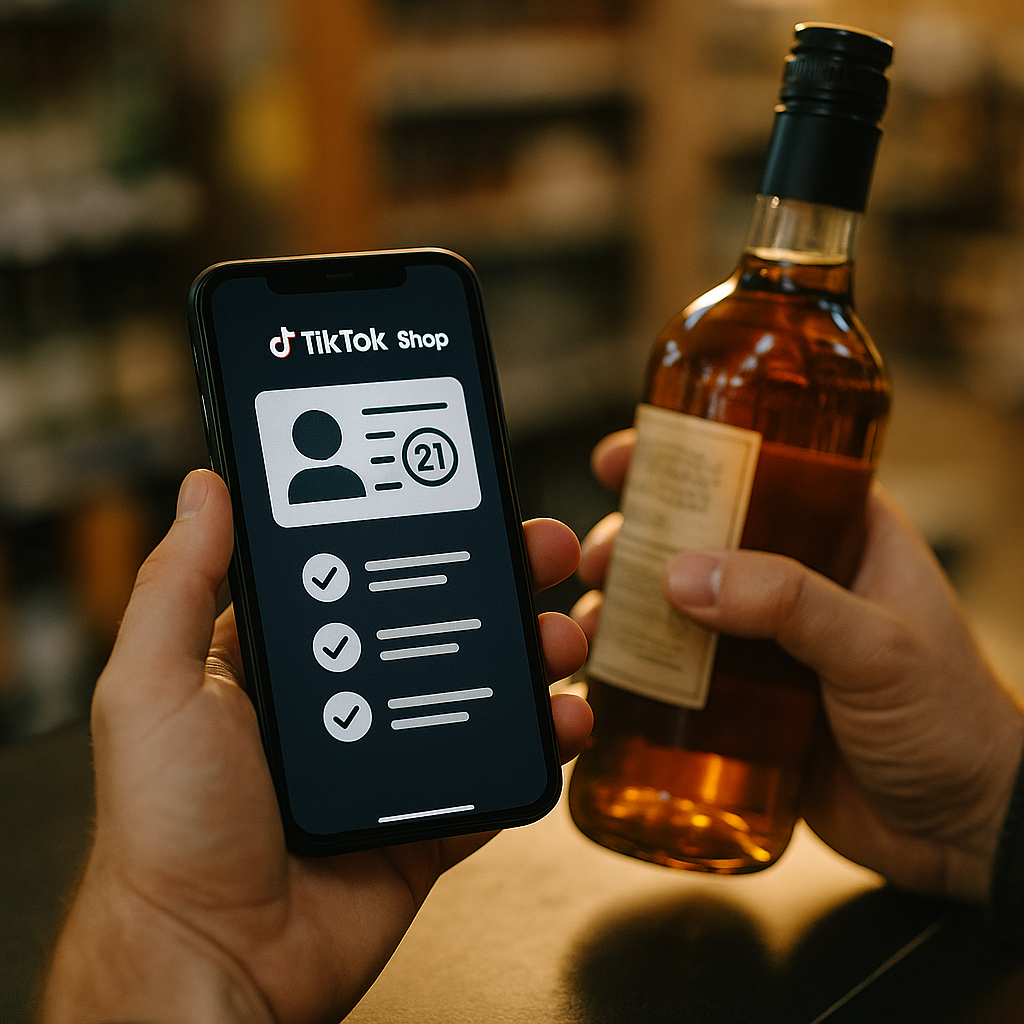
One failed ID check can freeze an entire beverage catalog. That’s the reality beverage brands face under TikTok Shop’s new alcohol age-verification system, a three-stage gate that now sits between every bottle and every buyer. Get it wrong, and you’re not just losing a sale — you’re risking your entire Shop’s selling privileges.
For alcohol brands, TikTok Shop was supposed to be the unlock: a native checkout, a built-in creator funnel, and a Gen Z-adjacent audience finally old enough to buy. But the platform has spent the past year tightening compliance after regulatory pressure from state attorneys general and industry watchdogs questioning how easily minors could reach age-restricted products through livestream commerce. The result is a verification architecture that’s more rigorous than anything alcohol e-commerce has seen on a social platform before.
This guide breaks down the three-stage check, what it means operationally, and how brands should restructure their TikTok Shop setup to stay compliant without tanking conversion.
Why TikTok Built a Three-Stage Gate, Not a Single Popup
Most platforms treat age verification as a formality — a checkbox, a birthdate field, done. TikTok Shop’s alcohol category doesn’t work that way anymore. The platform now requires verification at three separate checkpoints: account-level age attestation, point-of-sale ID confirmation, and delivery-time proof of age. Each stage exists to close a different loophole regulators flagged.
The account-level check catches users who never should have reached alcohol listings in the first place. The point-of-sale check confirms the person completing checkout is the same age-verified account holder, not a shared device or a younger sibling grabbing a parent’s phone. And the delivery-time check — the newest layer — shifts liability to the last mile, requiring couriers or fulfillment partners to confirm ID matches the order before handoff.
Brands that treat delivery-stage verification as “the logistics partner’s problem” are the ones getting suspended fastest — TikTok holds the merchant account responsible regardless of who drops the package.
This mirrors a broader shift in social commerce: platforms are pushing compliance obligations down to brands rather than absorbing the risk themselves, similar to how TikTok’s merchant IP verification rules shifted onboarding burden onto sellers.
Stage One: Account-Level Age Attestation
Before a user ever sees an alcohol listing, TikTok now requires an age attestation gate tied to the account itself, not just a one-time popup per session. This is a persistent flag stored against the user profile.
Here’s what that means practically for brands:
- Alcohol listings are automatically hidden from accounts that haven’t completed attestation, which shrinks your addressable audience until users opt in.
- Brands can’t bypass this with creative workarounds like “mocktail” framing or ambiguous product naming — TikTok’s classification system flags ABV content and alcohol-adjacent keywords regardless of how the product is marketed.
- Accounts flagged as under 21 (or the local legal drinking age) are permanently blocked from the category, not just temporarily restricted.
The practical takeaway: your top-of-funnel content strategy needs to account for a smaller addressable pool than other categories. Don’t benchmark alcohol campaign reach against beauty or apparel numbers on the platform. It’s an apples-to-oranges comparison, and marketers who don’t adjust expectations upward in leadership reporting end up explaining “underperformance” that isn’t actually underperformance.
Stage Two: Point-of-Sale ID Confirmation
This is where most of the friction — and most of the drop-off — happens. At checkout, TikTok Shop now requires a live ID scan or third-party verification handoff (TikTok has partnered with identity verification vendors similar to those used in fintech onboarding) before the order can process.
Brands don’t build this themselves. It’s baked into TikTok Shop’s checkout flow for any SKU tagged in the alcohol category. But brands do control how they prepare customers for it, and that preparation matters more than most beverage marketers realize.
Cart abandonment at the ID-scan step is running notably higher than standard checkout abandonment, based on early merchant feedback shared in TikTok Shop seller forums. Users don’t expect to pull out a driver’s license mid-scroll. If your product page and creator content don’t set that expectation upfront, you’re losing sales to surprise friction rather than genuine disinterest.
Set expectations in the caption, not just the checkout screen. Brands that mention “ID verification required at checkout” in creator captions see meaningfully lower cart abandonment than those that don’t, according to early merchant testing shared across TikTok Shop seller communities.
Practical fixes:
- Brief creators to mention the ID check naturally in video captions or verbal call-outs, similar to how disclosure language gets woven into hooks in buy-moment caption strategies on other platforms.
- Add a line to product descriptions: “Age verification required at checkout per TikTok Shop policy.”
- Test whether pinning a comment explaining the ID step reduces confusion-driven abandonment on your top-performing videos.
Stage Three: Delivery-Time Proof, the Stage Most Brands Ignore
This is the newest and least understood layer. TikTok now requires last-mile confirmation that the person accepting delivery is age-verified, either through courier-scanned ID or a signature-matched confirmation code tied to the original checkout identity.
Why does this matter so much? Because it’s the stage most likely to trigger a merchant-level compliance strike, not just a failed transaction. If your fulfillment partner isn’t equipped to handle ID-at-door verification, every failed delivery attempt logs against your Shop’s compliance score. Enough failures, and TikTok can suspend alcohol category access entirely, sometimes for the whole account, not just the beverage listings.
Brands running their own fulfillment need to audit courier contracts now, not after a suspension notice. Ask directly: does this courier support ID-scan-at-delivery for age-restricted goods, and do they log it in a format TikTok’s compliance API can ingest? If the answer is unclear, you have a gap.
Third-party logistics providers built for beverage alcohol (think platforms already handling direct-to-consumer wine and spirits shipping across state lines) are generally further ahead here than general-purpose courier networks. That’s worth the premium if your current 3PL can’t answer the question above with confidence.
What This Means for Creator Briefs and Affiliate Structures
Alcohol creator partnerships already carry more legal weight than most influencer deals, given FTC disclosure rules and state-level alcohol advertising restrictions. The three-stage check adds an operational layer on top of the legal one.
Creator briefs for alcohol brands on TikTok Shop should now include:
- Explicit instruction to avoid implying the product ships instantly or without verification, a claim that will generate customer complaints when the ID step surprises them.
- Age-verification language woven into the required disclosure block, alongside standard #ad tagging.
- Clear guardrails on audience targeting, since creators skew younger than the legal drinking age in many niches, and TikTok’s own account-level attestation won’t stop a creator from posting content that implicitly targets an underage audience.
This is also reshaping affiliate payout structures. Several beverage brands are moving toward hybrid models that reward creators partly on verified completed sales rather than raw click volume, since a chunk of clicks will fail to convert at the ID-scan stage regardless of creator quality. That mirrors the shift already happening across TikTok’s broader affiliate ecosystem, detailed in TikTok Shop affiliate deal structures and the platform’s move toward hybrid payout models more broadly.
Compliance Isn’t Optional Overhead, It’s a Retention Strategy
It’s tempting to treat all this as friction that hurts conversion. Flip that framing. Brands that lean into transparent verification messaging are seeing something interesting: verified customers convert at higher repeat-purchase rates than the industry average for social commerce, based on early merchant data shared informally in TikTok’s beverage seller cohort discussions. Once someone clears all three stages, they’re a genuinely qualified customer, not a bounce-prone browser.
That’s a retention asset, not a liability. Treat your verified customer list like the high-intent segment it is. Build post-purchase flows, loyalty incentives, and repeat-order prompts specifically for users who’ve already cleared the full verification stack. They’ve done the hard part. Don’t waste that.
Regulatory pressure on alcohol advertising isn’t easing up either. The FTC has signaled continued scrutiny of influencer disclosure practices in restricted categories, and state alcohol boards are increasingly asking platforms for verification audit trails. Brands that treat this three-stage system as a compliance floor, not a ceiling, will be better positioned when the next round of scrutiny arrives. Data from eMarketer continues to show social commerce growth outpacing traditional e-commerce, which means more regulatory eyes on exactly this kind of transaction, not fewer.
Building the Internal Playbook
Practically, here’s the rollout sequence brand teams should follow before scaling alcohol SKUs on TikTok Shop:
- Audit your current fulfillment partner’s ID-at-delivery capability and get written confirmation of compliance API support.
- Rewrite creator briefs to include verification-stage messaging as a required, not optional, disclosure element.
- Add verification-expectation language to every product listing and top-performing organic video caption.
- Rebuild affiliate payout math around verified-sale conversion rates rather than raw click-through, since the three-stage gate structurally lowers click-to-sale ratios versus non-restricted categories.
- Stand up a post-verification retention flow to capture lifetime value from the customers who clear the full gate.
None of this is a one-time setup. TikTok has adjusted alcohol compliance rules multiple times in the past eighteen months, and there’s no reason to expect that to slow down. Build a quarterly review into your compliance calendar, not just a launch checklist.
The brands winning in this category right now aren’t the ones with the flashiest creator content. They’re the ones whose operations team read the fine print before the marketing team built the campaign.
The Next Move
Don’t launch another alcohol SKU on TikTok Shop until your fulfillment partner can confirm, in writing, that they support ID-at-delivery logging compatible with TikTok’s compliance API. Everything else in this playbook is optimization; that one item is the gate that determines whether you keep selling at all.
Frequently Asked Questions
What is TikTok Shop’s three-stage alcohol age-verification process?
It’s a compliance system requiring age confirmation at three separate points: account-level attestation before alcohol listings become visible, point-of-sale ID confirmation during checkout, and delivery-time proof of age when the courier hands off the package.
Does TikTok require brands to build their own ID verification tools?
No. TikTok Shop handles account and checkout-level verification through built-in identity vendors. Brands are responsible for ensuring their fulfillment or courier partners can complete the delivery-stage check and report it back to TikTok’s compliance system.
Why is cart abandonment higher for alcohol listings on TikTok Shop?
The point-of-sale ID scan surprises many customers who don’t expect to verify identity mid-checkout. Brands that clearly flag the verification requirement in product descriptions and creator captions see lower abandonment rates.
Can creators promote alcohol brands to any TikTok audience?
No. Creator content promoting alcohol must avoid targeting or implicitly appealing to underage audiences, and briefs should include age-verification disclosure language alongside standard sponsorship tags to stay aligned with FTC guidance.
What happens if a beverage brand fails delivery-stage verification too often?
Repeated failures at the delivery stage log against the merchant’s compliance score and can trigger suspension of alcohol category access, and in some cases broader Shop selling privileges, regardless of which courier handled the delivery.
Frequently Asked Questions
FAQs
Top Influencer Marketing Agencies
The leading agencies shaping influencer marketing in 2026
Agencies ranked by campaign performance, client diversity, platform expertise, proven ROI, industry recognition, and client satisfaction. Assessed through verified case studies, reviews, and industry consultations.
Moburst

-
2

The Shelf
Boutique Beauty & Lifestyle Influencer AgencyA data-driven boutique agency specializing exclusively in beauty, wellness, and lifestyle influencer campaigns on Instagram and TikTok. Best for brands already focused on the beauty/personal care space that need curated, aesthetic-driven content.Clients: Pepsi, The Honest Company, Hims, Elf Cosmetics, Pure LeafVisit The Shelf → -
3

Audiencly
Niche Gaming & Esports Influencer AgencyA specialized agency focused exclusively on gaming and esports creators on YouTube, Twitch, and TikTok. Ideal if your campaign is 100% gaming-focused — from game launches to hardware and esports events.Clients: Epic Games, NordVPN, Ubisoft, Wargaming, Tencent GamesVisit Audiencly → -
4

Viral Nation
Global Influencer Marketing & Talent AgencyA dual talent management and marketing agency with proprietary brand safety tools and a global creator network spanning nano-influencers to celebrities across all major platforms.Clients: Meta, Activision Blizzard, Energizer, Aston Martin, WalmartVisit Viral Nation → -
5

The Influencer Marketing Factory
TikTok, Instagram & YouTube CampaignsA full-service agency with strong TikTok expertise, offering end-to-end campaign management from influencer discovery through performance reporting with a focus on platform-native content.Clients: Google, Snapchat, Universal Music, Bumble, YelpVisit TIMF → -
6

NeoReach
Enterprise Analytics & Influencer CampaignsAn enterprise-focused agency combining managed campaigns with a powerful self-service data platform for influencer search, audience analytics, and attribution modeling.Clients: Amazon, Airbnb, Netflix, Honda, The New York TimesVisit NeoReach → -
7

Ubiquitous
Creator-First Marketing PlatformA tech-driven platform combining self-service tools with managed campaign options, emphasizing speed and scalability for brands managing multiple influencer relationships.Clients: Lyft, Disney, Target, American Eagle, NetflixVisit Ubiquitous → -
8

Obviously
Scalable Enterprise Influencer CampaignsA tech-enabled agency built for high-volume campaigns, coordinating hundreds of creators simultaneously with end-to-end logistics, content rights management, and product seeding.Clients: Google, Ulta Beauty, Converse, AmazonVisit Obviously →