


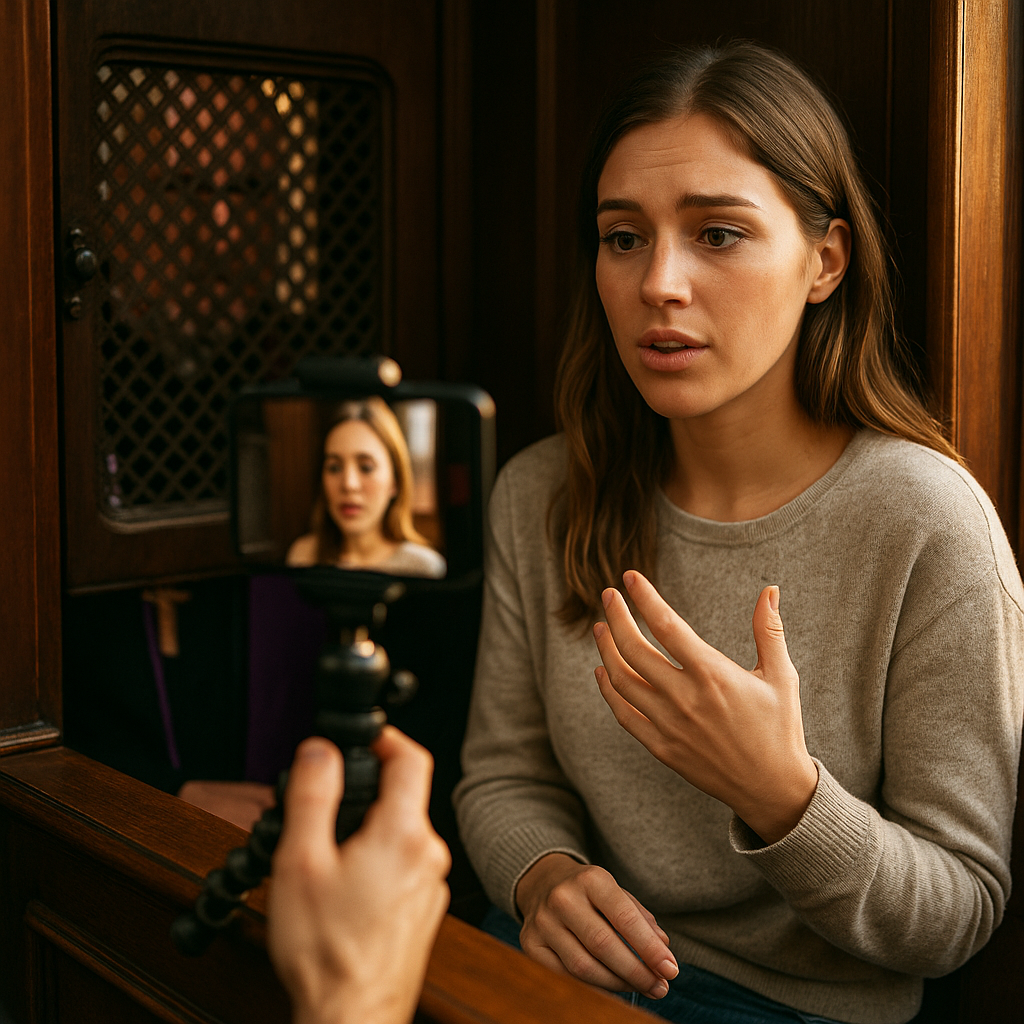
Viewers scroll past polished testimonials in under two seconds. But a shaky, badly-lit “interview” where someone seems to admit something? That gets watched to the end. The confession-booth format — a faux-interview product reaction shot to look like an unscripted sit-down — is quietly becoming one of the highest-retention UGC styles brands brief in 2026. Here’s how to build the creative brief without faking your way into an FTC problem.
Why This Format Works When Polished Testimonials Don’t
Think about the last “customer testimonial” ad you actually watched all the way through. Struggling to remember one? That’s the problem brands are trying to solve. Audiences have developed an almost involuntary skepticism toward anything that smells like a script. The confession-booth format borrows visual language from documentary filmmaking and reality TV: a single subject, direct-to-camera, minimal set dressing, slightly imperfect lighting. It reads as testimony, not advertising, even when it’s entirely brand-directed.
The psychology is simple. Confession-booth interviews (a staple of shows like Big Brother and The Office) signal privacy and honesty. When a creator looks slightly off-camera, pauses before answering, or admits something mildly unflattering (“I almost didn’t buy this because I thought it was a gimmick”), viewers register it as more credible than a straight pitch. Sprout Social’s research on social content trust signals consistently finds that perceived authenticity, not production value, drives engagement and purchase intent.
The format’s power isn’t the confession itself — it’s the illusion of a question being asked off-camera, which makes the answer feel earned rather than delivered.
The Core Brief: What to Actually Ask For
A confession-booth brief is deceptively simple to write and easy to get wrong. The goal is structured spontaneity: real enough to feel unscripted, controlled enough to stay on-message and compliant. Here’s the skeleton brands should hand creators.
- Setting: A neutral, slightly intimate background — a bedroom corner, car interior, bathroom mirror, closet. Avoid studio backdrops entirely; they kill the illusion instantly.
- Framing: Tight chest-up shot, handheld or slightly off-level. Perfect symmetry reads as produced, which is exactly what you’re avoiding.
- Implied interviewer: Creator should look just off-lens, as if responding to someone asking questions, not performing to an audience.
- Question prompts (not scripts): Give creators 4-6 open prompts — “What almost stopped you from trying this?” “What did you expect versus what happened?” “Would you tell a friend, honestly?” — and let them answer in their own words.
- Pacing: Include at least one pause, one self-correction, one moment of genuine hesitation. Editors should resist the urge to cut these out.
Notice what’s missing: a script. That’s intentional. The moment a creator recites brand copy in this format, the illusion collapses and the video reads as an ad in the worst possible way — one pretending not to be.
Prompt Design Is the Whole Game
Most brands over-brief the visuals and under-brief the questions. Flip that ratio. The prompts you give creators determine whether the output feels like testimony or like a hostage read. Good prompts are specific enough to stay on-brand but open enough to allow real disagreement or nuance. “Tell me about the packaging” produces nothing. “What’s one thing you’d change if you could?” produces gold — and it’s more persuasive precisely because it’s not 100% positive.
This mirrors a pattern seen across other UGC formats built on emotional realism. The reverse unboxing format works for similar reasons: showing friction or imperfection builds more trust than showing none. Brands that mandate five-star-only messaging in confession-booth briefs are missing the point of the format entirely.
Disclosure: The Part Brands Try to Skip
Here’s where marketing and legal teams need to be in the same room before a single camera rolls. A confession-booth video is still a paid endorsement if the brand initiated it, gifted product, or paid a fee — full stop. The “unscripted” aesthetic doesn’t exempt it from FTC disclosure requirements. If anything, the format’s realism raises the compliance stakes, because viewers are more likely to mistake it for organic opinion.
The fix is straightforward and non-negotiable: a clear, unambiguous disclosure — “#ad” or “Paid partnership with [Brand]” — placed in the first three seconds of on-screen text and repeated in the caption. Don’t bury it in a hashtag pile at the end of the caption. Don’t rely on platform-native paid partnership tags alone; the FTC has been explicit that they’re not always sufficient on their own.
Brands that have navigated this tension before know the playbook. The same logic underpins the ghost ad confession format and the broader ghost ad redemption arc: formats built on perceived candor need the strongest disclosure discipline, not the weakest, because audience trust is exactly what’s on the line if it later reads as deceptive.
Realism and compliance aren’t in tension. The riskiest confession-booth videos are the ones that hide the paid relationship — because that’s the exact moment “feels unscripted” becomes “was deceptive.”
Casting: Who Actually Pulls This Off
Not every creator can sell hesitation convincingly. Some are naturally performative and can’t dial it down; others are so flat they read as bored, not honest. When casting for this format, screen for creators who already do direct-to-camera storytime content organically — they’ve built the muscle for unscripted-feeling delivery because it’s their native format, not a stretch.
Micro and nano creators often outperform bigger names here, partly because their existing audience already expects lower production value from them. A confession-booth video from a creator with 8,000 followers and a shaky ring light reads as more credible than the same script delivered by someone with a full production team. This is the same dynamic driving success in nano-creator aisle tours and grocery-aisle walkthrough briefs: audience trust often scales inversely with production polish.
What to Put in the Casting Call
- Ask for a sample “unscripted reaction” clip, not a polished demo reel.
- Prioritize creators who already post confessional or storytime-style content.
- Avoid creators whose feed is entirely produced, high-gloss content — the tonal mismatch will show.
- Request raw, unedited footage submission so your team (not the creator) controls final pacing and cuts.
Editing Without Killing the Illusion
This is where brands most often ruin a good brief. Editors, trained to tighten everything, instinctively cut pauses, remove “ums,” and smooth out tonal shifts. Resist that instinct here. A confession-booth edit should feel like a documentary editor’s cut, not a commercial editor’s cut: a few jump cuts for time, but the awkward pauses and half-finished thoughts stay.
Music should be minimal or absent. A gentle ambient bed at most — nothing that signals “produced content.” Captions should be simple, burned-in text, not animated brand-style typography. Every polish decision either supports or undermines the format’s central promise: this looks real.
Length matters too. Most high-performing confession-booth clips run 20-45 seconds — long enough to include a real pause and a real turn in the narrative, short enough to hold attention through a full watch. Compare this to formats built for longer arcs, like the origin-to-launch micro-documentary, where a slower build is the point. Confession-booth content front-loads intimacy; it doesn’t have the runway for a slow build.
Measuring What Actually Matters
Standard vanity metrics undersell this format. Watch-through rate and comment sentiment matter more than raw view count. If comments include phrases like “wait is this an ad?” or “she seems so real,” that’s a signal the format landed — and also a cue to double-check your disclosure placement, since confusion about paid status is a compliance flag, not just a creative win.
eMarketer’s ongoing research on creator content performance has repeatedly found that completion rate correlates more strongly with purchase intent than impressions or likes for testimonial-style formats. Track it. Report it up. It’s a better story for your CMO than reach alone.
For brands running multiple creators against the same brief, treat confession-booth content as one format in a broader content system rather than a one-off. It pairs well with structured multi-format shoots — see how one shoot, three formats or the package-deal creative brief approach stretch a single session into multiple deliverables, since confession-booth footage can also be recut into shorter testimonial snippets for paid social.
Start small: brief one creator, give them four open prompts instead of a script, and measure watch-through rate against your last polished testimonial. The gap will make the case for scaling the format better than any deck could.
FAQs
What is the confession-booth format in influencer marketing?
It’s a UGC style where a creator delivers a product reaction as a direct-to-camera, faux-interview response, designed to look unscripted and documentary-style rather than produced or scripted.
Is the confession-booth format FTC compliant?
It can be, but only with clear, unambiguous paid partnership disclosure placed early in the video and repeated in the caption. The realistic style doesn’t reduce disclosure obligations under FTC guidelines — if anything, it raises the bar since viewers are more likely to mistake it for organic content.
Should creators use a script for confession-booth videos?
No. Scripts undermine the format’s core value. Brands should provide open-ended prompts and key messaging points instead, letting creators answer in their own words to preserve the unscripted feel.
What size creators work best for this format?
Micro and nano creators often perform best because their existing content already features lower production value, making the confessional style feel native rather than staged.
How long should a confession-booth video be?
Most effective clips run 20-45 seconds, long enough to include a genuine pause or hesitation but short enough to sustain a full watch-through.
How is this different from a standard testimonial video?
Standard testimonials are typically scripted, well-lit, and framed like an ad. Confession-booth videos deliberately use imperfect framing, implied off-camera questions, and unscripted pacing to feel like documentary footage rather than marketing.
Top Influencer Marketing Agencies
The leading agencies shaping influencer marketing in 2026
Agencies ranked by campaign performance, client diversity, platform expertise, proven ROI, industry recognition, and client satisfaction. Assessed through verified case studies, reviews, and industry consultations.
Moburst

-
2

The Shelf
Boutique Beauty & Lifestyle Influencer AgencyA data-driven boutique agency specializing exclusively in beauty, wellness, and lifestyle influencer campaigns on Instagram and TikTok. Best for brands already focused on the beauty/personal care space that need curated, aesthetic-driven content.Clients: Pepsi, The Honest Company, Hims, Elf Cosmetics, Pure LeafVisit The Shelf → -
3

Audiencly
Niche Gaming & Esports Influencer AgencyA specialized agency focused exclusively on gaming and esports creators on YouTube, Twitch, and TikTok. Ideal if your campaign is 100% gaming-focused — from game launches to hardware and esports events.Clients: Epic Games, NordVPN, Ubisoft, Wargaming, Tencent GamesVisit Audiencly → -
4

Viral Nation
Global Influencer Marketing & Talent AgencyA dual talent management and marketing agency with proprietary brand safety tools and a global creator network spanning nano-influencers to celebrities across all major platforms.Clients: Meta, Activision Blizzard, Energizer, Aston Martin, WalmartVisit Viral Nation → -
5

The Influencer Marketing Factory
TikTok, Instagram & YouTube CampaignsA full-service agency with strong TikTok expertise, offering end-to-end campaign management from influencer discovery through performance reporting with a focus on platform-native content.Clients: Google, Snapchat, Universal Music, Bumble, YelpVisit TIMF → -
6

NeoReach
Enterprise Analytics & Influencer CampaignsAn enterprise-focused agency combining managed campaigns with a powerful self-service data platform for influencer search, audience analytics, and attribution modeling.Clients: Amazon, Airbnb, Netflix, Honda, The New York TimesVisit NeoReach → -
7

Ubiquitous
Creator-First Marketing PlatformA tech-driven platform combining self-service tools with managed campaign options, emphasizing speed and scalability for brands managing multiple influencer relationships.Clients: Lyft, Disney, Target, American Eagle, NetflixVisit Ubiquitous → -
8

Obviously
Scalable Enterprise Influencer CampaignsA tech-enabled agency built for high-volume campaigns, coordinating hundreds of creators simultaneously with end-to-end logistics, content rights management, and product seeding.Clients: Google, Ulta Beauty, Converse, AmazonVisit Obviously →