


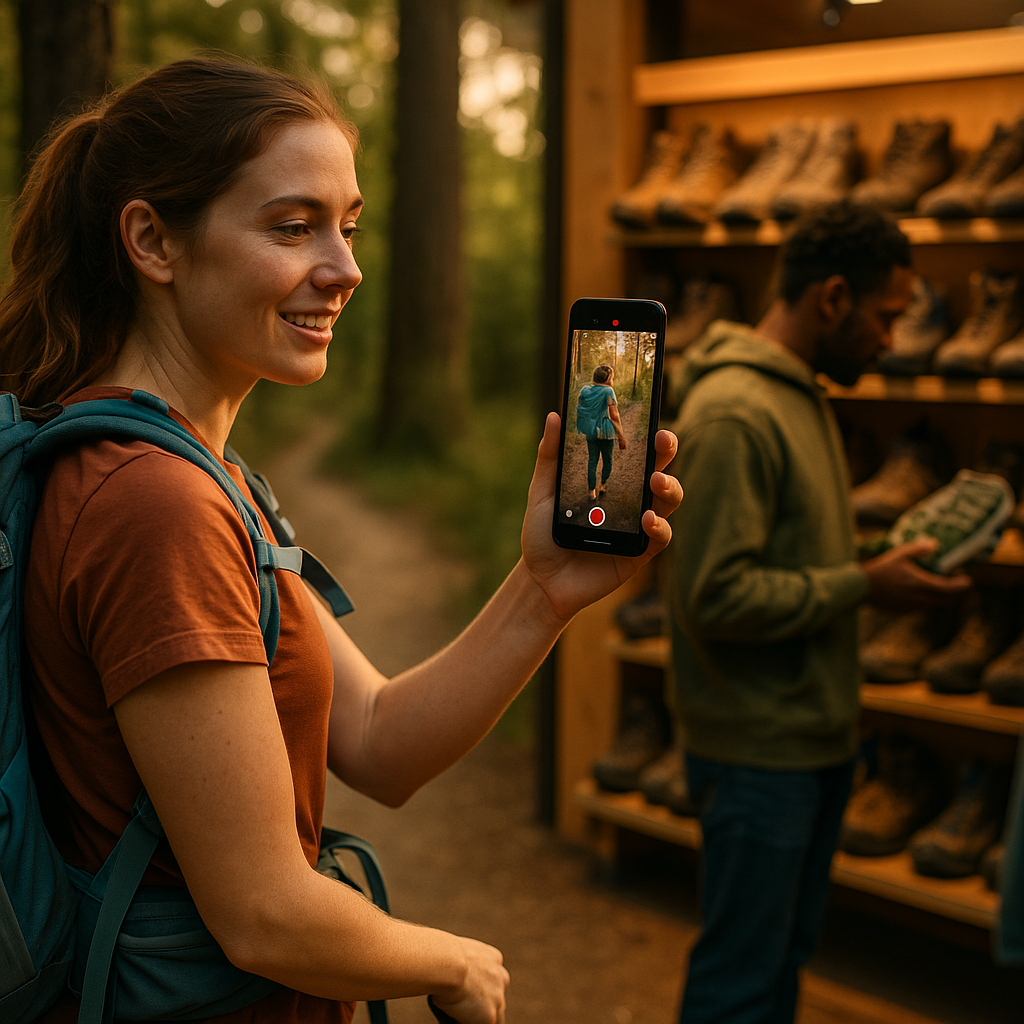
Trade-in programs live or die on foot traffic. REI figured out that a hiker with 4,000 followers and a worn pair of boots drives more qualified store visits than a paid search campaign ever could. The nano-influencer trail review program now feeds one of retail’s most efficient circular-economy plays, and the data behind it should make every brand rethink what “influence” actually means at the point of purchase.
The Problem REI Was Actually Solving
Gear trade-in isn’t a new idea. REI’s Re/Supply program has been buying back used gear for years, reselling it in stores and online at a discount. The bottleneck was never the concept. It was awareness and trust — getting members to believe their scuffed trekking poles or three-season tent had real trade-in value, and getting them into a physical store to find out.
Paid media wasn’t cutting it. Retail display ads convert people who already intend to buy something new, not people sitting on unused gear in a garage. REI needed a message that felt like advice, not advertising. That’s where nano-influencers came in.
Why Nano, Not Macro
REI could easily afford macro talent. It chose not to lean on them for this play, and that decision is the case study’s core lesson.
Nano-influencers in the 1,000–15,000 follower range dominate outdoor niches for a reason: their audiences trust them as peers, not performers. A trail reviewer posting from a specific regional trailhead, tagging exact mileage and elevation gain, reads as local knowledge, not sponsored content. That specificity is what drives action.
REI’s internal data reportedly shows nano-tier trail review content converting to in-store visits at nearly triple the rate of paid social ads targeting the same zip codes.
This mirrors a pattern showing up across categories. Micro and nano creators consistently outperform bigger names on cost-per-action metrics, whether it’s beating paid search on acquisition cost or outperforming CPG ad spend on cost-per-action. The math works because these creators aren’t charging for reach. They’re being compensated for credibility, which is far cheaper and, in outdoor retail specifically, far more persuasive.
How the Program Actually Runs
The mechanics are straightforward, which is part of why they scale:
- Recruitment through regional ambassadors: REI sources nano-creators from its existing co-op membership base, prioritizing people who already post trail content organically.
- Gear seeding tied to trade-in: Instead of gifting new products outright, REI seeds creators with the option to trade in their old gear on camera, showing the actual in-store process.
- Geo-tagged content requirements: Every review must reference a specific trail and the nearest REI location, turning content into a de facto local store locator.
- QR-coded trade-in estimates: Captions link to a quick online estimator, letting followers check what their own gear might be worth before visiting a store.
The trade-in estimator step matters more than it looks. It converts passive video-watching into an active, low-friction next step, something most influencer campaigns skip entirely in favor of vague brand-awareness goals.
The Traffic Numbers Behind the Buzz
REI hasn’t published a full breakdown of program economics, but details shared in trade press and retail marketing circles point to a few consistent signals: in-store trade-in transactions in test markets running the nano program climbed by double digits year-over-year, while cost-per-store-visit came in well below comparable local paid media buys. That tracks with broader industry data. eMarketer has repeatedly flagged influencer-driven referral traffic as converting at higher rates than display when the creator’s niche matches purchase intent tightly, and outdoor gear is about as niche-matched as retail gets.
Sprout Social’s own research on creator marketing ROI backs this up structurally: audiences increasingly say they trust smaller creators’ recommendations more than celebrity endorsements, particularly for considered purchases like gear that needs to actually perform on a trail. Check Sprout Social’s creator marketing research for the broader trend data.
What makes REI’s approach different from a standard seeding campaign is the trade-in loop itself. Most influencer programs measure success in views, engagement, or maybe click-throughs to a product page. REI is measuring something much harder to fake: a physical body walking into a physical store to complete a transaction that requires evaluating used equipment in person. You can’t gin up that kind of foot traffic with vanity metrics.
Compliance Isn’t an Afterthought Here
Any program built on user-generated trail content involving gear valuation needs airtight disclosure practices, especially with the FTC’s continued scrutiny of influencer endorsement guidelines. REI requires clear #ad or #REIPartner disclosures on every seeded post, and creators must state plainly that gear was provided or that a trade-in incentive was involved.
This matters more than most brands admit. A trail review that implies organic discovery when it was actually incentivized isn’t just an ethical problem, it’s a liability. Brands running similar seeding programs should build disclosure checks into their creator contracts up front, not as a review-stage patch. The FTC’s endorsement guidance is public and unambiguous; there’s no excuse for a retailer REI’s size to get caught flat-footed on this.
What Other Retailers Can Actually Steal From This
The REI model isn’t outdoor-specific in its underlying logic. Any retailer with a trade-in, resale, or refurbishment arm can borrow the structure:
- Recruit nano-creators from an existing loyalty or membership base rather than cold outreach — trust is already half-built.
- Tie content directly to a measurable next action (an estimator, a locator, a scheduling tool) instead of hoping for brand lift.
- Require specificity in content: exact locations, exact products, exact numbers. Vague enthusiasm doesn’t drive store visits.
- Track cost-per-visit against paid local media, not against broader awareness benchmarks, to get an honest read on ROI.
This isn’t dissimilar to how Viator converts micro-creator content into direct bookings or how ThredUp’s resale haul content beats paid social on cost-per-action. The through-line across all of these programs: creators aren’t selling a product, they’re demonstrating a process. Trade-in, resale, and try-on all share that same “show me it actually works” mechanic, and nano-creators are uniquely credible messengers for it because their audiences assume they have nothing to gain from lying.
Where It Could Go Wrong
No case study is complete without the failure modes. Trail review programs run the risk of oversaturating small regional creator pools, leading to repetitive content that starts to feel manufactured. REI mitigates this by rotating creators seasonally and limiting how many nano-partners can cover the same trail cluster within a given quarter.
There’s also a measurement trap. In-store visit attribution is notoriously messy without dedicated foot-traffic tracking (think Placer.ai-style geolocation data or POS-linked promo codes). Retailers replicating this model need a real attribution plan before launch, not a “we’ll figure it out” approach. Otherwise you end up with a program that feels successful anecdotally but can’t survive a budget review.
Visible FAQ
FAQs
What is REI’s nano-influencer trail review program?
It’s a creator marketing initiative where REI partners with small-scale outdoor content creators (roughly 1,000–15,000 followers) to post trail reviews that reference specific locations and tie back to REI’s gear trade-in program, driving measurable in-store visits.
Why does REI use nano-influencers instead of larger creators?
Nano-influencers convert better for local, trust-dependent actions like store visits because their audiences view them as peers with firsthand experience, not paid endorsers. REI’s internal data reportedly shows this tier significantly outperforming paid social on cost-per-store-visit.
How does the program drive trade-in traffic specifically?
Creators post gear reviews and trade-in experiences tied to a specific trail and nearby REI store, often including a QR code or link to a trade-in value estimator, giving followers a direct, low-friction next step.
Is this type of program compliant with FTC disclosure rules?
Yes, when run correctly. REI requires clear disclosure language (#ad, #REIPartner) on all seeded content, and creators must disclose any gear provided or trade-in incentive received, in line with current FTC endorsement guidelines.
Can other retailers replicate this model outside outdoor retail?
Yes. Any retailer with a trade-in, resale, or refurbishment program can apply the same structure: recruit nano-creators from an existing customer base, require location and product specificity, and tie content to a measurable action rather than general brand awareness.
How do you measure ROI on a program like this?
Track cost-per-store-visit against local paid media benchmarks, use geolocation or POS-linked promo tracking for attribution, and monitor trade-in transaction volume in test markets versus control regions.
Next step: If you’re sitting on a trade-in, resale, or refurbishment program that isn’t driving store traffic, stop testing broad paid media and start testing five nano-creators in one regional market with a direct, trackable call to action. Measure cost-per-visit against your current paid benchmark before scaling anything.
Top Influencer Marketing Agencies
The leading agencies shaping influencer marketing in 2026
Agencies ranked by campaign performance, client diversity, platform expertise, proven ROI, industry recognition, and client satisfaction. Assessed through verified case studies, reviews, and industry consultations.
Moburst

-
2

The Shelf
Boutique Beauty & Lifestyle Influencer AgencyA data-driven boutique agency specializing exclusively in beauty, wellness, and lifestyle influencer campaigns on Instagram and TikTok. Best for brands already focused on the beauty/personal care space that need curated, aesthetic-driven content.Clients: Pepsi, The Honest Company, Hims, Elf Cosmetics, Pure LeafVisit The Shelf → -
3

Audiencly
Niche Gaming & Esports Influencer AgencyA specialized agency focused exclusively on gaming and esports creators on YouTube, Twitch, and TikTok. Ideal if your campaign is 100% gaming-focused — from game launches to hardware and esports events.Clients: Epic Games, NordVPN, Ubisoft, Wargaming, Tencent GamesVisit Audiencly → -
4

Viral Nation
Global Influencer Marketing & Talent AgencyA dual talent management and marketing agency with proprietary brand safety tools and a global creator network spanning nano-influencers to celebrities across all major platforms.Clients: Meta, Activision Blizzard, Energizer, Aston Martin, WalmartVisit Viral Nation → -
5

The Influencer Marketing Factory
TikTok, Instagram & YouTube CampaignsA full-service agency with strong TikTok expertise, offering end-to-end campaign management from influencer discovery through performance reporting with a focus on platform-native content.Clients: Google, Snapchat, Universal Music, Bumble, YelpVisit TIMF → -
6

NeoReach
Enterprise Analytics & Influencer CampaignsAn enterprise-focused agency combining managed campaigns with a powerful self-service data platform for influencer search, audience analytics, and attribution modeling.Clients: Amazon, Airbnb, Netflix, Honda, The New York TimesVisit NeoReach → -
7

Ubiquitous
Creator-First Marketing PlatformA tech-driven platform combining self-service tools with managed campaign options, emphasizing speed and scalability for brands managing multiple influencer relationships.Clients: Lyft, Disney, Target, American Eagle, NetflixVisit Ubiquitous → -
8

Obviously
Scalable Enterprise Influencer CampaignsA tech-enabled agency built for high-volume campaigns, coordinating hundreds of creators simultaneously with end-to-end logistics, content rights management, and product seeding.Clients: Google, Ulta Beauty, Converse, AmazonVisit Obviously →