


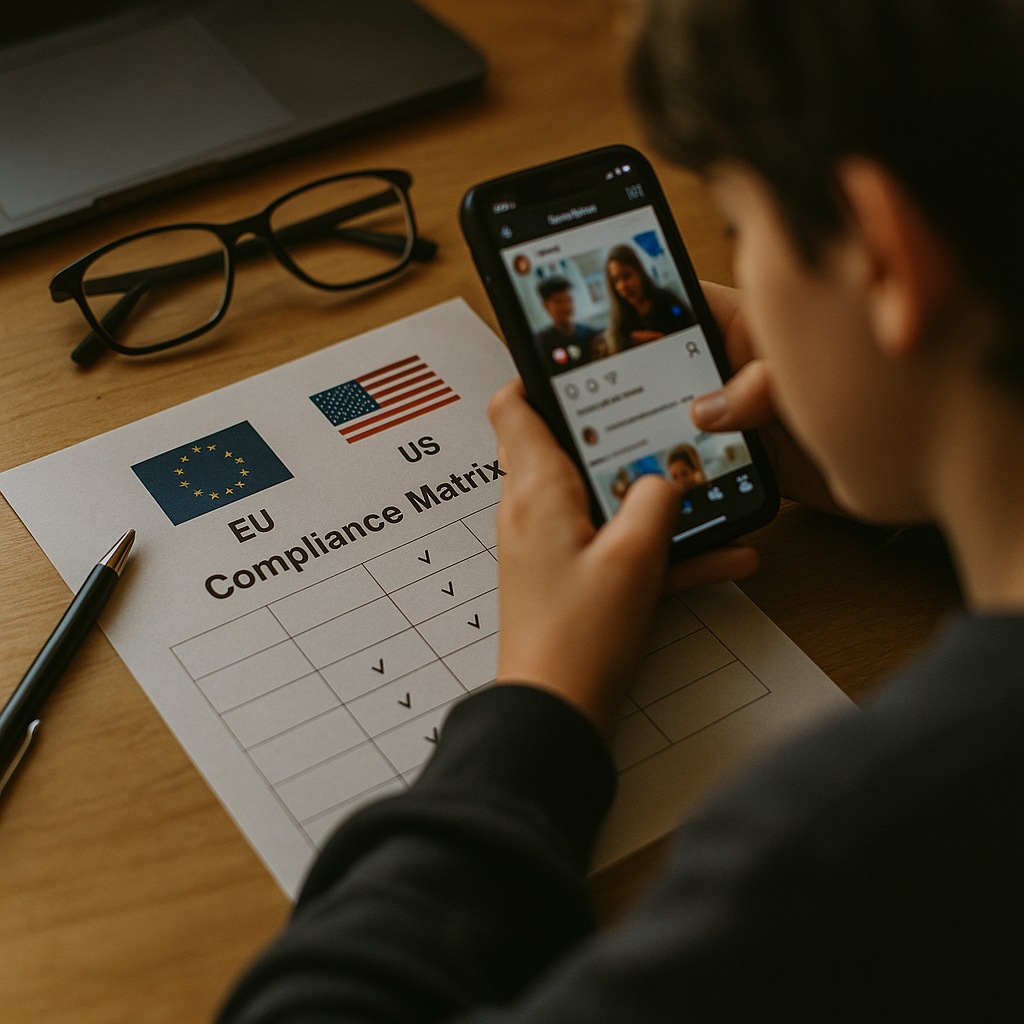
One rule says infinite scroll is a design defect. Another says it’s just Tuesday. Welcome to running a youth-facing influencer campaign in 2026, where the EU Digital Services Act addictive-design enforcement collides head-on with a patchwork of US state social media laws, and brands are stuck building creative that survives both.
Regulators aren’t waiting for consensus. The European Commission has already flagged platform features like autoplay, infinite feeds, and streak mechanics as potential DSA violations tied to minor protection. Meanwhile, states from Utah to New York have passed their own, often contradictory, youth social media statutes. If your brand runs pan-regional or global youth campaigns, you’re now designing for the strictest common denominator, whether legal wants to admit that or not.
What the DSA Actually Targets in Addictive Design
The Digital Services Act doesn’t use the word “addictive” casually. Article 28 requires platforms to ensure a high level of privacy, safety, and security for minors, and regulators have interpreted that to include design patterns that exploit developmental vulnerabilities. Think variable reward loops, endless scroll without natural stopping points, and notification systems tuned to pull kids back in during school hours.
The European Commission’s investigations into major platforms (TikTok among them) have specifically probed recommender systems that may keep minors engaged longer than intended. Fines under the DSA can reach 6% of global annual turnover, which gets a CMO’s attention fast. But here’s the catch for brand marketers: the DSA regulates platforms, not brands directly. Your exposure comes indirectly, through campaign placement, creator content formats, and whether your paid amplification leans into the very mechanics regulators are targeting.
If your youth campaign relies on streak-based challenges or algorithmic loop content to drive engagement, you’re now adjacent to the exact behavior the DSA is trying to dismantle, even if your brand isn’t the one being fined.
US State Laws Are Not One Law
This is where things get genuinely messy. Unlike the DSA’s single framework, the US approach is fifty potential rulebooks. Utah’s Social Media Regulation Act requires parental consent and curfew-style access restrictions for minors. Arkansas and Ohio have pushed similar age-verification mandates, several tied up in litigation. New York’s SAFE for Kids Act targets addictive feeds specifically, restricting algorithmic content delivery to minors without parental consent, echoing DSA logic more closely than any other state law.
California’s Age-Appropriate Design Code, modeled loosely on the UK’s approach, adds another layer: default high-privacy settings, data minimization, and design assessments for products likely to be accessed by minors. Some of these laws are enjoined or under appeal right now. NetChoice has successfully challenged several state statutes on First Amendment grounds, and that litigation risk means the legal landscape you’re planning for could shift mid-campaign.
So when a global brand asks “what’s the youth social media compliance standard in the US,” the honest answer is: it depends which state, which platform, and which week’s court ruling you’re checking.
Where the Two Frameworks Actually Overlap
Despite different legal architectures, the DSA and the more aggressive US state laws converge on a few practical points that make a workable compliance baseline possible.
- Algorithmic curation limits: Both New York’s SAFE Act and DSA guidance push toward chronological or non-personalized feeds as a default for minors.
- Notification and engagement caps: Restrictions on push notifications during night hours or school hours appear in both Utah-style laws and DSA minor-protection guidance.
- Design transparency: Both frameworks increasingly require documentation showing you assessed whether your content or campaign mechanics could be addictive or manipulative to minors.
- Parental or age verification signals: Even where methods differ, both regimes assume some verification layer exists upstream, which affects how you target and measure youth-adjacent campaigns.
That overlap is your starting point. Build to it first, then layer in jurisdiction-specific extras rather than starting from scratch for each market.
Building One Compliance Matrix Instead of Fifty
Trying to maintain separate creative and targeting rules for the EU, Utah, New York, California, and every other jurisdiction is operationally unsustainable. Most brand compliance teams we talk to are moving toward a single global matrix, weighted toward the strictest applicable rule per content mechanic, similar to how EU AI Act and US deepfake law reconciliation has already forced brands to think in unified frameworks rather than region-by-region patches.
A practical matrix should map: content mechanic (streaks, countdowns, algorithmic recommendation, gamified rewards) against jurisdiction, flag which regions restrict or ban it for minor-facing content, and assign a global fallback rule. If New York restricts algorithmic delivery to minors and the DSA discourages the same, your global default becomes non-personalized delivery for any campaign with meaningful youth reach, full stop. You adjust upward for regions with lighter rules, not the other way around.
This is also where creator brief language earns its keep. If a creator’s format leans on urgency (“only 3 left,” countdown timers, streak challenges), that same scarcity logic already draws FTC scrutiny domestically. The scarcity claims compliance checklist built for livestream shopping applies almost directly to youth-facing addictive-design review, since both hinge on manipulative urgency mechanics.
Age Signals Are the Real Bottleneck
Every framework, DSA or state law, assumes you know who your audience actually is. Most brands don’t, not with precision. Platform-reported age data is self-declared and famously unreliable; TikTok, Instagram, and YouTube all acknowledge gaps between declared age and actual age.
This creates a documentation problem more than a targeting problem. Regulators want to see that you made a reasonable effort to assess audience composition and adjusted creative accordingly, not that you achieved perfect age verification (which, frankly, nobody has). Build an audit trail showing your reasoning: audience data reviewed, mechanics flagged, adjustments made. That paper trail matters as much as the campaign output itself.
Teams already building audit trails for AI marketing decisions have a head start here. The same logging discipline, timestamped decisions, documented rationale, version history, translates directly into DSA and state-law defensibility if a campaign gets flagged post-launch.
Practical Steps for the Next Campaign Cycle
- Inventory every content mechanic in your youth-adjacent creator briefs (streaks, countdowns, algorithmic push, gamification) and score each against DSA and the strictest active US state law.
- Default to non-personalized, non-gamified delivery for any campaign where under-18 reach exceeds a defined threshold (many brands use 5-10% as a trigger for enhanced review).
- Require creators to disclose format mechanics in advance, not just sponsorship, so legal can review engagement design alongside disclosure compliance, similar to how creator compliance dashboards already flag disclosure gaps.
- Document age-assessment reasoning even when perfect verification isn’t feasible. Reasonable effort, recorded clearly, is your defense posture.
- Route any campaign with cross-border youth reach through a single escalation point rather than separate regional sign-offs, mirroring the structure in an FTC compliance escalation matrix.
None of this eliminates risk entirely. NetChoice litigation could reshape several state laws within the year, and the European Commission’s DSA enforcement priorities will keep evolving as more investigations conclude. But a matrix-based approach means you’re not rebuilding your compliance posture every time a new ruling drops. You’re adjusting inputs to a system that already assumes fragmentation.
For deeper context on how regulators define manipulative design at the platform level, the European Commission’s DSA resources and the FTC’s guidance on children’s online protections are worth bookmarking alongside your internal matrix. Industry benchmarking from eMarketer also tracks how platforms are adjusting default settings for minors region by region, which affects your baseline targeting assumptions every quarter.
Frequently Asked Questions
FAQs
Does the DSA apply to brands running influencer campaigns, or only to platforms?
The DSA’s direct obligations fall on platforms, not brands. But brands face indirect exposure through campaign placement, creator content formats, and reputational risk if their content amplifies mechanics regulators flag as addictive or exploitative toward minors.
Which US state social media laws are currently enforceable?
This changes frequently due to litigation. Several state laws, including provisions in Utah and Arkansas, have faced injunctions following NetChoice challenges. Always verify current enforcement status before finalizing campaign targeting rules, since a law being passed doesn’t mean it’s currently in effect.
What counts as “addictive design” under these frameworks?
Common flagged mechanics include infinite scroll without stopping cues, variable reward notifications, streak-based engagement loops, autoplay defaults, and algorithmic recommendation systems that maximize time-on-platform for minors without parental controls.
How can brands verify audience age without full platform-level verification?
Perfect verification isn’t realistic today. Best practice is documenting reasonable assessment: reviewing platform-reported demographic data, flagging campaigns with meaningful youth reach, and adjusting creative mechanics accordingly, then logging that reasoning for audit purposes.
Should global brands build separate campaigns for EU and US youth audiences?
Most compliance teams are moving away from that model toward a single global matrix that defaults to the strictest applicable rule per content mechanic, then adjusts upward only where local rules are more permissive. It’s more efficient and reduces the risk of missing a jurisdiction-specific requirement.
What’s the financial risk of getting this wrong?
DSA penalties can reach 6% of global annual turnover for platforms, and while brands aren’t directly fined under the DSA, state-level consumer protection actions, FTC scrutiny, and reputational fallout from a flagged campaign carry real financial and brand-equity costs.
The brands winning here aren’t the ones waiting for regulatory clarity that may never fully arrive. They’re the ones building one defensible matrix now, documenting their reasoning, and treating “strictest applicable rule” as the default rather than the exception.
Top Influencer Marketing Agencies
The leading agencies shaping influencer marketing in 2026
Agencies ranked by campaign performance, client diversity, platform expertise, proven ROI, industry recognition, and client satisfaction. Assessed through verified case studies, reviews, and industry consultations.
Moburst

-
2

The Shelf
Boutique Beauty & Lifestyle Influencer AgencyA data-driven boutique agency specializing exclusively in beauty, wellness, and lifestyle influencer campaigns on Instagram and TikTok. Best for brands already focused on the beauty/personal care space that need curated, aesthetic-driven content.Clients: Pepsi, The Honest Company, Hims, Elf Cosmetics, Pure LeafVisit The Shelf → -
3

Audiencly
Niche Gaming & Esports Influencer AgencyA specialized agency focused exclusively on gaming and esports creators on YouTube, Twitch, and TikTok. Ideal if your campaign is 100% gaming-focused — from game launches to hardware and esports events.Clients: Epic Games, NordVPN, Ubisoft, Wargaming, Tencent GamesVisit Audiencly → -
4

Viral Nation
Global Influencer Marketing & Talent AgencyA dual talent management and marketing agency with proprietary brand safety tools and a global creator network spanning nano-influencers to celebrities across all major platforms.Clients: Meta, Activision Blizzard, Energizer, Aston Martin, WalmartVisit Viral Nation → -
5

The Influencer Marketing Factory
TikTok, Instagram & YouTube CampaignsA full-service agency with strong TikTok expertise, offering end-to-end campaign management from influencer discovery through performance reporting with a focus on platform-native content.Clients: Google, Snapchat, Universal Music, Bumble, YelpVisit TIMF → -
6

NeoReach
Enterprise Analytics & Influencer CampaignsAn enterprise-focused agency combining managed campaigns with a powerful self-service data platform for influencer search, audience analytics, and attribution modeling.Clients: Amazon, Airbnb, Netflix, Honda, The New York TimesVisit NeoReach → -
7

Ubiquitous
Creator-First Marketing PlatformA tech-driven platform combining self-service tools with managed campaign options, emphasizing speed and scalability for brands managing multiple influencer relationships.Clients: Lyft, Disney, Target, American Eagle, NetflixVisit Ubiquitous → -
8

Obviously
Scalable Enterprise Influencer CampaignsA tech-enabled agency built for high-volume campaigns, coordinating hundreds of creators simultaneously with end-to-end logistics, content rights management, and product seeding.Clients: Google, Ulta Beauty, Converse, AmazonVisit Obviously →