


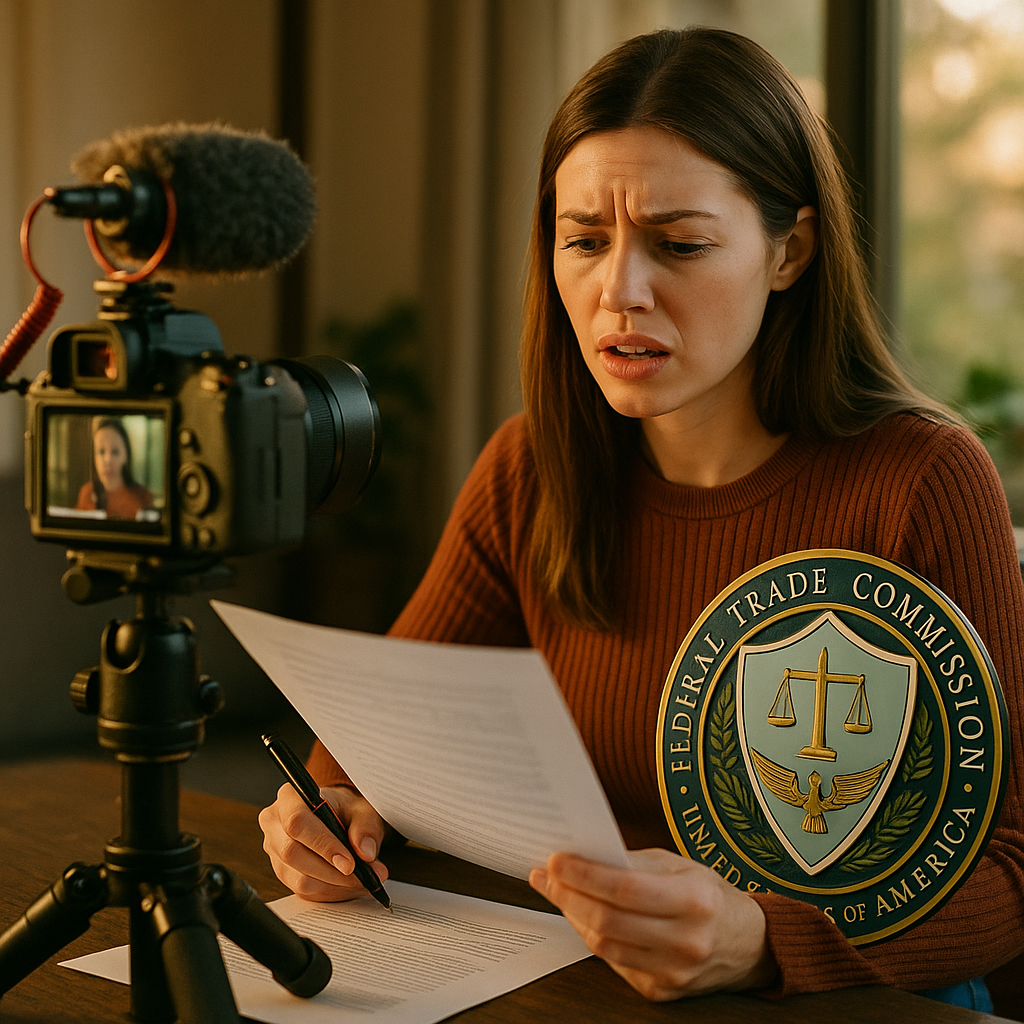
Ask most brand legal teams who’s liable for a creator’s ad claims, and they’ll point to the influencer. That confidence is misplaced. Brand-directed liability under the FTC’s evolving enforcement posture doesn’t hinge on who hit “publish” — it hinges on who controlled the message. And the line between “loose talking points” and “line-by-line script review” is where a lot of brands are about to get burned.
The Shift Nobody Announced
The FTC never issued a press release saying “we’re expanding brand liability now.” That’s not how this works. Instead, it’s happened through a string of consent orders, enforcement actions, and updated guidance language that quietly redraws the boundary of who counts as the “advertiser” in an influencer campaign.
Historically, brands felt insulated if they stayed a step removed from creator content. Give a creator some bullet points, let them riff, and you’re a sponsor — not a scriptwriter. The FTC’s endorsement guidance has always said disclosure obligations attach to both parties, but enforcement actions traditionally focused on the creator’s failure to disclose, not the brand’s degree of editorial control.
That’s changed. Recent FTC actions and settlement language increasingly evaluate the substance of control a brand exercises over creator output — not just whether a #ad tag appeared. If a brand’s legal or marketing team reviews, edits, and approves a script word-for-word, the agency is more willing to treat the brand as effectively the speaker, not just the sponsor.
The more a brand’s involvement resembles copywriting rather than coaching, the more the FTC treats the resulting content as the brand’s own speech — with all the liability that implies.
Talking Points vs. Line Edits: Where’s the Legal Line?
This is the part that trips up even experienced compliance teams. There’s no bright-line rule that says “three rounds of edits and you’re liable, two rounds and you’re safe.” Instead, the FTC and courts look at a cluster of factors:
- Degree of specificity. Did the brand supply general themes (“mention how easy setup was”) or exact sentences the creator had to recite verbatim?
- Approval authority. Could the creator publish without brand sign-off, or did the brand hold final veto over every line?
- Claim origination. Did the specific product claims (efficacy, comparative, health, financial) originate from brand-supplied copy rather than the creator’s own experience?
- Pattern across campaigns. Is line-by-line review a one-off, or is it baked into the brand’s standard operating procedure for every creator deal?
Loose talking points (“share your honest experience, mention the discount code”) generally keep the creator as the primary speaker. Line-by-line script control, especially when it dictates specific performance or health claims, starts to look like the brand is directing an ad it happens to have someone else deliver on camera. That distinction matters enormously when the FTC decides who to name in an enforcement action — and who pays the penalty.
Why Brands Started Tightening Script Control in the First Place
Ironically, brands didn’t start reviewing scripts line-by-line to cut corners. They did it to reduce risk. After a wave of enforcement around unsubstantiated claims, especially in supplements, financial products, and beauty tech, legal teams pushed for tighter creative control. The logic was simple: if we control the words, we control the risk.
That logic backfires under the current enforcement lens. Tighter control doesn’t insulate the brand from a bad claim slipping through — it makes the brand more directly responsible for that claim landing in the first place. It’s a classic compliance paradox: the safeguard becomes the liability trigger.
This mirrors what we’ve seen with AI co-written creator scripts, where brand-approved AI tooling generates claim language that a human reviewer then rubber-stamps. The FTC doesn’t care whether a human or a model drafted the sentence — it cares who had final say over what got published.
The Documentation Problem
Here’s where it gets operationally messy. Most brands don’t have a clean record of how much editorial control they exercised on any given piece of creator content. Script drafts live in Slack threads, Google Docs comment history, email chains, and creator platform messaging tools. When the FTC or a plaintiff’s attorney comes asking, “who wrote this claim,” reconstructing that trail can take weeks — and the answer often isn’t flattering.
This is precisely why more legal and compliance teams are pushing for structured creator compliance dashboards that log every round of script revision, timestamp approvals, and flag who requested specific claim language. Without that infrastructure, brands are essentially betting that no one ever asks the hard question.
According to eMarketer estimates on creator economy ad spend, influencer marketing budgets continue climbing into double-digit billions annually in the US alone. Scale that spend across thousands of scripted deals, and the odds that a regulator samples your campaign go up too.
How Much Control Is Too Much?
There’s no magic number of edit rounds that flips a brand from “sponsor” to “speaker.” But a few patterns consistently raise risk:
- Mandating exact phrasing for material claims (weight loss percentages, APR figures, comparative performance stats) rather than approving the general topic.
- Requiring creators to read from a teleprompter-style script with no room for personalization, especially in TikTok Shop-style live selling formats — a risk area we’ve covered in detail in our live-selling script audit breakdown.
- Rejecting creator drafts that hedge or soften a claim, then reinserting brand-preferred language.
- Centralizing script approval in a legal or brand safety team that has no visibility into substantiation requirements for the specific claim type.
If your review process looks more like a copyediting pipeline for brand-authored ad copy than light-touch guidance for an independent creator’s voice, treat that as a flashing warning light, not a compliance win.
What Smart Legal Teams Are Doing Differently
The brands navigating this well aren’t abandoning script review. They’re restructuring it. A few practical moves worth stealing:
- Separate claim substantiation from tone editing. Legal reviews specific factual claims for accuracy and substantiation. Marketing reviews tone and brand fit. Keep the two processes documented separately so it’s clear which team approved which type of language.
- Preserve creator authorship on delivery. Provide approved claim language as a reference bank, not a mandatory script. Let creators choose how to phrase it in their own words, within pre-cleared boundaries.
- Log every revision with a timestamp and rationale. This is the same instinct behind audit trails for AI marketing decisions — you want a record that shows exactly who requested what change and why, before anything goes live.
- Build a claims library with substantiation attached. If a claim requires a study citation or test data, that backup should be attached to the claim itself, not scattered across old briefs.
None of this eliminates liability entirely. Brands still bear disclosure and substantiation obligations regardless of how loosely they draft creator briefs. But it changes the fact pattern the FTC would review, and fact patterns are what determine enforcement outcomes.
Where This Intersects With AI-Generated Scripts
Add generative AI into the mix and the control question gets murkier fast. If a brand’s AI tool drafts a script and a human simply approves it without edits, is that “loose talking points” or “line-by-line control”? Arguably the latter, since the brand’s own system generated the exact language. We’ve broken this down more fully in our piece on auditing AI-assisted creator scripts, but the short version: AI-generated specificity doesn’t get a liability discount just because a human didn’t type it manually.
The same logic extends to synthetic performers and AI-voiced content, where disclosure requirements are still catching up to platform-level AI labeling standards — a gap we’ve mapped out in our synthetic performer disclosure comparison.
The Practical Bottom Line for Budget Owners
If you’re the one signing off on influencer campaign budgets, this isn’t just a legal team problem. Enforcement actions carry financial penalties, but the reputational fallout and campaign pause costs often dwarf the fine itself. A HubSpot analysis of marketing risk management consistently shows that compliance failures cost more in lost campaign velocity than in direct penalties — pulled content, paused partnerships, and creator trust erosion add up fast.
Build your script approval workflow with the assumption that a regulator, or a plaintiff’s attorney, will eventually read the full edit history. Because increasingly, they will.
Visible FAQ
What triggers brand-directed liability under FTC rules?
Brand-directed liability generally attaches when a brand exercises substantial control over the specific claims made in creator content, particularly when that control extends to dictating exact wording rather than general themes or topics.
Does script approval automatically make a brand liable for creator claims?
Not automatically, but it’s a significant factor. The FTC and courts weigh the degree of control, including whether the brand mandated verbatim language, rejected creator-authored alternatives, or originated the specific factual claims in question.
Is it safer to give creators loose talking points instead of full scripts?
Generally, yes, from a liability perspective, because it preserves the creator as the primary speaker. However, brands still must ensure claims are substantiated and disclosures are clear, regardless of how the script was structured.
How should brands document script revisions to reduce risk?
Maintain timestamped records of who requested each edit, why it was requested, and whether legal or marketing approved the final language. This creates a defensible record if enforcement questions arise later.
Does this liability standard apply to AI-generated creator scripts?
Yes. If a brand’s AI tool generates specific claim language and a human simply approves it, that’s still treated as brand-originated content for liability purposes, regardless of whether a human manually typed the words.
FAQs
What triggers brand-directed liability under FTC rules?
Brand-directed liability generally attaches when a brand exercises substantial control over the specific claims made in creator content, particularly when that control extends to dictating exact wording rather than general themes or topics.
Does script approval automatically make a brand liable for creator claims?
Not automatically, but it’s a significant factor. The FTC and courts weigh the degree of control, including whether the brand mandated verbatim language, rejected creator-authored alternatives, or originated the specific factual claims in question.
Is it safer to give creators loose talking points instead of full scripts?
Generally, yes, from a liability perspective, because it preserves the creator as the primary speaker. However, brands still must ensure claims are substantiated and disclosures are clear, regardless of how the script was structured.
How should brands document script revisions to reduce risk?
Maintain timestamped records of who requested each edit, why it was requested, and whether legal or marketing approved the final language. This creates a defensible record if enforcement questions arise later.
Does this liability standard apply to AI-generated creator scripts?
Yes. If a brand’s AI tool generates specific claim language and a human simply approves it, that’s still treated as brand-originated content for liability purposes, regardless of whether a human manually typed the words.
The next campaign brief you sign off on should draw a hard line between “approving claim accuracy” and “editing creator voice” — and your edit history should prove which one actually happened.
Top Influencer Marketing Agencies
The leading agencies shaping influencer marketing in 2026
Agencies ranked by campaign performance, client diversity, platform expertise, proven ROI, industry recognition, and client satisfaction. Assessed through verified case studies, reviews, and industry consultations.
Moburst

-
2

The Shelf
Boutique Beauty & Lifestyle Influencer AgencyA data-driven boutique agency specializing exclusively in beauty, wellness, and lifestyle influencer campaigns on Instagram and TikTok. Best for brands already focused on the beauty/personal care space that need curated, aesthetic-driven content.Clients: Pepsi, The Honest Company, Hims, Elf Cosmetics, Pure LeafVisit The Shelf → -
3

Audiencly
Niche Gaming & Esports Influencer AgencyA specialized agency focused exclusively on gaming and esports creators on YouTube, Twitch, and TikTok. Ideal if your campaign is 100% gaming-focused — from game launches to hardware and esports events.Clients: Epic Games, NordVPN, Ubisoft, Wargaming, Tencent GamesVisit Audiencly → -
4

Viral Nation
Global Influencer Marketing & Talent AgencyA dual talent management and marketing agency with proprietary brand safety tools and a global creator network spanning nano-influencers to celebrities across all major platforms.Clients: Meta, Activision Blizzard, Energizer, Aston Martin, WalmartVisit Viral Nation → -
5

The Influencer Marketing Factory
TikTok, Instagram & YouTube CampaignsA full-service agency with strong TikTok expertise, offering end-to-end campaign management from influencer discovery through performance reporting with a focus on platform-native content.Clients: Google, Snapchat, Universal Music, Bumble, YelpVisit TIMF → -
6

NeoReach
Enterprise Analytics & Influencer CampaignsAn enterprise-focused agency combining managed campaigns with a powerful self-service data platform for influencer search, audience analytics, and attribution modeling.Clients: Amazon, Airbnb, Netflix, Honda, The New York TimesVisit NeoReach → -
7

Ubiquitous
Creator-First Marketing PlatformA tech-driven platform combining self-service tools with managed campaign options, emphasizing speed and scalability for brands managing multiple influencer relationships.Clients: Lyft, Disney, Target, American Eagle, NetflixVisit Ubiquitous → -
8

Obviously
Scalable Enterprise Influencer CampaignsA tech-enabled agency built for high-volume campaigns, coordinating hundreds of creators simultaneously with end-to-end logistics, content rights management, and product seeding.Clients: Google, Ulta Beauty, Converse, AmazonVisit Obviously →