


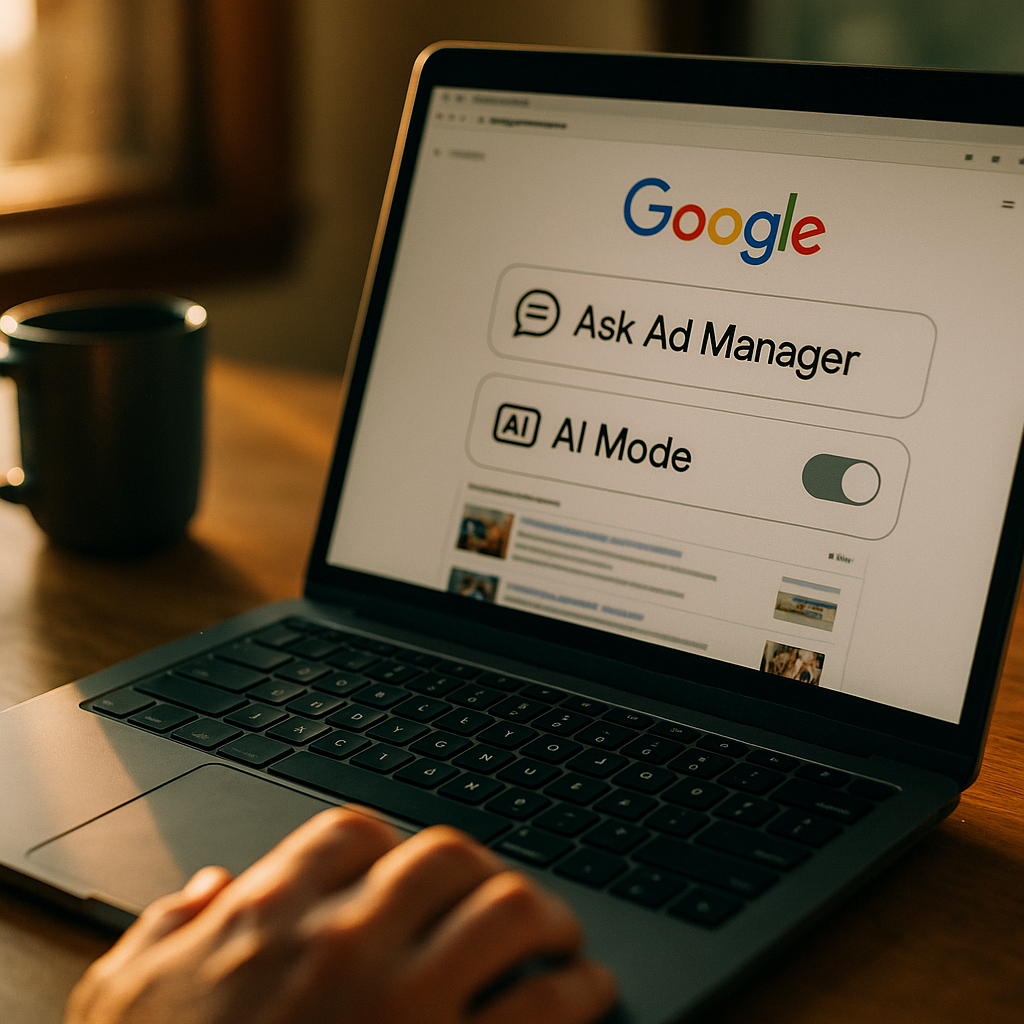
Sixty percent. That’s roughly the share of complex B2B ad adjustments Google’s newest agentic tools can now propose, configure, and in growing numbers of accounts, actually execute without a human clicking “publish.” Google’s AI Mode and Ask Ad Manager aren’t just chat interfaces bolted onto Google Ads anymore. They’re becoming the operating layer for campaign decisions, and the line between “here’s a suggestion” and “it’s already live” is disappearing fast.
For brand marketers, that’s either the productivity unlock of the decade or a compliance nightmare waiting to happen. Probably both.
From Chatbot to Campaign Operator
When Ask Ad Manager launched inside Google Ads, most practitioners treated it like a smarter help center. Ask it why conversions dropped, get a diagnosis, maybe a recommendation. That was the whole interaction model: ask, answer, human decides.
That model is gone. Ask Ad Manager now sits inside a broader agentic stack alongside AI Mode, Google’s conversational search layer, and Performance Max’s automated bidding logic. Together they don’t just flag an underperforming ad group anymore. They diagnose it, draft the fix, and in accounts where autonomy settings are loosened, push the change live. The suggestion box became a steering wheel.
This mirrors what’s happening across the broader ad-tech stack. Meta’s Advantage+ suite has pushed brands toward briefing creative for algorithmic assembly rather than manual ad building, a shift covered in depth in this breakdown of Advantage+ creative briefing. Google’s move follows the same trajectory: less manual toggling, more governance of an autonomous system that acts on your behalf.
The real shift isn’t that AI can now execute campaign changes. It’s that “suggestion” and “execution” have collapsed into a single, often invisible step, unless brands deliberately re-insert friction.
Why This Matters More Than the Last Round of “AI-Powered” Features
Marketers have heard “AI-powered” pitched at them for a decade. Smart bidding, dynamic creative, automated audience expansion. What’s different now is scope. Previous automation touched one lever, bids, or creative variants, or audience targeting. AI Mode and Ask Ad Manager touch the entire decision chain: research, diagnosis, budget reallocation, creative generation, and publishing, often across multiple campaigns simultaneously.
Google reports that advertisers using AI-assisted campaign tools see meaningful gains in conversion efficiency, and independent research from eMarketer has tracked accelerating enterprise adoption of generative and agentic ad tools across nearly every major platform. The direction of travel isn’t in question. What’s in question is who stays in the loop, and where.
This is the same tension explored in the Ask Ad Manager autonomy audit: the tool’s default settings increasingly favor action over approval, and most marketing teams haven’t audited where that threshold actually sits in their own accounts.
What Autonomous Execution Actually Looks Like Right Now
Strip away the marketing language and here’s what’s happening inside accounts using the full AI Mode and Ask Ad Manager stack:
- Budget reallocation: The system detects underperformance in one campaign and shifts spend to a higher-performing one, sometimes across different product lines, without a change-request ticket.
- Creative generation and rotation: New ad variants get written, assembled, and tested against existing creative, drawing on brand assets already uploaded to the account.
- Bid strategy switching: The tool can recommend, and in some configurations apply, a different bidding model entirely (say, shifting from maximize conversions to target ROAS) based on a few weeks of signal.
- Audience and keyword expansion: Broad match and audience signals get widened automatically when the system judges there’s headroom for volume.
None of that is inherently reckless. It’s genuinely useful when it works. The problem is when it works quietly, and nobody notices until the monthly spend report looks wrong.
The Governance Gap Nobody Budgeted For
Here’s the uncomfortable part. Most brand marketing teams built their approval workflows around a world where humans initiated every material change. Legal reviewed the ad copy. Media buyers approved the budget shift. Brand safety teams checked the creative. That workflow assumed a human was always the first mover.
Agentic tools break that assumption. The AI is now frequently the first mover, and the human role shifts to after-the-fact review, if it happens at all. That’s a fundamentally different governance posture, and it requires different controls: spend caps, mandatory pause states, audit trails, and clearly defined override thresholds.
Teams that have already been burned by this transition aren’t unusual. One brand safety audit found ad creative going live without the review step anyone assumed was mandatory. It wasn’t malice. It was a default setting nobody had checked.
If your approval workflow was designed for a world where humans click “publish,” it’s already obsolete. The question isn’t whether to add controls, it’s how fast you can retrofit them.
AI Mode’s Search-Side Ripple Effect
It’s tempting to treat AI Mode as a search feature and Ask Ad Manager as a separate ads feature. They’re increasingly the same system viewed from two angles. AI Mode is reshaping how users discover brands (fewer clicks, more synthesized answers), which changes what performs in paid search, which then feeds back into what Ask Ad Manager recommends and executes.
This has direct implications for how brands structure content and campaigns. If AI Mode is answering queries directly rather than sending traffic to a results page, the ad and organic strategies both need to adapt to an answer-first environment. That’s the same dynamic driving the shift toward citation-ready content discussed in how AI Overviews are rewriting SEO, and it’s why answer engine optimization has become a board-level conversation rather than an SEO team footnote, a distinction worth understanding via AEO versus GEO for AI search.
Brands running paid and organic in silos are going to feel this acutely. The systems making autonomous ad decisions are increasingly trained on and responsive to the same synthesized-answer environment reshaping organic discovery. Treat them separately at your own risk.
Building Guardrails Without Killing the Efficiency Gains
Nobody sensible is arguing brands should switch autonomy off entirely. The efficiency case is real: faster testing cycles, fewer manual hours spent on rote optimization, and campaign responsiveness that no human team could match at scale. The HubSpot state-of-marketing research consistently shows AI adoption correlating with reported time savings across ad operations teams.
But adoption without governance is how brands end up as case studies in the wrong kind of article. A workable middle path looks like this:
- Set explicit spend caps at the campaign and account level, not just monthly budget totals, so autonomous reallocation can’t silently drain a category budget into another.
- Define mandatory human checkpoints for anything touching brand-sensitive creative, regulated claims, or spend above a defined threshold. The framework in this agentic ad buying error audit is a useful starting model.
- Build a kill switch that’s actually accessible to the people running campaigns day to day, not buried three settings menus deep. The governance checklist in this AI agent governance checklist covers the specifics.
- Audit weekly, not quarterly. Autonomous systems make dozens of micro-decisions daily. Quarterly reviews catch problems long after the spend has left the building.
- Document the override rationale whenever a human reverses an AI decision. That log becomes the training data for tightening (or loosening) future thresholds.
This isn’t about distrust of the technology. It’s about applying the same operational discipline brands already apply to human media buyers, expense limits, approval chains, audit trails, to a system that now behaves like one.
What Happens to the Media Buyer’s Job?
Fair question, and one every media buying team is quietly asking. The honest answer: the job shifts from execution to supervision and exception-handling. Less time building ad groups, more time setting the rules the AI operates within and catching the edge cases it gets wrong.
That’s not a downgrade, though it can feel like one. It’s the same shift that’s happened in lead scoring and CRM workflows, where marketers moved from manually qualifying leads to configuring and auditing the systems that do it, a transition mapped out in this comparison of autonomous lead scoring platforms. The skill that matters now isn’t campaign building. It’s knowing exactly where the system is likely to go wrong, and building the checkpoint before it does.
Google itself has been fairly candid that this is the direction things are headed, positioning Ask Ad Manager and AI Mode as complementary layers of a broader shift toward what it calls AI-assisted advertising, detailed in Google Ads Help documentation. Read between the lines and the message is clear: manual campaign management is being phased into a supervisory role, not eliminated, but redefined.
The Bottom Line for Brand Teams
Google’s AI Mode and Ask Ad Manager have already crossed the threshold from advisory tool to autonomous operator in a meaningful share of accounts, and that share is growing every quarter. The brands that win here won’t be the ones with the most aggressive automation settings. They’ll be the ones with the tightest governance around it, spend caps that actually cap, checkpoints that actually check, and audit trails that catch problems in days rather than months.
Start with an honest audit of your current account’s autonomy settings this week, not next quarter, because the gap between what you think Ask Ad Manager is allowed to do and what it’s actually doing is usually wider than expected.
FAQs
What is Ask Ad Manager and how is it different from previous Google Ads automation?
Ask Ad Manager is Google’s conversational AI layer inside Google Ads that diagnoses performance issues, recommends fixes, and in accounts with looser autonomy settings, can execute changes like budget reallocation or creative updates directly. Earlier automation (like Smart Bidding) touched a single lever; Ask Ad Manager can act across budget, creative, targeting, and bid strategy simultaneously.
Does AI Mode affect paid campaigns or only organic search results?
Both. AI Mode changes how users discover and interact with search results, which shifts what performs in paid search. That performance data feeds back into the signals Ask Ad Manager and Performance Max use to make automated decisions, so the two systems are increasingly interdependent rather than separate.
Can brands turn off autonomous execution entirely?
Most accounts allow granular control over autonomy levels, from full manual approval to fully automated execution. The safer approach for regulated or brand-sensitive categories is a hybrid model: automation for low-risk optimizations, mandatory human review for spend thresholds, creative claims, or anything brand-safety adjacent.
What’s the biggest risk of letting AI execute campaign changes without review?
Silent drift, small autonomous decisions compounding over weeks into budget misallocation, off-brand creative going live, or bid strategies shifting in ways nobody signed off on. Without weekly audits and clear override thresholds, these issues often surface only when a monthly report looks materially wrong.
How should marketing teams prepare their workflows for agentic ad tools?
Set explicit spend caps below the account level, define mandatory human checkpoints for high-risk changes, build an accessible kill switch, and audit account activity weekly rather than quarterly. Document every human override to refine autonomy thresholds over time.
FAQs
What is Ask Ad Manager and how is it different from previous Google Ads automation?
Ask Ad Manager is Google’s conversational AI layer inside Google Ads that diagnoses performance issues, recommends fixes, and in accounts with looser autonomy settings, can execute changes like budget reallocation or creative updates directly. Earlier automation (like Smart Bidding) touched a single lever; Ask Ad Manager can act across budget, creative, targeting, and bid strategy simultaneously.
Does AI Mode affect paid campaigns or only organic search results?
Both. AI Mode changes how users discover and interact with search results, which shifts what performs in paid search. That performance data feeds back into the signals Ask Ad Manager and Performance Max use to make automated decisions, so the two systems are increasingly interdependent rather than separate.
Can brands turn off autonomous execution entirely?
Most accounts allow granular control over autonomy levels, from full manual approval to fully automated execution. The safer approach for regulated or brand-sensitive categories is a hybrid model: automation for low-risk optimizations, mandatory human review for spend thresholds, creative claims, or anything brand-safety adjacent.
What’s the biggest risk of letting AI execute campaign changes without review?
Silent drift, small autonomous decisions compounding over weeks into budget misallocation, off-brand creative going live, or bid strategies shifting in ways nobody signed off on. Without weekly audits and clear override thresholds, these issues often surface only when a monthly report looks materially wrong.
How should marketing teams prepare their workflows for agentic ad tools?
Set explicit spend caps below the account level, define mandatory human checkpoints for high-risk changes, build an accessible kill switch, and audit account activity weekly rather than quarterly. Document every human override to refine autonomy thresholds over time.
Top Influencer Marketing Agencies
The leading agencies shaping influencer marketing in 2026
Agencies ranked by campaign performance, client diversity, platform expertise, proven ROI, industry recognition, and client satisfaction. Assessed through verified case studies, reviews, and industry consultations.
Moburst

-
2

The Shelf
Boutique Beauty & Lifestyle Influencer AgencyA data-driven boutique agency specializing exclusively in beauty, wellness, and lifestyle influencer campaigns on Instagram and TikTok. Best for brands already focused on the beauty/personal care space that need curated, aesthetic-driven content.Clients: Pepsi, The Honest Company, Hims, Elf Cosmetics, Pure LeafVisit The Shelf → -
3

Audiencly
Niche Gaming & Esports Influencer AgencyA specialized agency focused exclusively on gaming and esports creators on YouTube, Twitch, and TikTok. Ideal if your campaign is 100% gaming-focused — from game launches to hardware and esports events.Clients: Epic Games, NordVPN, Ubisoft, Wargaming, Tencent GamesVisit Audiencly → -
4

Viral Nation
Global Influencer Marketing & Talent AgencyA dual talent management and marketing agency with proprietary brand safety tools and a global creator network spanning nano-influencers to celebrities across all major platforms.Clients: Meta, Activision Blizzard, Energizer, Aston Martin, WalmartVisit Viral Nation → -
5

The Influencer Marketing Factory
TikTok, Instagram & YouTube CampaignsA full-service agency with strong TikTok expertise, offering end-to-end campaign management from influencer discovery through performance reporting with a focus on platform-native content.Clients: Google, Snapchat, Universal Music, Bumble, YelpVisit TIMF → -
6

NeoReach
Enterprise Analytics & Influencer CampaignsAn enterprise-focused agency combining managed campaigns with a powerful self-service data platform for influencer search, audience analytics, and attribution modeling.Clients: Amazon, Airbnb, Netflix, Honda, The New York TimesVisit NeoReach → -
7

Ubiquitous
Creator-First Marketing PlatformA tech-driven platform combining self-service tools with managed campaign options, emphasizing speed and scalability for brands managing multiple influencer relationships.Clients: Lyft, Disney, Target, American Eagle, NetflixVisit Ubiquitous → -
8

Obviously
Scalable Enterprise Influencer CampaignsA tech-enabled agency built for high-volume campaigns, coordinating hundreds of creators simultaneously with end-to-end logistics, content rights management, and product seeding.Clients: Google, Ulta Beauty, Converse, AmazonVisit Obviously →