


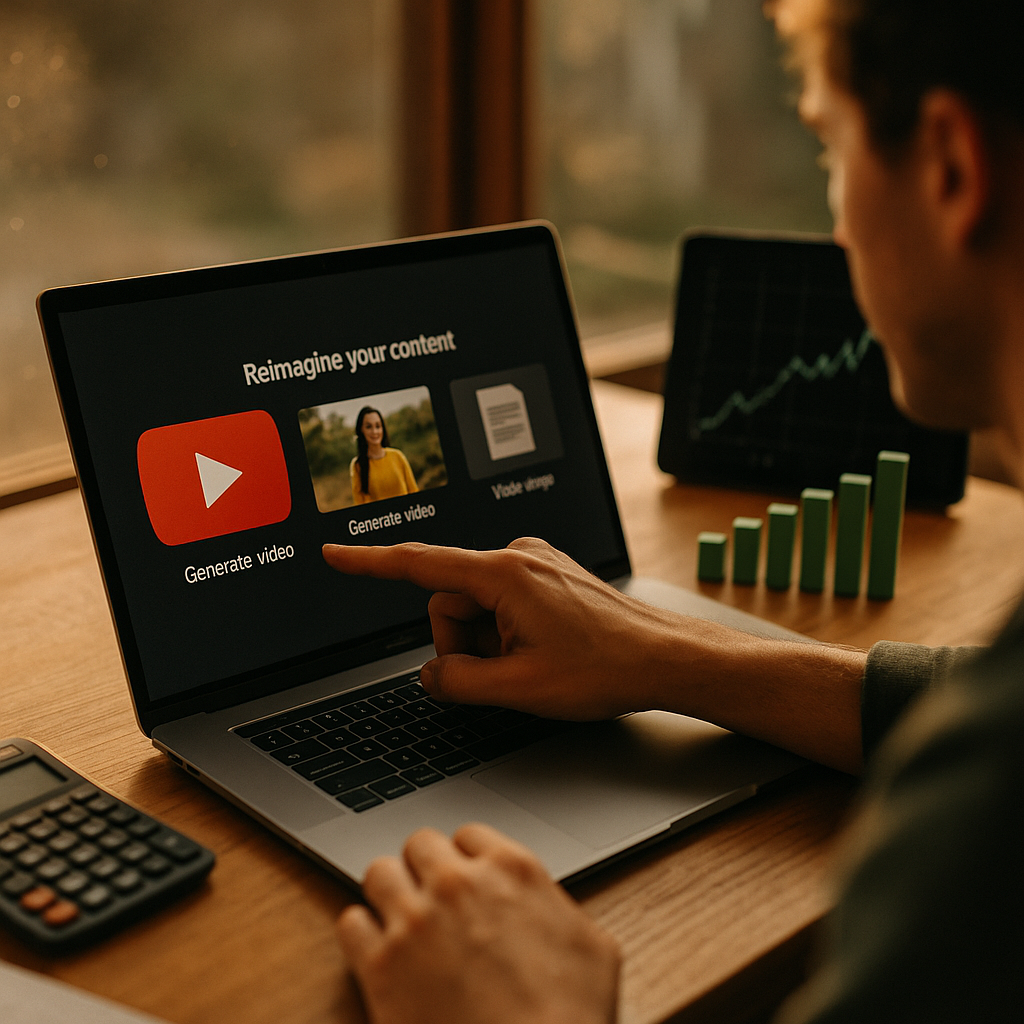
Six billion Shorts views a day and YouTube still thinks brands aren’t repurposing enough of their catalog. That’s the pitch behind Reimagine, YouTube’s AI-powered Shorts remixing tool now rolling into more creator and business accounts. The YouTube Reimagine tool promises to turn one video into a dozen variants automatically. But does it hold up for brands managing real budgets and real compliance risk? We ran it through its paces.
What Reimagine Actually Does
Reimagine sits inside YouTube Studio’s Shorts creation flow. Feed it an existing video, long-form or Short, and it generates AI-assisted remixes: reframed crops, auto-generated B-roll insertions, style transfers, and caption-driven cutdowns. Think of it as a repurposing engine built directly into the platform you’re already publishing on, rather than a third-party tool bolted onto your export workflow.
For brands, the appeal is obvious. Agencies burn hours reformatting a single hero asset into six-second hooks, 15-second product demos, and 60-second narrative cuts. Reimagine claims to compress that timeline from hours to minutes. YouTube has been explicit that this is aimed at closing the gap between content volume and creative production capacity, a gap that eMarketer has flagged repeatedly as the top bottleneck cited by in-house social teams.
The Technical Walkthrough: How It Handles Real Assets
We tested Reimagine against three asset types: a 12-minute product tutorial, a 45-second UGC-style testimonial, and a studio-shot brand anthem video. Results varied more than the marketing copy suggests.
- Long-form to Shorts: The tool identified natural chapter breaks and pulled three candidate cutdowns from the 12-minute tutorial. Two were usable with minor trims. One badly misjudged pacing, cutting mid-sentence on a pricing disclaimer, which is exactly the kind of error that turns into a compliance headache if published unreviewed.
- UGC remix: Style transfer on the testimonial clip added unnecessary visual noise, a stylized filter that made the creator’s face look artificially smoothed. Authenticity is the entire value of UGC. An AI filter that plastic-wraps a testimonial defeats the purpose.
- Studio anthem cutdown: This is where Reimagine performed best. Clean footage, consistent lighting, and clear brand beats gave the model more signal to work with. Output here was near publish-ready.
Reimagine performs best on high-production assets and worst on the raw, authentic UGC that actually drives Shorts engagement — a mismatch brands need to plan around, not ignore.
Where the ROI Math Actually Lands
Assume an agency spends four hours per asset on manual repurposing at a blended rate of $85/hour. That’s $340 per source video for a basic set of cutdowns. If Reimagine gets you 70% of the way there in ten minutes, and a human editor spends 45 minutes finishing the job, you’ve cut cost to roughly $65 per asset. Scale that across a quarterly content calendar of 40 hero assets, and you’re looking at savings north of $11,000 — assuming quality holds.
That’s the optimistic case. The catch: our testing showed usable-without-heavy-edit output on only about half the assets. Factor in review time, rework, and legal sign-off on anything customer-facing, and the real savings compress to something closer to 30-40%, not the 80% efficiency gain implied in YouTube’s own promotional messaging.
Brands should model this the way they’d model any automation investment: input volume, defect rate, and downstream review cost. This isn’t fundamentally different from evaluating TikTok’s Symphony agent, which faces similar tradeoffs between speed and creative control.
Compliance and Brand Safety: The Part YouTube’s Demo Doesn’t Show
Here’s the uncomfortable question nobody at the product launch wanted to answer directly: who is liable when an AI remix alters a claim, drops a disclosure, or misrepresents a product feature? Reimagine’s style transfer and auto-caption features generate new text and visual context that didn’t exist in the source material. That’s a legal exposure point, not just a creative one.
Regulatory bodies have been unambiguous about disclosure obligations even when content is machine-generated. The FTC’s endorsement guidance applies regardless of whether a human or an algorithm produced the final cut. If Reimagine auto-generates a caption implying a health claim your legal team never approved, that’s your brand’s problem, not YouTube’s.
Brands running influencer-sourced content through Reimagine face an added layer: creator contracts rarely anticipate AI remixing of their likeness or voice. Before turning this on for any UGC library, check your usage rights language. This is the same identity and consent terrain covered in identity resolution risk decisions — except now it’s applied to video assets instead of data matching.
Scaling Considerations: Batch Processing and Governance
YouTube is positioning Reimagine for batch use, not one-off edits. That’s where operational discipline matters most. A few things brand teams should build into workflow before flipping the switch at scale:
- Human-in-the-loop review gates. Every AI-remixed cutdown touching pricing, health, or financial claims should route through legal or compliance before publishing, no exceptions.
- Version control tagging. Track which Shorts were AI-remixed versus manually edited. When something underperforms or triggers a complaint, you need to know the provenance fast.
- Creator consent audits. For UGC-sourced content, confirm contracts cover AI-based derivative editing before batch processing creator videos.
- Performance benchmarking against manual cuts. Don’t assume AI output performs equivalently. Run a controlled test, same source asset, AI cut versus manual cut, and compare watch time and completion rate over at least a few weeks.
This governance layer isn’t optional overhead. It’s the difference between Reimagine being a genuine efficiency win and a quiet source of brand risk that surfaces three months later in a customer complaint or regulatory inquiry.
How It Stacks Up Against Competing Repurposing Tools
Reimagine isn’t operating in a vacuum. TikTok’s Symphony, various AI clipper networks, and third-party tools like Opus Clip and Vidyo all compete for the same repurposing budget line. The distinguishing factor for Reimagine is native platform integration: no export/import cycle, no separate billing relationship, and presumably better alignment with YouTube’s own recommendation algorithm since the tool understands what performs on-platform.
But native doesn’t mean superior. Independent clipper networks often offer more granular control over pacing and caption styling, precisely the areas where Reimagine stumbled in our UGC test. Brands already running AI clipper networks should benchmark Reimagine against existing vendor output rather than assuming platform-native means better.
There’s also a data portability question. Content generated through Reimagine lives inside YouTube’s ecosystem by default. If your team repurposes across TikTok, Instagram Reels, and YouTube Shorts simultaneously, a platform-locked tool creates friction, not efficiency. Compare this to the kind of cross-platform data feed thinking brands now expect from their broader martech stack. Repurposing tools should arguably meet the same standard.
What This Means for Attribution and Measurement
Every new Short generated by Reimagine is a new content ID, a new set of watch-time metrics, a new attribution touchpoint. Teams already stretched thin on measurement need to decide upfront how AI-remixed variants get tagged in their analytics stack. Lump them in with organic content and you lose the ability to isolate whether the AI tool is actually driving incremental reach, or just redistributing existing engagement across more assets.
This is the same incrementality question marketing teams already wrestle with elsewhere in the stack, and the same discipline applies here: measure lift, not just volume. For teams building this into broader measurement frameworks, the same logic covered in attribution versus incrementality analysis is directly transferable to Shorts repurposing decisions.
More Shorts published doesn’t automatically mean more reach earned. Without incrementality testing, brands risk mistaking content volume for content performance.
Platforms like Sprout Social and HubSpot already offer cross-channel reporting that can help normalize this data, but only if teams tag AI-generated variants distinctly from the outset. Retrofitting that tagging after three months of unlabeled publishing is a painful, largely manual cleanup job.
Verdict: Cautious Adoption, Not Blanket Rollout
Reimagine is a legitimate efficiency tool for brands with strong source footage and lighter for brands relying on raw UGC. It shines on studio-quality assets and struggles with the authentic, lower-production content that often performs best on Shorts. The ROI case is real but smaller than the demo suggests once you factor in review time and compliance checks.
Treat this as a pilot, not a platform migration. Run it against 15-20 assets, benchmark output quality against your current process, and build the governance layer before scaling batch processing across your full content calendar.
Frequently Asked Questions
What is YouTube’s Reimagine tool used for?
Reimagine is an AI-powered feature inside YouTube Studio that automatically generates Shorts variants from existing long-form or short-form video, including reframed crops, style transfers, and auto-generated captions, aimed at speeding up content repurposing at scale.
Does Reimagine work equally well on all content types?
No. Testing shows it performs best on high-production, studio-quality footage and worse on raw UGC-style content, where style transfer can strip away the authenticity that drives engagement on Shorts.
Is AI-remixed content from Reimagine compliant with FTC disclosure rules?
Compliance depends on brand oversight, not the tool itself. If Reimagine auto-generates captions or visual context implying claims, brands remain fully liable under FTC endorsement guidance, regardless of whether the edit was AI-generated or manual.
How should brands measure ROI on Reimagine versus manual editing?
Calculate cost per asset factoring in review and rework time, not just generation speed. Testing suggests realistic efficiency gains of 30-40%, well below the 80%-plus improvements implied in platform marketing.
Can Reimagine be used on creator or influencer-sourced UGC?
Only if creator contracts explicitly permit AI-based derivative editing of their likeness or voice. Brands should audit usage rights before batch processing any UGC library through the tool.
How does Reimagine compare to third-party clipper tools or TikTok’s Symphony?
Reimagine offers native platform integration and no export/import friction, but independent clipper networks often provide finer control over pacing and captioning. Brands should benchmark output quality directly rather than assuming native tools automatically outperform.
Top Influencer Marketing Agencies
The leading agencies shaping influencer marketing in 2026
Agencies ranked by campaign performance, client diversity, platform expertise, proven ROI, industry recognition, and client satisfaction. Assessed through verified case studies, reviews, and industry consultations.
Moburst

-
2

The Shelf
Boutique Beauty & Lifestyle Influencer AgencyA data-driven boutique agency specializing exclusively in beauty, wellness, and lifestyle influencer campaigns on Instagram and TikTok. Best for brands already focused on the beauty/personal care space that need curated, aesthetic-driven content.Clients: Pepsi, The Honest Company, Hims, Elf Cosmetics, Pure LeafVisit The Shelf → -
3

Audiencly
Niche Gaming & Esports Influencer AgencyA specialized agency focused exclusively on gaming and esports creators on YouTube, Twitch, and TikTok. Ideal if your campaign is 100% gaming-focused — from game launches to hardware and esports events.Clients: Epic Games, NordVPN, Ubisoft, Wargaming, Tencent GamesVisit Audiencly → -
4

Viral Nation
Global Influencer Marketing & Talent AgencyA dual talent management and marketing agency with proprietary brand safety tools and a global creator network spanning nano-influencers to celebrities across all major platforms.Clients: Meta, Activision Blizzard, Energizer, Aston Martin, WalmartVisit Viral Nation → -
5

The Influencer Marketing Factory
TikTok, Instagram & YouTube CampaignsA full-service agency with strong TikTok expertise, offering end-to-end campaign management from influencer discovery through performance reporting with a focus on platform-native content.Clients: Google, Snapchat, Universal Music, Bumble, YelpVisit TIMF → -
6

NeoReach
Enterprise Analytics & Influencer CampaignsAn enterprise-focused agency combining managed campaigns with a powerful self-service data platform for influencer search, audience analytics, and attribution modeling.Clients: Amazon, Airbnb, Netflix, Honda, The New York TimesVisit NeoReach → -
7

Ubiquitous
Creator-First Marketing PlatformA tech-driven platform combining self-service tools with managed campaign options, emphasizing speed and scalability for brands managing multiple influencer relationships.Clients: Lyft, Disney, Target, American Eagle, NetflixVisit Ubiquitous → -
8

Obviously
Scalable Enterprise Influencer CampaignsA tech-enabled agency built for high-volume campaigns, coordinating hundreds of creators simultaneously with end-to-end logistics, content rights management, and product seeding.Clients: Google, Ulta Beauty, Converse, AmazonVisit Obviously →