


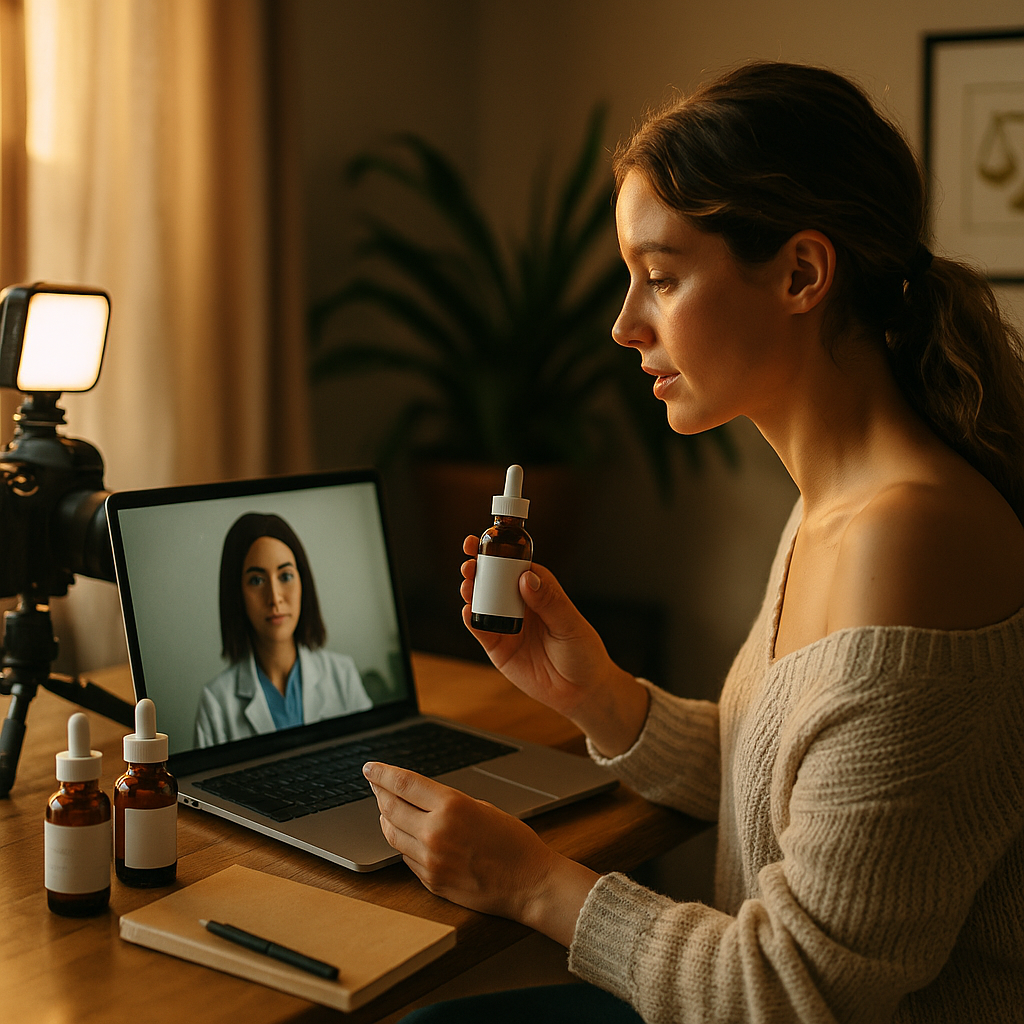
Forty-one state attorneys general sent warning letters about health claims made by wellness influencers last year. Now add a federal AI health ad guidance overhaul into the mix, and you’ve got a compliance puzzle that’s tripping up even sophisticated brand teams. If your influencer program touches supplements, telehealth referrals, mental wellness apps, or AI-generated symptom content, the rules just got a lot more layered — and a lot less forgiving.
This is the reality of running wellness creator campaigns right now: two regulatory systems, often pulling in different directions, both with teeth.
Why This Collision Was Inevitable
The FTC’s updated AI health ad guidance tightened requirements around AI-generated or AI-assisted health claims — think chatbot-drafted product descriptions, algorithmically personalized supplement recommendations, or synthetic “doctor” avatars endorsing a wellness brand. The agency made clear that AI tools don’t dilute liability. If a creator uses an AI script generator to write a claim about reducing cortisol or “supporting thyroid function,” the brand is still on the hook the same way it would be for a human-written claim under Section 5 of the FTC Act.
That part isn’t new. What’s new is the specificity: disclosure standards for AI-personalized health content, documentation requirements for substantiation when AI selects which claims to surface to which audience segments, and heightened scrutiny of AI-driven “quiz funnel” wellness campaigns that route users toward telehealth providers.
Meanwhile, state telehealth advertising rules have been evolving on a completely separate track. States like Texas, Florida, and New York have specific statutes governing how telehealth services can be advertised, including restrictions on testimonials, mandatory disclaimers about licensed-provider relationships, and in some cases outright bans on influencer-driven patient acquisition for certain prescription categories (looking at you, compounded GLP-1 marketing).
A campaign that’s perfectly compliant with federal AI disclosure guidance can still violate a state’s telehealth advertising statute — and vice versa. Brands need both lenses, applied simultaneously, not sequentially.
Where the Federal and State Rules Actually Conflict
The friction shows up in three predictable places.
Disclosure placement and format. FTC guidance on AI-generated health content generally allows disclosures in caption text or on-screen text, consistent with existing FTC endorsement guidance. But several states with telehealth advertising statutes require verbal disclosures within the video itself, not just text overlays — a much higher production bar for short-form content.
Testimonial restrictions. This is the big one. States including Texas and California restrict or heavily regulate the use of patient testimonials in telehealth advertising, particularly for prescription-adjacent services (weight loss injectables, hormone therapy, ADHD medication management). A creator campaign built around “my experience with this telehealth provider” content — which is standard practice on TikTok and Instagram — can run headlong into a state law that treats that testimonial as a regulated medical advertisement, regardless of what the FTC says about AI disclosure.
Licensed-provider attribution. Federal guidance focuses on truthful, substantiated claims. State telehealth rules often go further, requiring that any advertisement referencing a specific treatment name a supervising licensed provider or include a disclaimer that the service isn’t a substitute for in-person care. AI-generated ad copy trained primarily on brand messaging frequently skips this because it’s not a federal requirement — it’s buried in state medical board regulations that most marketing teams never read.
The AI Layer Makes Enforcement Faster, Not Slower
Here’s the part brands underestimate: regulators are now using the same AI detection tools that generated the problematic content in the first place. State attorneys general and the FTC have both signaled increased use of automated scanning tools to flag health claim patterns across influencer content at scale. That means a single non-compliant script template, deployed across fifty creators, doesn’t get caught once — it gets caught fifty times, in fifty jurisdictions, nearly simultaneously.
This is a fundamentally different risk profile than five years ago, when a single influencer’s bad claim was a one-off headache. Now it’s a template-level, program-wide exposure.
Building a Reconciliation Framework, Not a Patchwork
Trying to create fifty state-specific creator briefs is operationally unworkable for most mid-sized brand teams. The smarter approach is building a reconciliation framework: identify the highest common denominator across your target states, then layer state-specific triggers on top.
Practically, this looks like:
- Map your creator footprint to telehealth-regulated categories first. If your wellness campaign touches weight management, mental health, hormone therapy, or any prescription-adjacent product, treat every state where you have audience concentration as a potential trigger jurisdiction — not just where the brand is headquartered.
- Default to the strictest disclosure standard across your active states. If one state requires verbal disclosure and others don’t, build verbal disclosure into every script. It’s cheaper than managing fifty variants and it satisfies FTC’s AI guidance simultaneously since verbal disclosure is always “clear and conspicuous.”
- Audit AI-generated scripts against a state-specific claims checklist before they reach creators. This is where most brands are exposed — the AI tool generating creator briefs doesn’t know Texas telehealth advertising law, and nobody’s checking its output against it.
- Document your substantiation trail for every AI-influenced claim. Regulators are explicitly asking whether a human reviewed AI-generated health claims before publication. “The AI wrote it” is not a defense; it’s an admission.
This mirrors a pattern we’ve covered before around AI-generated ad assets more broadly — the pre-flight checklist approach works especially well here because health claims need the same pre-publication gate that other high-risk AI content requires, just with a state-law layer bolted on.
Contracts Need to Catch Up Too
Most influencer agreements still treat “compliance with applicable law” as boilerplate. That’s not sufficient anymore for wellness verticals. Contracts need explicit clauses requiring creators to use only brand-approved, legally reviewed scripts for health claims, prohibiting creator-improvised testimonials about treatment outcomes, and establishing a sign-off checkpoint before any AI-assisted content referencing health benefits goes live.
The sign-off matrix model we’ve detailed for FTC risk gaps applies directly here — you just need to add a state telehealth review step to the matrix, not build a separate process from scratch. Brands running programs across multiple verticals should also look at how contract audits tied to the FTC disclosure update can be extended to flag telehealth-specific liability gaps during the same review cycle.
If you’re using AI tools to draft creator contracts at scale, don’t skip the review step. The risks in AI-drafted contracts compound quickly when the underlying subject matter is regulated health content — a generic AI-generated indemnification clause won’t hold up if it doesn’t specifically address state telehealth advertising exposure.
What About Platform-Level AI Labels?
One more wrinkle: platforms like TikTok and Meta increasingly apply their own AI-generated content labels automatically, and those labels don’t necessarily satisfy either FTC or state disclosure requirements. We’ve written about this gap in detail — platform AI labels generally fall short of FTC disclosure standards on their own, and the same logic applies to state telehealth rules. A TikTok-generated “AI info” tag is not a substitute for a state-mandated licensed-provider disclaimer. Brands relying on platform defaults are essentially outsourcing legal compliance to a system that wasn’t built for it.
This gets more complicated when platform labeling conflicts with your own disclosure strategy — imagine a creator’s verbal disclaimer getting visually buried under a platform-applied AI badge. It happens more than brands realize, and it’s worth testing before a campaign goes wide.
A Quick Gut Check for Legal and Marketing Teams
Ask these questions before greenlighting any wellness creator campaign involving AI-generated content or telehealth referrals:
- Does this claim reference a specific health outcome that would require substantiation under FTC guidance?
- Does the target state require a licensed-provider disclaimer or verbal disclosure for this category?
- Was the script AI-generated, and if so, did a qualified human reviewer sign off before publication?
- Does the creator’s testimonial cross into regulated patient-testimonial territory under the relevant state’s telehealth statute?
- Is there an audit trail documenting substantiation and legal review for this specific piece of content?
If your team can’t answer all five quickly, the campaign isn’t ready to launch. According to industry benchmarking from eMarketer, wellness and health-adjacent influencer spend continues to grow faster than the influencer market overall, which means the compliance exposure is scaling right alongside the budget.
The Bigger Strategic Point
Brands that treat this as a legal problem to solve once and forget are setting themselves up for repeat exposure. State telehealth advertising rules are still being written and amended actively — several states introduced new telehealth marketing restrictions in the past year alone. Federal AI health ad guidance will keep evolving too, likely tightening further as the FTC continues to signal aggressive enforcement priorities around health and AI overlap.
The brands getting this right aren’t the ones with the most lawyers. They’re the ones who built a repeatable review process — a sign-off matrix, a pre-flight checklist, a documented substantiation trail — that flexes as new state rules land, instead of starting from scratch every time a new statute passes. That operational muscle, more than any single legal opinion, is what actually reduces risk at scale.
Next step: Pull your active wellness creator briefs this week and run them against the five-question gut check above. If even one campaign fails on the licensed-provider disclaimer question, pause distribution in that state until your sign-off matrix catches up.
FAQs
Does FTC AI health ad guidance override state telehealth advertising rules?
No. Federal guidance sets a compliance floor, not a ceiling. Brands must satisfy both the FTC’s disclosure and substantiation standards and any stricter state-level telehealth advertising requirements that apply in the creator’s or audience’s jurisdiction.
Which wellness categories carry the highest combined compliance risk?
Weight management (especially GLP-1 and compounded medication referrals), mental health and therapy-adjacent services, hormone therapy, and any AI-personalized supplement recommendation funnel carry the highest risk because they sit at the intersection of FTC health claim scrutiny and state medical advertising statutes.
Can platform AI-content labels satisfy state telehealth disclosure requirements?
Generally no. Platform-applied AI labels are automated and inconsistent, and they weren’t designed to meet specific state disclaimer language or placement requirements. Brands need their own disclosure language built into the creator brief, independent of platform defaults.
How should brands handle creators who operate across multiple states?
Default to the strictest applicable state standard across the creator’s likely audience footprint rather than trying to geofence disclosures. This simplifies production and reduces the risk of missing a stricter jurisdiction.
Is “the AI generated the claim” a valid defense against FTC enforcement?
No. Regulators have explicitly stated that AI involvement does not reduce brand liability. Human review and documented substantiation before publication are expected regardless of how the content was drafted.
Visible FAQ (HTML)
FAQs
Does FTC AI health ad guidance override state telehealth advertising rules?
No. Federal guidance sets a compliance floor, not a ceiling. Brands must satisfy both the FTC’s disclosure and substantiation standards and any stricter state-level telehealth advertising requirements that apply in the creator’s or audience’s jurisdiction.
Which wellness categories carry the highest combined compliance risk?
Weight management (especially GLP-1 and compounded medication referrals), mental health and therapy-adjacent services, hormone therapy, and any AI-personalized supplement recommendation funnel carry the highest risk because they sit at the intersection of FTC health claim scrutiny and state medical advertising statutes.
Can platform AI-content labels satisfy state telehealth disclosure requirements?
Generally no. Platform-applied AI labels are automated and inconsistent, and they weren’t designed to meet specific state disclaimer language or placement requirements. Brands need their own disclosure language built into the creator brief, independent of platform defaults.
How should brands handle creators who operate across multiple states?
Default to the strictest applicable state standard across the creator’s likely audience footprint rather than trying to geofence disclosures. This simplifies production and reduces the risk of missing a stricter jurisdiction.
Is “the AI generated the claim” a valid defense against FTC enforcement?
No. Regulators have explicitly stated that AI involvement does not reduce brand liability. Human review and documented substantiation before publication are expected regardless of how the content was drafted.
Top Influencer Marketing Agencies
The leading agencies shaping influencer marketing in 2026
Agencies ranked by campaign performance, client diversity, platform expertise, proven ROI, industry recognition, and client satisfaction. Assessed through verified case studies, reviews, and industry consultations.
Moburst

-
2

The Shelf
Boutique Beauty & Lifestyle Influencer AgencyA data-driven boutique agency specializing exclusively in beauty, wellness, and lifestyle influencer campaigns on Instagram and TikTok. Best for brands already focused on the beauty/personal care space that need curated, aesthetic-driven content.Clients: Pepsi, The Honest Company, Hims, Elf Cosmetics, Pure LeafVisit The Shelf → -
3

Audiencly
Niche Gaming & Esports Influencer AgencyA specialized agency focused exclusively on gaming and esports creators on YouTube, Twitch, and TikTok. Ideal if your campaign is 100% gaming-focused — from game launches to hardware and esports events.Clients: Epic Games, NordVPN, Ubisoft, Wargaming, Tencent GamesVisit Audiencly → -
4

Viral Nation
Global Influencer Marketing & Talent AgencyA dual talent management and marketing agency with proprietary brand safety tools and a global creator network spanning nano-influencers to celebrities across all major platforms.Clients: Meta, Activision Blizzard, Energizer, Aston Martin, WalmartVisit Viral Nation → -
5

The Influencer Marketing Factory
TikTok, Instagram & YouTube CampaignsA full-service agency with strong TikTok expertise, offering end-to-end campaign management from influencer discovery through performance reporting with a focus on platform-native content.Clients: Google, Snapchat, Universal Music, Bumble, YelpVisit TIMF → -
6

NeoReach
Enterprise Analytics & Influencer CampaignsAn enterprise-focused agency combining managed campaigns with a powerful self-service data platform for influencer search, audience analytics, and attribution modeling.Clients: Amazon, Airbnb, Netflix, Honda, The New York TimesVisit NeoReach → -
7

Ubiquitous
Creator-First Marketing PlatformA tech-driven platform combining self-service tools with managed campaign options, emphasizing speed and scalability for brands managing multiple influencer relationships.Clients: Lyft, Disney, Target, American Eagle, NetflixVisit Ubiquitous → -
8

Obviously
Scalable Enterprise Influencer CampaignsA tech-enabled agency built for high-volume campaigns, coordinating hundreds of creators simultaneously with end-to-end logistics, content rights management, and product seeding.Clients: Google, Ulta Beauty, Converse, AmazonVisit Obviously →