


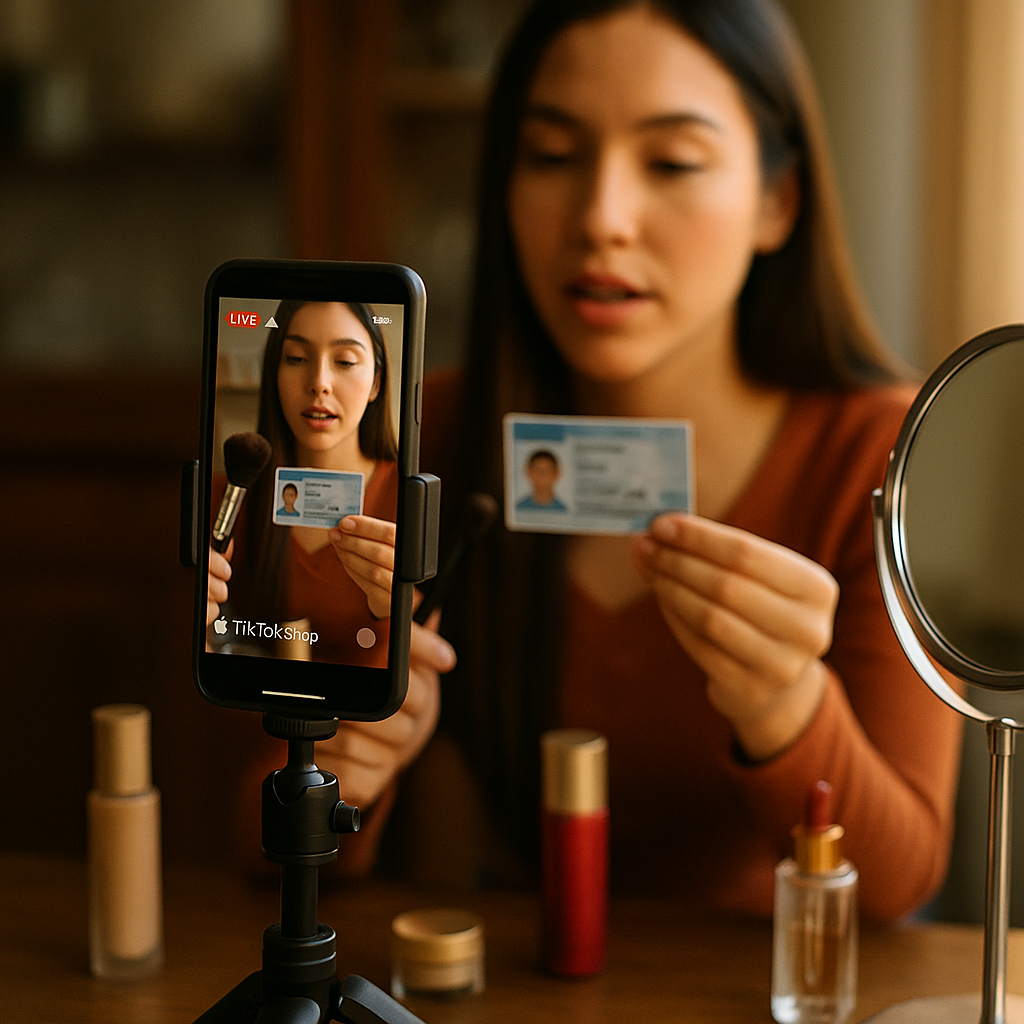
Fourteen-year-olds are watching your brand’s TikTok Shop livestream sell “clinically proven” retinol serums right now. Some states have laws that say that shouldn’t happen without verified parental consent. TikTok Shop livestream age verification has quietly become one of the messiest compliance problems in beauty and supplement marketing, and most brand teams haven’t even mapped the exposure yet.
Here’s the uncomfortable math: TikTok’s core demographic skews young, livestream shopping has no age gate beyond account creation, and at least a dozen states now have social media or e-commerce age-verification statutes with real teeth. Layer beauty actives and supplement ingredients into that mix, and you’ve got a legal collision that most legal teams are still treating as a hypothetical.
The Regulatory Patchwork Nobody Asked For
Utah, Louisiana, Texas, and a growing list of other states have passed age-verification or parental-consent laws aimed at social platforms and, in some cases, e-commerce transactions involving minors. These laws vary wildly in scope. Some target account creation. Others target specific transaction categories, like supplements or products with age-restricted ingredients. A few reach into advertising targeting itself, not just checkout.
None of these laws were written with livestream shopping in mind. Lawmakers pictured static social feeds, not a shoppable video stream where a host says “link’s in the cart, first 50 people get 20% off” while a countdown timer ticks down. That gap between statutory intent and platform reality is exactly where brand risk lives.
A law written for “social media use” doesn’t cleanly map to a livestream checkout flow that completes in under 90 seconds, but state attorneys general aren’t going to give brands credit for the platform’s design choices.
Compare that to TikTok’s own content policies, which already create friction for beauty and supplement sellers. Our TikTok Shop content policy audit breaks down how pricing claims and livestream mechanics create separate exposure even before you add age verification into the picture.
Why Beauty and Supplements Are the Highest-Risk Categories
Not every product category carries the same age-verification burden. Beauty and supplements sit at the top of the risk list for three reasons.
- Ingredient sensitivity: Retinoids, hydroquinone alternatives, caffeine-based supplements, and certain botanicals carry age-related warnings on their own labeling, separate from any platform rule.
- Audience overlap: Beauty and wellness content on TikTok pulls disproportionately young engagement, even when the brand’s stated target audience is 25+.
- Claims density: Both categories are claims-heavy verticals already under scrutiny. Add an under-18 audience question and you’ve got a second regulator interested in the same content.
Supplement brands in particular should already be nervous about claims substantiation. If you haven’t reviewed your process for vetting AI-assisted product claims, start with auditing AI-generated supplement claims before an FDA warning letter forces the issue. Age-verification exposure just adds another layer on top of a claims problem you may already have.
What “Reaching” a Minor Actually Means Legally
This is where brand counsel gets nervous, and rightly so. Some state statutes define “reaching” minors broadly enough to include algorithmic targeting and content exposure, not just completed purchases. That means a livestream that never processes a single sale to a minor can still trigger exposure if the platform’s recommendation engine served that stream to under-18 viewers at scale.
Does your legal team know what percentage of your last livestream’s viewership skewed under 18? Most brands don’t, because TikTok Shop doesn’t hand over granular age-bracket viewership data by default. That data gap is itself a compliance risk. You can’t mitigate what you can’t measure.
Platform Controls vs. State Law: A Persistent Gap
TikTok has rolled out age-assurance features, screen-time limits for teen accounts, and restrictions on certain commerce features for younger users. That’s genuine progress. But platform-level controls and state statutory requirements are not the same thing, and brands that treat TikTok’s settings as a compliance substitute are making a costly assumption.
Platform controls protect the platform. State age-verification laws create obligations for the seller. When a state AG investigates a supplement brand’s livestream sales to minors, “TikTok has a teen mode” is not going to be an adequate defense. The seller of record carries independent liability, and in most influencer-driven livestream setups, that’s the brand, not the creator and not the platform.
This mirrors a pattern we’ve flagged before: platform-provided compliance tools rarely satisfy regulator-level requirements. The same disconnect shows up in AI content labeling, where platform AI labels don’t meet FTC disclosure rules either. Brands keep assuming platform infrastructure equals legal cover. It doesn’t, and regulators keep proving that the hard way.
Building an Actual Compliance Framework
So what does a defensible approach look like in practice? Not a single silver-bullet tool, but a layered operational process.
- Map your exposure state by state. Build a matrix of which states have age-verification or minor-targeting statutes relevant to beauty and supplement e-commerce, and update it quarterly. These laws are moving targets; several were amended or newly enacted within the past eighteen months.
- Segment livestream content by risk tier. Not every livestream needs the same scrutiny. A skincare cleanser demo carries less risk than a stream pushing a caffeine-heavy pre-workout supplement. Tier your content calendar accordingly.
- Add verbal and visual disclaimers to script. Hosts should state age restrictions on camera, not bury them in product descriptions nobody reads during a 90-second flash sale.
- Pressure-test your creator contracts. Does your influencer agreement obligate the creator to include age-gate language? Does it specify who’s liable if they skip it? If you haven’t reviewed sign-off responsibilities recently, the sign-off matrix for creator contracts is a useful model for closing that gap.
- Coordinate legal escalation paths in advance. If a state AG inquiry lands, who owns the response? Marketing, legal, or both? An escalation matrix aligning FTC and state AG risk keeps this from becoming a scramble when the letter actually arrives.
None of this eliminates risk entirely. Livestream commerce is inherently harder to gate than static product pages. But a documented, consistently applied framework is exactly what regulators look for when deciding whether to pursue enforcement or accept a consent decree. Documented good-faith effort matters enormously in these investigations.
Data Minimization Makes This Harder, Not Easier
Here’s a wrinkle that trips up a lot of compliance teams: privacy law and age-verification law pull in opposite directions. Age verification wants you to collect more identity data. Data minimization principles, increasingly baked into state privacy laws and vendor contracts, want you to collect less.
Brands running TikTok Shop and Instagram commerce simultaneously need vendor agreements that resolve this tension explicitly, not by accident. Our piece on data minimization clauses for TikTok Shop vendors covers how to draft around this without accidentally violating either obligation. Getting this wrong doesn’t just create age-verification exposure. It creates a second, separate privacy claim.
Collecting a birthdate to satisfy age-verification law while ignoring your own data minimization commitments is a textbook way to turn one compliance problem into two.
What Enforcement Actually Looks Like
State AG offices have shown they’ll move on consumer protection theories even without a perfectly tailored statute. Texas and California have both signaled active interest in social commerce practices reaching minors, and enforcement doesn’t require a smoking-gun “we knew it was a 13-year-old” email. Pattern evidence, algorithmic targeting data, and internal marketing decks discussing “Gen Z and Gen Alpha appeal” are exactly the kind of discovery material that turns a routine inquiry into a costly settlement.
Marketing teams routinely create this evidence themselves. Internal strategy decks touting “authentic appeal to teen audiences” for a supplement brand are a gift to any investigator building a minor-targeting case. If your creative briefs or influencer casting notes reference teen appeal anywhere near a beauty or supplement SKU, that language needs review before your next campaign cycle, not after a subpoena.
For context on how quickly platform and regulatory expectations shift around younger audiences, the under-16 creator compliance matrix for UK and Australia rules shows how other markets are already ahead of the US on this exact tension. US brands operating internationally should treat that as a preview, not a foreign curiosity.
Industry data backs up the urgency here. Reports from eMarketer continue to show livestream commerce growing faster than traditional social commerce formats in the US, which means more transaction volume flowing through exactly the channel with the weakest age-gating infrastructure. Meanwhile, Statista data on TikTok’s US age demographics makes clear that under-18 users remain a substantial share of active accounts, not a rounding error brands can dismiss.
Practical Next Steps for Brand Teams
Start with an honest audit, not a policy rewrite. Pull your last quarter of TikTok Shop livestream recordings for beauty and supplement SKUs. Check for age-related disclaimers, review creator scripts, and cross-reference against your state exposure matrix. If you find gaps, and you probably will, prioritize fixes by which states carry the steepest per-violation penalties first.
Consult the FTC’s guidance on endorsement disclosures alongside your state-level review. Federal and state requirements aren’t identical, but they overlap enough that a single audit process can catch most of both categories of risk at once.
Frequently Asked Questions
Do state age-verification laws actually apply to TikTok Shop livestreams?
In most cases, yes, if the statute covers e-commerce transactions or targeted marketing reaching minors, not just social media account access. The specific application depends on how each state defines “commercial transaction” and “targeting,” which varies significantly by jurisdiction.
Who is liable if a minor buys a supplement during a brand’s livestream?
Liability typically falls on the seller of record, usually the brand, even when a third-party creator hosts the livestream. Platform terms of service rarely shift this liability, and creator contracts should explicitly address who bears responsibility for age-gate compliance failures.
Does TikTok’s teen account system satisfy state age-verification requirements?
Not necessarily. Platform-level protections address TikTok’s own obligations but don’t automatically satisfy a seller’s independent statutory duties under state law. Brands should treat platform tools as a supplement to, not a replacement for, their own compliance process.
What’s the biggest mistake brands make with livestream age compliance?
Assuming verbal disclaimers or fine-print disclosures are sufficient without documenting the process, and failing to track which states have enacted relevant statutes as new laws pass. Treating this as a one-time policy update instead of an ongoing monitoring obligation is the most common failure point.
Should supplement brands avoid TikTok Shop livestreams entirely?
Not necessarily, but high-risk ingredient categories warrant tighter content controls, documented age-gate scripts, and closer legal review before each campaign than lower-risk beauty categories require.
Next step: Run a 90-day audit of every beauty and supplement livestream your brand has aired on TikTok Shop, cross-referenced against your state exposure matrix, before your next campaign cycle locks in creative and creator contracts.
Frequently Asked Questions
Do state age-verification laws actually apply to TikTok Shop livestreams?
In most cases, yes, if the statute covers e-commerce transactions or targeted marketing reaching minors, not just social media account access. The specific application depends on how each state defines “commercial transaction” and “targeting,” which varies significantly by jurisdiction.
Who is liable if a minor buys a supplement during a brand’s livestream?
Liability typically falls on the seller of record, usually the brand, even when a third-party creator hosts the livestream. Platform terms of service rarely shift this liability, and creator contracts should explicitly address who bears responsibility for age-gate compliance failures.
Does TikTok’s teen account system satisfy state age-verification requirements?
Not necessarily. Platform-level protections address TikTok’s own obligations but don’t automatically satisfy a seller’s independent statutory duties under state law. Brands should treat platform tools as a supplement to, not a replacement for, their own compliance process.
What’s the biggest mistake brands make with livestream age compliance?
Assuming verbal disclaimers or fine-print disclosures are sufficient without documenting the process, and failing to track which states have enacted relevant statutes as new laws pass. Treating this as a one-time policy update instead of an ongoing monitoring obligation is the most common failure point.
Should supplement brands avoid TikTok Shop livestreams entirely?
Not necessarily, but high-risk ingredient categories warrant tighter content controls, documented age-gate scripts, and closer legal review before each campaign than lower-risk beauty categories require.
Top Influencer Marketing Agencies
The leading agencies shaping influencer marketing in 2026
Agencies ranked by campaign performance, client diversity, platform expertise, proven ROI, industry recognition, and client satisfaction. Assessed through verified case studies, reviews, and industry consultations.
Moburst

-
2

The Shelf
Boutique Beauty & Lifestyle Influencer AgencyA data-driven boutique agency specializing exclusively in beauty, wellness, and lifestyle influencer campaigns on Instagram and TikTok. Best for brands already focused on the beauty/personal care space that need curated, aesthetic-driven content.Clients: Pepsi, The Honest Company, Hims, Elf Cosmetics, Pure LeafVisit The Shelf → -
3

Audiencly
Niche Gaming & Esports Influencer AgencyA specialized agency focused exclusively on gaming and esports creators on YouTube, Twitch, and TikTok. Ideal if your campaign is 100% gaming-focused — from game launches to hardware and esports events.Clients: Epic Games, NordVPN, Ubisoft, Wargaming, Tencent GamesVisit Audiencly → -
4

Viral Nation
Global Influencer Marketing & Talent AgencyA dual talent management and marketing agency with proprietary brand safety tools and a global creator network spanning nano-influencers to celebrities across all major platforms.Clients: Meta, Activision Blizzard, Energizer, Aston Martin, WalmartVisit Viral Nation → -
5

The Influencer Marketing Factory
TikTok, Instagram & YouTube CampaignsA full-service agency with strong TikTok expertise, offering end-to-end campaign management from influencer discovery through performance reporting with a focus on platform-native content.Clients: Google, Snapchat, Universal Music, Bumble, YelpVisit TIMF → -
6

NeoReach
Enterprise Analytics & Influencer CampaignsAn enterprise-focused agency combining managed campaigns with a powerful self-service data platform for influencer search, audience analytics, and attribution modeling.Clients: Amazon, Airbnb, Netflix, Honda, The New York TimesVisit NeoReach → -
7

Ubiquitous
Creator-First Marketing PlatformA tech-driven platform combining self-service tools with managed campaign options, emphasizing speed and scalability for brands managing multiple influencer relationships.Clients: Lyft, Disney, Target, American Eagle, NetflixVisit Ubiquitous → -
8

Obviously
Scalable Enterprise Influencer CampaignsA tech-enabled agency built for high-volume campaigns, coordinating hundreds of creators simultaneously with end-to-end logistics, content rights management, and product seeding.Clients: Google, Ulta Beauty, Converse, AmazonVisit Obviously →