


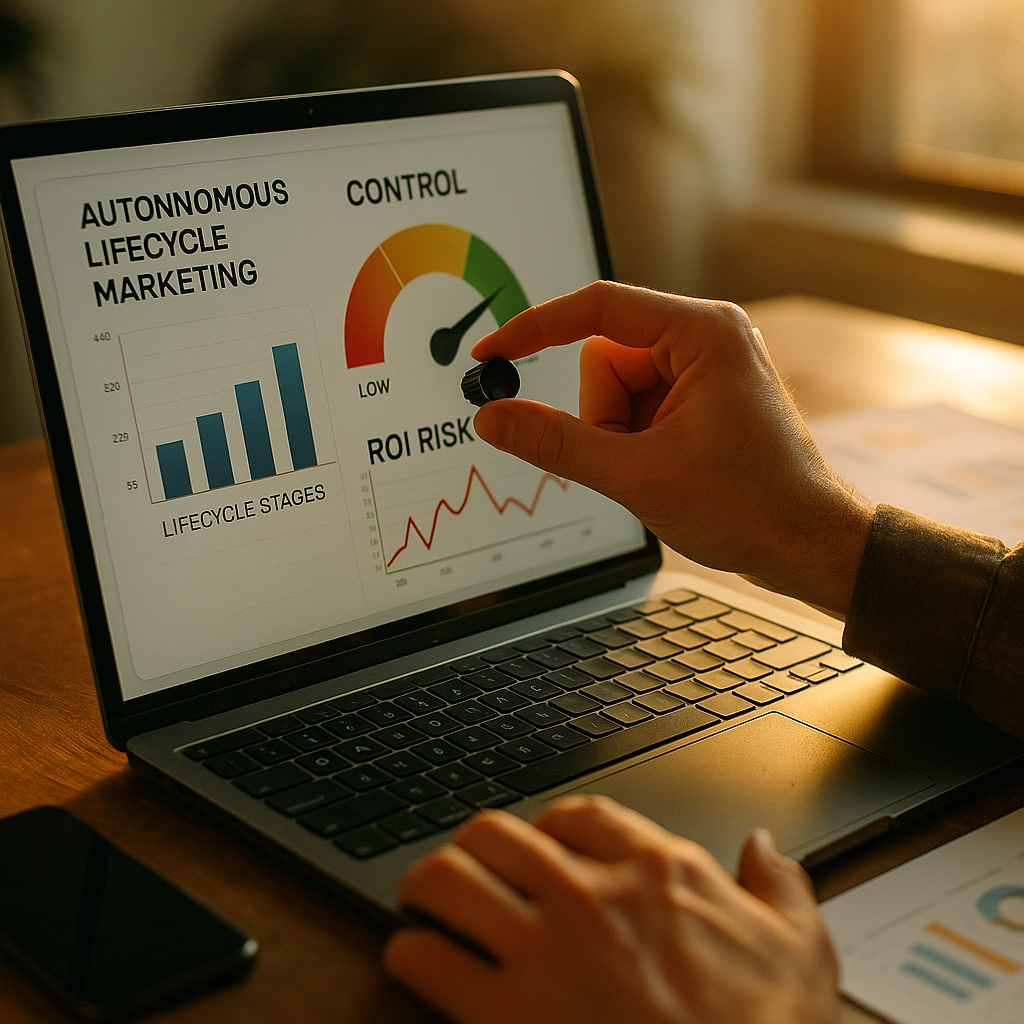
Seventy percent of app users churn within 90 days, and most brands still let a marketer guess whether to send a push notification or an email to win them back. OneSignal’s autonomous lifecycle marketing platform skips the guessing entirely. It watches app-usage signals and picks the channel itself. No campaign manager. No A/B test queue. Just a model deciding, in real time, what gets sent, when, and where.
That’s either the natural next step in lifecycle marketing or a governance headache waiting to happen, depending on who you ask. Let’s dig into what’s actually happening under the hood, and what brand teams need to lock down before they hand channel selection to a predictive model.
What “Autonomous” Actually Means Here
OneSignal has spent years as infrastructure for push notifications, in-app messaging, email, and SMS. The newer layer changes the operating model: instead of marketers building journeys and picking channels manually, a prediction engine scores each user’s likelihood to engage across push, email, SMS, and in-app, then routes the message to whichever channel scores highest at that moment.
The inputs are the usual app-usage telemetry: session frequency, recency, feature engagement, notification opt-in status, historical open and click behavior, even time-of-day responsiveness. Feed that into a model, and you get a per-user, per-moment channel recommendation that updates continuously rather than sitting inside a static segment rule.
The shift isn’t just automation of send timing — it’s automation of the channel decision itself, a step most lifecycle stacks still leave to human rule-builders.
Compare that to legacy lifecycle tools, where a marketer sets up a branching journey: “if user hasn’t opened app in 7 days, send push; if no push open in 24 hours, fallback to email.” That’s automation of sequencing. What’s different now is automation of the decision itself — the model, not a rule a human wrote, decides push beats email for this specific user on this specific day.
Why Brands Are Actually Interested
Push notification opt-in rates on iOS have hovered stubbornly low for years — Apple’s App Tracking Transparency changes didn’t help — and email deliverability keeps getting squeezed by Gmail and Yahoo’s sender requirements. Brands are tired of building rigid journey maps that assume every user behaves the same way. A predictive model that reallocates send channel per-user, in theory, recovers engagement that static rules leave on the table.
There’s a real efficiency argument too. Lifecycle teams are usually small relative to the volume of campaigns they’re expected to run. If a model can handle channel selection, that frees up strategist time for message strategy, offer design, and testing — the parts of the job that actually require human judgment. It’s the same logic driving adoption of automated media buying tools in paid social: let the machine handle allocation, let humans handle strategy.
The ROI Case, and Where It Gets Murky
OneSignal and competing platforms cite lift numbers from case studies — improved retention, higher session frequency, reduced unsubscribe rates. Treat those with the same skepticism you’d apply to any vendor-supplied benchmark. Independent, third-party validation of channel-selection lift specifically (as opposed to lift from better timing or personalization generally) is thin. eMarketer and Statista both track mobile engagement benchmarks broadly, but neither has published isolated data on autonomous channel-routing performance yet. It’s early.
Here’s the practical question brand teams should be asking instead of “does it work”: does it work better than our current rules, measured against our own baseline? That means running the autonomous model against a holdout group still on manual rules for at least one full lifecycle cycle before rolling it out fleet-wide. Anything less is taking the vendor’s word for it, and that’s not how mature marketing orgs make budget decisions.
This is the same discipline that should apply to any AI-driven marketing claim. If you can’t attribute the lift cleanly, you can’t defend the budget line when finance asks. The marketing-mix modeling approach for influencer spend offers a useful template: isolate the variable, hold everything else constant, measure incrementality, not correlation.
Where This Gets Risky: Compliance and Consent
Autonomous channel selection sounds efficient until you remember that push, email, and SMS carry different consent regimes. SMS marketing in the US requires TCPA-compliant opt-in. Email requires CAN-SPAM adherence and increasingly strict list hygiene under Gmail/Yahoo bulk sender rules. Push notifications are governed by app-store permission dialogs, not statute, but that doesn’t mean brands are off the hook, especially under GDPR in the EU or UK GDPR post-Brexit.
If a predictive model decides SMS is the highest-scoring channel for a user who opted into push notifications but never explicitly consented to SMS marketing, that’s not an efficiency win. That’s a compliance violation, and “the algorithm chose it” is not a defense regulators or courts will accept. The FTC has been explicit that automated decision systems don’t dilute existing consent obligations, and the ICO in the UK has said the same about algorithmic marketing more broadly.
An autonomous model can suggest a channel. It cannot manufacture consent that doesn’t exist. Brands that let the platform route messages without a hard consent gate are one class-action complaint away from a very bad quarter.
Practically, this means brand teams need a consent layer sitting above the prediction layer, not folded into it. The model should only ever be allowed to choose among channels the user has actually opted into. That sounds obvious. It’s shockingly easy to get wrong when the routing logic lives inside a third-party black box and your compliance team doesn’t have visibility into the decision path.
Governance: Who Owns the Decision When No One Made It?
This is the operational question that keeps CMOs up at night. When a human marketer builds a journey, there’s an owner. Someone approved the copy, the cadence, the channel logic. When a model makes that call dynamically, ownership gets fuzzy. If open rates tank or complaint volume spikes, who’s accountable — the vendor, the data science team, the lifecycle marketer who turned the feature on?
The answer has to be: the brand, always. Vendors will not indemnify you for engagement decisions their model made using your customer data. That means brands need internal documentation of exactly what the model is authorized to decide, what guardrails exist, and how often outputs get audited. This is the same governance muscle brands are having to build for AI in creative production — see the discipline outlined in tracking every AI tool touching content, just applied to lifecycle messaging instead of creative assets.
A basic governance checklist for autonomous channel selection:
- Document which channels the model can choose between for each user segment, tied explicitly to verified consent status.
- Set a maximum send-frequency cap the model cannot override, regardless of predicted engagement score.
- Require human review of model outputs on a sampling basis, not just aggregate performance dashboards.
- Maintain a rollback plan: if the model’s channel choices trigger a spike in opt-outs or spam complaints, someone needs authority to pause it within hours, not after the next sprint review.
- Log every routing decision for at least the retention period required by your strictest applicable regulation (GDPR generally means longer retention scrutiny than CAN-SPAM).
None of this is exotic. It’s the same operational rigor brands are (slowly) applying to AI agents in media buying and creator vetting. Lifecycle marketing just hasn’t caught up yet, mostly because it’s been treated as a lower-risk, more “operational” function than paid media or influencer partnerships. That assumption is aging badly.
How This Compares to Predictive Send-Time Tools You Already Know
If you’ve used predictive send-time optimization in Braze, Klaviyo, or Iterable, this will feel familiar, just extended. Send-time optimization answers “when.” OneSignal’s model answers “when and where.” That’s a meaningfully bigger decision to hand off, because channel choice has cost implications (SMS costs money per send, push and email largely don’t) and regulatory implications that timing decisions simply don’t carry.
It’s worth noting the parallel to how platform algorithms decide content distribution for brands on social. In both cases, a black-box model is making a resource-allocation decision that used to be a human call, and in both cases, brands are being asked to trust outputs they can’t fully audit. The difference is that a bad TikTok algorithm call costs you reach. A bad autonomous lifecycle call can cost you a regulatory fine.
What Actually Changes for Lifecycle Teams
If your team adopts this, the job doesn’t disappear, it shifts upstream. Less time spent building branching journey logic, more time spent on:
- Defining consent boundaries and guardrails before the model gets access to a segment.
- Auditing model outputs against brand and legal standards, not just conversion metrics.
- Testing message content and offer strategy, since channel selection is no longer the variable you’re optimizing manually.
- Building the incrementality tests that prove the autonomous layer is actually outperforming your prior rules-based approach.
That last point matters more than vendors want to admit. Small language models and lighter-weight prediction engines are increasingly competitive with larger models on narrow, well-defined marketing tasks — the same trend covered in small language models outperforming frontier LLMs on marketing tasks. Channel selection is exactly the kind of narrow, high-volume, low-context task where a purpose-built model can outperform a general one, and where the ROI case is genuinely plausible, if you validate it yourself rather than taking a case study at face value.
The Bottom Line
OneSignal’s approach is a legitimate signal of where lifecycle marketing is heading: fewer manual rules, more dynamic per-user decisioning, and less human involvement in the mechanics of send logic. That’s not inherently bad. But “autonomous” should never mean “unaccountable.” Run it against a holdout, gate it behind hard consent rules, and keep a human with rollback authority in the loop — the moment nobody owns the model’s decisions is the moment this stops being lifecycle marketing and starts being a liability.
FAQs
What is OneSignal’s autonomous lifecycle marketing platform?
It’s a predictive layer added to OneSignal’s messaging infrastructure that uses app-usage data to automatically choose which channel (push, email, SMS, or in-app) to send a message through for each user, rather than relying on a marketer-built rules engine.
Does autonomous channel selection replace lifecycle marketers?
No. It shifts the job from building manual journey logic to setting guardrails, auditing outputs, testing message content, and validating whether the model’s channel choices actually outperform prior rules-based approaches.
Is autonomous channel selection compliant with SMS and email regulations?
Only if consent is gated above the model, not inside it. The model should only ever choose among channels a user has explicitly consented to; regulators like the FTC and ICO hold brands responsible regardless of whether an algorithm made the routing decision.
How can a brand measure ROI from this kind of platform?
Run the autonomous model against a holdout segment still using manual channel rules for at least one full lifecycle cycle, then compare engagement, opt-out rates, and cost per send before rolling it out broadly.
What’s the biggest risk with predictive channel selection?
Consent and compliance gaps. If the model can select a channel the user never opted into (like SMS), the brand carries the regulatory liability, not the vendor.
FAQs
Top Influencer Marketing Agencies
The leading agencies shaping influencer marketing in 2026
Agencies ranked by campaign performance, client diversity, platform expertise, proven ROI, industry recognition, and client satisfaction. Assessed through verified case studies, reviews, and industry consultations.
Moburst

-
2

The Shelf
Boutique Beauty & Lifestyle Influencer AgencyA data-driven boutique agency specializing exclusively in beauty, wellness, and lifestyle influencer campaigns on Instagram and TikTok. Best for brands already focused on the beauty/personal care space that need curated, aesthetic-driven content.Clients: Pepsi, The Honest Company, Hims, Elf Cosmetics, Pure LeafVisit The Shelf → -
3

Audiencly
Niche Gaming & Esports Influencer AgencyA specialized agency focused exclusively on gaming and esports creators on YouTube, Twitch, and TikTok. Ideal if your campaign is 100% gaming-focused — from game launches to hardware and esports events.Clients: Epic Games, NordVPN, Ubisoft, Wargaming, Tencent GamesVisit Audiencly → -
4

Viral Nation
Global Influencer Marketing & Talent AgencyA dual talent management and marketing agency with proprietary brand safety tools and a global creator network spanning nano-influencers to celebrities across all major platforms.Clients: Meta, Activision Blizzard, Energizer, Aston Martin, WalmartVisit Viral Nation → -
5

The Influencer Marketing Factory
TikTok, Instagram & YouTube CampaignsA full-service agency with strong TikTok expertise, offering end-to-end campaign management from influencer discovery through performance reporting with a focus on platform-native content.Clients: Google, Snapchat, Universal Music, Bumble, YelpVisit TIMF → -
6

NeoReach
Enterprise Analytics & Influencer CampaignsAn enterprise-focused agency combining managed campaigns with a powerful self-service data platform for influencer search, audience analytics, and attribution modeling.Clients: Amazon, Airbnb, Netflix, Honda, The New York TimesVisit NeoReach → -
7

Ubiquitous
Creator-First Marketing PlatformA tech-driven platform combining self-service tools with managed campaign options, emphasizing speed and scalability for brands managing multiple influencer relationships.Clients: Lyft, Disney, Target, American Eagle, NetflixVisit Ubiquitous → -
8

Obviously
Scalable Enterprise Influencer CampaignsA tech-enabled agency built for high-volume campaigns, coordinating hundreds of creators simultaneously with end-to-end logistics, content rights management, and product seeding.Clients: Google, Ulta Beauty, Converse, AmazonVisit Obviously →