


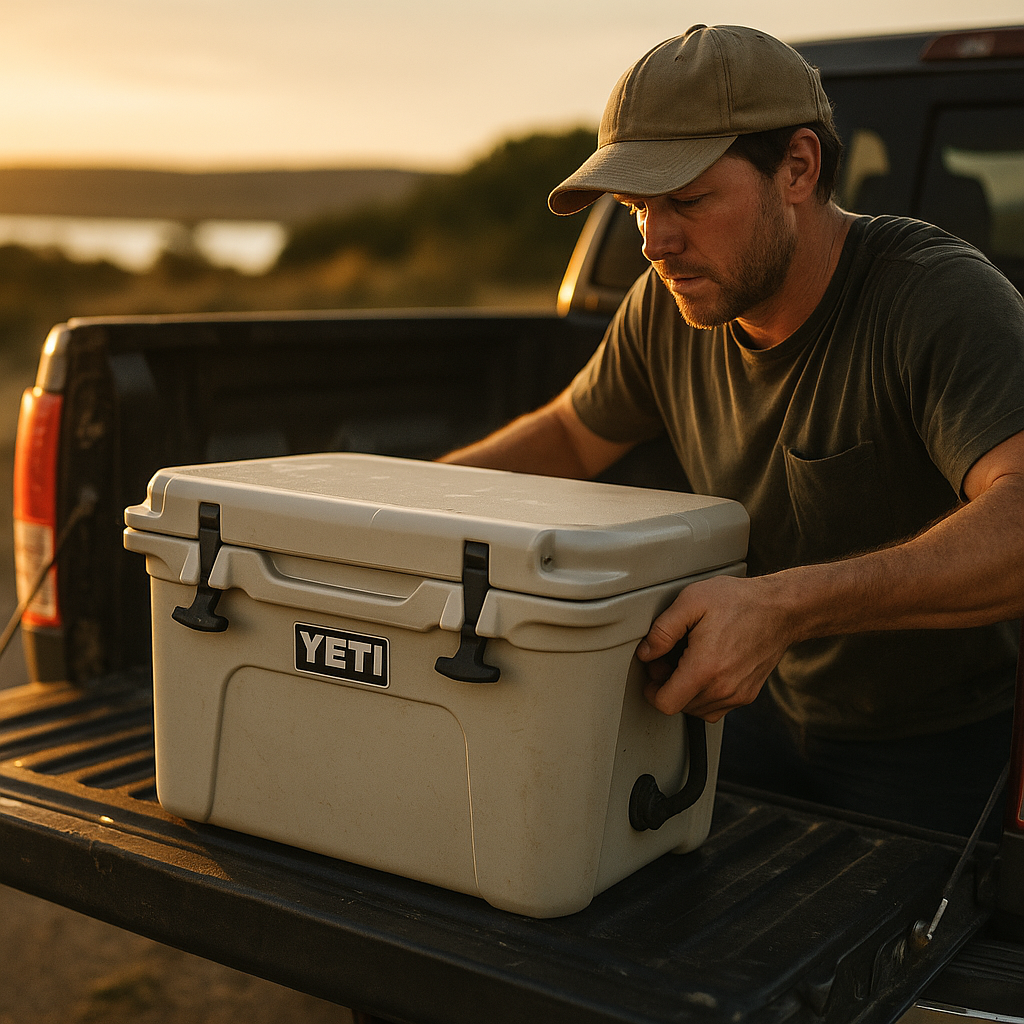
A $350 cooler shouldn’t outsell a $40 one. Yet YETI did exactly that, building a premium cooler category from nothing while spending a fraction of what competitors poured into national TV and retail circulars. The secret wasn’t a Super Bowl spot. It was fishing guides, hunting outfitters, and backyard barbecue obsessives posting real photos of real coolers taking real abuse.
The Category Didn’t Exist Until YETI Made It
Before YETI, a cooler was a cooler. You bought whatever was cheapest at the hardware store, it cracked after two summers, and you replaced it. Nobody aspired to own a better cooler. There was no “premium” tier because nobody had proven the category could support one.
YETI’s founders, Roy and Ryan Seiderman, built a cooler that could survive a bear attack and hold ice for days. Then came the harder part: convincing people to pay four to seven times more than a standard cooler cost. National advertising couldn’t do that job. Trust could. And trust, it turns out, travels fastest through people who already have credibility with a skeptical audience.
That’s why YETI’s early growth engine wasn’t a media buy. It was a network of hunting guides, fishing charters, and ranch hands who used the product daily and had something to lose if they vouched for junk.
Local Guides as the Original Trust Layer
Long before “nano-creator” was a marketing term, YETI was seeding coolers to fishing guides in Texas, hunting outfitters in Montana, and ranchers who needed gear that could survive being run over by a truck. These weren’t influencers in the platform sense. They were tradespeople with small but devoted local followings, the kind of person a whole town trusts because they’ve watched them work for twenty years.
The mechanics were simple. Give away product to people whose professional reputation depends on gear performing under real conditions. Let them talk about it unprompted, at the boat ramp, in hunting forums, at the feed store. No script, no hashtag requirement, no posting calendar.
YETI treated regional trust networks as media inventory long before “creator economy” was a category, buying credibility with product instead of impressions.
This mirrors a pattern showing up across the outdoor and lifestyle space today. REI’s nano-influencer trail review program works on the same logic: hyperlocal credibility outperforms broad reach when the purchase decision hinges on durability and trust, not just visibility.
Why National Ads Would Have Killed the Premium Story
Here’s the uncomfortable truth about premium positioning: mass advertising tends to cheapen it. A 30-second national spot screams for attention, competes with fast food and car insurance ads, and gets processed by the viewer as “just another commercial.” That’s fine for commodity products. It’s poison for a brand trying to justify a 400% price premium.
YETI needed the opposite: quiet, credible, word-of-mouth validation from people the target buyer already respected. A hunting guide’s Instagram post showing a YETI Tundra strapped to a truck bed after ten years of abuse does more to justify the price tag than any polished ad ever could. It’s proof, not persuasion.
Consider the buyer psychology. Someone spending $350 on a cooler isn’t impulse-buying. They’re researching, asking friends, reading forums, watching how the gear performs in conditions they recognize. Sprout Social’s research on consumer trust consistently shows that peer recommendations and authentic use-case content outperform branded messaging for considered purchases, and a cooler that costs more than a flight is a considered purchase.
The Seeding Playbook, Broken Down
YETI’s approach can be reverse-engineered into a repeatable framework, and it’s one other brands in the outdoor, food, and lifestyle spaces have since adapted:
- Identify micro-communities with high trust density. Fishing guides, hunting outfitters, competitive BBQ pitmasters, ranch families. Small audiences, but audiences that believe every word.
- Seed product without scripts. No brand deal, no required post cadence. Just gear in the hands of people who’ll use it hard and talk about it honestly.
- Let regional pockets build before going national. YETI grew state by state, sport by sport, before it was a household name. Texas and the Gulf Coast fishing scene came first, then hunting, then general outdoor and tailgate culture.
- Sponsor events, not campaigns. Fishing tournaments, rodeos, hunting expos. Physical presence where the community already gathers beats a digital ad buy targeting the same demographic.
- Turn owners into unpaid sales reps. A branded sticker on a truck bumper, a cooler visible at every tailgate, becomes ambient advertising that costs nothing after the initial seed.
This isn’t dramatically different from what food and beverage brands are doing now with nano-creator seeding. Chomps built an entire meat stick category using a nearly identical logic: seed real users, let authentic reactions do the convincing, skip the national ad spend until the category itself has proof of demand.
Scaling Without Losing the Authenticity That Built It
The hard part isn’t starting a seeding program. It’s scaling one without turning it into the same over-produced influencer marketing that made it necessary in the first place. YETI’s approach evolved as the brand grew, but the core discipline held: partner with people who’d use the product regardless of payment, and resist the urge to control the message too tightly.
As YETI expanded into new verticals, drinkware, backpacks, apparel, it applied the same playbook to new audiences. Campers, off-roaders, tailgaters, even corporate office workers carrying a Rambler tumbler. Each new segment got its own set of credible, small-scale voices rather than a single celebrity spokesperson trying to speak to everyone.
This is the same tension brands like Vuori navigated when cracking menswear with a nano-to-macro creator ladder, and what Duluth Trading solved for workwear using nano-creators instead of celebrity endorsement deals. The pattern holds across categories: authenticity scales through volume and selection discipline, not through bigger budgets per creator.
What the Data Says About Category-Building Without Mass Media
YETI’s financial trajectory backs up the strategy. The company went public in 2018 and has consistently posted premium margins that would be impossible if the brand were competing purely on price or ad share of voice. eMarketer’s research on influencer and creator marketing spend shows brands increasingly shifting budget away from broad-reach media toward creator partnerships precisely because of this margin protection effect: when trust does the selling, you don’t need to discount to compete.
There’s also a risk-mitigation angle marketers should weigh carefully. National ad campaigns carry brand-safety exposure, production costs, and long lead times. A seeding-based approach, when structured properly with clear disclosure guidance aligned to FTC endorsement guidelines, spreads risk across many smaller relationships instead of concentrating it in one expensive campaign that can misfire.
A cooler that costs seven times the category average doesn’t get justified by a jingle. It gets justified by a guide who’s used it for a decade and still trusts it not to crack.
Where This Leaves Brands Building a New Premium Category
YETI’s story isn’t really about coolers. It’s a template for any brand trying to convince a skeptical buyer to pay more for something that looks, on paper, like a commodity. The same logic has powered premium plays across categories, from Olipop’s $2B soda category build to Wyze’s cult camera following. In every case, small, credible voices did what mass media couldn’t: prove the premium was earned, not marketed.
Marketers evaluating this model should ask a blunt question before copying it: does your product actually hold up under the scrutiny of an expert user? YETI’s playbook only works if the product survives the bear attack, literally and figuratively. Seeding a mediocre product to credible voices just accelerates honest, public disappointment.
Frequently Asked Questions
What made YETI’s marketing different from typical consumer product launches?
YETI skipped national advertising almost entirely in its early years, instead seeding product directly to hunting guides, fishing charters, and outdoor professionals whose credibility with local audiences couldn’t be bought through a media buy.
Is local guide seeding the same as nano-creator marketing?
They’re closely related. Local guide seeding predates the platform-driven creator economy, but the underlying mechanic, giving product to trusted micro-community voices instead of paying for mass reach, is the same principle powering modern nano-creator strategies.
Can this strategy work for brands outside the outdoor category?
Yes. The same logic has been applied successfully in food and beverage, apparel, and consumer electronics. The requirement is a product durable or effective enough to survive scrutiny from credible, hands-on users.
How does a brand measure ROI on a seeding program versus paid media?
Track regional sales lift, branded search volume growth, retail sell-through in seeded markets, and organic mention volume rather than traditional impression or click metrics, since the goal is trust-building, not immediate direct response.
What’s the biggest risk in running a seeding-based strategy instead of ads?
Slower initial scale and less control over messaging timing. Brands need patience for regional pockets of demand to build before the strategy pays off nationally, and they need FTC-compliant disclosure practices in place from the start.
The takeaway: if your product can survive scrutiny from the people who’d know a fake claim instantly, seed it to them before you buy a single impression. Category creation isn’t won with reach. It’s won with proof, distributed one credible voice at a time.
Frequently Asked Questions
What made YETI’s marketing different from typical consumer product launches?
YETI skipped national advertising almost entirely in its early years, instead seeding product directly to hunting guides, fishing charters, and outdoor professionals whose credibility with local audiences couldn’t be bought through a media buy.
Is local guide seeding the same as nano-creator marketing?
They’re closely related. Local guide seeding predates the platform-driven creator economy, but the underlying mechanic, giving product to trusted micro-community voices instead of paying for mass reach, is the same principle powering modern nano-creator strategies.
Can this strategy work for brands outside the outdoor category?
Yes. The same logic has been applied successfully in food and beverage, apparel, and consumer electronics. The requirement is a product durable or effective enough to survive scrutiny from credible, hands-on users.
How does a brand measure ROI on a seeding program versus paid media?
Track regional sales lift, branded search volume growth, retail sell-through in seeded markets, and organic mention volume rather than traditional impression or click metrics, since the goal is trust-building, not immediate direct response.
What’s the biggest risk in running a seeding-based strategy instead of ads?
Slower initial scale and less control over messaging timing. Brands need patience for regional pockets of demand to build before the strategy pays off nationally, and they need FTC-compliant disclosure practices in place from the start.
Top Influencer Marketing Agencies
The leading agencies shaping influencer marketing in 2026
Agencies ranked by campaign performance, client diversity, platform expertise, proven ROI, industry recognition, and client satisfaction. Assessed through verified case studies, reviews, and industry consultations.
Moburst

-
2

The Shelf
Boutique Beauty & Lifestyle Influencer AgencyA data-driven boutique agency specializing exclusively in beauty, wellness, and lifestyle influencer campaigns on Instagram and TikTok. Best for brands already focused on the beauty/personal care space that need curated, aesthetic-driven content.Clients: Pepsi, The Honest Company, Hims, Elf Cosmetics, Pure LeafVisit The Shelf → -
3

Audiencly
Niche Gaming & Esports Influencer AgencyA specialized agency focused exclusively on gaming and esports creators on YouTube, Twitch, and TikTok. Ideal if your campaign is 100% gaming-focused — from game launches to hardware and esports events.Clients: Epic Games, NordVPN, Ubisoft, Wargaming, Tencent GamesVisit Audiencly → -
4

Viral Nation
Global Influencer Marketing & Talent AgencyA dual talent management and marketing agency with proprietary brand safety tools and a global creator network spanning nano-influencers to celebrities across all major platforms.Clients: Meta, Activision Blizzard, Energizer, Aston Martin, WalmartVisit Viral Nation → -
5

The Influencer Marketing Factory
TikTok, Instagram & YouTube CampaignsA full-service agency with strong TikTok expertise, offering end-to-end campaign management from influencer discovery through performance reporting with a focus on platform-native content.Clients: Google, Snapchat, Universal Music, Bumble, YelpVisit TIMF → -
6

NeoReach
Enterprise Analytics & Influencer CampaignsAn enterprise-focused agency combining managed campaigns with a powerful self-service data platform for influencer search, audience analytics, and attribution modeling.Clients: Amazon, Airbnb, Netflix, Honda, The New York TimesVisit NeoReach → -
7

Ubiquitous
Creator-First Marketing PlatformA tech-driven platform combining self-service tools with managed campaign options, emphasizing speed and scalability for brands managing multiple influencer relationships.Clients: Lyft, Disney, Target, American Eagle, NetflixVisit Ubiquitous → -
8

Obviously
Scalable Enterprise Influencer CampaignsA tech-enabled agency built for high-volume campaigns, coordinating hundreds of creators simultaneously with end-to-end logistics, content rights management, and product seeding.Clients: Google, Ulta Beauty, Converse, AmazonVisit Obviously →