


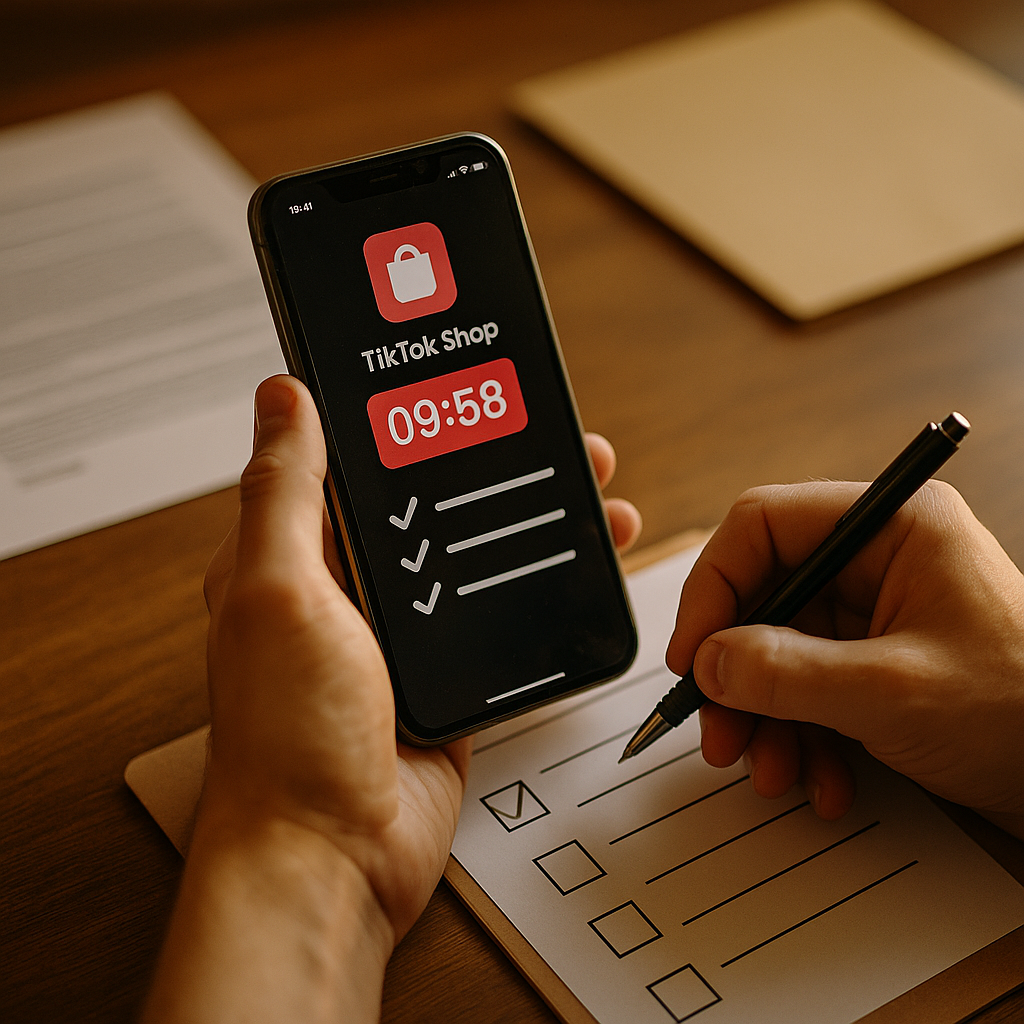
Sixty-two percent of TikTok Shop livestreams now use a countdown timer to push checkout — and the FTC has made clear it’s watching. If your influencer program treats the compliance checklist for reconciling FTC endorsement rules with livestream urgency mechanics as an afterthought, you’re one screenshot away from a demand letter.
The mechanics of TikTok Shop livestreams weren’t built with the FTC’s Endorsement Guides in mind. They were built to move product in real time. Those two goals aren’t naturally compatible, and legal teams are only now catching up to how badly they can collide.
Why This Collision Is Happening Now
TikTok Shop livestream commerce crossed $33 billion in US gross merchandise value last year, according to industry estimates, and countdown timers are the platform’s favorite conversion lever. Hosts flash “3 minutes left at this price,” the clock hits zero, and then — surprise — it resets. Sometimes automatically. Sometimes at the host’s discretion. Either way, viewers who bought at minute two often watch the same “limited-time” deal reappear at minute twelve.
That’s not a UX quirk. That’s a live demonstration of false scarcity, and the FTC has spent the last two years signaling it treats manufactured urgency as a deceptive practice, regardless of whether a human host or an algorithm triggers the reset. Add an affiliate commission structure, a paid partnership, or a brand-supplied script, and you’ve stacked disclosure obligations on top of scarcity claims. Most compliance teams are reviewing these two risks separately. They need one checklist that handles both.
A countdown timer that resets after hitting zero isn’t just a UX pattern — in FTC terms, it’s a testable claim about scarcity, and testable claims need substantiation.
The Core Conflict: Urgency Mechanics vs. Disclosure Clarity
FTC endorsement law requires that a “material connection” — payment, free product, affiliate commission — be disclosed clearly and conspicuously, in a way an average consumer notices before making a purchase decision. TikTok Shop’s countdown UI is optimized for the opposite: fast scanning, minimal friction, instant tap-to-buy.
Put a disclosure banner on screen for eight seconds during a sixty-second countdown, and you’ve technically checked a box while functionally hiding the ball. Regulators don’t grade on technicalities.
Three specific friction points show up in nearly every audit we’ve reviewed:
- Timer resets erase the shopper’s sense of window. If “ends in 5 minutes” becomes “ends in 5 minutes” again twenty minutes later, that’s a repeatable deception, not a one-off glitch.
- Disclosure timing doesn’t match purchase timing. A host might disclose “#ad” at the top of a two-hour stream, but a viewer who joins mid-stream and buys during a countdown never sees it.
- Pinned comments and on-screen text disappear during peak urgency. Platforms often bury persistent disclosure text behind product cards, gift animations, or the countdown graphic itself.
Our sister analysis on livestream countdown timer audits breaks down how FTC deceptive-urgency doctrine applies frame by frame. Pair that with the disclosure-language specifics in FTC disclosure language for timer resets, and you start to see the shape of a defensible program.
The Compliance Checklist
Here’s the operational version — the one you can hand to a creator manager or paste into a livestream production brief.
1. Pre-Stream: Script and Disclosure Placement
- Require every host to verbally disclose the material connection (“this is a paid partnership with [Brand]”) within the first 30 seconds of stream start, and again after every timer reset.
- Add a persistent, non-collapsible on-screen disclosure label — not just a pinned comment that scrolls out of view.
- Document who controls the countdown timer: platform automation, host manually, or a brand-side dashboard. You need this on record before the stream airs, not after a complaint.
2. During the Stream: Urgency Claims Need a Paper Trail
If a host says “only 12 left,” someone on your team should be able to produce inventory data proving that at the timestamp it was said. If a timer says “price ends in 5 minutes,” the price needs to actually change — or the claim needs to be reworded to something defensible, like “featured price” rather than “ending” price.
If you can’t produce a timestamped record proving a scarcity claim was true when it was made, assume a regulator will treat it as false.
This is where most brands get caught flat. Marketing wants urgency language because it converts. Legal wants substantiation. The fix isn’t picking a side — it’s building a real-time logging requirement into the livestream tech stack so urgency claims are automatically time-stamped against actual inventory and pricing data.
3. Post-Stream: Archive Everything, Not Just Highlights
- Keep the full unedited stream recording, not a clipped highlight reel, for a minimum of the FTC’s typical look-back window plus a buffer — most compliance teams standardize on three years.
- Log every timer reset event with a timestamp and the reason (inventory replenished, host discretion, automated rule).
- Store the disclosure script version that was actually used, since hosts frequently improvise off the approved copy.
If your team is already tracking AI-assisted clip generation from these streams for repurposing, note that re-editing a livestream clip can strip the disclosure that was present in the original broadcast. That’s a separate but related risk — see how disclosure breaks when AI remixes clips for how that gap opens up downstream.
Where State Law Adds a Second Layer
The FTC isn’t the only regulator with an opinion on countdown timers. Several states have their own deceptive-urgency statutes that don’t require proof of federal-level materiality — meaning a claim that survives FTC scrutiny might still violate California or New York consumer protection law. If your brand runs national livestream campaigns, a state-by-state urgency claim review isn’t optional anymore.
Our breakdown of state deceptive-urgency law risk maps which states have the lowest tolerance for repeat-reset timers, and it’s worth building into your legal review cadence rather than treating as a one-time check.
Contract language matters here too. If your influencer agreements don’t explicitly assign responsibility for disclosure compliance during livestream urgency mechanics, you’re exposed regardless of what the creator actually says on camera. The TikTok Shop livestream disclosure clause template is a reasonable starting point for locking that down contractually rather than hoping creators self-police.
What Good Looks Like: A Realistic Operating Model
Brands that get this right generally do three things differently.
First, they treat livestream commerce as a regulated marketing channel, not a creative wildcard — meaning it gets the same pre-approval workflow as a paid media buy, not the light-touch review reserved for organic content.
Second, they build disclosure into the platform layer, not just the script. That means working with TikTok Shop’s dashboard tools to hard-code disclosure text into the stream overlay rather than relying on host memory.
Third, they run quarterly self-audits using recorded stream footage, checking timer-reset frequency against actual inventory changes.
None of this is exotic. It’s the same discipline brands already apply to paid partnership labeling in static posts, just extended to a faster, higher-pressure format. The tools exist. The gap is usually operational will, not technical capability.
For teams weighing platform mix, it’s also worth comparing how disclosure timing rules differ across channels — the disclosure rule comparison across YouTube, TikTok, and Instagram is a useful reference when standardizing policy across a multi-platform creator roster.
Industry benchmarks from eMarketer and social commerce data tracked by Sprout Social both point to livestream shopping as the fastest-growing segment of influencer-driven revenue in the US market. Growth of that speed always outpaces the compliance infrastructure built to support it. That’s exactly the gap this checklist is meant to close.
Next Step
Don’t wait for a warning letter to build this workflow. Pull your last ten TikTok Shop livestreams, check timer-reset frequency against actual disclosure timestamps, and if more than one shows a gap, treat that as your compliance priority for the next planning cycle — not a someday project.
FAQs
Does the FTC specifically regulate countdown timers on TikTok Shop?
The FTC doesn’t name TikTok Shop specifically, but its Endorsement Guides and Section 5 deceptive-practices authority apply to any urgency claim, including countdown timers, regardless of platform. If a timer implies a deal ends and then resets, that’s the kind of claim the FTC has pursued in other contexts.
Who is liable when a creator’s livestream disclosure is inadequate — the brand or the creator?
Both can be held liable. The FTC has stated brands share responsibility for ensuring disclosures happen, even when a creator controls the live delivery. Contracts should explicitly assign disclosure duties, but that doesn’t eliminate brand-side exposure.
How long should brands retain livestream recordings for compliance purposes?
Most legal teams recommend at least three years of full, unedited recordings, matching typical FTC and state-level look-back periods for consumer protection claims. Highlight clips alone aren’t sufficient documentation.
Can a countdown timer legally reset after hitting zero?
It can, but only if the underlying claim was true when made and the reset reflects a genuinely new offer (restocked inventory, new price tier) rather than a repeated version of the same “ending soon” claim. Repeated resets without substantiation are a common trigger for deceptive-urgency scrutiny.
Do state laws impose stricter standards than the FTC on livestream urgency claims?
Yes, several states have consumer protection statutes with lower thresholds for proving deception than federal law requires, meaning a claim that survives FTC review could still violate state law. National livestream programs should build state-specific review into their compliance process.
FAQs
Top Influencer Marketing Agencies
The leading agencies shaping influencer marketing in 2026
Agencies ranked by campaign performance, client diversity, platform expertise, proven ROI, industry recognition, and client satisfaction. Assessed through verified case studies, reviews, and industry consultations.
Moburst

-
2

The Shelf
Boutique Beauty & Lifestyle Influencer AgencyA data-driven boutique agency specializing exclusively in beauty, wellness, and lifestyle influencer campaigns on Instagram and TikTok. Best for brands already focused on the beauty/personal care space that need curated, aesthetic-driven content.Clients: Pepsi, The Honest Company, Hims, Elf Cosmetics, Pure LeafVisit The Shelf → -
3

Audiencly
Niche Gaming & Esports Influencer AgencyA specialized agency focused exclusively on gaming and esports creators on YouTube, Twitch, and TikTok. Ideal if your campaign is 100% gaming-focused — from game launches to hardware and esports events.Clients: Epic Games, NordVPN, Ubisoft, Wargaming, Tencent GamesVisit Audiencly → -
4

Viral Nation
Global Influencer Marketing & Talent AgencyA dual talent management and marketing agency with proprietary brand safety tools and a global creator network spanning nano-influencers to celebrities across all major platforms.Clients: Meta, Activision Blizzard, Energizer, Aston Martin, WalmartVisit Viral Nation → -
5

The Influencer Marketing Factory
TikTok, Instagram & YouTube CampaignsA full-service agency with strong TikTok expertise, offering end-to-end campaign management from influencer discovery through performance reporting with a focus on platform-native content.Clients: Google, Snapchat, Universal Music, Bumble, YelpVisit TIMF → -
6

NeoReach
Enterprise Analytics & Influencer CampaignsAn enterprise-focused agency combining managed campaigns with a powerful self-service data platform for influencer search, audience analytics, and attribution modeling.Clients: Amazon, Airbnb, Netflix, Honda, The New York TimesVisit NeoReach → -
7

Ubiquitous
Creator-First Marketing PlatformA tech-driven platform combining self-service tools with managed campaign options, emphasizing speed and scalability for brands managing multiple influencer relationships.Clients: Lyft, Disney, Target, American Eagle, NetflixVisit Ubiquitous → -
8

Obviously
Scalable Enterprise Influencer CampaignsA tech-enabled agency built for high-volume campaigns, coordinating hundreds of creators simultaneously with end-to-end logistics, content rights management, and product seeding.Clients: Google, Ulta Beauty, Converse, AmazonVisit Obviously →