


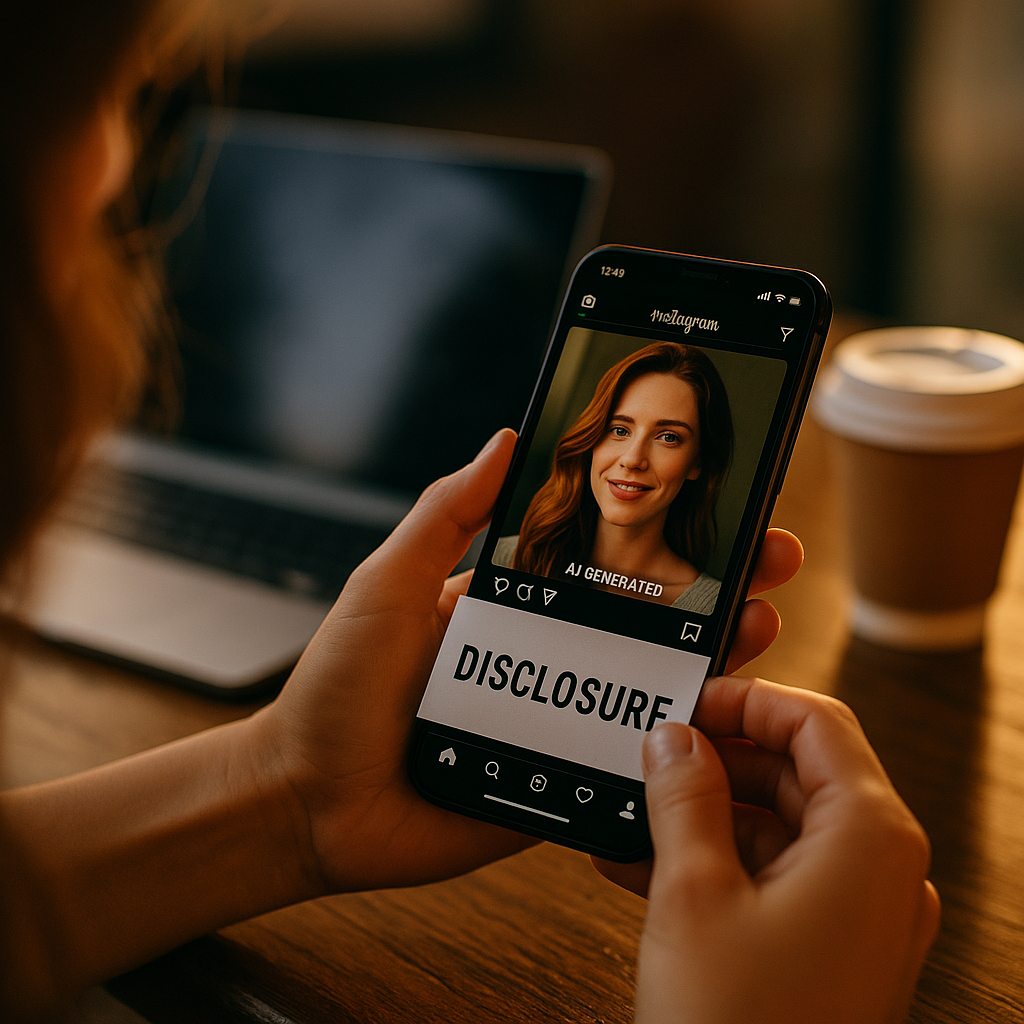
73% of consumers say they’ve been misled by an AI-generated recommendation at least once — and the FTC has decided it’s had enough. The FTC clear-and-conspicuous standard for AI-assisted endorsements now requires brands to disclose material connections before a shopper takes any action that moves them toward a purchase, not after they’ve already clicked, swiped, or asked a chatbot for a second opinion.
If your compliance playbook still treats disclosure as a caption hashtag or a buried footer link, you’re already behind. This standard changes the timing, the placement, and the burden of proof — and it puts brands, not just creators, squarely on the hook.
What Actually Changed in the Standard
The FTC’s endorsement guidance has always required disclosures to be “clear and conspicuous.” That phrase used to leave room for interpretation — a #ad tag at the end of a caption often passed muster. Not anymore. The updated framework specifically addresses AI-assisted endorsements: content generated, curated, or amplified by AI agents, shopping assistants, or synthetic personas acting on a brand’s behalf.
The core shift is about sequencing. Disclosure now has to happen before the first meaningful interaction — before a user clicks through from an AI shopping agent’s recommendation, before they follow a chatbot’s product suggestion, before they engage with an AI-voiced avatar pitching a discount code. The FTC’s logic is straightforward: if a consumer has already taken an action based on an undisclosed endorsement, the disclosure arrived too late to inform their decision.
The new benchmark isn’t “was it disclosed somewhere” — it’s “was it disclosed before the consumer did anything that moved them closer to a purchase.”
This matters enormously for AI shopping agents, browser copilots, and conversational commerce tools that surface product picks mid-conversation. If an AI assistant recommends a skincare brand because that brand paid for placement, and the user clicks through before ever seeing a disclosure, that’s a violation under the new timing rule — full stop.
Why “First Extra Click” Is the New Compliance Trigger
Marketers love a bright line, and the FTC has finally drawn one. The “first extra click” concept refers to any action beyond the initial view — a tap on a product card, a swipe to a linked page, a voice command that triggers a purchase flow. The disclosure has to be visible and unambiguous before that action happens, not layered in afterward as a disclaimer.
Think about how many AI-assisted touchpoints now exist in a typical purchase journey. A shopper sees a TikTok Shop livestream where an AI-generated avatar recommends a product. They tap the product card. They land on a page with an AI chatbot upselling a bundle. Each of those moments is a potential disclosure checkpoint, and each one needs to pass the clear-and-conspicuous test independently.
This is exactly the kind of layered-touchpoint problem brands have been fighting with countdown timers and livestream urgency tactics, too. Our breakdown of FTC endorsement rules and countdown timers covers a similar sequencing issue: the moment a disclosure needs to appear versus the moment a consumer commits to acting.
Where Brands Get This Wrong
- Disclosure buried in a linked terms page. If it requires a second click to find, it fails the standard.
- AI-generated captions that summarize but strip disclosure text. Automated repurposing tools often drop hashtags during rewrites.
- Voice-based disclosures that are too fast or too quiet. Audio disclosures in AI avatar content need to match the pacing and volume of the main pitch.
- Assuming platform labels count as your disclosure. TikTok’s “AI-generated” tag is not the same as an FTC-compliant material connection disclosure — a distinction we unpack in TikTok AI labels vs FTC disclosure rules.
That last point trips up more brands than anything else. Platform-level AI labels exist to inform users about content generation methods. They say nothing about who paid for the endorsement. Two entirely different disclosure obligations, frequently confused as one.
The Compliance Gap Between State Law and Federal Guidance
Here’s where it gets messy for legal teams. The FTC’s clear-and-conspicuous standard operates at the federal level under Section 5, but several states have layered on their own AI disclosure statutes with different triggers, different exemptions, and different penalty structures. A disclosure that satisfies the FTC might still fall short of a state requirement, and vice versa.
We’ve tracked this tension in detail in state AI disclosure laws vs FTC Section 5, and the gap hasn’t closed with this update — if anything, it’s widened. Brands running national campaigns through AI-assisted creator content now need a disclosure standard that satisfies the strictest applicable jurisdiction, then applies it uniformly. Patchwork compliance, where disclosure language varies by state targeting, is operationally exhausting and legally risky if your geo-targeting logic has any gaps.
Building to the strictest state requirement and applying it everywhere is no longer a “nice to have” — it’s the only version of this that scales without a legal review for every regional variant.
What This Means for AI Shopping Agents and Conversational Commerce
AI shopping agents are the sharpest edge of this issue. These tools — whether built by retailers, browser makers, or third-party assistants — increasingly recommend products based on paid placement, affiliate arrangements, or brand partnerships baked into their training or retrieval systems. The FTC has made clear that if an AI agent’s recommendation carries a material connection, that connection needs disclosure before the user acts on it.
Our AI shopping agent compliance checklist walks through the practical mechanics: where in the conversation flow disclosure needs to appear, how to handle multi-turn conversations where the recommendation surfaces several messages in, and how to document compliance for audit purposes.
Multi-turn conversations are the trickiest part. A user might ask an AI agent for skincare advice, get a general answer, ask a follow-up, and only then receive a sponsored recommendation three messages deep. Does the disclosure need to appear at message one or message three? Under the current standard, it needs to appear immediately adjacent to the recommendation itself — every time it appears, not just once at the start of the session.
Livestream and Real-Time Disclosure Challenges
Livestream shopping formats add another layer of difficulty because recommendations happen in real time and often get amplified by AI-generated overlays, price trackers, or synthetic hosts. If a livestream resets a countdown timer or an AI co-host repeats a sponsored claim, the disclosure needs to reset and repeat with it. We cover the mechanics of this in FTC disclosure language for livestream timer resets, and the same logic applies here: disclosure isn’t a one-time event, it’s a persistent obligation tied to every instance of the endorsement.
Brands running livestream programs through TikTok Shop or similar formats should treat every AI-assisted segment — every avatar appearance, every automated price call-out — as its own disclosure checkpoint. That’s a heavier operational lift than a single pinned comment, but it’s what the standard now demands.
Building an Audit Trail Before You Need One
Regulators don’t just want compliance — they want proof of compliance. That means brands need documentation showing when disclosures appeared, how they were formatted, and whether they preceded the relevant consumer action. For AI-assisted content specifically, this means capturing:
- Timestamped screenshots or session recordings of AI agent interactions, including disclosure placement
- Version logs for AI-generated content showing disclosure text wasn’t stripped during automated edits or remixing
- Contractual language with creators and AI vendors specifying disclosure requirements and liability if they’re dropped
On that last point, indemnification language matters more than ever. If a third-party AI vendor’s tool strips disclosure during content generation or remixing, brands need contractual protection. Our guide to indemnification clauses for AI agent errors is a useful starting point for legal teams drafting or revising vendor agreements.
According to FTC guidance, enforcement priorities increasingly target the party that benefits commercially from the endorsement, regardless of who technically published it. That means brands can’t outsource disclosure risk to creators or AI vendors and assume they’re covered. Marketing leaders should also watch industry benchmarking from firms like eMarketer and Statista, which have started tracking consumer trust erosion tied to undisclosed AI-driven recommendations — a trend that makes this as much a brand equity issue as a legal one.
Practical Steps for the Next Compliance Review
Start by mapping every AI touchpoint in your current campaigns — chatbots, shopping agents, livestream avatars, automated caption generators. For each one, identify the moment before the “first extra click” and confirm a disclosure sits there, formatted to match the platform’s own conventions (visual for video, audible for voice, textual for chat).
Then pressure-test your creator and vendor contracts. Do they explicitly require disclosure placement before user action, or do they just say “include appropriate disclosures”? Vague language won’t hold up under an FTC investigation, and it definitely won’t satisfy stricter state statutes layered on top. Resources like HubSpot’s marketing compliance resources and Sprout Social’s platform policy trackers can help teams stay current on platform-specific labeling requirements that intersect with FTC obligations.
Finally, build a quarterly audit cadence. AI tools change fast, and a compliant workflow today can drift out of compliance after a vendor updates its content generation pipeline. Treat disclosure placement as a living requirement, not a one-time setup task.
FAQs
Frequently Asked Questions
What counts as an “AI-assisted endorsement” under the new FTC standard?
Any endorsement where AI plays a role in generating, curating, or delivering the recommendation — including chatbots, shopping agents, synthetic avatars, and automated content remixing tools — qualifies if there’s a material connection between the brand and the endorsement’s origin.
Does a platform’s “AI-generated” label satisfy FTC disclosure requirements?
No. Platform labels indicate content generation method, not commercial relationships. Brands still need a separate, clear disclosure of any material connection, regardless of whether the platform has already tagged the content as AI-generated.
What does “before the first extra click” actually mean in practice?
It means the disclosure must be visible and understandable before a consumer takes any action beyond initial viewing — clicking a product link, following a chatbot suggestion, or engaging with a livestream call-to-action. Disclosures that appear only after that action don’t meet the standard.
How does this interact with state-level AI disclosure laws?
State laws often have different triggers and thresholds than the federal standard. Brands running multi-state campaigns should build to the strictest applicable state requirement and apply it uniformly to avoid a patchwork compliance approach.
Who is liable if a creator or AI vendor strips the disclosure during content editing?
The brand typically retains liability if it benefits commercially from the endorsement, even if a third party’s tool caused the omission. Strong indemnification clauses in vendor and creator contracts are essential to allocate that risk appropriately.
The brands that treat this as a creative constraint rather than a legal afterthought will win trust faster than competitors still hiding disclosures behind a click. Audit your AI touchpoints this quarter, fix contract language before your next campaign brief goes out, and stop assuming platform labels have you covered.
Top Influencer Marketing Agencies
The leading agencies shaping influencer marketing in 2026
Agencies ranked by campaign performance, client diversity, platform expertise, proven ROI, industry recognition, and client satisfaction. Assessed through verified case studies, reviews, and industry consultations.
Moburst

-
2

The Shelf
Boutique Beauty & Lifestyle Influencer AgencyA data-driven boutique agency specializing exclusively in beauty, wellness, and lifestyle influencer campaigns on Instagram and TikTok. Best for brands already focused on the beauty/personal care space that need curated, aesthetic-driven content.Clients: Pepsi, The Honest Company, Hims, Elf Cosmetics, Pure LeafVisit The Shelf → -
3

Audiencly
Niche Gaming & Esports Influencer AgencyA specialized agency focused exclusively on gaming and esports creators on YouTube, Twitch, and TikTok. Ideal if your campaign is 100% gaming-focused — from game launches to hardware and esports events.Clients: Epic Games, NordVPN, Ubisoft, Wargaming, Tencent GamesVisit Audiencly → -
4

Viral Nation
Global Influencer Marketing & Talent AgencyA dual talent management and marketing agency with proprietary brand safety tools and a global creator network spanning nano-influencers to celebrities across all major platforms.Clients: Meta, Activision Blizzard, Energizer, Aston Martin, WalmartVisit Viral Nation → -
5

The Influencer Marketing Factory
TikTok, Instagram & YouTube CampaignsA full-service agency with strong TikTok expertise, offering end-to-end campaign management from influencer discovery through performance reporting with a focus on platform-native content.Clients: Google, Snapchat, Universal Music, Bumble, YelpVisit TIMF → -
6

NeoReach
Enterprise Analytics & Influencer CampaignsAn enterprise-focused agency combining managed campaigns with a powerful self-service data platform for influencer search, audience analytics, and attribution modeling.Clients: Amazon, Airbnb, Netflix, Honda, The New York TimesVisit NeoReach → -
7

Ubiquitous
Creator-First Marketing PlatformA tech-driven platform combining self-service tools with managed campaign options, emphasizing speed and scalability for brands managing multiple influencer relationships.Clients: Lyft, Disney, Target, American Eagle, NetflixVisit Ubiquitous → -
8

Obviously
Scalable Enterprise Influencer CampaignsA tech-enabled agency built for high-volume campaigns, coordinating hundreds of creators simultaneously with end-to-end logistics, content rights management, and product seeding.Clients: Google, Ulta Beauty, Converse, AmazonVisit Obviously →