


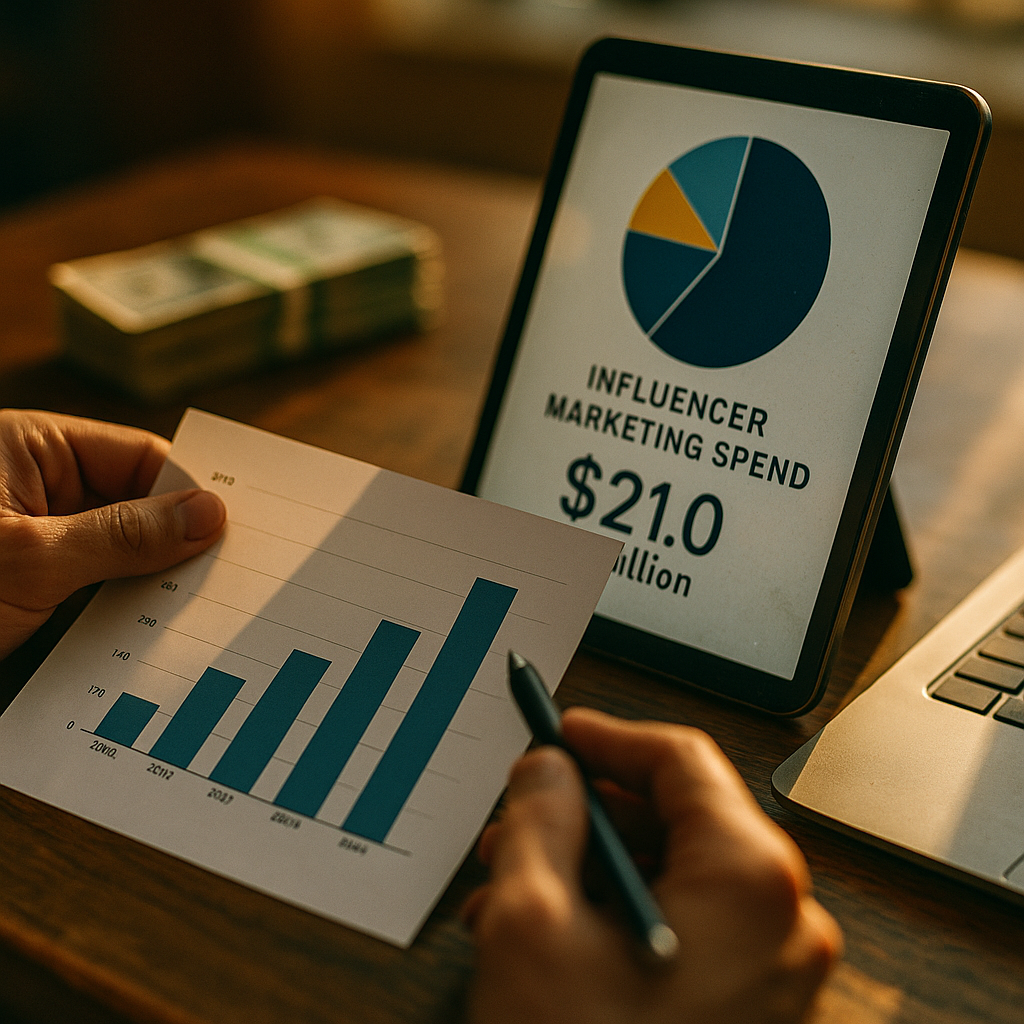
Twenty-one billion dollars. That’s where influencer marketing spend is projected to land, according to industry forecasts tracking the creator economy’s climb from scrappy experiment to core media line item. If your 2026 budget still treats creator spend as a rounding error under “social,” you’re not just behind — you’re planning against a market that no longer resembles the one you built your playbook for.
The $21 billion creator spend forecast isn’t a headline to skim past. It’s a signal that the channel has crossed into a new phase: systematic, data-driven, and increasingly unforgiving of brands that still buy creators the way they did five years ago.
Why This Number Matters More Than It Looks
Big forecasts get thrown around constantly in marketing media. Most fade into the noise. This one deserves attention because of what’s driving it, not just the size of it.
Growth used to come from novelty. Brands tried influencer marketing because TikTok was new, because Gen Z ignored banner ads, because someone in leadership saw a competitor do it. That phase is over. Spend is now growing because the channel produces measurable, repeatable returns that finance teams can model with confidence.
That’s the maturity shift. Budgets tied to experimentation get cut first in a downturn. Budgets tied to proven ROI get protected, and often expanded. According to eMarketer’s ad spend tracking, creator and influencer spend has consistently outpaced broader digital ad growth for several consecutive years — a pattern that doesn’t happen in channels still considered speculative.
When a channel moves from “test budget” to “forecasted line item,” the questions brands ask change entirely — from “should we do this” to “how do we do this more efficiently than our competitors.”
What “Channel Maturity” Actually Means for Planners
Maturity isn’t a vibe. It shows up in specific, operational ways that directly affect how you plan budgets.
- Standardized measurement: EMV, engagement rate, and conversion attribution are no longer optional add-ons agencies pitch you. They’re baseline expectations, the same way a media buyer expects reach and frequency data from a TV or programmatic partner.
- Tiered pricing benchmarks: Nano, micro, mid-tier, and macro rates have settled into recognizable ranges by vertical, making it possible to build defensible CPMs instead of guessing.
- Platform-specific planning: Budgets now get split by platform behavior, not just audience demographics, because algorithm behavior varies by platform in ways that directly affect reach forecasting.
- Retainer-first thinking: One-off gifting campaigns are giving way to structured, renewable creator relationships built for compounding returns.
This is what “systematic” really means. Not bigger budgets for the sake of bigger budgets, but budgets built on repeatable inputs: known costs, known conversion ranges, known risk factors. Marketers used to defend influencer spend with anecdotes. Now they defend it with spreadsheets. That’s progress, even if it makes the job less fun.
The Retainer Shift Is the Clearest Proof Point
Nothing signals channel maturity like the move from transactional deals to retainers. One-off posts are cheap to plan and easy to greenlight, but they’re operationally wasteful. Sourcing, vetting, negotiating, and onboarding a new creator for every single campaign burns time that a mature program shouldn’t be spending.
Data backs this up starkly. Industry research cited in why 63% of creator deals don’t renew shows the majority of one-off partnerships simply die after a single campaign, forcing brands back into expensive discovery cycles. Compare that to the retention economics detailed in the internal business case for retainer renewals, where repeat creator relationships consistently outperform on cost-per-acquisition simply because the creator already understands the brand voice, the product, and the audience.
If you’re building a 2026 plan and still budgeting for a churn-heavy roster of one-time deals, you’re fighting the market’s own momentum. The $21 billion pool isn’t flowing toward experimentation. It’s flowing toward retained, repeatable partnerships that agencies and brands can forecast a full year out.
Where the Money Is Actually Going
Not every platform or format is capturing this growth equally, and budget planners need to be specific here, not directional.
Short-form video still dominates, but the sourcing behind it is changing fast. TikTok’s own moves are instructive: the platform’s push detailed in TikTok’s 500 creator meetings shows a platform actively trying to fix sourcing friction for brands, because the old discovery process — manual outreach, DM negotiations, spreadsheet tracking — doesn’t scale to a $21 billion market.
Commerce-integrated content is pulling disproportionate budget. Live shopping formats are converting at rates that make traditional ecommerce look sluggish by comparison — the gap detailed in live shopping’s 30% conversion rate versus ecommerce’s 3% is the kind of number that gets a CFO’s attention fast. When a format converts 10x better, budget follows, regardless of how comfortable your team is with the production complexity.
Mid-tier creators are absorbing budget that used to go to macro names. The economics are simply better: broader reach per dollar, tighter niche alignment, and audiences that haven’t been fatigued by dozens of competing brand deals. The shift is well documented in how the creator middle class is outgrowing macro influencers on ROI.
A $21 billion market doesn’t distribute evenly. It concentrates around whatever combination of format, tier, and platform produces the clearest attribution path back to revenue.
Risk Doesn’t Disappear Just Because Spend Grows
Here’s the part budget planners tend to underweight: a maturing channel isn’t automatically a safer channel. It’s a channel with different risks, and they need line-item attention in your planning process.
Vendor and MarTech consolidation is squeezing the tools brands rely on to manage creator relationships. As covered in Arizton’s MarTech consolidation forecast, platform mergers and acquisitions can disrupt renewal terms, pricing, and integration stability with little warning. If your creator CRM or payment platform gets absorbed into a larger suite mid-contract, that’s a renewal negotiation you need to be ready for, not blindsided by — a scenario also explored in how to renegotiate vendor renewals amid AI-MarTech bundling.
Sourcing risk is also shifting shape. As more creators operate through parent companies, talent networks, or creator-run studios rather than as solo operators, contract complexity increases. Brands need to understand exactly who they’re contracting with and who owns the content rights, a issue laid out clearly in what brands must know before signing with creator parent companies.
And production risk hasn’t gone away just because budgets are bigger. Brands leaning on creators for owned production, rather than traditional agencies, face real exposure if that creator’s business changes hands or shuts down mid-campaign — a scenario detailed in what brands risk when sourcing production from creator-run studios.
None of this means slow down. It means budget for governance the same way you’re budgeting for reach. A compliance review line item costs far less than a contract dispute mid-campaign.
Building a Budget That Reflects the Forecast, Not Fights It
So what does a 2026 budget actually look like if it’s built for a mature, $21 billion market instead of a legacy experimental one?
- Shift dollars from acquisition to retention. Budget for renewals as a default, not an exception. Use retainer economics as your baseline model, not one-off campaign costs.
- Build platform-specific line items. Don’t lump “influencer marketing” into one bucket. TikTok, Instagram, and emerging platforms behave differently and deserve separate performance benchmarks, especially given how TikTok’s engagement rate outperforms Instagram by over four points.
- Reserve budget for compliance and vetting. Vetting creator income sources and contract structures, as outlined in how brands should vet creator income streams, is cheaper upfront than resolving a dispute after launch.
- Plan for production scale, not just media spend. As UGC programs grow, brand teams increasingly need to operate like production studios internally — a shift documented in how scaling UGC programs turn brand teams into production ops.
- Benchmark against industry-standard tools. Platforms like Sprout Social and resources from HubSpot offer useful frameworks for tying creator content performance to broader funnel metrics, which matters when you’re defending budget to finance.
None of this is glamorous. It’s the operational plumbing of a channel that’s grown up. But plumbing is exactly what separates brands compounding returns from brands still explaining influencer ROI to skeptical CFOs every quarter.
Next step: Before finalizing your 2026 budget, audit your current creator roster for renewal rate. If it’s below industry benchmarks, redirect a portion of acquisition spend toward retention infrastructure now, not after next year’s forecast comes in even higher.
Frequently Asked Questions
What is driving the $21 billion creator spend forecast?
Growth is being driven by improved measurement standards, commerce-integrated formats like live shopping, and a shift toward retainer-based creator relationships that produce more predictable returns than one-off campaigns.
How should brands adjust budgets for a maturing creator economy?
Brands should shift spend from one-off acquisition deals toward retention and retainer models, build platform-specific budget lines, and reserve dedicated funds for compliance, contract vetting, and vendor risk management.
Is influencer marketing still cost-effective as spend grows?
Yes, particularly with mid-tier creators, who often deliver stronger ROI than macro influencers due to lower costs, tighter audience alignment, and less audience fatigue from competing brand deals.
What risks come with increased creator marketing spend?
Key risks include MarTech vendor consolidation disrupting tools and pricing, contract complexity from creator parent companies and talent networks, and production continuity risk when relying on creator-run studios.
How can brands measure ROI on creator partnerships more systematically?
Brands should standardize on metrics like EMV, engagement rate, and conversion attribution, and use retainer performance data rather than one-off campaign results to build reliable, forecastable benchmarks.
Top Influencer Marketing Agencies
The leading agencies shaping influencer marketing in 2026
Agencies ranked by campaign performance, client diversity, platform expertise, proven ROI, industry recognition, and client satisfaction. Assessed through verified case studies, reviews, and industry consultations.
Moburst

-
2

The Shelf
Boutique Beauty & Lifestyle Influencer AgencyA data-driven boutique agency specializing exclusively in beauty, wellness, and lifestyle influencer campaigns on Instagram and TikTok. Best for brands already focused on the beauty/personal care space that need curated, aesthetic-driven content.Clients: Pepsi, The Honest Company, Hims, Elf Cosmetics, Pure LeafVisit The Shelf → -
3

Audiencly
Niche Gaming & Esports Influencer AgencyA specialized agency focused exclusively on gaming and esports creators on YouTube, Twitch, and TikTok. Ideal if your campaign is 100% gaming-focused — from game launches to hardware and esports events.Clients: Epic Games, NordVPN, Ubisoft, Wargaming, Tencent GamesVisit Audiencly → -
4

Viral Nation
Global Influencer Marketing & Talent AgencyA dual talent management and marketing agency with proprietary brand safety tools and a global creator network spanning nano-influencers to celebrities across all major platforms.Clients: Meta, Activision Blizzard, Energizer, Aston Martin, WalmartVisit Viral Nation → -
5

The Influencer Marketing Factory
TikTok, Instagram & YouTube CampaignsA full-service agency with strong TikTok expertise, offering end-to-end campaign management from influencer discovery through performance reporting with a focus on platform-native content.Clients: Google, Snapchat, Universal Music, Bumble, YelpVisit TIMF → -
6

NeoReach
Enterprise Analytics & Influencer CampaignsAn enterprise-focused agency combining managed campaigns with a powerful self-service data platform for influencer search, audience analytics, and attribution modeling.Clients: Amazon, Airbnb, Netflix, Honda, The New York TimesVisit NeoReach → -
7

Ubiquitous
Creator-First Marketing PlatformA tech-driven platform combining self-service tools with managed campaign options, emphasizing speed and scalability for brands managing multiple influencer relationships.Clients: Lyft, Disney, Target, American Eagle, NetflixVisit Ubiquitous → -
8

Obviously
Scalable Enterprise Influencer CampaignsA tech-enabled agency built for high-volume campaigns, coordinating hundreds of creators simultaneously with end-to-end logistics, content rights management, and product seeding.Clients: Google, Ulta Beauty, Converse, AmazonVisit Obviously →